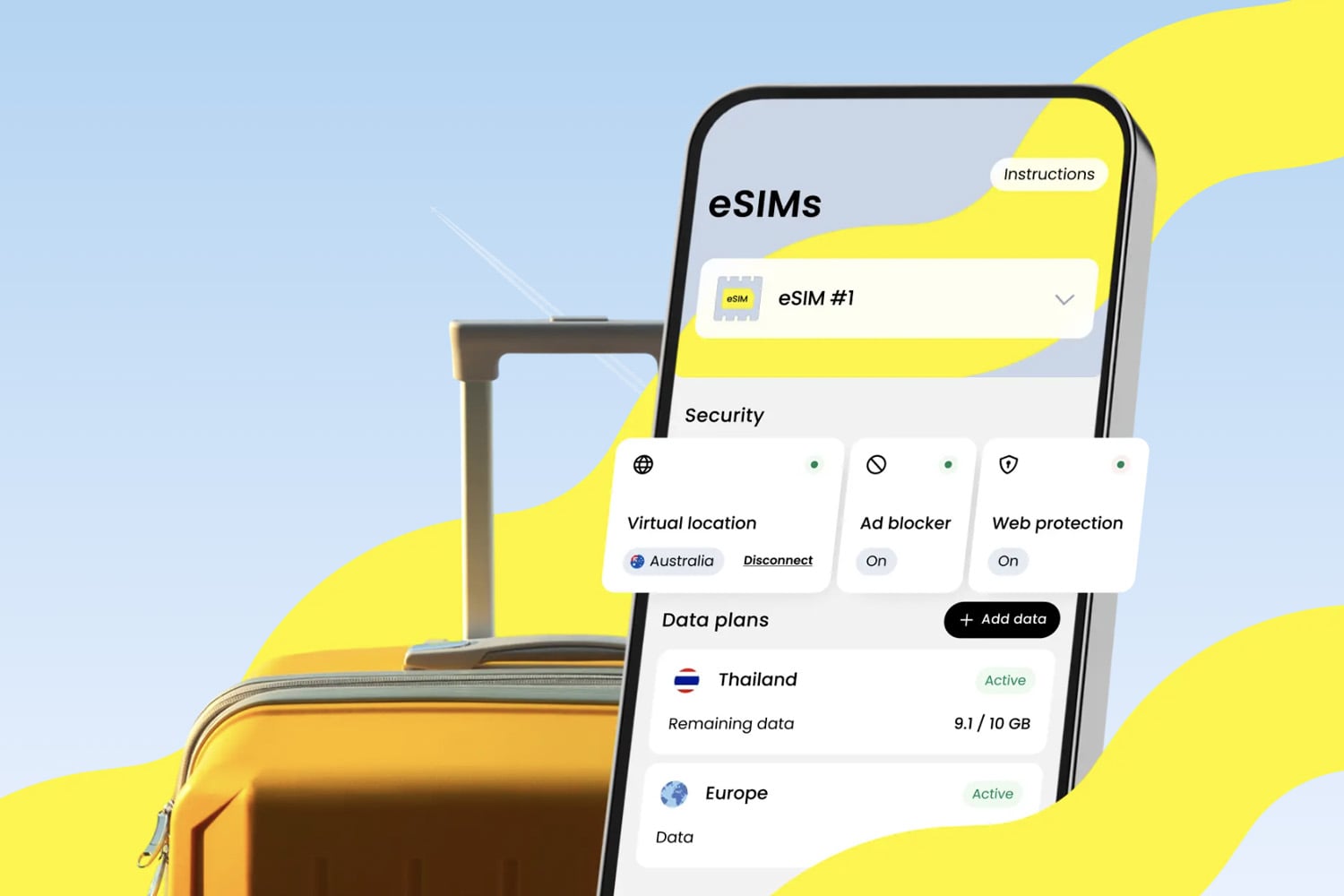
The SIM card (it stands for Subscriber Identity Module, by the way) has been with us since the early days of the cell phone revolution but it hasn’t changed a whole lot in that time (apart from getting smaller). Down the years, the ritual of moving SIM cards from old phones to new phones has been a traditional part of the upgrade experience.
Now though, we’re seeing a serious shift in the tech, with the popularization of eSIM technology. These eSIMs (electronic SIMs) don’t use physical cards, but instead are loaded on your phone like an app or a file would be. If you want to learn more about eSIMs and are wondering “what eSIM should I buy?”, you’re in the right place. According to Juniper Research, there were already 1.2 billion devices using eSIMs in 2025, with 30% growth expected in 2026, which makes this a good time to make the switch.
Best eSIM providers for international travel:
Best eSIM Providers Compared: Coverage, Data and Extras
The six providers side by side, before the detail:
| Provider | Best for | Destinations | Hotspot | Calls & SMS | Promo code |
|---|---|---|---|---|---|
| Ubigi | Best overall | 200+ | Unlimited | N/A | GIZMODO (-10% first order) |
| Saily | Security, travel perks and cruises | 200+ | Unlimited | Optional US +1 number | GIZMODO (-15%, or -35% North America) |
| Airalo | Widest country coverage | 200+ | Unlimited | In some country plans | N/A |
| Holafly | Uncapped unlimited data | 160+ | 500 MB/day | N/A | N/A |
| Jetpac | Budget and lounge access on delays | 200+ | Yes | Voice beta (iOS) | N/A |
| AloSIM | Free international number | 200+ | Yes | Yes, Hushed number | N/A |
How We Chose These eSIM Providers
With dozens of providers competing for travelers’ attention in 2026, we focused on those that hold up across the criteria that matter most in real-world use. Our selection process looked at five factors: global coverage (minimum 150 destinations), pricing transparency and value per GB, ease of setup and app quality, data plan flexibility (plan length, top-up options, hotspot support), and built-in security or privacy features. We also checked compatibility with both iOS and Android, and dropped any provider with a pattern of unresolved complaints. The six below came out on top for international travelers in 2026.
What’s an eSIM?
Before we get into any comparison eSIM talk, it’s worth knowing what an eSIM actually is. Like a physical SIM, it identifies your cell phone on a network. It tells the network who you are, so the calls and messages from your friends and family reach the right destination. The key difference is that there’s no card to pop in or out of your phone.
You can think of an eSIM like a profile page for a social media account. It’s stored on your phone, together with your number and some key details, and that information is relayed to your chosen network. For this to work, you need a phone with eSIM support, which is now standard on most modern devices. One question travelers often ask is “eSIM vs physical SIM, which is better?” For international travel, the answer is almost always eSIM: no waiting for delivery, no swapping cards, and you’re online as soon as you land.
One of the key benefits is the quick setup. There’s no need to open up your phone to fit a physical SIM, or to wait for one to arrive in the post. Changing your number or contract is as simple as downloading or updating an app. You can even run two eSIMs on the same phone and switch between them whenever you need to.
Typically, eSIMs give you more control over what you pay than traditional SIMs, and let you jump between countries and network providers more easily. They’re the modern way of managing your phone’s identity, and they give you far more flexibility in how you get connected.
Comparative Overview of Top eSIM Providers in 2026
If you’re asking “what eSIM should I buy?” in 2026, the good news is there are many providers and plans out there. No matter your budget or travel habits, you should find something that fits, whether you need a cheap eSIM for a weekend trip, a data roaming solution for a business journey, or an affordable eSIM to cover a whole summer.
1) Ubigi – Our Top Pick
Load up the Ubigi site and you’ll find extensive eSIM coverage for personal users, business users, and even connected cars. With a range of flexible data plans and solid 5G support, it’s not hard to find a plan that suits you, and once you’ve signed up you get easy app management and dedicated customer support. Ubigi remains one of the best eSIM providers for Europe and has one of the strongest coverage options in the U.S.
One reason to go with Ubigi is the selection of recurring monthly subscriptions, which save money if you’re willing to commit for longer. It’s also the best option here for hotspot connections, which rivals often restrict in some way. Ubigi tethering is uncapped on every plan, and the GIZMODO code takes 10% off your first order.

2) Saily
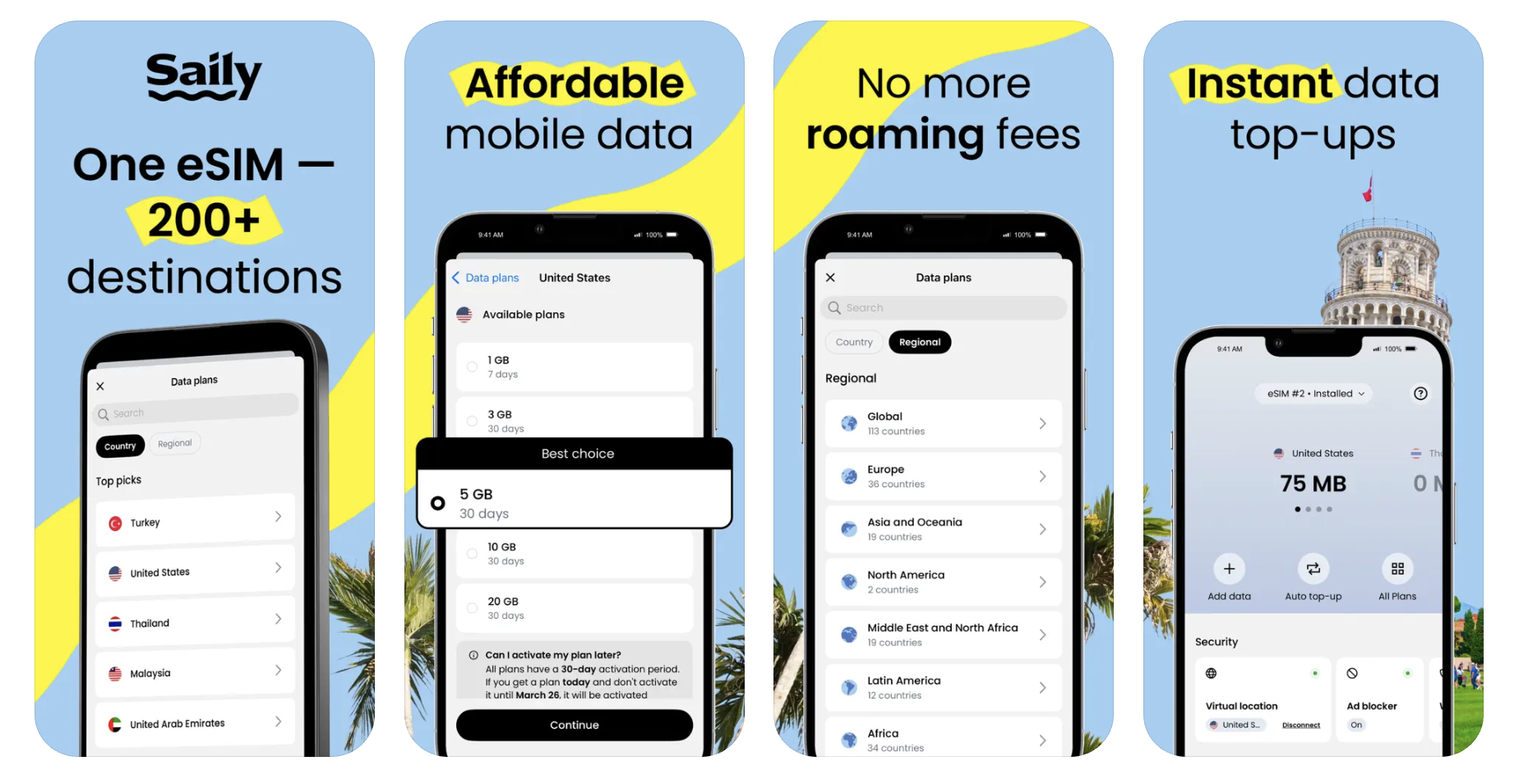
The friendly Saily tries to make eSIMs as simple as possible, starting with an intuitive app. It has global coverage, a good range of affordable and flexible plans, and built-in security features like virtual locations and ad blocking. There’s an emphasis on sustainability too, with everything handled virtually, and it’s a serious contender for the best eSIM provider overall.
One key benefit is that you can use the same eSIM for any destination, which is ideal when jumping between countries. You don’t need to register a new eSIM each time you cross a border. Users report not always getting the very top speeds with Saily, though they’re by no means slow.
Saily was developed by Nord Security (the company behind NordVPN) and has quickly become one of the best eSIM providers in the world. In 2026, it’s widely rated as the best eSIM for security-conscious travelers, since Nord Security has a well-established reputation for online privacy, which matters a great deal on foreign networks. Saily puts that expertise to work in a reliable, easy-to-use eSIM service for international travelers. It was named “Rising Star” at the MVNOs World Congress in Amsterdam in June 2026.
Three things landed in 2026 that no rival matches. First, cruise plans: once a ship passes twelve nautical miles from shore it drops off land networks entirely, and your normal eSIM stops working. Saily now covers more than 200 vessels across Royal Caribbean, Carnival, Norwegian, MSC, Disney Cruise Line, Virgin Voyages, P&O and Cunard. Second, an optional US phone number in +1 for $0.84 a month, persistent and usable worldwide, which solves the two-factor authentication problem every traveler eventually hits. Third, airport lounge access and fast-track security passes bought directly in the app, with no subscription needed, which puts it head to head with Jetpac’s SmartDelay.
With coverage in over 200 destinations, Saily keeps you connected in the US, Europe, Asia, Turkey, Thailand and beyond, on 5G where available and 4G/LTE elsewhere. Plans run from 7 to 30 days, plus regional and global options for longer trips. The regional plans cover Europe, Asia, North America and the Middle East, while global plans span over 100 countries. Pricing is competitive: 1 GB of data in Europe now costs $4.24 with the GIZMODO code.
One thing to know before buying an unlimited plan: it gives you 5 GB per day at full speed, then keeps you connected at 1 Mbps. That’s plenty for maps and messaging, less so for streaming. Saily also offers 24/7 support and a refund guarantee if installation goes wrong. Before you buy, take a look at our exclusive Saily coupon code for 15% off all eSIM plans.
3) Airalo
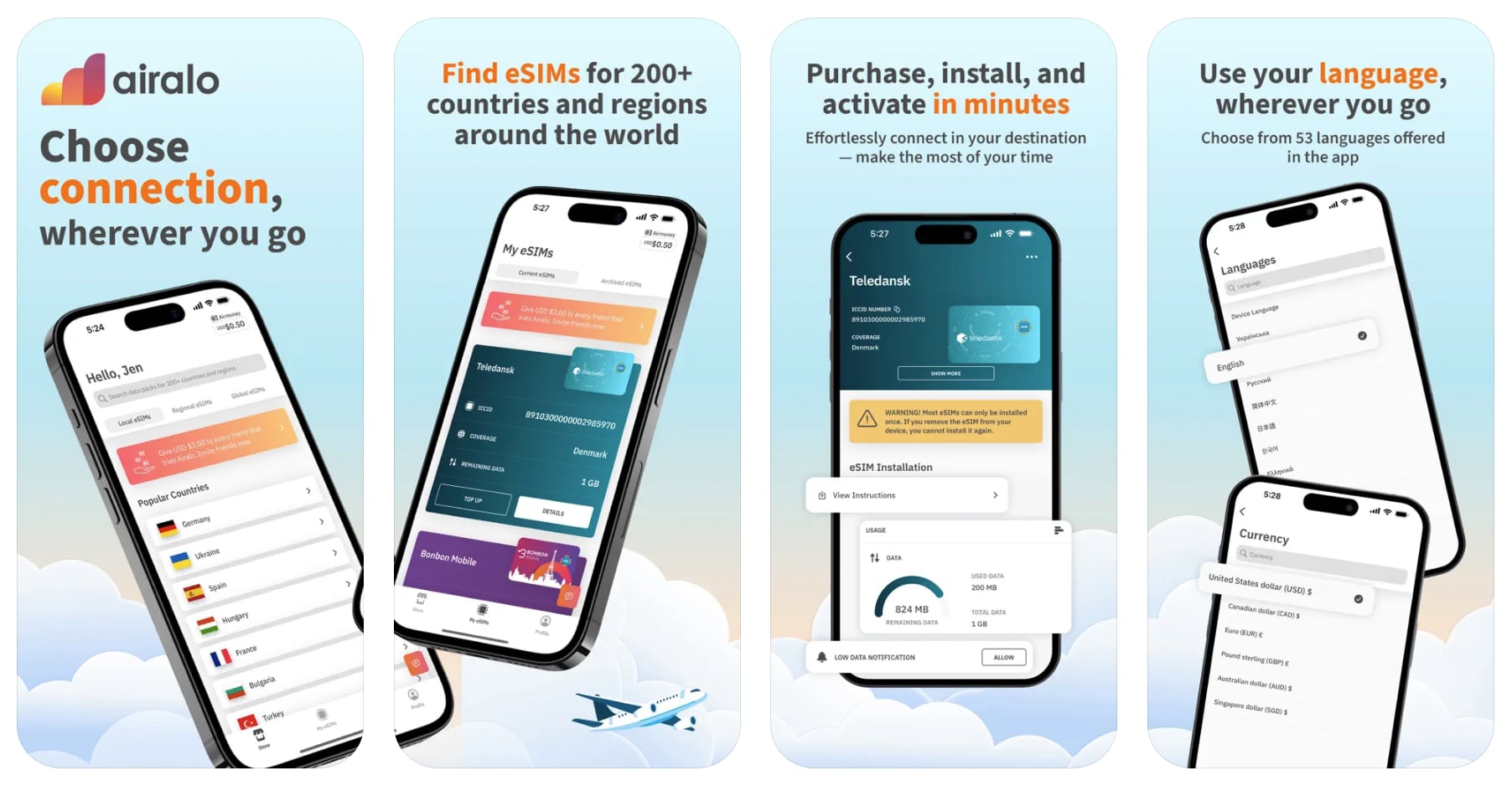
International travel is the particular focus of Airalo (though you can use these eSIMs at home too) and you’ll find a broad selection of destinations, competitive pricing and easy activation once you’ve picked a plan. It’s a provider with a strong brand reputation, and eSIM sharing is included as well.
What helps Airalo stand out is the loyalty bonuses that come up if you stick with it over time, though these vary by location. It tends to cost a bit more than some competitors, but you get reliable service and solid performance in return, plus the widest country coverage of the six. It’s also the safest bet in regions others skip, like the Balkans, where our best eSIM for Albania comparison found several rivals simply don’t operate.
4) Holafly
With wide coverage and a focus on unlimited data plans, Holafly is a strong pick for your eSIM provider (and one of the best eSIM services for the U.S.). The pricing is simple to work out: pick the number of days you need, and 24/7 support is there if anything goes wrong.
Holafly’s mobile app is one of the best in the business, and its unlimited data is the only one here that never throttles, at any point, on any plan. There are restrictions elsewhere, though: hotspot sharing is capped at 500 MB per day, and there’s no calling or texting, so keep that in mind when deciding “what eSIM should I buy?”.
5) Jetpac
Jetpac is a Singapore-based eSIM provider with data plans in over 200 destinations, fast 4G/5G connectivity, and prices starting as low as $1 for 1GB for new users, which makes it the most budget-friendly option here. Plans are mainly data-only, though Jetpac has added a voice beta for iOS users, with outgoing calls to 50+ countries from $1.99.
The feature that sets Jetpac apart is its SmartDelay program. If your flight is delayed by 60 minutes or more, you and up to five travel companions get free airport lounge access. Saily now sells lounge access outright in its app, but the delay-triggered version remains unique to Jetpac. Jetpac also keeps WhatsApp, Uber, Google Maps and Grab running even after your data runs out, which is handy when you’re finding your way around somewhere new. There’s no affiliate deal in place for Jetpac, but their plans are easy to find on their website.
6) AloSIM
AloSIM is a Canadian eSIM provider founded in 2022, with prepaid data plans across 200+ destinations. Its main selling point is that many plans include a free international phone number via Hushed, which is unusual for a data-only provider and useful for booking confirmations, two-factor authentication, or staying reachable without giving out your main number.
Prices are reasonable, with local plans from around $4.50 for 1GB, and regional plans covering Europe (35 countries), Asia, and the Americas. The app is clean and easy to use, with QR code or manual activation. One thing to note: AloSIM has no global plans, so if you’re visiting several regions you’ll need separate plans for each. There’s no affiliate deal in place for AloSIM, but plans are on their website.
Device Compatibility and How to Check
Most phones sold today have eSIM support built in, but it’s worth checking that yours is compatible before spending any money.
If you’re using an iPhone, open iOS Settings and tap Cellular. If you can see an Add eSIM option, you’re good to go. Any iPhone from the XS, XS Max, and XR onwards (2018 and later) is eSIM-compatible, as long as it wasn’t made for sale in mainland China.
With Android, the steps vary by phone. On Pixels, go to Settings, tap Network and Internet, then SIMs, then Add SIM. If you see a Set up an eSIM option, you’re all set. On Galaxy phones, go to Settings, tap Connections, then SIM manager, and look for Add eSIM.
You can also check with your phone manufacturer, your carrier, or an eSIM seller. Any of them will tell you whether your device is compatible, and a quick search for your exact model usually answers the question too.
Activating and Setting Up Your eSIM
Once you’ve chosen a provider, there are a few ways to get set up. The most common is a QR code sent by email: scan it and follow the on-screen steps to install the eSIM profile.
Alternatively, you can use an activation code. Follow the steps above for your device and you’ll be prompted to enter it, sometimes alongside a confirmation code, both of which your provider will send you.
The easiest option for most people is the provider’s own app. Log in and the app walks you through choosing and installing an eSIM without digging through your phone settings.
Most modern phones can hold more than one eSIM, so you can keep your regular number active and add a travel eSIM on top. Switching between them takes a couple of minutes.
Comparative Pricing and Plans
There are several ways to compare eSIM providers depending on what you need. Here’s how the current pricing for a UK eSIM across the main providers breaks down, to help you decide “what eSIM should I buy?” and from where.
Top eSIM providers for Europe in 2026:
| eSIM Provider | Duration | Data | Pricing |
|---|---|---|---|
| Ubigi | From 7 to 365 days | From 1 GB to unlimited | From $2.90 to $185 |
| Saily | From 5 to 180 days | From 1 GB to unlimited | From $2.99 to $179 |
| Airalo | From 7 to 180 days | From 1 to 100 GB | From $5 to $185 |
| Holafly | From 1 to 90 days | Unlimited only | From $6.90 to $139.90 |
| AloSIM | From 7 to 30 days | From 1 to 50 GB | From $4.50 to $99 |
| Jetpac | From 4 to 30 days | From 1 to 40 GB | From $4 to $39 |
Prices verified as of October 2026. Always check provider apps for current rates before you book.
Security and Privacy with eSIM
eSIMs are generally considered safer than physical SIM cards, for a few reasons. They’re built into your phone, so there’s no SIM slot for anyone to pop open and walk off with your card.
Each eSIM profile also has a secure element that blocks unauthorized access, and if your phone is lost or stolen, you can shut down the number remotely. The card can’t be physically removed, either.
That said, eSIM security isn’t foolproof. You should still avoid sharing your account credentials with anyone. Saily is the only provider here that adds a layer on top, with an ad blocker and a virtual location tool bundled into every plan.
As always, watch out for phishing attempts, where scammers try to get you to hand over your eSIM account login. These come by phone or email, so be cautious about sharing your username or password. If something seems off, contact your provider directly to check whether the request is real.
eSIM for the 2026 FIFA World Cup
The 2026 FIFA World Cup runs across the USA, Canada, and Mexico from June through July, and millions of fans are travelling between those three countries this summer. Staying connected without racking up roaming fees across three different networks is a genuine headache. All six providers cover the USA, Canada, and Mexico, so any of them will work.
There is one offer worth knowing about, though. The GIZMODO code takes 35% off Saily’s North America plan, which covers all three host countries on a single eSIM. That’s the cheapest way we’ve found to follow the tournament across borders. If cross-border coverage and security are your priorities, Ubigi and Saily are our picks.
Get 35% off Saily’s North America plan
Conclusion: Which Shall You Go For?
There are plenty of good reasons to switch to an eSIM, from the convenience of not carrying a physical card to better security if your phone gets lost. In many ways eSIMs are where mobile is heading: some newer phones already have no physical SIM slot at all.
Even in a crowded market, Ubigi stands out as the best eSIM provider because it does well across everything that counts: the pricing is competitive and flexible, it covers a huge number of destinations, setup is straightforward through the Ubigi app, and its hotspot is uncapped on every plan.
Saily is the one that has changed most this year, adding cruise coverage, a US phone number and lounge access to a product that was already the best on security. If either of those matters to you, it’s the one to buy.
Frequently Asked Questions
What is the best eSIM provider?
Ubigi is the best eSIM provider overall. It covers more than 200 destinations, offers flexible one-off, monthly and annual plans, and is the only provider here with uncapped hotspot on every plan. The GIZMODO code takes 10% off your first order. Saily is the best alternative, especially for security-conscious travelers.
Which eSIM works on a cruise ship?
Only Saily. Once a ship passes twelve nautical miles from the coast it leaves land-based networks and switches to its own satellite cellular system, at which point standard eSIMs stop working. Saily’s dedicated cruise plans cover more than 200 vessels across Royal Caribbean, Carnival, Norwegian, MSC, Disney Cruise Line, Virgin Voyages, P&O and Cunard.
Can I get a phone number with an eSIM?
Yes, with three of the six. Saily now sells an optional US number in +1 for $0.84 a month, which is persistent and works worldwide. AloSIM includes a free international number via Hushed on many plans. Jetpac has a voice beta for iOS with outgoing calls from $1.99. Ubigi and Holafly are data-only.
Which eSIM has truly unlimited data?
Holafly. Its unlimited plans have no speed cap at any point. Saily’s unlimited plans give you 5 GB per day at full speed and then throttle to 1 Mbps, which is fine for maps and messaging but not for streaming. Always read the fair use policy before assuming unlimited means unlimited.
Can I share my eSIM data with other devices?
Ubigi, Saily, Airalo, Jetpac and AloSIM all allow tethering, and Ubigi and Saily place no cap on it. Holafly is the exception, limiting hotspot use to 500 MB per day, which effectively means one plan per person.
Is my phone compatible with an eSIM?
Almost certainly, if it’s recent. Any iPhone from the XS, XS Max or XR onwards supports eSIM, unless it was sold in mainland China. On Android, check Settings for an Add eSIM option, available on Pixels and on Samsung Galaxy phones from the S20 onwards. Every provider also has a compatibility checker on its website.