
A VPN is one of those subscriptions most people want to pay as little as possible for. You use it for a handful of things, like keeping your banking private on public Wi-Fi or watching your usual shows on a trip, so the lowest monthly price on the pricing page looks like the obvious place to start. The trouble is that the advertised price doesn’t last.
It applies only to the longest plan, paid up front, and it goes up when that first term ends, often steeply. The best cheap VPN still makes sense after that first renewal, with the speed and privacy you’d expect from a pricier one. The ranking below counts both prices.
Cheap VPNs Ranked by Value
- NordVPN: Best for speed, with the fastest US servers we tested
- Proton VPN: Best for privacy on a budget, from an audited Swiss company
- ExpressVPN: Best for simple apps, matching NordVPN’s speed for less money
- Private Internet Access: Best for long-term savings, with the lowest renewal price
- Surfshark: Best for streaming value, unblocking all but one service we tried for less
- CyberGhost: Best for trying before you commit, with the longest refund window
Cheap VPNs Compared
The monthly rate is the figure each VPN advertises. The two columns beside it show what you pay up front and at renewal, and the lowest headline rate isn’t always the best value.
| Monthly rate | First term | Annual renewal | Speed loss | Devices | |
| NordVPN | $3.49 | $94.23 for 27 months | $139.08 a year ($11.59/mo) | 7.8% | 10 |
| Proton VPN | $2.99 | $71.76 for 24 months | $83.88 a year ($6.99/mo) | 10.2% | 10 |
| ExpressVPN | $2.99 | $83.72 for 28 months | $99.95 a year ($8.33/mo) | 7.8% | 10 |
| Private Internet Access | $2.19 | $56.94 for 26 months | $56.94 a year ($4.75/mo) | 12.7% | Unlimited |
| Surfshark | $2.49 | $67.23 for 27 months | $79.00 a year ($6.58/mo) | 9.6% | Unlimited |
| CyberGhost | $2.19 | $56.94 for 26 months | $56.94 a year ($4.75/mo) | 13.3% | 7 |
What Counts as Cheap, and What the Catch Is
Under $3.50 a month counts as affordable for a VPN with an audited no-log policy, a kill switch to stop traffic leaking when the connection fails, and a usable server network. Below about $2, audits and features disappear, so nothing under that price made our ranking. The catch is the same for all six VPNs.
- The advertised rate requires the longest commitment, paid in one charge, while a one-month subscription costs several times as much.
- Then the renewal arrives, covering 12 months where the first payment covered 24 or more. PIA shows it most clearly: the same charge of about $57 that bought 26 months buys only 12 the second time, so its monthly rate more than doubles. Every renewal in the table at least doubles the advertised monthly rate.
Judged across a first term plus one renewal year, PIA and CyberGhost come out cheapest, then Surfshark, Proton VPN, ExpressVPN, and NordVPN. None of this makes them bad deals. Every VPN in the table has a money-back guarantee of at least 30 days, and you can cancel before the renewal if the new price is too high.
The Six Cheap VPNs in Detail
For our October tests, we used the same connection for every VPN: 190.36 Mbps down with a 10 ms ping, over Ethernet with nothing else active. Ping is the delay before a server responds, and lower is better for gaming and video calls. We connected to UK, US, and Japanese servers on each VPN, then tried 14 streaming platforms, clearing cookies and cache between attempts.
1. NordVPN: Best Cheap VPN for Speed

Pros
- Top US speeds
- Unblocks every major streaming service
- Malware scanning on the Complete plan
- Post-quantum toggle
- Obfuscated servers
- Bonus months on long plans
Cons
- Expensive to renew
- Busy interface
NordVPN lost 7.8% of its speed across three server locations, tied with ExpressVPN for the smallest drop we recorded, so you won’t notice it while streaming or downloading. Its US result of 181.50 Mbps was the highest any VPN produced on that location, and a later retest put its UK ping at 41 ms, low enough for gaming. It unblocked every streaming service in our set, one of them only through the browser extension.
On the Complete plan, next-gen antivirus checks files for malware as they download and blocks ad and tracker domains. NordLynx, NordVPN’s own protocol, is the method its app uses to set up the encrypted connection, and quantum-safe encryption, built to withstand attacks from future quantum computers, is a simple toggle on it. Obfuscated servers and NordWhisper hide VPN use from network filters.
It makes NordVPN usable on networks that restrict VPNs, such as some office or hotel Wi-Fi. Our VPN for China guide covers the hardest case. Independent auditors have also checked its no-log policy. The cost comes at renewal. NordVPN has the highest first-term rate in the table and the steepest increase when that term ends, so compare it with PIA or CyberGhost if you plan to stay for years. Our NordVPN review has the rest.
2. Proton VPN: Best Cheap VPN for Privacy
Pros
- Yearly independent audits
- Open-source apps
- Swiss company
- Port forwarding
- Unmetered free plan
- Secure Core servers
Cons
- Refund paid pro rata
- No Smart DNS
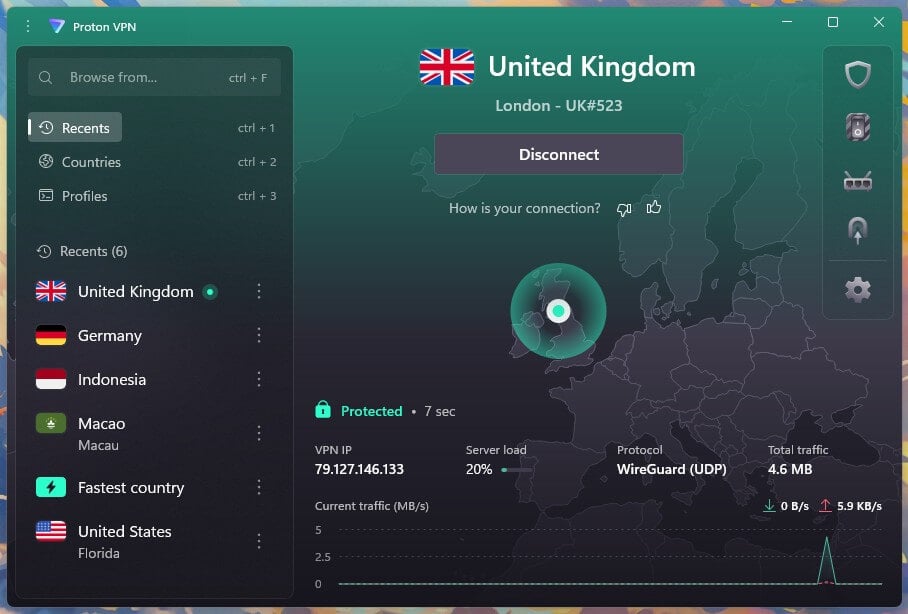
Proton VPN is the least expensive Swiss VPN whose privacy claims have been checked by outsiders. Switzerland belongs to no surveillance alliance, and Securitum has audited the no-log policy year after year. The apps are also open source, so their code is public on GitHub. Secure Core sends your traffic through a second server the company owns before it leaves, at a 12.1% speed cost in our tests, which you’d rarely notice on a fast home connection.
Its 10.2% average speed loss put it fourth for speed, and its UK server came in at 178.89 Mbps. Streaming is its weaker side. It unblocked 10 of the 14 platforms, and Hulu, Pluto TV, and ITVX were among the four it couldn’t unblock. Surfshark unblocked Hulu and Pluto TV. Proton VPN’s network of 20,798 servers spans 149 countries, and port forwarding, which helps torrent uploads connect, is configurable.
One condition counts against it. Proton VPN’s 30-day guarantee is paid pro rata, covering only the unused part of the term, while NordVPN, Surfshark, and PIA refund the whole amount. Its free plan has no data limit, so try the apps there before you pay.
3. ExpressVPN: Best Cheap VPN for Easy Setup

Pros
- Low average speed loss
- Fast on distant Japanese servers
- Obfuscated without setup
- RAM-based servers
- Smart DNS on board
Cons
- No multi-hop option
- Little to configure
- Steep renewal
ExpressVPN spent years as a name that never appeared on a budget list. On its 28-month term, it now costs less per month than NordVPN, and it matched NordVPN’s 7.8% average speed loss. Japan is the hardest location from our test PC in Europe, and its 163.94 Mbps there was the best Japan result we recorded, fast enough for 4K on several screens. Every connection is obfuscated automatically, with no protocol to pick, which is unusual at this price and useful on a filtered office or campus network.
Its streaming record was perfect at 14 of 14 platforms. Smart DNS is included too, letting TVs and consoles without VPN apps switch streaming regions. ExpressVPN’s servers write nothing to disk, and KPMG audited the no-log policy in 2025. Our ExpressVPN vs NordVPN comparison found the two close enough that price decides it. The simplicity has a cost.
There’s no multi-hop, which sends traffic through two servers, and the settings list is short, so if you like adjusting how your VPN connects, NordVPN and PIA offer far more control. The renewal price also increases steeply once that first term ends. If you expect to renew, PIA costs far less after the first term. Our ExpressVPN review covers every setting.
4. Private Internet Access: Best Cheap VPN for Long-Term Savings
Pros
- Gentle renewal price
- Uncapped device count
- Customizable encryption
- Shadowsocks support
- Court-tested no-log
Cons
- No Hulu or Prime Video
- Untidy app
- Big speed drop in Japan
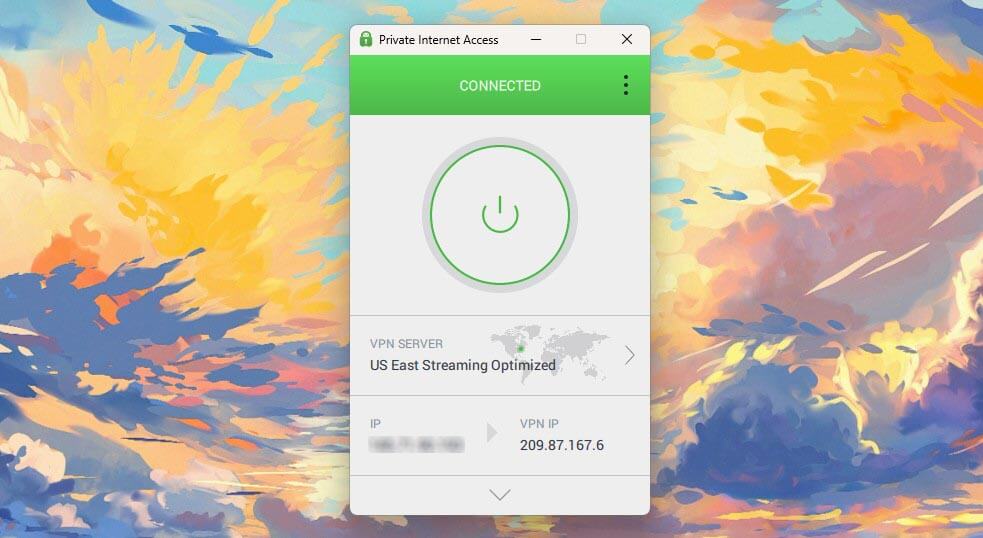
PIA and CyberGhost share the lowest advertised rate and the gentlest renewal in our price table. Counting the first renewal, PIA costs about $114 for 38 months, roughly half of what NordVPN charges for 39. If you plan to keep a VPN past its first discount, that difference adds up every year. Its three-location average came to a 12.7% speed loss, pulled down by 141.61 Mbps on the Japanese server, which is still enough for 4K.
You can switch protocols, pick 128-bit or 256-bit encryption on OpenVPN, set up port forwarding, and enable Shadowsocks, which disguises VPN traffic on networks that filter it. The no-log policy came through a court case intact, and Deloitte has audited it independently. Streaming is where PIA falls short.
It unblocked only 9 of the 14 platforms and couldn’t unblock Netflix Japan, Prime Video, HBO Max, JioHotstar, or Hulu. If you want a VPN mostly for streaming, Surfshark costs more and unblocked far more. The app is also the untidiest we used, though every setting is there once you learn the layout.
5. Surfshark: Best Cheap VPN for Streaming Value

Pros
- Near-full speed on UK servers
- Netflix and iPlayer unblocked
- Any number of devices
- Free static IP
- Optional antivirus
Cons
- Longer connection times
- No Smart DNS
- Netherlands in 9 Eyes
Surfshark’s UK server produced the fastest single result in our tests: 186.96 Mbps, or a 1.8% speed loss, ahead of NordVPN and ExpressVPN there. Averaged across the three locations, it came third, with a 9.6% speed loss. It unblocked 13 of the 14 platforms, every one except ITVX, and it didn’t require the browser extension for Netflix or any other platform.
Its CleanWeb ad blocker blocked 79% of d3ward’s test domains, and Surfshark places no limit on device connections. Static IP addresses come at no extra cost, IP Rotator changes your visible IP address on a timer, and the One plan adds antivirus. Deloitte checked Surfshark’s no-log policy in 2023 and 2025, and SecuRing tested its servers in January 2026.
Connecting takes longer than with the other five VPNs, a minor annoyance. The Netherlands, its home country, belongs to the 9 Eyes intelligence-sharing group, though the audited no-log policy limits what Surfshark could hand over.
6. CyberGhost: Best Cheap VPN With a Long Refund Window
Pros
- Low ping on UK servers
- Extra-long refund window
- Task-based server lists
- NoSpy servers in Romania
- Smart DNS for streaming
- Deloitte-audited no-log policy
Cons
- Small device allowance
- Obfuscation missing
- Slows down on distant servers
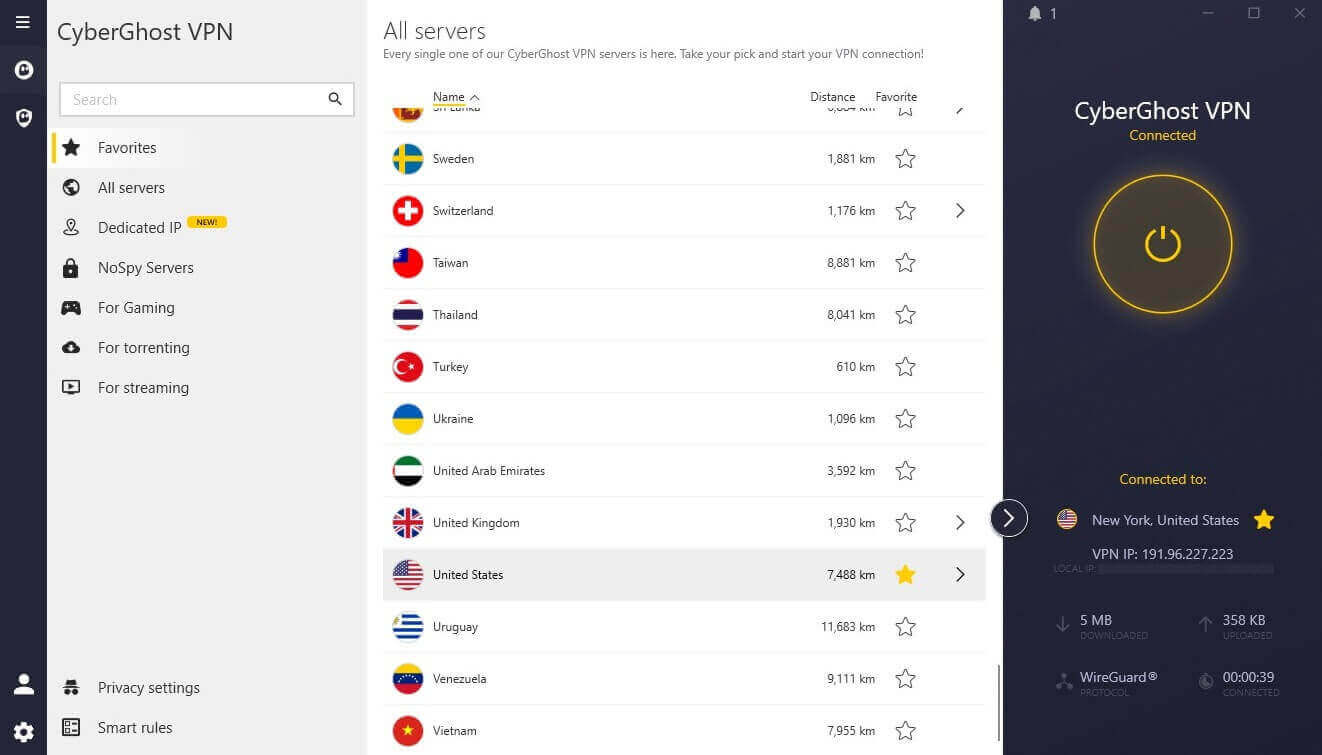
CyberGhost costs the same as PIA, renews on the same terms, and allows 45 days to change your mind on its two-year plan instead of 30, the longest window we found. Its 39 ms UK ping was the lowest we recorded, so nearby servers feel quick for browsing and video calls. Server lists are split by activity, with separate lists for streaming, torrenting, and gaming, which saves guessing which server to use.
The NoSpy servers belong to CyberGhost and operate from Romania, and Smart DNS covers streaming boxes without VPN apps. It unblocked 11 of the 14 streaming platforms, and Netflix Japan and JioHotstar were among the three it couldn’t unblock. Its no-log policy was audited in February 2026. CyberGhost’s network has 11,700 servers across 100 countries.
Speed is the trade-off, at a 13.3% average speed loss, mostly on distant servers, so choose a server close to you when you can. The subscription covers only seven devices, and no obfuscation of any kind is offered, which makes it the wrong VPN for travel to countries that block VPNs. Our CyberGhost review covers the rest.
Below $2 a Month: What a Budget VPN Loses
VPNs advertising less than $2 a month exist, and we tested several without recommending them. The audit is the first thing to go. Without one, a no-log policy is only a promise, and at the bottom of the market, most VPNs offer nothing more. The kill switch goes next, often present but unreliable when a connection actually fails.
Then the network shrinks to 30 or 40 countries instead of 90 or more, which shows when you want an IP address outside Western Europe or the US. Two VPNs from our wider tests show what the bottom of the market delivers. TunnelBear lost 23.9% of its speed and unblocked only 2 of the 14 streaming platforms.
Hotspot Shield lost 22.2% of its speed and keeps some connection data. Neither is a bargain at any price. If even the lowest rate in the table is more than you want to spend, a free plan is the alternative.
Cheap VPN or Free VPN?
Free plans fall short on data. Speed is rarely the problem: the quickest free tiers we tested lost about as much as a paid VPN. The limit is the data cap: most free plans offer between 500 MB and 10 GB a month, and an evening of streaming uses that up. Proton VPN is the exception. Its free tier has no data limit, and the company behind it also operates the paid service.
The free tier still limits you to one device, the app assigns the country, and Netflix US blocks its free servers. Free tiers in general also log more often than paid ones, and many block P2P, the file-sharing traffic torrents use. A cheap paid VPN removes those limits for a few dollars a month.
Summary
NordVPN is the strongest VPN at this price for most people. It tied for the smallest speed loss, unblocked every streaming service we tried, and adds malware scanning on the Complete plan. It’s also the most expensive to keep once the first term ends. If you’ll keep the VPN for years, PIA and CyberGhost have the gentlest renewal in the table.
PIA adds unlimited devices and slightly better speed, while CyberGhost allows more time to request a refund and unblocked more streaming services. For privacy on a budget, Proton VPN is the most affordable audited Swiss VPN. Before you subscribe, compare the renewal with the first-term price. You’ll pay the renewal price every year after the discount ends.
FAQ About Cheap VPNs
Which cheap VPNs are legit, and what is the catch?
NordVPN, Proton VPN, Private Internet Access, CyberGhost, Surfshark, and ExpressVPN are legit, with audited no-log policies. The catch is renewal, which costs considerably more than the first term.
What is the cheapest VPN?
The cheapest VPN is Private Internet Access, with the lowest first-term rate and renewal price among major VPNs. CyberGhost matches that rate and renews on the same terms.
Is a cheap VPN safe to use?
Yes, from an established VPN. NordVPN, Proton VPN, Private Internet Access, and CyberGhost have independently audited no-log policies and kill switches, which the lowest-priced unknown VPNs often lack.
Is a cheap VPN good enough for streaming?
Yes. NordVPN unblocks Netflix, BBC iPlayer, Hulu, and ITVX, and Surfshark unblocks every major streaming service except ITVX at a lower first-term price.
Is an expensive VPN better than a cheap one?
No, rarely. A monthly subscription buys the same encryption, servers, and apps as that VPN’s long-term plan, which costs far less per month when paid up front.