ExpressVPN and NordVPN are two of the best-known VPNs out there, and if you’re reading this, you’ve probably narrowed your choice down to them. Both have easy apps, servers all over the world, and a solid record on privacy. So which one should you pay for? I subscribed to both and put them through the same tests, side by side.
They turned out to be closer than you might think, and on speed and streaming, there was nothing between them. The difference is in what each one adds on top, and which one comes out ahead depends on how you use a VPN. My short answer comes first, and the rest of this ExpressVPN vs NordVPN comparison shows where each one pulls ahead.
ExpressVPN vs NordVPN: The Short Answer
My pick is NordVPN. It matches ExpressVPN on speed and streaming and adds more privacy tools for a little more money.
- Pick NordVPN if you want extra privacy tools, like sending your traffic through two servers at almost no speed cost, plus servers in more countries.
- Pick ExpressVPN if you want the simplest apps, more devices on one subscription, and a lower price when the plan renews.
- Speed and streaming are a tie. Both kept almost all of my connection’s speed and unblocked every streaming service I tried.
ExpressVPN vs NordVPN: Quick Comparison
| ExpressVPN | NordVPN | |
| Starting price | $2.99 a month | $3.49 a month |
| Renewal | $99.95 a year | $139.08 a year |
| Download speed loss | 7.8% | 7.8% |
| Upload speed loss | 8.9% | 5.5% |
| Countries | 113 | 152 |
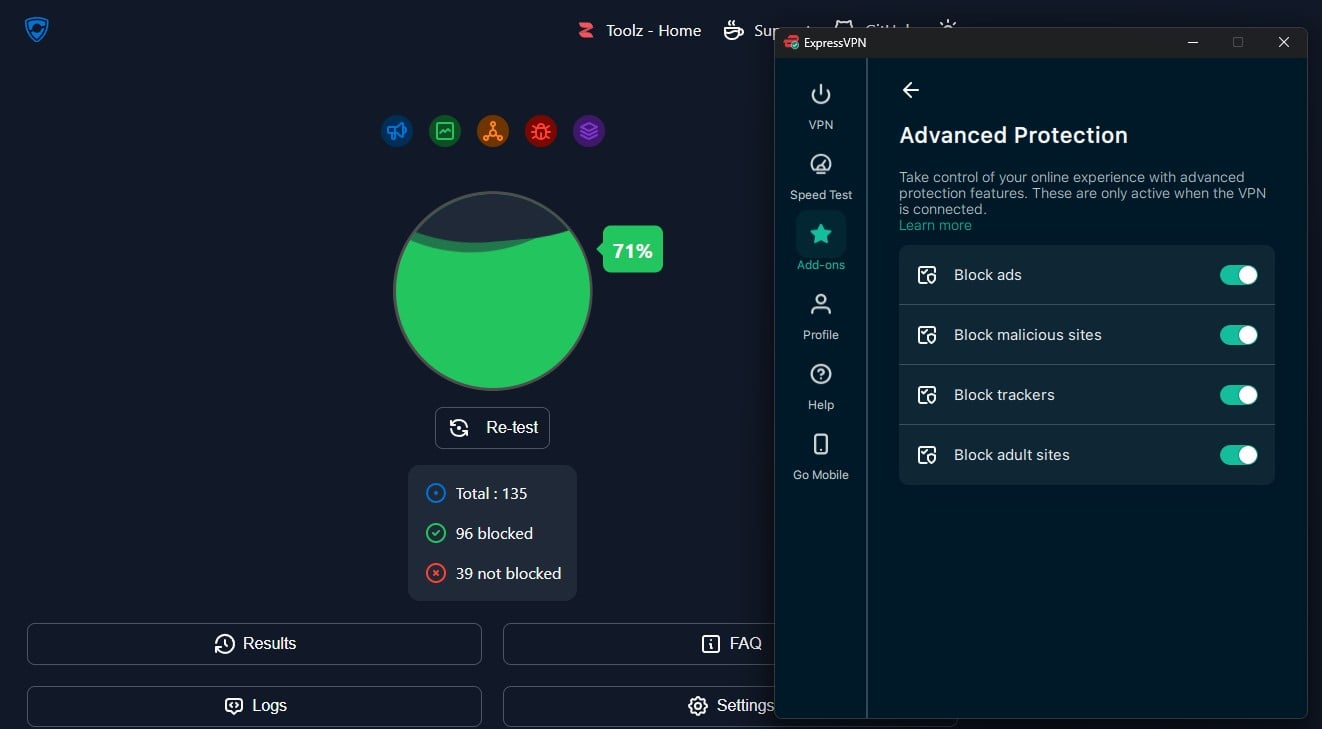
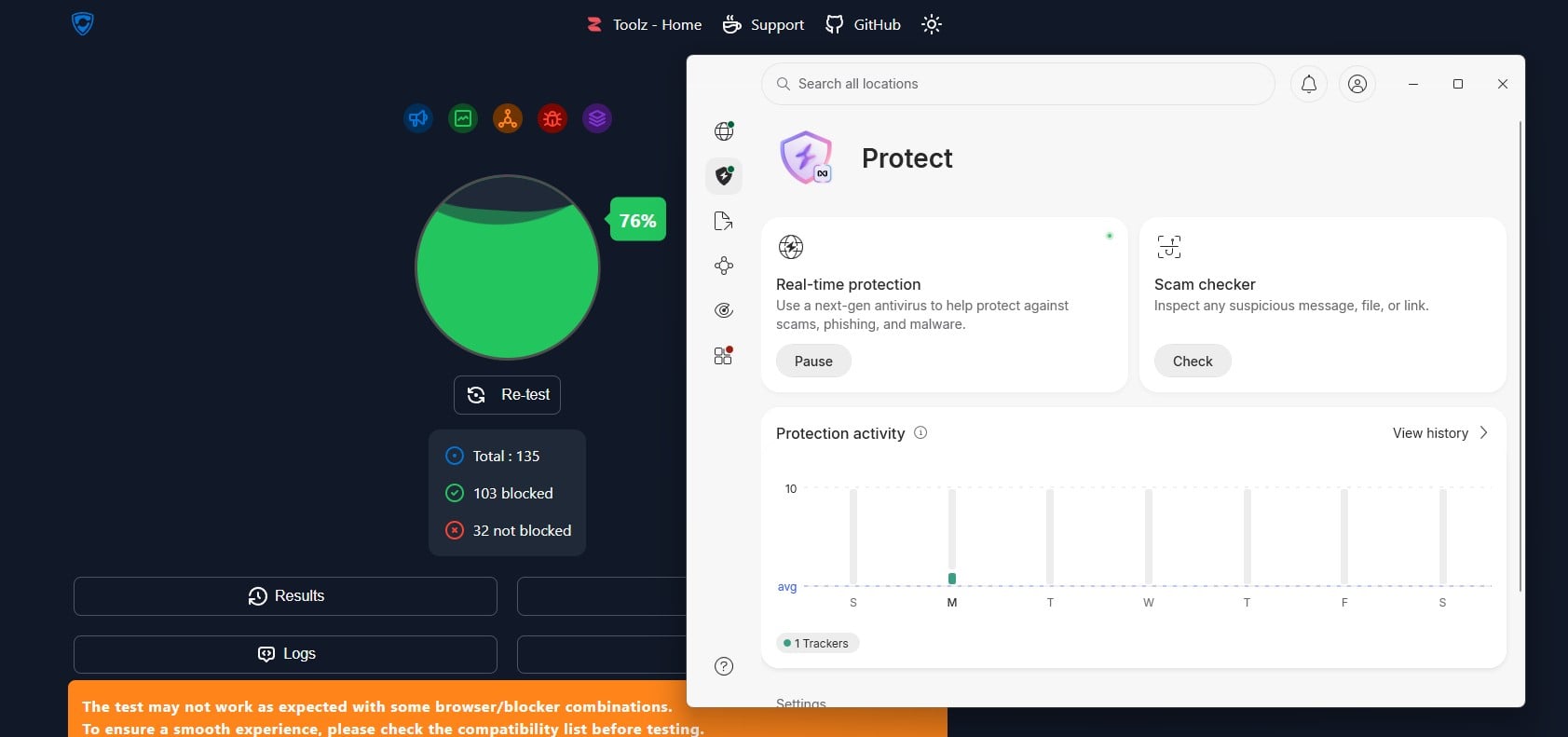
| Ad blocking on d3ward | 71% | 76% |
| Multi-hop | No | Double VPN |
| Port forwarding | No | No |
| Streaming services unblocked | 14 of 14 | 14 of 14 |
| Simultaneous devices | 10 to 14 | 10 |
| Connection time | 1 to 2 seconds | 2 seconds |
| No-log audits | KPMG, most recently February 2025 | Six since 2018, most recently December 2025 |
| Jurisdiction | British Virgin Islands | Panama |
How I Tested
All my tests took place in October on the same Windows 11 PC, wired to the router, on a 190.36 Mbps connection in Europe. Without a VPN, upload speed was 19.37 Mbps and ping was 10 ms. Ping is the time data takes to travel to a server and back, so lower is better for calls and games. I tested speed on servers in the UK, the US, and Japan, three sessions a day for three days, using each VPN’s default protocol.
For ad blocking, I used d3ward’s test of 135 ad and tracker domains with every category enabled. Leak tests used ipleak.net and browserleaks.com, and I deleted the browser cache between sessions. For streaming, I checked 14 services, from Netflix to JioHotstar.
Speed: A Dead Heat
| Server | ExpressVPN | NordVPN | No VPN |
| UK | 185.74 Mbps | 184.73 Mbps | 190.36 Mbps |
| US | 177.03 Mbps | 181.50 Mbps | 190.36 Mbps |
| Japan | 163.94 Mbps | 160.47 Mbps | 190.36 Mbps |
| Average | 175.57 Mbps | 175.57 Mbps | 190.36 Mbps |
The averages came out identical to two decimal places, 175.57 Mbps on both, which is about 92% of my connection. That’s more than ten times what a 4K stream requires, so you won’t see a difference between them while streaming or browsing. Server by server, ExpressVPN was slightly ahead in the UK and Japan and NordVPN in the US, never by more than 4.5 Mbps.
Upload speed showed the one clear difference. NordVPN lost 5.5% of its upload speed across the three servers, compared to 8.9% on ExpressVPN. You’d notice that only when sending a lot of data, for example during a video call, a cloud backup, or seeding a torrent. Ping was close too, at about 40 ms to the UK, around 130 ms to the US, and around 220 ms to Japan on both.
With the connection busy, ping on the British server increased to about 70 ms on both, compared to 30 ms without a VPN, which is still fine for video calls. For results from more VPNs, see our fastest VPN ranking.
Winner: Tie
Identical download averages, plus a smaller upload speed loss for NordVPN that you’d hardly notice day to day.
Security Features: NordVPN Goes Deeper
The basics are equal: AES-256 encryption with post-quantum protection against future quantum computers, private DNS, RAM-only servers that wipe on every reboot, and split tunneling, which lets chosen apps skip the VPN. A kill switch cuts your internet if the VPN drops, and both passed when I pulled the Ethernet cable and force-closed the app.
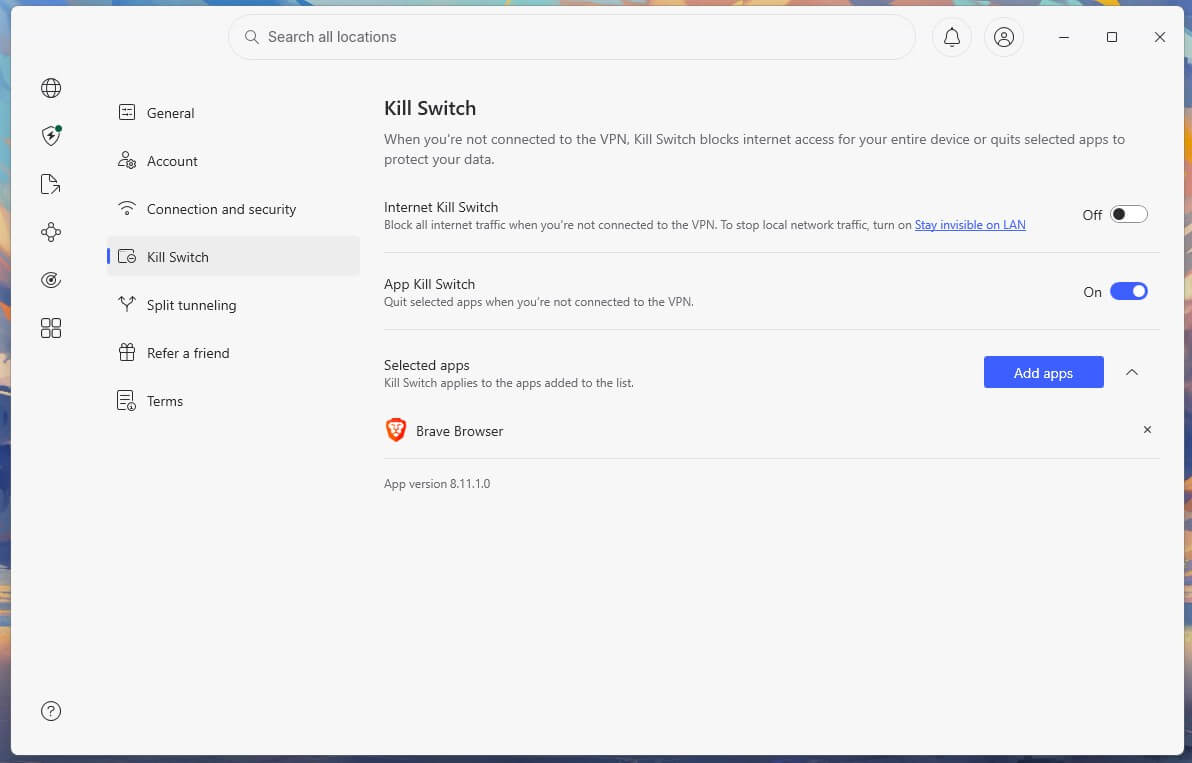
NordVPN’s Internet Kill Switch stayed on through a PC restart with no extra setting. ExpressVPN’s default Network Lock didn’t, and traffic got out before the app reconnected, so enable its strictest mode if you choose ExpressVPN.
The ad and malware blockers show a clearer difference.
| Feature | ExpressVPN Advanced Protection | NordVPN next-gen antivirus |
| Domains blocked on d3ward | 71% | 76% |
| Scans downloaded files | No | Yes |
| Checks apps for vulnerabilities | No | Yes |
| Adult site blocking | Yes | Yes, on mobile |
| Works with the tunnel off | No | Yes |
| Included on the entry plan | Lite version only | No, Complete tier upward |
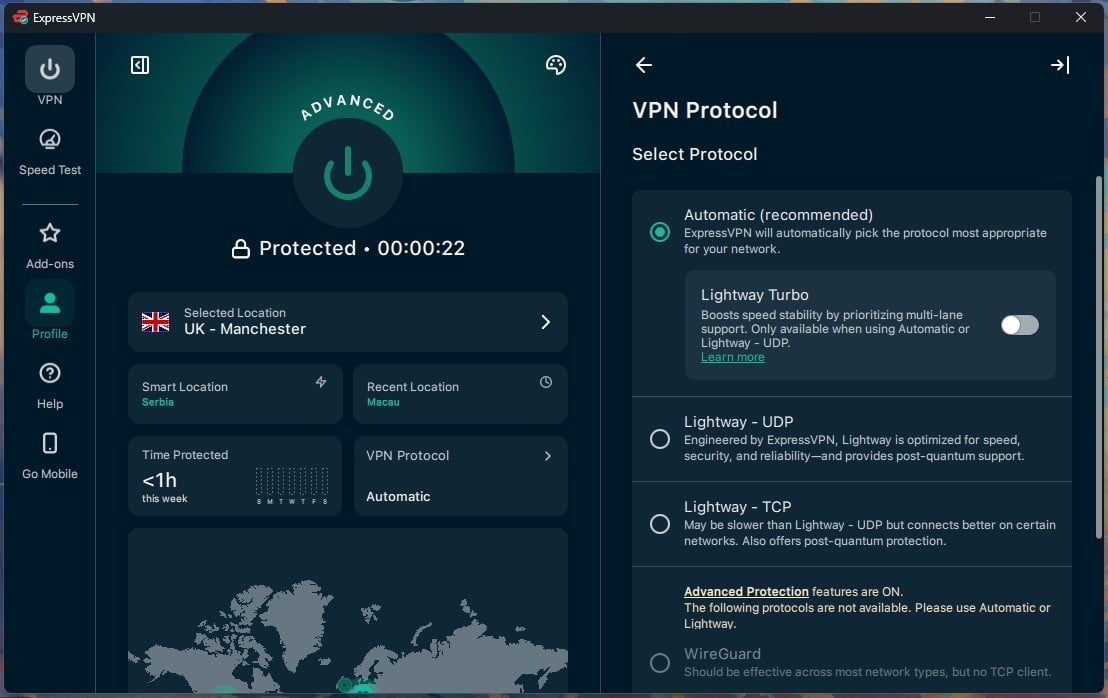
| Restricts protocol choice | Yes, Automatic or Lightway only | No |
The last row bothered me most. Enabling Advanced Protection disables WireGuard and OpenVPN, so on ExpressVPN, using the ad blocker means giving up the protocol menu.
Extra Privacy Tools
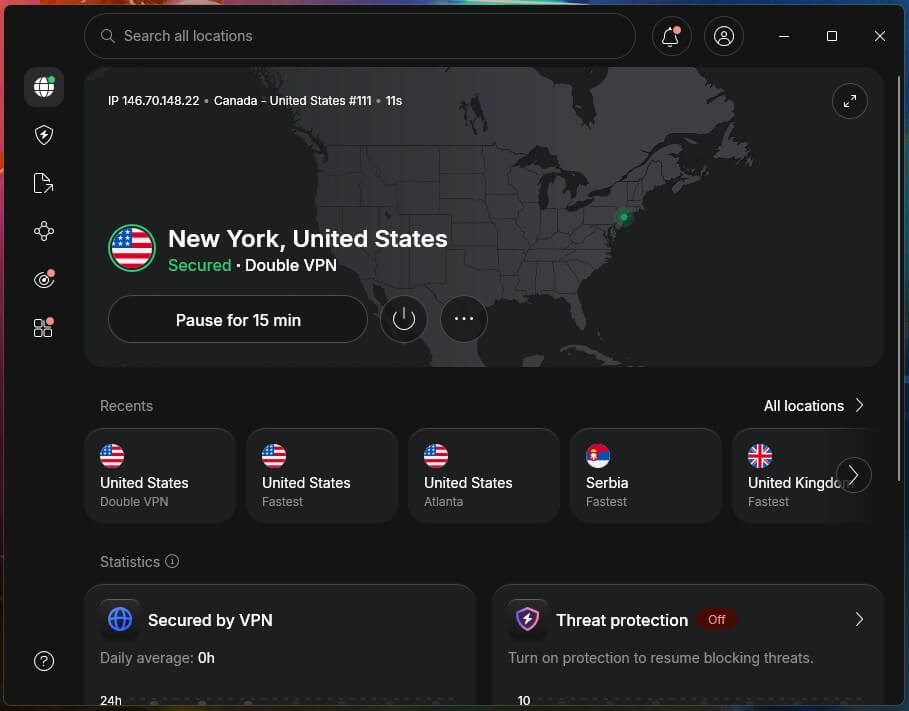
NordVPN also has tools ExpressVPN lacks. Double VPN encrypts your connection twice by passing it through two servers, yet it cost only 2.9% of my download speed and connected in 3 seconds, fast enough for daily use.
Onion Over VPN adds the Tor network for extra anonymity, obfuscated servers and NordWhisper disguise VPN traffic on networks that block VPNs, and Meshnet links up to 60 devices over encrypted tunnels, so you can access your home PC while traveling. NordVPN’s App Kill Switch closes only the apps you choose when the VPN drops.
The differences between the two kill switch types are in our kill switch guide. ExpressVPN’s newest extra, added in 2026, is an MCP server that lets an AI assistant change your server or protocol from a plain-language request, a first for a VPN.
Lightway Turbo disappointed me. The toggle is meant to speed up Lightway, ExpressVPN’s own protocol, but it added just 0.45 Mbps and disabled split tunneling while active, so I’d leave it off.
Winner: NordVPN
A stronger blocker, a second encrypted server with a 2.9% speed cost, Meshnet, and a kill switch with more control.
Privacy: Different Kinds of Proof
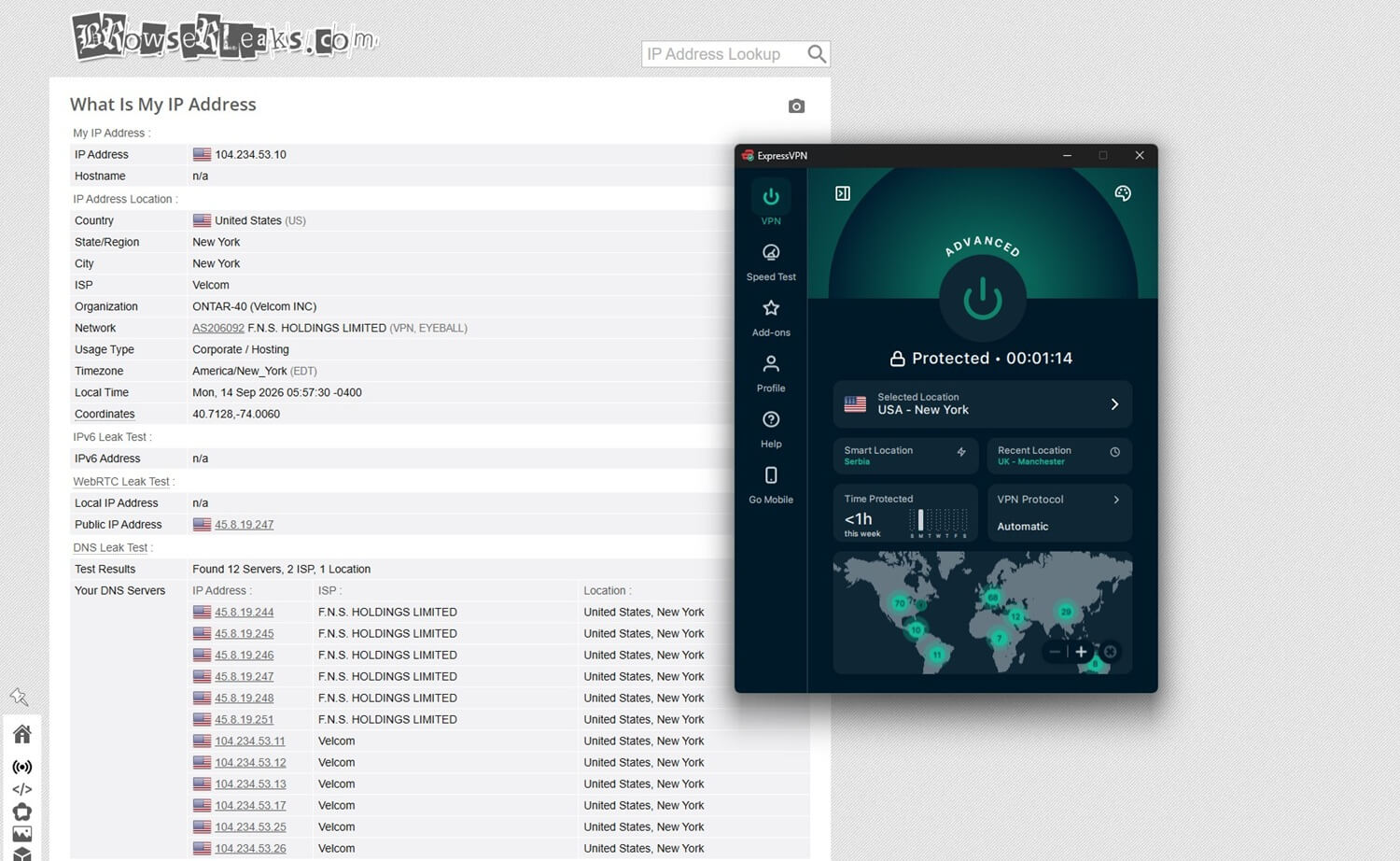
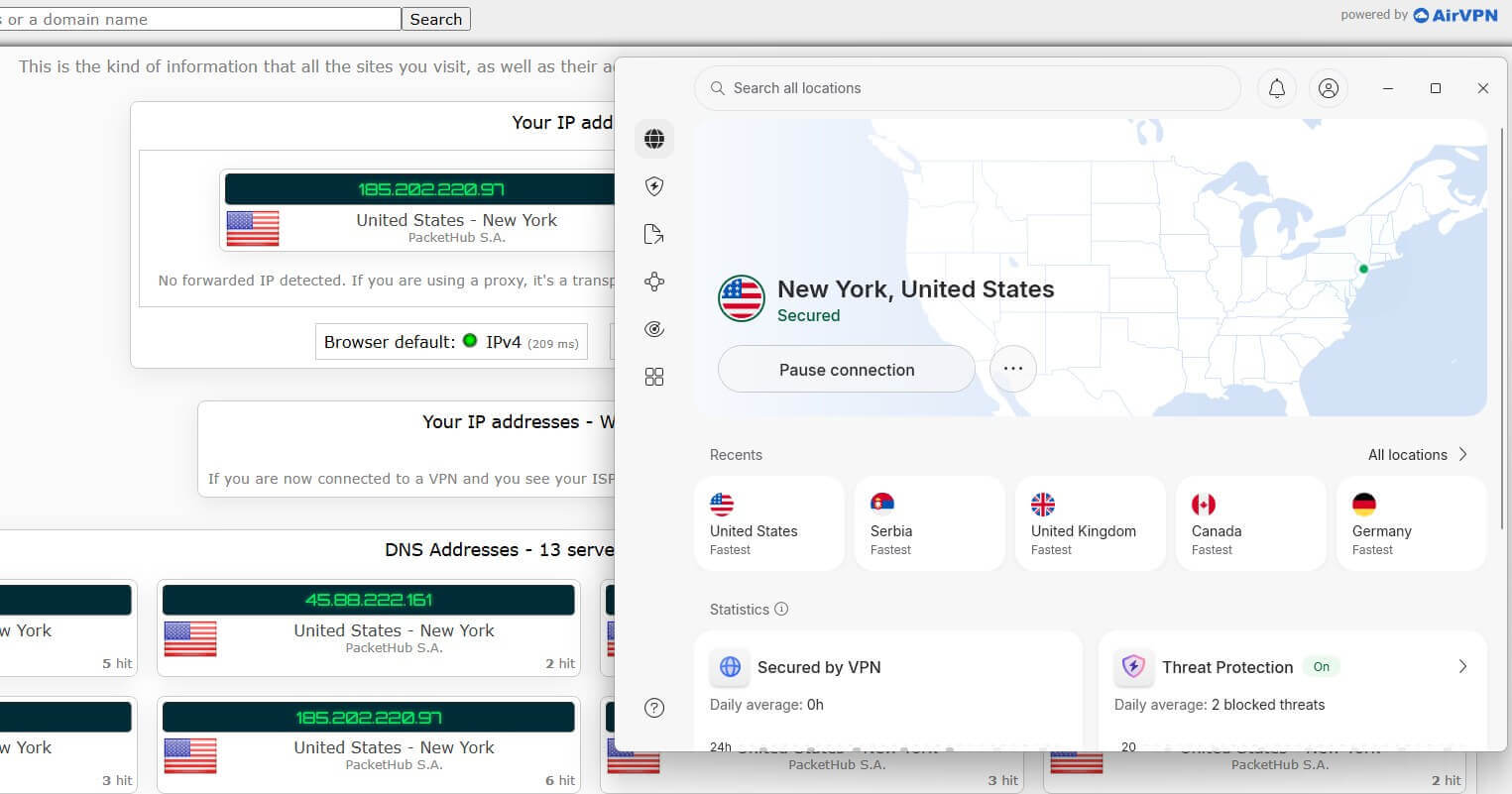
ExpressVPN is based in the British Virgin Islands and NordVPN in Panama. Neither country has a data retention law or belongs to the Five, Nine, or 14 Eyes, the intelligence-sharing alliances between mostly Western governments. Neither VPN logs your IP address, DNS requests, browsing history, or traffic, and my leak tests came back clean on both across three servers, including the IPv6 and WebRTC checks that show whether your own IP address leaks.
Beyond that, they keep slightly different account data, and both say so openly. ExpressVPN records how much data you use each day, the dates you connect, and which server location you choose. NordVPN keeps none of that, only a timestamp of your last session for about 15 minutes, to enforce the device limit.
Neither set of records shows what you did online.
| ExpressVPN | NordVPN | |
| Jurisdiction | British Virgin Islands | Panama |
| No-log audits | KPMG, as of 28 February 2025 | Six since 2018, latest December 2025 |
| Audit standard | ISAE 3000 Type I | ISAE 3000 (Revised) |
| Specialty servers audited | Not stated | Double VPN, Onion Over VPN, obfuscated |
| Tested by seizure | Turkey, 2017: no logs found | No |
| Documented failure | DNS leak, 2022 to 2024 | Finland server breach, 2018 |
What the Record Shows
- Look at the audit type alongside the count. A Type I audit checks how the no-log controls are designed on one date, while a Type II would check whether they worked over a period of months. NordVPN’s six audits cover eight years, and the latest also inspected its specialty servers.
- A seized server is strong proof. Turkish investigators took an ExpressVPN server in 2017 and found no logs or connection records on it. An audit can’t recreate that, because the auditor is invited and the police aren’t. NordVPN’s transparency report lists one Panamanian warrant it complied with, handing over payment details and confirming an email address, which is account information with no browsing activity.
- Each has a security failure on record. ExpressVPN’s Windows app leaked DNS requests in one split tunneling mode between May 2022 and February 2024. A reviewer spotted it before the company did, and Nettitude later verified the fix. In 2018, a NordVPN server in Finland was breached through the data center’s own remote management tool. No user data was exposed, and the rebuild that followed shaped the audit record NordVPN has today.
ExpressVPN’s parent company, Kape Technologies, is also behind Private Internet Access and CyberGhost, and every brand in the group commissions its own independent audits.
Winner: Tie
NordVPN has six audits that include its specialty servers, and ExpressVPN has a seized server that proved its no-log claim in practice. I’d trust either record.
Streaming and Torrenting
ExpressVPN and NordVPN unblocked all 14 streaming services I tried, which no other VPN I’ve tested has matched.
| Service | ExpressVPN | NordVPN |
| Netflix US, Canada, Japan | Unblocked | Unblocked |
| BBC iPlayer | Unblocked | Unblocked |
| ITVX | Switch servers | Unblocked |
| Prime Video | Switch servers | Switch servers |
| JioHotstar | Unblocked | Unblocked |
One service blocked the desktop apps of both VPNs, and each VPN unblocked it only with location spoofing enabled in its browser extension, which makes the browser report the server’s location as well. Changing your Netflix region worked on the first try with both.
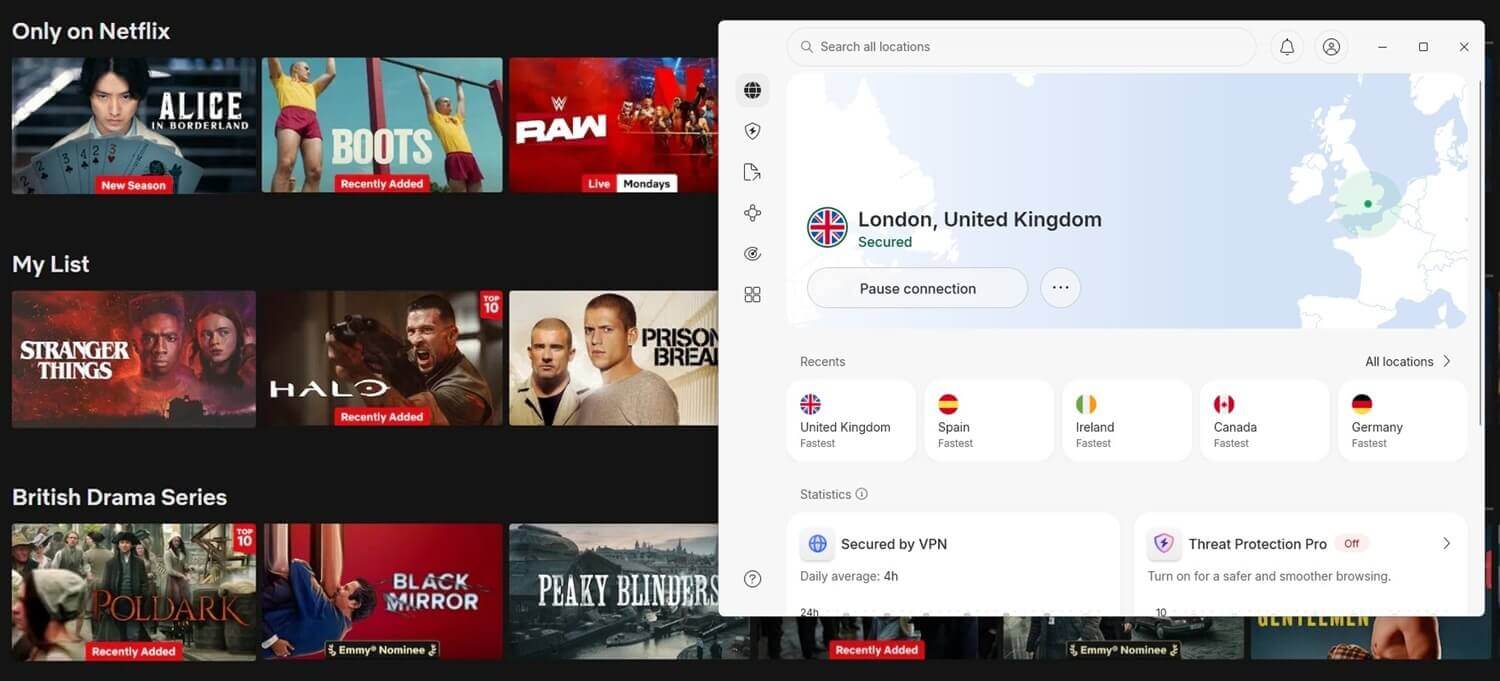
NordVPN’s SmartPlay, which keeps streaming services working through the VPN, is automatic in its app on every device, including Android TV and Fire TV. For Samsung and LG TVs, which don’t support VPN apps, NordVPN offers Smart DNS, which swaps the DNS servers your TV uses so streaming apps see a different country, with no encryption involved.
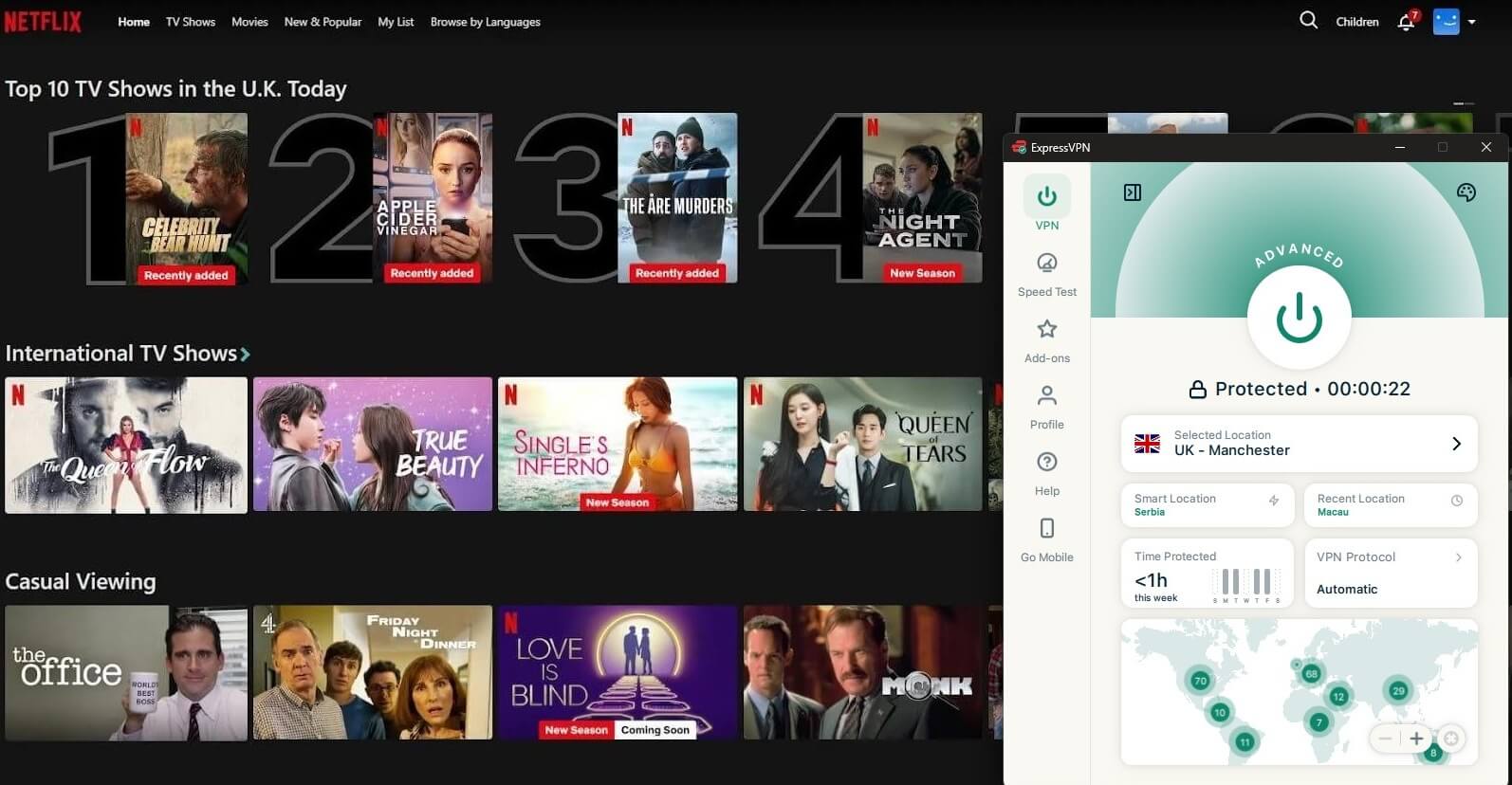
ExpressVPN’s version is MediaStreamer, a DNS service that requires registering your home IP address first, and ExpressVPN says it can’t change your location. For torrenting, every server on both networks supports P2P file sharing, and downloads move as fast as the VPN connection allows. Neither offers port forwarding, which lets other users connect to you directly and helps with seeding on private trackers, so look at PIA or Proton VPN if you need it.
Winner: NordVPN, Narrowly
The same result on every service, except that NordVPN unblocked ITVX without a server switch.
Censored Countries: Two Approaches
I haven’t tested either VPN in China for this comparison, so I compared how each one disguises VPN traffic and what that costs in speed. That disguise is called obfuscation, and ExpressVPN applies it to every Lightway connection automatically. There’s no separate server list and nothing to configure, and my speed results already include it, because it was active throughout testing.
NordVPN makes it a choice. Its obfuscated servers use OpenVPN TCP disguised as ordinary HTTPS traffic, and the newer NordWhisper protocol does the same job through a web tunnel. You have to switch to either one yourself, and NordWhisper is slower. On the same British server, it came in at 161.13 Mbps, compared to 184.73 Mbps on NordLynx, NordVPN’s default protocol, a 12.8% drop.
Ping increased from 42 ms at idle to 180 ms down and 808 ms up under load, fine for browsing and messaging but too slow for smooth video calls. Our VPN for China page covers what still works there, and the UAE guide covers the Gulf states.
Winner: ExpressVPN
Obfuscation on every connection with no setup, compared to a settings change and a 12.8% speed drop.
Servers and Coverage
| ExpressVPN | NordVPN | |
| Countries in the app | 113 | 152 |
| Servers | 3,000, last published figure | Over 9,500 |
| Specialty servers | Dedicated IP | Double VPN, Onion Over VPN, obfuscated, dedicated IP |
| Virtual locations | Yes, labeled in the app | Yes, labeled in the app |
| Router | Aircove, its own router | Manual setup and Smart DNS |
NordVPN’s app lists 152 countries to ExpressVPN’s 113, and NordVPN operates over 9,500 servers. ExpressVPN stopped publishing a server count at 3,000 and focuses on depth instead, with more than 20 US cities, which helps if you want a server near a particular American region. It also sells Aircove, its own Wi-Fi router with the VPN built into the firmware, so every device at home is covered without separate apps.
Winner: NordVPN
Thirty-nine more countries and over 9,500 servers, compared to the 3,000 ExpressVPN last published.
Apps, Devices, and Support
ExpressVPN’s apps are the simplest I’ve used: one connection button, recent locations underneath, and the full list a click away, with the same layout on every platform. The 2026 redesign removed the Settings menu, though.
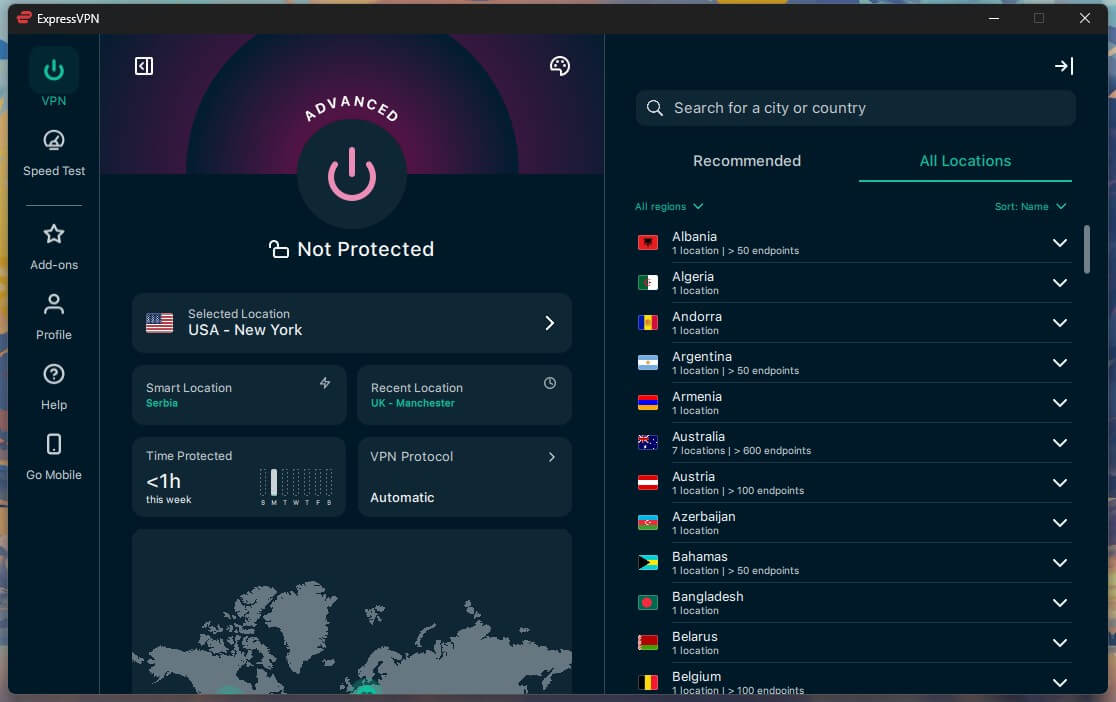
The protocol picker, kill switch, and split tunneling moved under Profile, which took me about a week to learn. NordVPN’s app shows more, with a side panel full of specialty servers and features, some of which only the higher plans include. Its default map view looks better than it works, and I found typing a country name in the search bar much quicker than scrolling the globe.
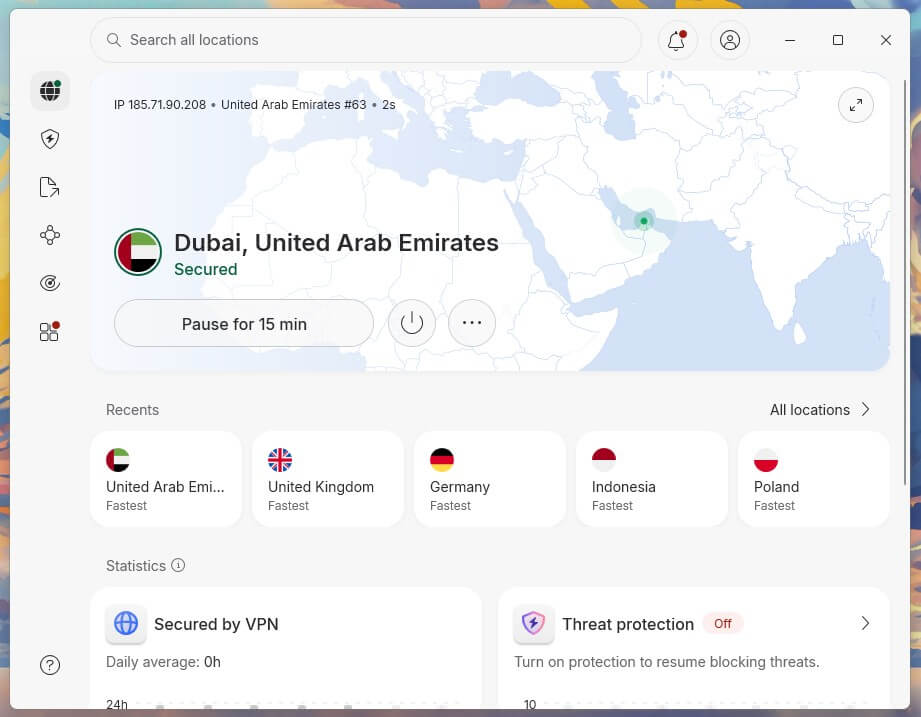
ExpressVPN connected a little faster, in 1 to 2 seconds, compared to 2 seconds for NordVPN on NordLynx, 3 on OpenVPN, and 4 on NordWhisper. Both cover Windows, macOS, Linux, iOS, Android, Fire TV, Apple TV, routers, and browsers. Devices are ExpressVPN’s clearest advantage: 10 on the Basic plan, 12 on Advanced, and 14 on Pro, compared to 10 on every NordVPN plan.
I also tested the browser extensions in Chrome, and the result surprised me. ExpressVPN’s blocked 87% of tracker domains, compared to 52% for NordVPN’s. NordVPN’s extension works on its own, while ExpressVPN’s requires Proxy Mode if the desktop app isn’t installed. Both offer live chat with a human agent if something goes wrong.
Winner: ExpressVPN
Simpler apps, quicker connections, up to four more devices, and a much stronger browser extension.
Price: ExpressVPN Costs Less, Twice Over
| Plan | ExpressVPN | NordVPN | Difference |
| Entry tier, long-term | $2.99 a month | $3.49 a month | 50 cents |
| Paid up front | $83.72 for 28 months | $94.23 for 27 months | $10.51 |
| Renewal | $99.95 a year | $139.08 a year | $39.13 |
| Middle tier | $4.49 a month | $4.49 a month | None |
| Top tier | $7.49 a month | $7.49 a month | None |
| Monthly | $14.99 | $14.99 | None |
The middle and top plans cost the same, but they include different extras. NordVPN’s Complete plan adds next-gen antivirus, the NordPass password manager, and 1 TB of NordLocker cloud storage, and its Prime plan adds Coveron identity protection, which only covers the US. ExpressVPN’s Advanced plan adds tracker blocking, the ExpressKeys password manager, and ExpressMailGuard, and its Pro plan adds a dedicated IP address and 14 devices.
The prices differ most at renewal. On the Basic plans, the first term costs about the same, but after that, NordVPN renews for about $40 a year more. If you plan to keep your VPN for years, that adds up, and our low-cost ranking covers cheaper VPNs. Each comes with a 30-day money-back guarantee. Mobile trials last three days: ExpressVPN offers one on Android and iOS, NordVPN on Android only, and each requires a card.
Winner: ExpressVPN
A little cheaper to start, and about $40 a year cheaper at renewal.
ExpressVPN vs NordVPN: The Scorecard
| Round | Winner |
| Speed | Tie |
| Security features | NordVPN |
| Privacy | Tie |
| Streaming and torrenting | NordVPN |
| Censored countries | ExpressVPN |
| Servers and coverage | NordVPN |
| Apps, devices and support | ExpressVPN |
| Price | ExpressVPN |
Verdict
For most people, I’d say pay for NordVPN. Speed is a tie and streaming is close, so the decision rests on the extras, and NordVPN has more of the ones I use: Double VPN that barely affects speed, a kill switch that stayed on through a restart, and servers in 39 more countries. To me, that’s worth the higher renewal price. My NordVPN review covers it in full.
ExpressVPN is the better buy for the simplest apps, more than ten devices on one subscription, or the lowest long-term price, and choosing it costs you nothing in speed. Its automatic obfuscation also makes it the easier choice on hotel, school, or office networks that block VPNs. The ExpressVPN review has the details.
Look elsewhere only if you need port forwarding for torrenting, which neither offers. Otherwise, I’d subscribe to NordVPN, and my best VPN ranking shows how it compares with the rest of the field.
Frequently Asked Questions
Is NordVPN faster than ExpressVPN?
No, the two are about equally fast. Both use lightweight protocols, NordLynx and Lightway, that keep most of a connection’s speed, so the difference is too small to notice day to day.
Which is cheaper, ExpressVPN or NordVPN?
ExpressVPN is cheaper. Its entry plan costs slightly less for the first term and noticeably less at renewal, while the middle and top plans from both VPNs cost about the same.
Does ExpressVPN have multi-hop?
No, ExpressVPN has no multi-hop servers. NordVPN’s Double VPN sends traffic through two servers in different countries, and Proton VPN’s Secure Core works in a similar way for extra privacy.
Which has more servers?
NordVPN has more servers and covers more countries. ExpressVPN focuses on depth instead, with many city locations in the US and other large markets, plus its own VPN router.
Which is better for streaming?
NordVPN, by a small margin. Both unblock the major streaming services, but NordVPN requires fewer server switches for British services like ITVX, and its SmartPlay feature works automatically on every device.
Do ExpressVPN and NordVPN offer port forwarding?
No, neither ExpressVPN nor NordVPN offers port forwarding. Users who want it for torrenting or hosting a game server can choose Proton VPN or Private Internet Access, which support it on paid plans.