Arriving in Beijing or Shanghai usually brings a surprise: Google Maps won’t load, WhatsApp messages don’t send, and Instagram stays blank. China’s Great Firewall blocks these services and thousands more websites, and it also detects and blocks most of the VPNs people rely on to access them.
To work there, the best VPN for China has to disguise its traffic well enough to connect, and you’ll want a backup for the days it doesn’t. Most of the setup also has to happen before you fly, because VPN websites and app stores are blocked on the mainland. Here’s what we’d install before a trip.
Quick Picks for China
- NordVPN: Best for travelers who set up in advance, with servers that disguise VPN use and a backup connection
- Proton VPN: Best for hiding VPN use on any server, with strong Swiss privacy
- ExpressVPN: Best for beginners, with disguised connections and nothing to configure
- Surfshark: Best value, with step-by-step backup guides if the app won’t connect
- Astrill VPN: Best for long-term residents who use a VPN all day
- Mullvad VPN: Best for signing up without an email, though it requires US servers from China
China VPNs Compared
Each VPN disguises its traffic differently, and their official advice about China differs too. As of October 2026, here’s where they stand:
| VPN | Obfuscation | Setting for China | What the company says | Money-back | Audited no-logs |
| NordVPN | NordWhisper, obfuscated servers | Obfuscated server, manual IKEv2 backup | Apps blocked; manual setup offered | 30 days | Yes |
| Proton VPN | Stealth | Stealth protocol | May work, no guarantee | 30 days | Yes |
| ExpressVPN | Automatic | Automatic protocol | China troubleshooting guide | 30 days | Yes |
| Surfshark | NoBorders, Camouflage Mode | App first, manual WireGuard backup | Manual WireGuard recommended | 30 days | Yes |
| Astrill VPN | StealthVPN, OpenWeb | StealthVPN | No public statement | None | No |
| Mullvad VPN | QUIC, LWO, Shadowsocks, UDP-over-TCP | US servers with obfuscation | Asian servers blocked | 14 days | Yes |
Each VPN’s Setup for China
None of these VPN companies promises that its service works in China. Set up your VPN, and a backup, before you arrive. From our test PC, we tested each VPN’s obfuscation on a Hong Kong server, the closest of our test locations to the mainland. Mullvad was the exception: China blocks its Asian servers, so we used Los Angeles instead.
1. NordVPN: Best for Travelers Who Set Up in Advance
Pros
- Obfuscated servers near China
- NordWhisper protocol for filtered networks
- Manual IKEv2 connection as a backup
- Kill switch passed our failure tests
- Blocks phishing and malicious sites
- Apps for phones, computers, TVs, and routers
Con
- Its apps are blocked in China
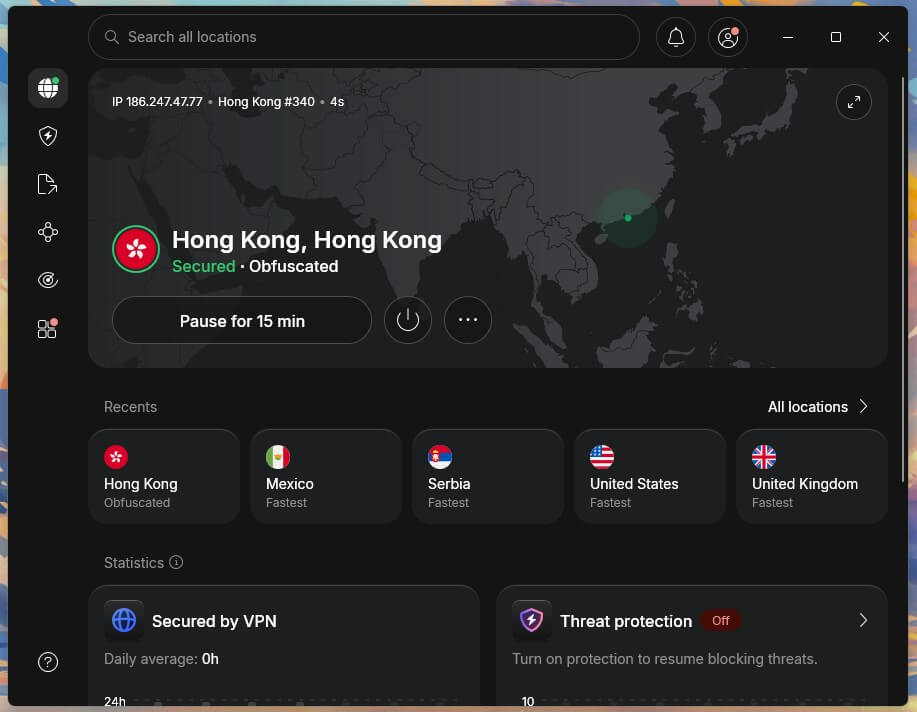
For China, NordVPN’s main tool is its obfuscated servers, which disguise VPN traffic so the firewall has a harder time spotting it. Since July 2026, they’ve used NordWhisper, a protocol NordVPN built to pass VPN traffic off as ordinary browsing. Switch the protocol to NordWhisper or Automatic, and the obfuscated locations, including Hong Kong, Japan, and Singapore, appear in the app.
On the Hong Kong server, downloads over the obfuscated connection stayed quick enough for 4K streaming, though upload speed dropped sharply. However, NordVPN itself says its apps are blocked in China and points users to a manual IKEv2 connection, which you set up from your Nord Account. On Windows, it says even manual setups have recently been blocked, which makes a phone the safer device for that fallback.
Prepare the app and the IKEv2 profile at home, following the NordVPN China setup steps. Outside China, NordVPN ranks near the top of our fastest VPNs list, and its more distant servers in Japan and Singapore remain quick enough for video calls.
2. Proton VPN: Best for Hiding VPN Use on Any Server
Pros
- Stealth protocol works on every server
- NetShield blocks ads, trackers, and malware
- Secure Core servers in privacy-friendly countries
- Unlimited free plan as a backup
Cons
- Results in China vary from day to day
- Slower with Stealth on Hong Kong servers
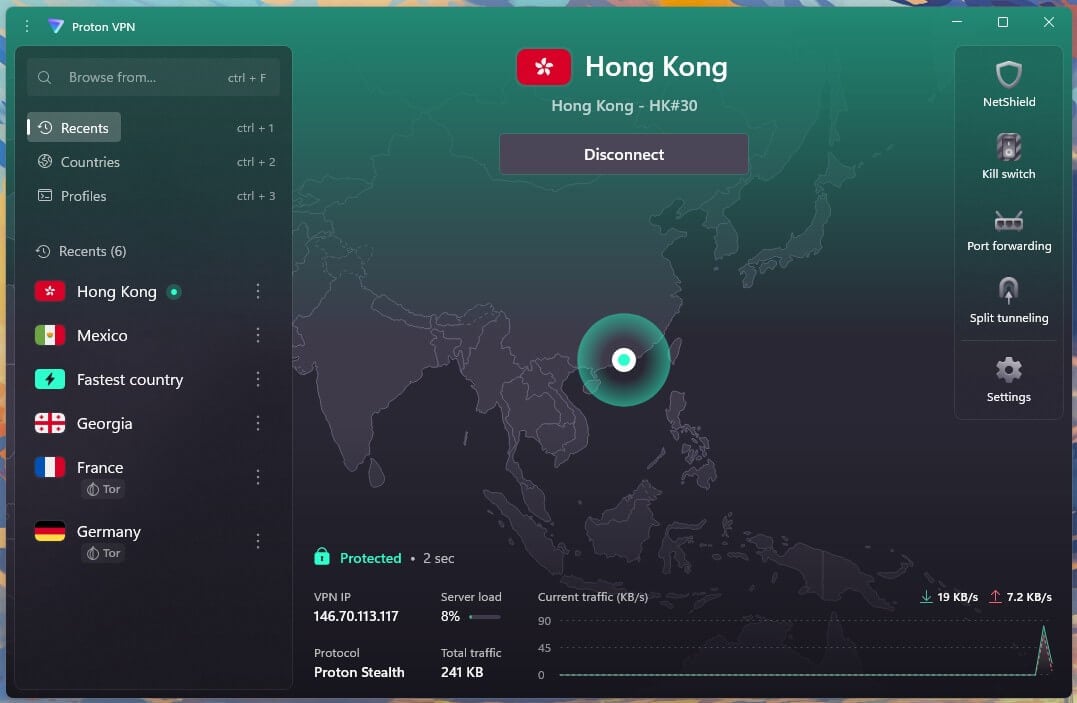
Proton VPN’s Stealth protocol wraps VPN traffic in an encrypted tunnel that resembles a normal secure website connection. That makes it harder for deep packet inspection, the firewall’s method of reading traffic patterns to spot VPNs, to flag the connection.
Its alternative routing, enabled by default, helps the app connect to Proton when its usual servers are blocked. Proton says there’s some evidence that its VPN works in China, though it won’t guarantee it, so keep a second VPN installed beside it. On our Hong Kong server, Stealth was noticeably slower than NordVPN’s and ExpressVPN’s obfuscation.
Though it was still fast enough for 4K streaming. Proton suggests trying servers in Japan, Hong Kong, or Singapore first, then moving further away if those are blocked. Its Swiss base and audited no-logs policy also put Proton among the best VPNs for privacy.
3. ExpressVPN: Best for Beginners Who Want Nothing to Configure
Pros
- Disguised connections with default settings
- Strong speeds on distant Asian servers
- Simple apps for first-time VPN users
- MediaStreamer for TVs and consoles
Cons
- Renewals cost more than the first term
- Few settings for advanced users
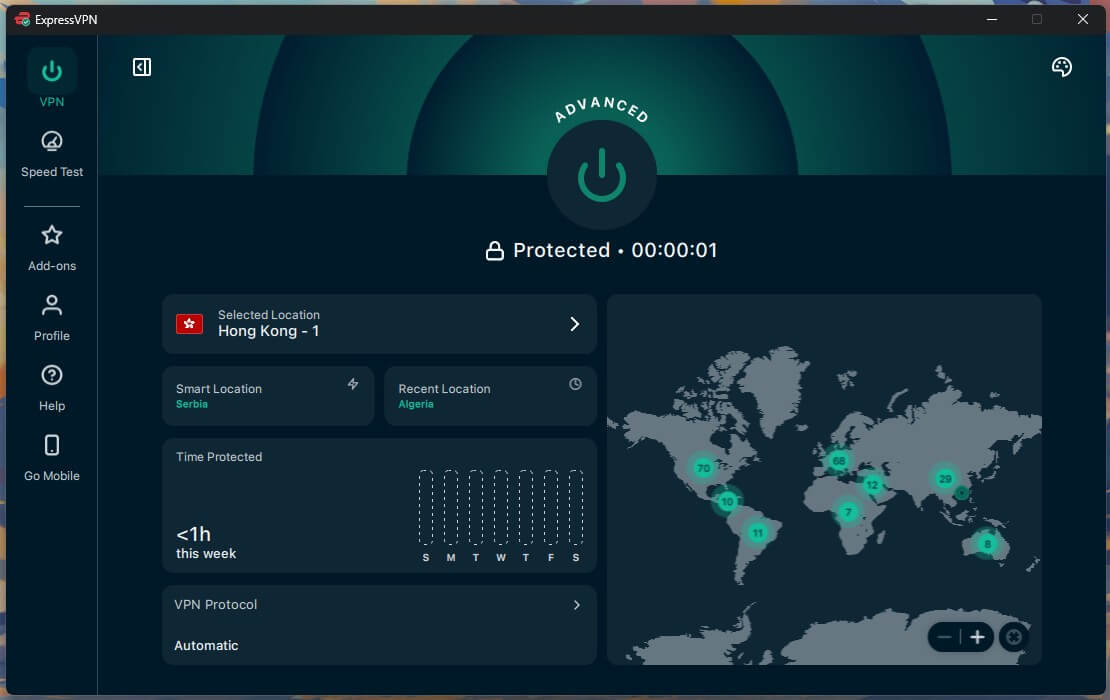
ExpressVPN applies obfuscation automatically, so there’s no protocol to pick before you connect. For a first-time VPN user, that’s one less setting to worry about. In our Hong Kong test, it recorded the fastest obfuscated result, and its upload speed barely dropped.
ExpressVPN doesn’t claim to work in China, but it keeps a China troubleshooting page. If the connection fails, it suggests updating the app first, then trying its protocols one by one, starting with Automatic and Lightway.
If ExpressVPN still won’t connect, NordVPN or Proton VPN are the alternatives we’d keep installed beside it. ExpressVPN has servers in Hong Kong, Japan, Singapore, and South Korea, plus a Taiwan location, and KPMG has audited its no-log policy. Advanced users will find few settings to change, but beginners won’t miss them.
4. Surfshark: Best Value for a China Trip
Pros
- NoBorders mode for restricted networks
- Camouflage Mode hides OpenVPN traffic
- CleanWeb blocks ads and trackers
- Strong streaming results
- No limit on connected devices
Cons
- May require a manual setup in China
- Camouflage Mode is limited to OpenVPN
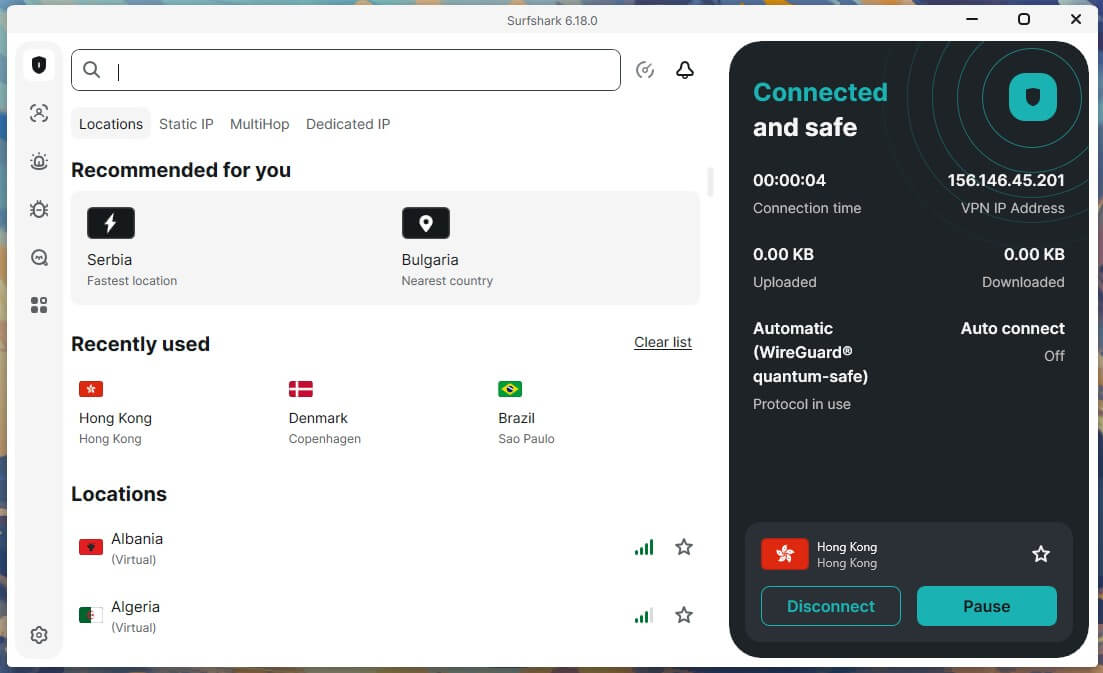
Surfshark’s app adjusts automatically on restricted networks, but its help center currently recommends a manual WireGuard setup for Surfshark users in China who can’t connect through the app. Download the configuration files from your account before you travel, and keep them on each device.
With OpenVPN selected to activate Camouflage Mode, Surfshark’s Hong Kong server delivered the second-fastest obfuscated download and kept almost all of its upload speed. The app usually picks WireGuard on its own, so set OpenVPN manually before you travel.
Surfshark is also cheaper than NordVPN over a long plan, as our Surfshark vs. NordVPN comparison shows.
5. Astrill VPN: Best for Long-Term Residents
Pros
- StealthVPN and OpenWeb protocols
- Optional VIP servers tuned for Asia
- Router app covers a whole household
Cons
- Expensive long-term plans
- No refunds or free trial
- No independent no-logs audit
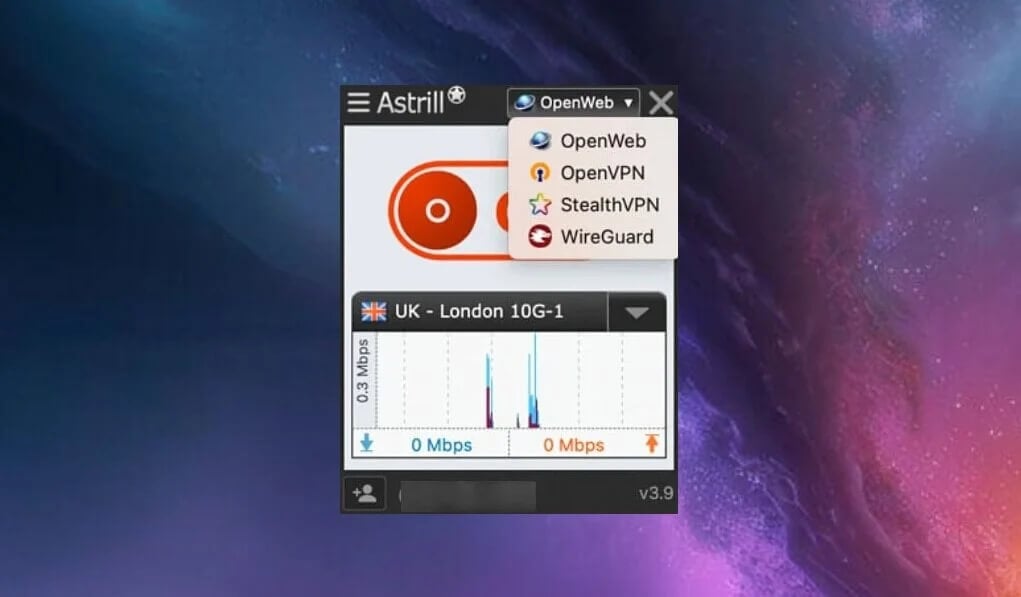
Astrill’s features are designed for heavy daily use behind a firewall. Its Smart Mode, for example, sends only international traffic through the VPN, so WeChat and Chinese banking apps keep working normally while Google and WhatsApp go through the encrypted connection.
For the connection itself, it relies on StealthVPN and OpenWeb, two protocols designed to hide VPN use. On download speed, StealthVPN came in behind NordVPN, ExpressVPN, and Surfshark in Hong Kong, and upload speed dropped sharply. Astrill costs several times more than NordVPN on a two-year plan.
All sales are final and there’s no free trial, so start with the one-month plan if you want to try it. No independent firm has audited its no-logs policy either. Veloxee Corp. in Liechtenstein runs Astrill, and personal plans allow five devices at once. Several Astrill alternatives cost less and come with a refund window.
6. Mullvad VPN: Best for Signing Up Without an Email
Pros
- No email or personal details at sign-up
- 4 obfuscation methods
- Same flat monthly price on every plan
- Open-source, audited apps
Cons
- Asian servers blocked from China, per Mullvad
- Short refund window
- Low device limit
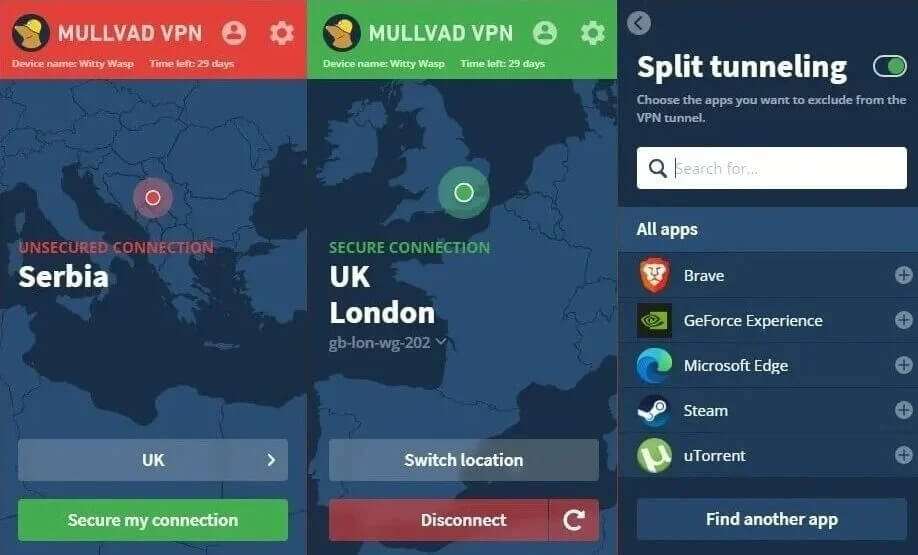
Does Mullvad VPN work in China? Not reliably, and it takes more effort than NordVPN or ExpressVPN. Mullvad’s own help page says the Great Firewall blocks all its servers in Asia. Instead, it suggests US servers, trying its obfuscation methods one by one, or Multihop, which enters through a server you can connect to and exits in another country.
Those methods disguise WireGuard in different ways. QUIC makes it look like the HTTP/3 traffic modern websites use, and Shadowsocks wraps it in an encrypted proxy built for censored networks. LWO scrambles WireGuard’s signature, while UDP-over-TCP sends it over TCP.
In January 2026, Mullvad removed OpenVPN, and Shadowsocks now does the job of its old bridge mode. We tested QUIC on a Los Angeles server, the closest US location to China. Its download speed was higher than Astrill’s and Proton VPN’s in Hong Kong. Even so, US servers are far from China.
That instantly means higher ping and slower browsing than on a nearby location. Privacy is Mullvad’s main appeal, and it even accepts cash sent by post. Refunds are limited to 14 days and don’t apply to cash or crypto payments, so test it soon after paying. One account covers five devices.
Fastest VPN for China: Obfuscated Speeds
In China, speed depends on the distance to the server, the time of day, and the extra work obfuscation adds. Here’s how our six picks compared with their disguise methods enabled:
| VPN | Server | Setting | Download (Mbps) | Upload (Mbps) |
| No VPN (baseline) | None | None | 190.36 | 19.37 |
| ExpressVPN | Hong Kong | Automatic | 133.56 | 16.97 |
| Surfshark | Hong Kong | OpenVPN (Camouflage Mode) | 128.68 | 17.15 |
| NordVPN | Hong Kong | Obfuscated server | 116.30 | 5.71 |
| Astrill VPN | Hong Kong | StealthVPN | 84.29 | 5.13 |
| Proton VPN | Hong Kong | Stealth | 60.75 | 3.48 |
| Mullvad VPN | Los Angeles | QUIC | 108.13 | 10.12 |
Every result is fast enough for 4K video. The bigger difference was upload speed, which fell sharply on NordVPN, Astrill, and Proton VPN and slows uploads of photos and large files. Mullvad’s QUIC connection to Los Angeles lost less upload speed than those three.
Instagram’s feed, Stories, and Reels worked on each VPN we tested. Servers in neighboring countries and territories, such as Japan, Taiwan, and South Korea, usually offer the lowest ping from China. Speeds also tend to drop in the evening, China time, when international connections are busiest.
What Is a CN2 GIA Route?
CN2 GIA is China Telecom’s premium international network. Regular traffic leaves China over the busier ChinaNet backbone, while CN2 GIA uses a separate, less congested path from end to end. As a result, ping stays steadier during the evening peak.
It mainly benefits China Telecom subscribers, and it’s sold by server hosts in Hong Kong and Japan and by Chinese proxy services. No major consumer VPN, including NordVPN and ExpressVPN, advertises CN2 GIA servers, and the network does nothing to hide a VPN from the firewall.
During the April 2026 crackdown, many Chinese proxy services reportedly lost the forwarding servers that used it.
How to Set Up a VPN Before You Travel to China
Using a VPN is simple at home, but for China, most of the setup happens before you leave. On the mainland, VPN websites are blocked, Google Play doesn’t work, and Apple’s Chinese App Store has no foreign VPN apps:
- Install the VPN on your phone and your Mac or Windows laptop, and sign in on each.
- Add a second VPN as a backup, ideally one with a different obfuscation method.
- Try the obfuscation setting before the trip, on a server near China.
- Save the manual setups, such as NordVPN’s IKEv2 profile or Surfshark’s WireGuard files.
- Enable the kill switch to stop traffic from leaking during a dropped connection.
- Update every app before you board. Downloading updates in China is difficult.
Once you arrive, connect before opening Gmail or WhatsApp.
How to Download a VPN in China
If you arrive without a VPN, start with mobile data from a travel eSIM or a roaming SIM, which often avoids China’s filtering. From there, Android users can download the app straight from the VPN company’s website as an APK file, which NordVPN and ExpressVPN offer.
iPhone users require an Apple ID registered in another country to find VPN apps in the App Store. A stopover in Hong Kong works too. The city is outside the Great Firewall, so you can download a VPN normally there.
What to Do When Your VPN Stops Working in China
When a VPN that worked yesterday won’t connect today, try these steps:
- Switch servers, starting with nearby countries and moving further away.
- Change the protocol or obfuscation setting, following your VPN’s China advice.
- Change networks. Hotel Wi-Fi, mobile data, and a foreign eSIM can behave differently.
- Use your manual setup or switch to your backup VPN.
- Wait it out during sensitive political periods, when blocks often tighten for a few days.
VPN or Travel eSIM?
A travel eSIM for China is a useful backup on a short trip. Roaming on your home SIM usually sends data back through your own carrier, and many travel eSIMs connect via Hong Kong or Singapore. Either way, the connection often avoids China’s filtering, and Google and WhatsApp may work without a VPN.
It depends on the carrier, though, and an eSIM that uses a Chinese carrier’s network is filtered like a local connection. An eSIM covers only mobile data on your phone. Hotel Wi-Fi and a laptop that isn’t tethered still require a VPN, and an eSIM doesn’t encrypt your traffic.
VPNs for Remote Workers in China
Remote workers face a stricter version of the same problem. Video calls, cloud drives, and work email often depend on blocked foreign services. The legal option is a company connection: China allows businesses to use cross-border lines and corporate VPNs from licensed carriers, such as China Telecom, China Unicom, and China Mobile, for internal use.
If your employer offers one, use it for work. Without one, a commercial VPN is the usual alternative, though it’s a legal risk under Chinese rules. A few habits make the workday more reliable:
- Keep two VPNs and a travel eSIM, so one failure doesn’t end a meeting.
- Before the trip, test upload speed on obfuscated servers, which video calls rely on.
- Use split tunneling so Chinese apps such as WeChat and Alipay connect directly.
- Book important calls outside the evening peak, China time.
Astrill vs. ExpressVPN vs. LetsVPN
Astrill, ExpressVPN, and LetsVPN take very different approaches to China:
| Astrill VPN | ExpressVPN | LetsVPN | |
| Built for | Censored networks | Users worldwide | Chinese-speaking users |
| Obfuscation | StealthVPN, OpenWeb | Automatic | Not disclosed |
| Refunds | None | 30 days | Not stated |
| Independent audit | No | Yes | No |
| Company location | Liechtenstein | British Virgin Islands | Canada, per its app listings |
LetsVPN is a Chinese-language VPN that was popular with mainland users. In April 2026, it announced it was ending service for mainland China after weeks of failed connection fixes, then resumed in May without promising that it works there.
Its own website names no legal entity, and its apps are closed source and unaudited, so we wouldn’t use it for private browsing or sensitive work. Astrill is built for long-term residents willing to pay more, while ExpressVPN is simpler for travelers and comes with a refund window. For a closer look at those two, see our Astrill vs. ExpressVPN comparison.
Free VPNs in China
Free VPNs for China are a weak choice, though a few include obfuscation. Proton VPN’s free plan has Stealth, Windscribe’s free plan offers Stealth, WStunnel, and AmneziaWG with a monthly data allowance, and PrivadoVPN’s free plan has a Scramble option.
Still, no free plan comes with a promise of access in China, and server choice is limited, so there are fewer ways to work around a block. Be careful with free VPN apps from unknown developers. Some log user activity, and some have ties to companies in mainland China.
How the Great Firewall Blocks VPNs
The Great Firewall uses several methods at once. It blocks the IP addresses of known VPN servers, filters domain names and keywords, and inspects traffic for the patterns standard VPN protocols create. When a connection looks suspicious, it can probe the server to confirm it’s a VPN.
Researchers have found that since late 2021, it can also flag fully encrypted traffic that doesn’t resemble a known protocol. Obfuscation responds by making VPN traffic look like ordinary web browsing. Blocking varies across the country, too.
In April 2026, carriers in parts of China reportedly received orders to block VPN services. Disruptions tend to spike in March, when parliament meets, and around June 4 and October 1. The firewall covers Beijing and Shanghai alike, but results still differ by city, carrier, and network.
What’s Blocked in China
GreatFire, which monitors censorship in China, finds more than a quarter of the URLs it tests blocked. These are some of the services visitors miss most:
- Google services, including Search, Maps, and Gmail
- YouTube, Facebook, Instagram, and X
- WhatsApp and Signal
- Telegram
- Discord
- Wikipedia and news sites such as The New York Times, Reuters, and Bloomberg
- AI chatbots, including ChatGPT and Gemini
- Adult sites, including Pornhub
A VPN is the usual way to unblock websites like these from the mainland. The firewall doesn’t block Netflix; the service simply doesn’t operate in China. TikTok isn’t available on the mainland either, where its owner, ByteDance, offers Douyin instead.

Most of these services work normally in Hong Kong, which has its own internet rules, though some political sites are blocked under its national security law. TikTok left Hong Kong in 2020.
OpenAI doesn’t support Hong Kong or mainland China, so using ChatGPT in Hong Kong requires a VPN too.
VPNs That Don’t Work Well in China
Some popular VPNs lack the tools China requires, or offer weaker versions of them:
- CyberGhost has no obfuscation, so the firewall can spot its connections easily.
- Private Internet Access disguises traffic only through a Shadowsocks proxy that requires OpenVPN.
- IPVanish offers a Scramble option on OpenVPN, but it doesn’t guarantee access from China.
Outside China, CyberGhost in particular is a good choice for streaming Netflix.
Is It Legal to Use a VPN in China?
Only government-approved VPNs are legal in China, and none of the VPNs we recommend is approved. Rules dating back to 1996 allow warnings and fines for using unapproved international connections, and a 2017 notice from China’s telecom ministry banned unapproved VPN services.
The US State Department warns that using a VPN in China “is illegal in most cases and may result in confiscation of your device, a fine, or detention.” Chinese police have mostly gone after those selling VPN access. Individuals haven’t been exempt, though.
A Guangdong resident paid a fine in 2019, and in 2023, a Hebei programmer was fined and had his earnings from a foreign employer confiscated. Reports from 2026 describe more small fines after the April crackdown. The cases we found involved residents, though police can tell visitors to delete VPN apps.
A draft cybercrime law published in January 2026 would add penalties for providing circumvention tools, though it hadn’t passed as of October 2026. These rules don’t apply in Hong Kong and Macau, and VPNs are legal there.
Conclusion
China’s blocks shift too often for any VPN to guarantee access. You can still control the setup: a VPN with strong disguise tools, a backup method, and every app installed before you fly. For most travelers, NordVPN makes the strongest base, with obfuscated servers near China and a manual IKEv2 fallback.
Pair it with Proton VPN for its Stealth protocol, or with ExpressVPN if you’d rather configure nothing. Long-term residents with a bigger budget may prefer Astrill, while Mullvad works for anonymous sign-up but requires US servers and more patience.
Add a travel eSIM as well, so you still have a way online on days when no VPN connects. For everyday use outside China, start with our best VPNs ranking.
Frequently Asked Questions
Does Mullvad VPN work in China?
No, not reliably. According to Mullvad, China blocks its entire Asian network, so connections depend on US servers with obfuscation, which may or may not connect on a given network.
Does Astrill VPN still work in China?
Yes, for many users, based on reports from people in China. However, Astrill doesn't guarantee access, offers no refunds, and its connections can still fail in crackdowns.
What happened to LetsVPN in China?
LetsVPN paused service for mainland users after its connections failed for weeks. It has since restarted, but it says it can't guarantee service on the mainland.
Can you download a VPN in China?
No, not easily. Mainland app stores don't list foreign VPNs, and most VPN websites are blocked. Travelers usually install one through a travel eSIM or while passing through Hong Kong.
Is there a free VPN that works in China?
No. A few free VPN plans, such as Proton VPN's and Windscribe's, include obfuscation, but their short server lists and limits leave little room to switch when a server is blocked.
Which server location works best from China?
Asian locations close to China, such as Japan, Hong Kong, and Singapore, generally offer the lowest ping. If a VPN's Asian servers are blocked, US servers are the usual fallback.
Do VPNs work on hotel Wi-Fi in China?
Yes, sometimes. Hotel networks in mainland China face the same filtering as other connections, so a VPN that works on mobile data can still fail on hotel Wi-Fi.