
Having in mind its privacy benefits, many non-VPN users are asking if using a VPN is legal. Well, in most cases, we can say YES. This is great because you get to experience total internet freedom while keeping your security and privacy intact. However, we recommend only the best ones if you’re going to use them.
Our recommendations go as far as your country’s laws. Chances are you’re in a country where VPNs are legal, so you can go right away and pick one up. Are VPNs legal everywhere? Sadly, they’re not. This article will explain where VPNs are legal (and illegal). We’ll also discuss notorious VPN restrictions and how to bypass them.
Is Using a VPN Legal? Countries Where It’s Allowed
As explained in the introduction, VPNs are allowed in most countries worldwide. This means you can pick NordVPN, ExpressVPN, or any other provider, subscribe to it, and connect to it without consequences. This brings about another topic. This is how you use the VPN. Think about illicit activities.
Selling drugs, violating copyrights, and online harassment are only some examples. Such activities can be, in a way, concealed by the VPN connection, in which case, they don’t magically become legal. Despite the protection, they are still illegal, and you can be prosecuted if you’re caught.
To make it clear, we’re against crossing this line. We assume you use the internet normally for things like accessing blocked websites, streaming, gaming, etc. In this case, you won’t have a problem and can fully enjoy your chosen VPN. Now, which regions allow you to use a VPN legally and without restrictions?
To avoid mentioning all countries because there are at least 150, we’ll mention these:
- The majority of Europe (except for a few countries mentioned below)
- The United States (all states)
- Canada
- Australia
- The United Kingdom
- South America
- Asia (with a few exceptions)
- Africa (with a few exceptions, such as Middle-Eastern countries)
The 3 VPNs Recommended by Our Experts in 2026:



 9200 servers
 128 covered countries
 30 days money-back guarantee
 10 simultaneous connections
9.4 /10

20396 servers
148 covered countries
30 days money-back guarantee
10 simultaneous connections
9.2 /10

3000 servers
105 covered countries
30 days money-back guarantee
10 simultaneous connections
9.1 /10
Countries Where VPNs Are Illegal or Restricted
Are VPNs legal in Russia, China, India, and other, so to speak, questionable regions? These three, and many more countries, either ban or restrict VPNs. All are addressed below, where we explain the situation in each country.
Are VPNs Legal in China?
In a recent post on Gizmodo, we presented a few amazing VPNs that work in China. We explicitly pointed out that China HEAVILY restricts these services using filters and deep packet inspection. These measures are often called The Great Firewall, alluding to the Great Wall that spans nearly 21,200 kilometers.

So, are VPNs legal in China? To be honest, it’s unclear. Many call it a grey area because, on the one hand, VPNs are heavily restricted. On the other hand, people use VPNs (NordVPN, ExpressVPN, and Surfshark) to sidestep censorship without consequences. The government allows VPNs to operate in this country.
However, they must cooperate with it and hand over user-related data, which goes against the goal of the VPN. That’s why no reputable VPN offers Chinese servers, as that would force them to comply with the law. Similarly, they offer servers in Hong Kong, as a separate region without VPN-restricting laws.
To cut it short, we’ll say VPNs are restricted but not illegal in China. You can still use them, although not many will work. We recommend NordVPN and its obfuscated servers. Connect to one, and you should be able to beat the Great Firewall.
Use NordVPN’s Obfuscated Servers in China
Is Using a VPN Legal in Russia?
Russian air is still polluted by the good old communist spirit. Reminiscent of China? Absolutely! It’s not strange that this country also restricts VPNs but doesn’t deem them illegal. 2017 was the year things changed for the worse when the country banned so-called unapproved providers.
These providers refused to comply with the law and provide the government with user data. This year also saw a ban on using VPNs to unblock sites, while keeping them allowed for everything else. Later on, Russia clenched its grip further.

In 2019, just two years later, the government requested access to all VPN servers in Russia. Such a bold request made many providers remove their Russian servers to enforce their no-logging policies. We can point out ExpressVPN and NordVPN as the best examples. Providers like Surfshark, PIA, and Proton VPN have done the same.
You’ll see virtual servers in some, but they’re not physically in Russia. So, is a VPN legal in Russia, and can you use it? Yes, you can, but it would be good to have obfuscation. NordVPN, ExpressVPN, and Private Internet Access will fit the bill.
What About India?
Despite being the most populated country according to Worldometers, India’s large population suffers from VPN restrictions. Think about nearly 1.5 billion people who struggle the protect their online privacy. That’s roughly 20% of the world’s population. Are VPNs legal in India? Technically, not yet.
In 2022, the government requested the providers who operate in the country to store logs, and of course, hand them on a silver platter. Not complying with these laws would mean hefty fines for the provider. The solution for most VPNs was to quickly remove their servers from India.

That way, they wouldn’t need to comply with the law, as they wouldn’t have any ties to the country. Options like NordVPN, ExpressVPN, and Private Internet Access are still great Indian VPNs – how so? Again, with the help of virtual servers. They house them somewhere else and “simulate” the Indian IP address.
Connecting to them still lets you unblock Hotstar or watch Indian TV as if you were in India. Again, we have the same conclusion here – restrictions, not illegality.
Enjoy NordVPN in India Risk-Free
VPN Restrictions & Illegality in Other Countries
We’ve clarified the three most requested countries and their love-hate relationship with VPNs. But what about the rest? Some are surprising, so let’s analyze them and see if they completely ban providers or partially restrict them.
Turkey
Turkey has a restricted status. VPNs aren’t illegal but rather restricted, with minor VPN blocks that can be bypassed with obfuscation. In general, the state of the internet in Turkey isn’t great due to many website blocks, censorship, and the lack of freedom of speech. All is masked by good intentions, such as anti-terrorism.
However, we all know that terrorists don’t kill people with VPNs. Guns kill people, and the lack of freedom of speech doesn’t seem to bode well for the country. Thankfully, a VPN can fix that, and the best VPNs for Turkey are here if you need them.
Belarus
Is it legal to use a VPN in Belarus? No – this is an explicit law that shouldn’t be broken. Belarus banned VPNs and Tor in 2015, preventing the use of any service that changes your IP address or improves your privacy. Should you use any provider in this country? Again, the answer is a bold NO.
You can be fined or even jailed for breaking the law. Instead of restrictions, Belarus opted for a complete ban on all VPN services in the country.
United Arab Emirates & Saudi Arabia
The UAE is mildly censored with insignificant restrictions. Accessing blocked websites and watching pornography using a VPN can be problematic. Not many people are caught because they mostly use safe and secure VPNs in the UAE. However, if you get caught, you can be charged more than $130K.
The UAE’s laws aren’t the clearest, but from what we’ve gathered, the authorities aren’t so happy to let you use VPNs just like that. This puts the country in the restricted category. If you use these services for online privacy and not breaching any laws, you’re good. We haven’t mentioned Saudi Arabia.
However, this country’s situation is roughly identical. These services aren’t illegal, but since it’s a censored country, it’s technically a grey area. Abide by the laws and use only the best providers here – NordVPN, ExpressVPN, and Private Internet Access.
Egypt
Heavy censorship has taken a toll on the Egyptian internet space, so are VPNs legal in this country? Yes, but they’re restricted. You can use them meticulously, but do not try to access blocked sites because this can land you in jail. If you want to do it on your own responsibility, at least use additional security features.
Obfuscation and Multi-hop connections are your best bet. However, Gizmodo will gladly prevent you from doing that for your own good and out of respect for Egyptian laws.
Iran & Iraq
We put these two together because they share similar stances in terms of VPN legality. Both countries deem them ILLEGAL except if they have legal permission, i.e., collect logs and hand them out to the authorities. Have you noticed that providers don’t have Iranian or Iraqi servers?
There’s a reason – they don’t want to store logs, let alone give them to the government. Apart from banning VPNs, these countries are under heavy censorship, making different websites and apps unavailable. We don’t recommend using VPNs here. But if you must, it’s better to use the quality ones.
Uganda
Is using a VPN legal if you’re in Uganda? Yes, but expect restrictions because of the social media tax. Uganda isn’t a censorship-heavy country, but some people reported being unable to access some websites and apps, which is fixable with a VPN. NordVPN works well in this country, especially with obfuscated servers.
We also recommend ExpressVPN if you want more straightforward apps.
North Korea
North Korea is the most hardcore country for internet access. It restricts internet access completely, instead allowing all citizens to use the country’s intranet. Very few people have a telephone service, let alone proper internet access. It goes without saying that VPNs are ILLEGAL here, so don’t even bother.
Oman
Like most other countries, Oman restricts VPNs but allows only government-approved ones. So-called personal VPNs aren’t legal, so we don’t recommend using them. If you’re caught, expect to be fined roughly $1,300, a lot of money for this country. Oman’s laws forbid communication encryption, naturally restricting VPNs.
On the other hand, it seems like corporate VPNs can operate freely, as long as they maintain user logs and hand them out to the government.
Turkmenistan
We’ve left Turkmenistan for last because it’s a bit funny. Obviously, using any VPN service in this country is illegal, but not only that. In 2021, internet users in Turkmenistan were forced to swear on the Quran that they wouldn’t use VPN services.
We don’t know how the government treats people who violate their oath, and likely don’t want to find out. If you’re in this country, refrain from using all IP-changing services if you care about your safety.
VPN Blocks: Should You Bypass Them and How?
Some countries impose VPN blocks for various reasons, such as religion, culture, censorship, and so forth. Most of these blocks can be bypassed by using feature-rich providers like NordVPN, ExpressVPN, Private Internet Access, and a few others. This brings the question of whether you should do it.
Well, ask yourself – is using a VPN legal in my country? If the answer is yes, like in China, Russia, India, Uganda, etc, it’s okay to bypass the block. In the opposite scenario, you shouldn’t attempt this. People in censored regions can bypass such blocks by using advanced security features.
- Obfuscation. This is the best way of circumventing VPN blocks. It masks your VPN traffic and makes it look like a regular one. As a result, it tricks the firewall and allows you to use the service without restrictions. Providers with obfuscation include NordVPN, ExpressVPN, PIA VPN, Proton VPN, and Surfshark.
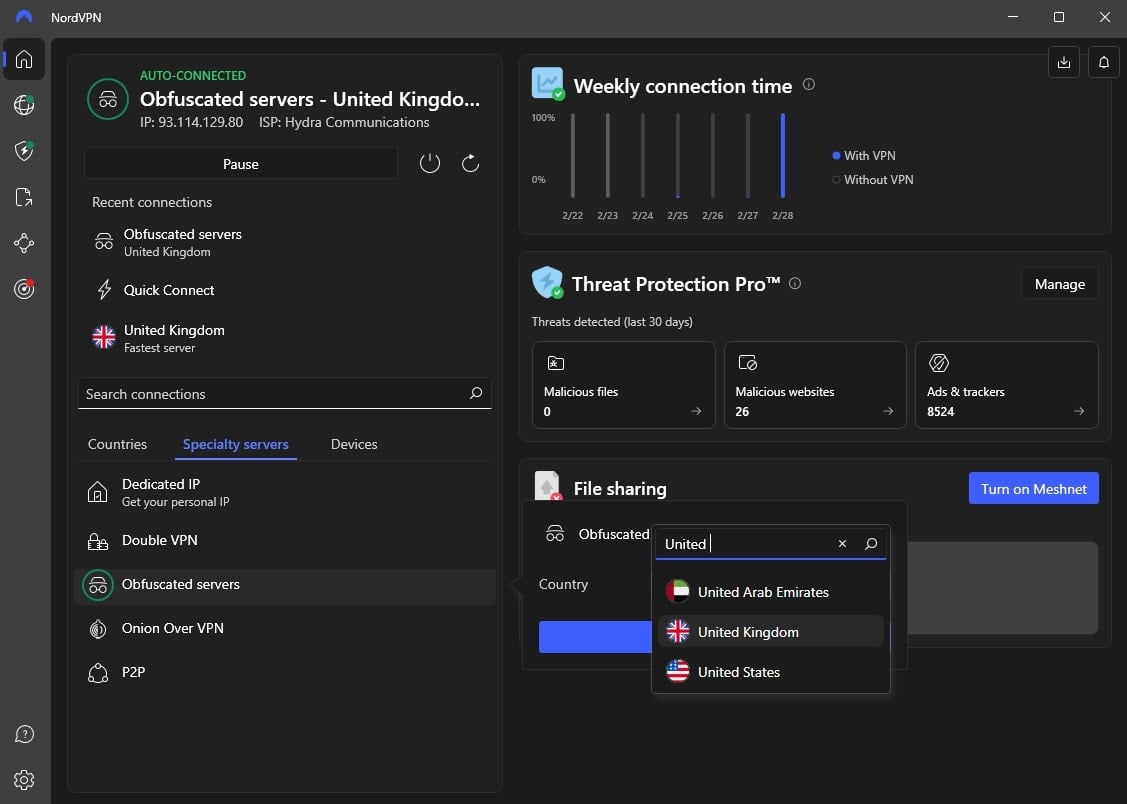
- Double VPN. You can sometimes get away with Multi-hop, also known as a Double VPN. This feature encrypts your connection two times, making you untraceable on the internet. It’s great if you’re a whistleblower or someone who likes additional privacy measures. You’ll find it in NordVPN, PIA, and Surfshark.
- Kill Switch. This is a must-enable for all users. It prevents IP leaks by shutting down your internet connection if the VPN connection drops. All premium providers offer this feature.
Bypass All VPN Blocks With NordVPN
VPN Legality: Your Frequently Asked Questions Answered
Before we wrap up this discussion, let’s address a few more questions.
Why Are VPNs Illegal in Some Countries?
If you’ve read this article thoroughly, you noticed one pattern – politics. VPN blocks and restrictions usually revolve around politics, freedom of speech, and censorship. Many times, these reasons go far beyond politics, delving into religion and culture. Muslim countries restrict them because VPNs allow you to watch pornography.
Other times, the country’s authoritarian regime doesn’t want you to know something, so it restricts VPNs to prevent you from accessing restricted news outlets, and so on. The only thing that matters is the severity of these restrictions. If the government says it’s illegal, you should by no means use this service.
Can I Be Caught Using a VPN?
There’s one misconception regarding VPNs. They encrypt your data, but do not hide the fact that you’re using them. Your ISP can still see that you’ve encrypted your connection, but due to encryption, it can’t tell what you’re doing. This means you can still be detected.
The ISP will then inform the authorities, and you could be fined or sent to jail if the VPN is illegal in your region. The solution is to use forms of obfuscation, but again, we wouldn’t always bet on this card in countries where VPNs are illegal.
Are VPNs Legal for Torrenting?
Yes and no. They’re legal for downloading non-copyrighted torrents. Download a paid game, movie, or music, and you’re crossing the red line. Many VPNs are suitable for torrenting, but none promote infringing copyrights and pirating.
Conclusion
There’s no black without white and no darkness without light. Similarly, VPNs are legal in some regions, while in others, they’re banned or restricted. The answer to the question of whether VPNs are legal to use is neither black nor white – it’s grayish.
In most cases, you can legally use them if you’re not in one of the very few countries that completely ban them. They include Belarus, North Korea, Iraq, Iran, and a few others. There are 195 countries in the world. As you can see, merely a few totally ban VPNs, while the majority allow them.
By now, you already know if they’re legal where you are. Why not give some of them a shot? Perhaps NordVPN, ExpressVPN, or Private Internet Access will do it for you.