NordVPN and Private Internet Access often end up on the same shortlist. PIA is one of the cheapest VPNs from a well-known name, and one subscription covers every phone, laptop, and TV in the house. Most people have heard of NordVPN, and it costs a little more each month. So what does the extra money pay for, and would you notice it day to day?
The answer changes with what you plan to do. Watching your usual shows from a hotel abroad, downloading torrents at home, and keeping your banking safe on coffee shop Wi-Fi each test a VPN in a different way. I put both through the same tests, on the same PC and phones, and they aren’t equally strong on every one. Each also let me down on a feature its own marketing promotes heavily. My pick comes first, followed by the results behind it.
PIA vs NordVPN at a Glance
My pick is NordVPN. It was faster, it worked with more streaming services, and it has more privacy tools, for a little more money each month.
- Pick NordVPN if you stream a lot, travel often, or want the faster connection.
- Pick PIA if price comes first or your household has more than ten devices. It costs less now and much less at renewal.
- PIA is also better for torrenting on private sites, because port forwarding comes free. NordVPN charges extra for it.
- Skip PIA for streaming. It couldn’t unblock Hulu, HBO Max, or Prime Video.
PIA vs NordVPN Side by Side
| NordVPN | Private Internet Access | |
| Our current ranking | #1 | #4 |
| Starting price | $3.49 a month | $2.19 a month |
| Renewal | $139.08 a year | $56.94 a year |
| Money-back guarantee | 30 days | 30 days |
| Free version/free trial | No / 3 days on Android | No / 7 days on Android |
| Logging/jurisdiction | No logs / Panama | No logs / United States |
| Protocols | NordLynx, NordWhisper, OpenVPN, IKEv2 | WireGuard, OpenVPN, IKEv2 |
| Servers | 9,000+ in 152 countries | Not published, 91 countries |
| Specialty servers | Double VPN, Onion Over VPN, obfuscated, dedicated IP | Multi-Hop, streaming, dedicated IP |
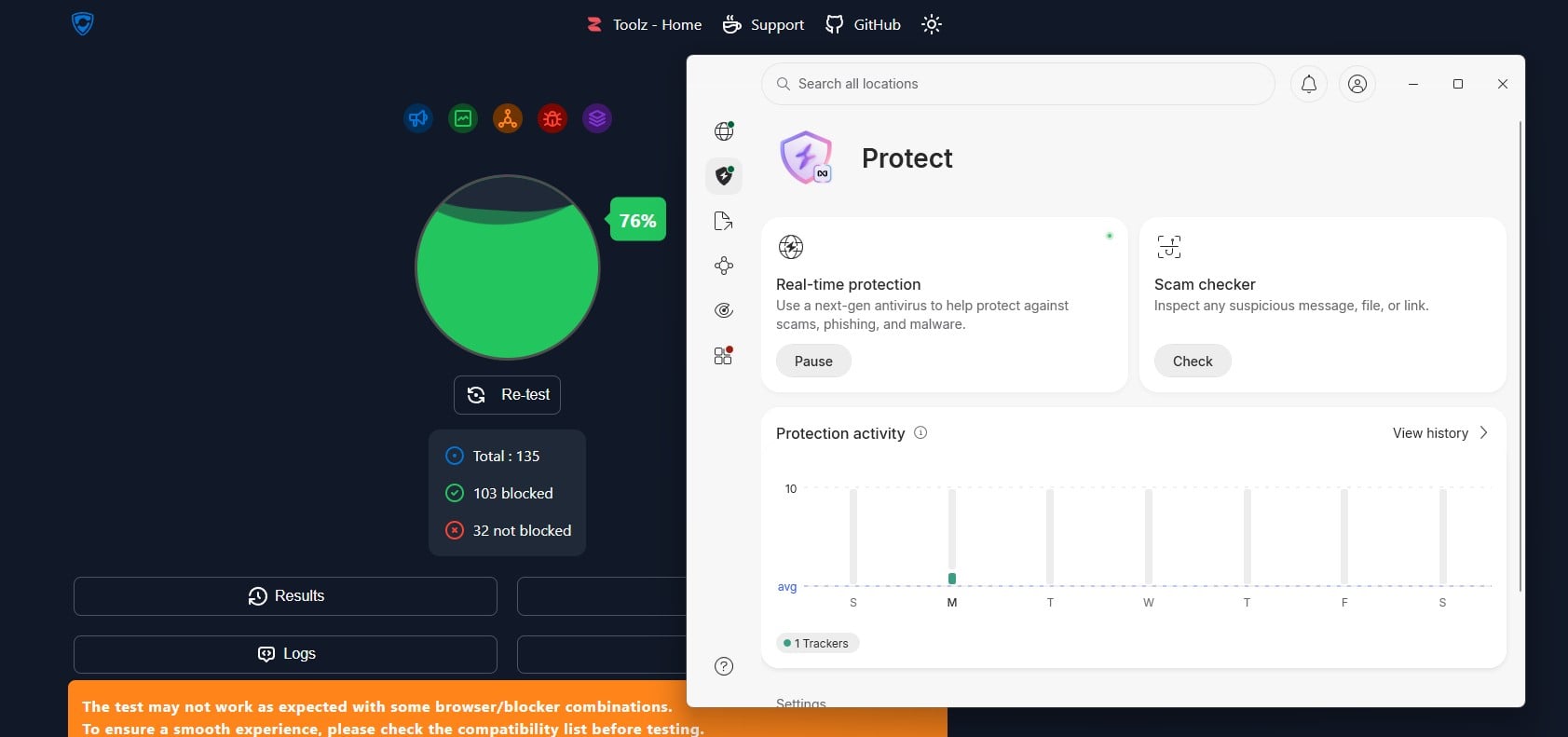
| Ad blocking on d3ward | 76% | 96% |
| RAM-only servers | Yes | Yes |
| Streaming services unblocked | 14 of 14 | 8 of 14 |
| P2P | Every server | Every server |
| Port forwarding | Paid Dedicated Server add-on only | Yes, outside the US |
| Simultaneous devices | 10 | Unlimited |
How I Tested
I did my October tests on one Windows 11 PC, plugged into a wired home connection in Europe. Without a VPN, that connection tested at 190.36 Mbps down, 19.37 Mbps up, and a 10 ms ping. Ping is the delay between your device and the server, so lower is better, especially for gaming and video calls.
I tested UK, US, and Japanese servers three times a day for three days, with NordVPN on NordLynx and PIA on WireGuard. Those are protocols, the methods a VPN uses to connect, and NordLynx is NordVPN’s own version of WireGuard, so the two were evenly matched.
For ad blocking, I used d3ward’s test, which checks 135 ad and tracker domains. I checked for leaks on ipleak.net and browserleaks.com, and for streaming, I tried 14 services, deleting the cache and cookies before each session.
Speed: NordVPN Was Faster on Every Server
| Server | NordVPN (NordLynx) | PIA (WireGuard) |
| UK | 184.73 Mbps | 181.15 Mbps |
| US | 181.50 Mbps | 175.68 Mbps |
| Japan | 160.47 Mbps | 141.61 Mbps |
| Average download | 175.57 Mbps | 166.15 Mbps |
| Download loss | 7.8% | 12.7% |
| Upload loss | 5.5% | 7.5% |
On the UK and US servers, I’d struggle to tell the two apart. Both stayed over 170 Mbps, many times the 15 Mbps Netflix recommends for 4K. The difference showed on the Japanese server, the farthest from my PC: NordVPN lost about 16% of its speed there, and PIA about 26%. Even PIA’s slower Japanese result is fast enough for 4K streaming.
NordVPN’s ping was lower on every server, too. On the UK server, both stayed low, at 41 ms on NordVPN and 48 ms on PIA, so you wouldn’t notice a difference. The US server came in at 134 ms on NordVPN and 150 ms on PIA. Japan was 215 ms on NordVPN and 270 ms on PIA, both too slow for fast-paced online games.
One result impressed me. Even on OpenVPN, an older protocol that’s usually slower, NordVPN averaged 172.31 Mbps, faster than PIA’s WireGuard average. On NordLynx, its average download speed was identical to ExpressVPN‘s on the same connection, down to two decimal places.
On Android and iPhone: NordVPN Lost Less Speed
| Phone test | NordVPN | PIA |
| Galaxy S26 Ultra, download loss (UK and US) | 11.7% | 19.3% |
| iPhone 17 Pro, download loss (UK, US, and Japan) | 13.6% | 24.2% |
| Battery used, Android | 5% | 5% |
| Battery used, iPhone | 4% | 5% |
I repeated the tests on a Galaxy S26 Ultra and an iPhone 17 Pro, over home Wi-Fi that tested at 54.7 Mbps without a VPN. Both VPNs used WireGuard, in its NordLynx form on NordVPN, and the Android results cover the UK and US servers.
NordVPN lost less speed on both phones. PIA’s biggest drop was on the iPhone’s Japanese server, at 34.42 Mbps compared to 42.29 Mbps on NordVPN. On Android, its US server came in at 41.5 Mbps, next to 46.5 Mbps on NordVPN. Both are still comfortable speeds for HD video on a phone, so you’d notice the difference mainly when downloading large files.
Battery use was almost identical during a 20-minute 1440p YouTube video at full brightness, so battery life is no reason to choose one over the other.
Winner: NordVPN
NordVPN was faster on the PC and both phones, with lower ping on every server.
Security: More Tools on NordVPN, a Stronger Blocker on PIA
Neither VPN leaked in my tests. Your IP address, your DNS requests (the lookups your device makes to find websites), and WebRTC data (a browser feature for calls that can reveal your IP address) stayed hidden.
PIA’s Windows app defaults to AES-128 encryption on OpenVPN, which is still secure, and AES-256 is one change away in Settings. NordVPN also adds post-quantum encryption, designed to protect today’s traffic against future quantum computers. PIA doesn’t offer it yet.
Kill Switch: PIA’s Standard Mode Leaked on Restart
A kill switch cuts your internet if the VPN connection drops, so your traffic never leaves your device unprotected. I tested each one three ways: unplugging the Ethernet cable, closing the VPN in Task Manager, and restarting the PC. NordVPN passed every test. With its Internet Kill Switch enabled, the PC stays offline while the VPN is off, including during a restart. It also has an app-level mode that closes the apps you choose, like a torrent client, if the VPN disconnects.
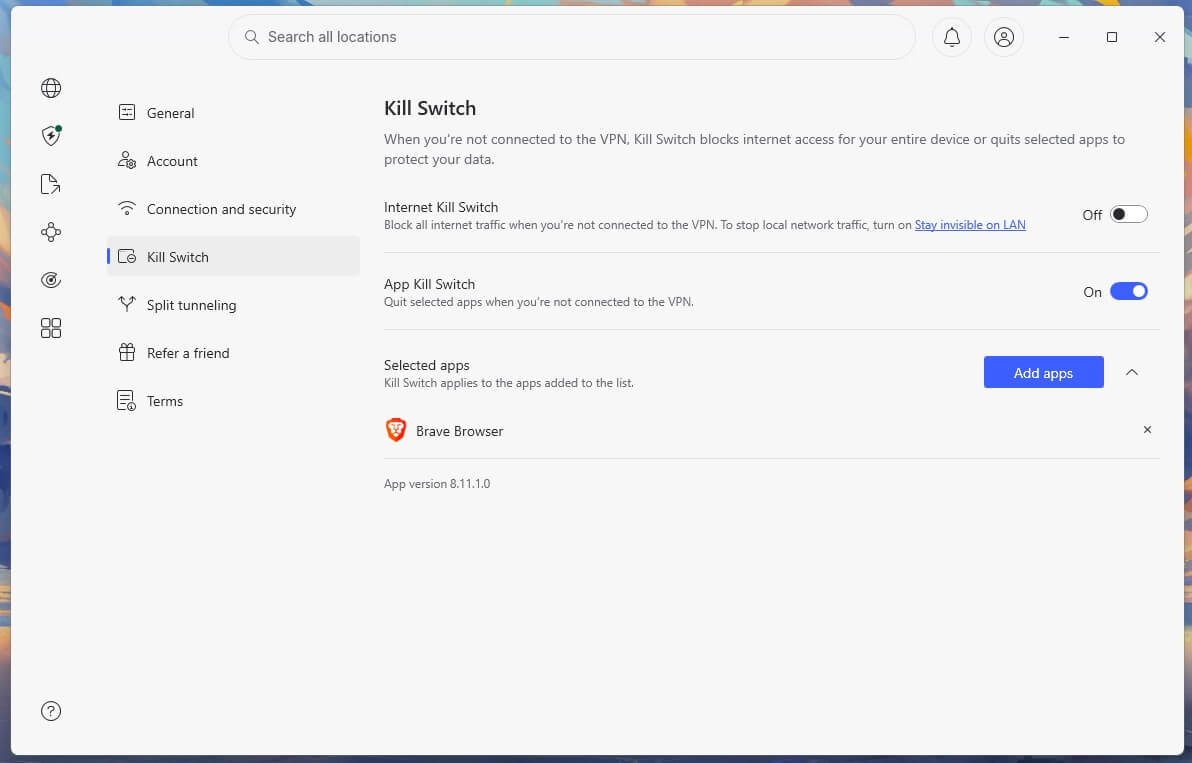
PIA passed the first two tests. With its standard kill switch enabled, unencrypted traffic left the PC while it restarted. In practice, apps that connect at startup, like a cloud drive or a torrent client, could briefly expose your IP address before PIA connects. I didn’t expect that from a VPN that puts privacy at the center of its marketing.
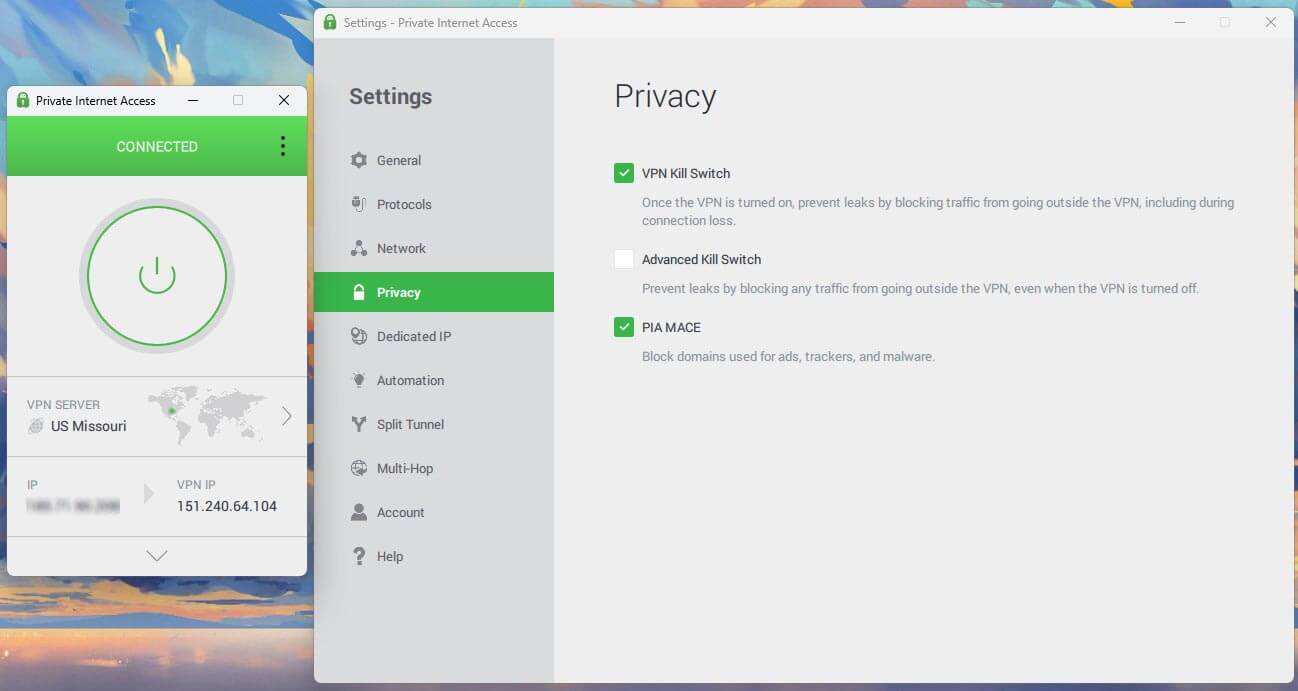
If you use PIA, choose its Advanced Kill Switch in the app’s settings. It blocks all internet access while the VPN is disconnected, and it passed my restart test, keeping the PC offline until PIA connected.
Ad Blocking: PIA’s MACE Blocked More
| Feature | NordVPN next-gen antivirus | PIA MACE |
| Domains blocked on d3ward | 76% | 96% |
| Scans downloaded files | Yes | No |
| Works with the VPN off | Yes | No |
| Plans that include it | Complete and Prime | All plans |
MACE, PIA’s built-in blocker for ads, trackers, and malicious websites, stopped many more domains in d3ward’s test. On an ad-heavy news site, that means fewer ads and pop-ups with PIA. NordVPN’s 76% block rate disappointed me a little. The feature is called next-gen antivirus, and it isn’t even on the Basic plan, so you pay extra for it through the Complete or Prime plan.
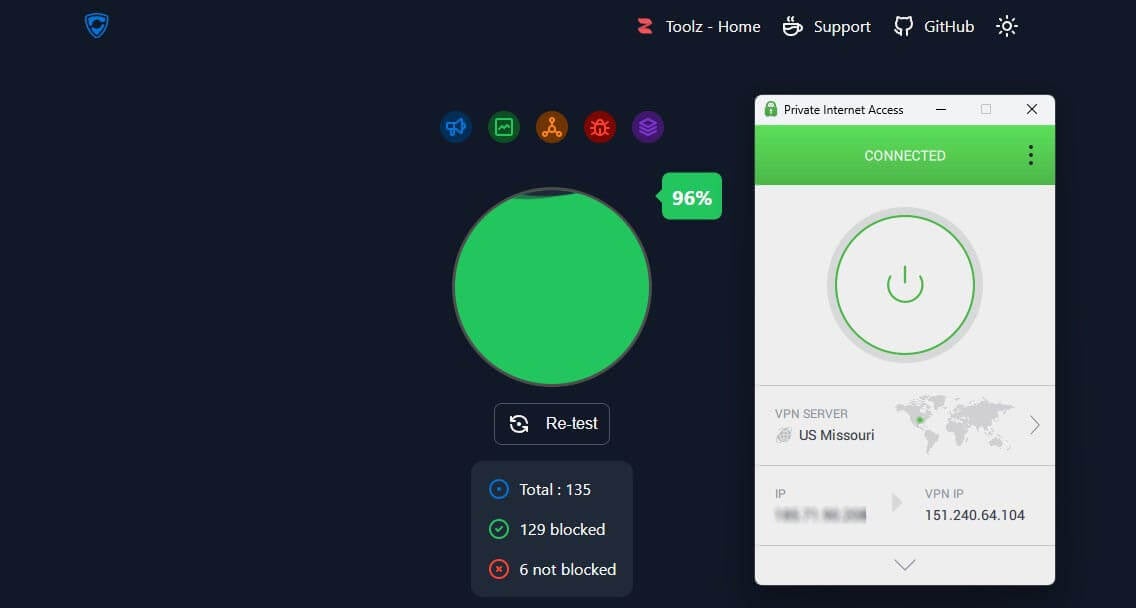
If you choose NordVPN mainly for streaming, a free ad blocker in your browser makes up the difference. To be fair, next-gen antivirus has two extras that MACE lacks. It scans your downloads for malware, and it keeps protecting you when NordVPN is disconnected. PIA sells its antivirus separately for Windows, at under $1.50 a month.
Multi-Hop: Double VPN Loses Less Speed
Multi-hop sends your traffic through two servers instead of one, so no single server sees both your IP address and the sites you visit. Double VPN is NordVPN’s version, using two of its own servers. On the UK server, it was only 2.9% slower than a direct connection and added 4 ms of ping. That’s a small cost for going through two servers, and I wouldn’t notice it while browsing or streaming.
PIA’s Multi-Hop was a different story. It pairs a VPN server with a Shadowsocks or SOCKS5 proxy, a simpler relay that forwards your traffic, with proxies in six countries. I connected to PIA’s US Missouri server through the Dutch Shadowsocks proxy. It lost 20.1% of its direct-connection speed and added 122 ms of ping, enough to cause a noticeable delay on video calls.
Features Only NordVPN Offers
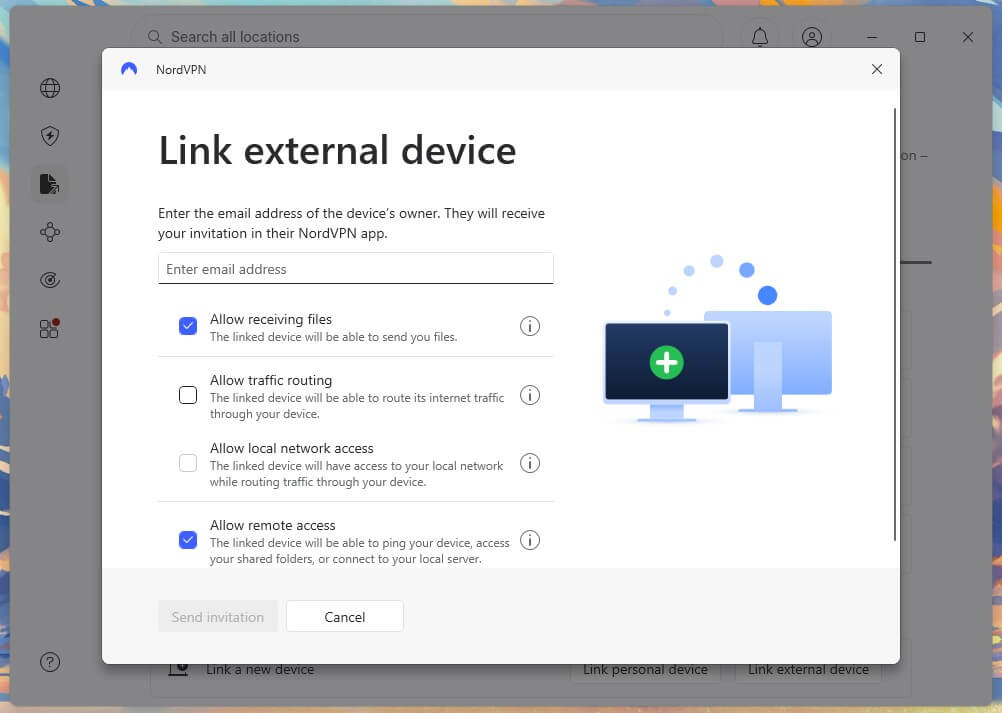
Onion Over VPN sends your traffic into Tor, a network of volunteer servers that adds extra layers of anonymity. The guide to accessing the dark web privately explains when it helps. Meshnet is handier day to day. It links up to 60 of your own devices through encrypted connections, as if they were on the same home network. On a trip, for example, you could browse through your home computer to unblock websites that work only from home, or send files from your phone to your laptop.
Winner: NordVPN
NordVPN’s kill switch passed every test, and it has more ways to protect you. PIA’s MACE is the stronger ad and tracker blocker.
Privacy: Panama Jurisdiction or a US Court Record
Both VPNs have audited no-log policies. They don’t keep records of the sites you visit, your DNS queries, or the IP address you connect from, and independent auditors have checked those claims. Where they’re based is different. NordVPN is registered in Panama, which has no data retention law and isn’t part of the Five, Nine, or Fourteen Eyes, the alliances that share intelligence between countries. PIA is based in the United States, a founding Five Eyes member.
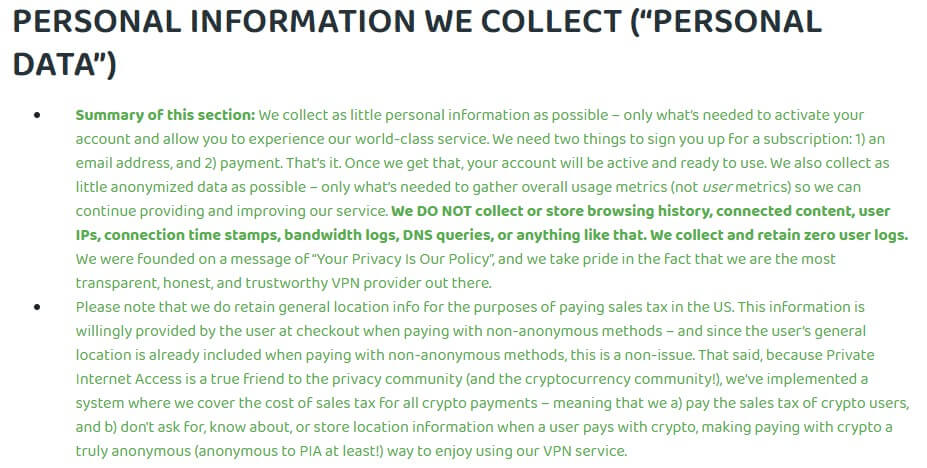
Being in the US sounds like a risk, but PIA has proof few VPNs can show: its policy was tested in court. In 2016 and 2018, US subpoenas requested connection records, and PIA had none to provide. Deloitte audited the policy in 2022, 2024, and 2025, and PIA publishes the source code of its apps, so experts can check what they do. PIA belongs to Kape’s VPN group, with ExpressVPN and CyberGhost, and it commissions its own audits. Its court record shows that strong US-based VPNs do exist.
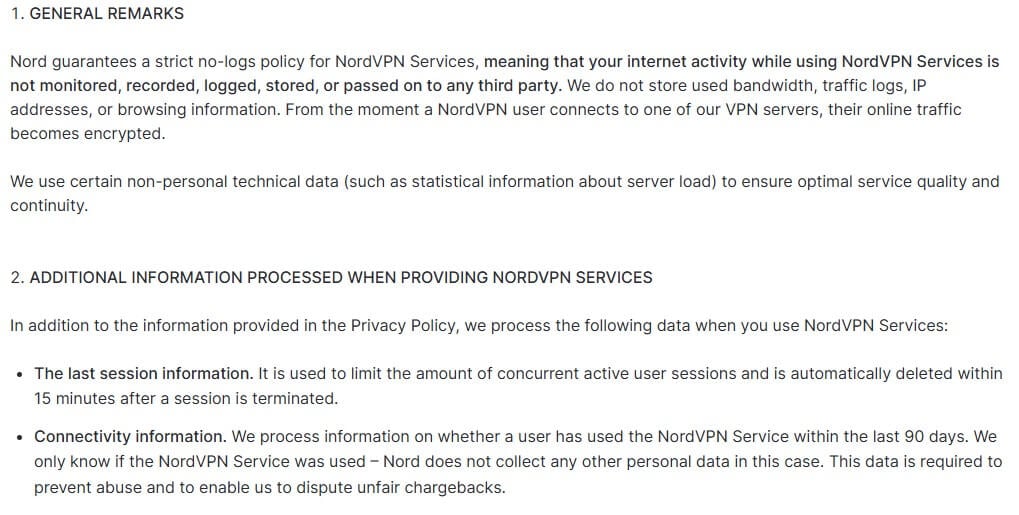
NordVPN relies on its audit record instead, and it’s a long one: six no-log audits since 2018, the first two by PwC and the other four by Deloitte. The latest report, issued in December 2025, also covered its Double VPN, Onion Over VPN, and obfuscated servers. NordVPN keeps the time of your last session for about 15 minutes, only to count your devices toward its ten-device limit. Its transparency report lists a Panamanian warrant, and NordVPN answered it with payment details and confirmation of an email address.
Winner: Tie
NordVPN is based in a more privacy-friendly country and has more audits behind it. PIA has proven its policy in court.
Streaming and Torrenting: NordVPN Unblocked 6 More Services
| Streaming service | NordVPN | PIA |
| Netflix US | Unblocked | Unblocked |
| Netflix Canada | Unblocked | Unblocked |
| Netflix Japan | Unblocked | Blocked |
| BBC iPlayer | Unblocked | Unblocked |
| ITVX | Unblocked | Unblocked |
| Channel 4 | Unblocked | Unblocked |
| Now TV | Unblocked | Unblocked |
| Pluto TV | Unblocked, occasional blocks | Unblocked |
| Peacock | Unblocked | Unblocked |
| Hulu | Unblocked | Blocked |
| HBO Max | Unblocked | Blocked |
| Prime Video | Unblocked, occasional blocks | Blocked |
| JioHotstar | Unblocked | Blocked |
For streaming, NordVPN was the easier VPN to live with. Its app unblocked 13 of the 14 services I tried, including Hulu, HBO Max, and Prime Video, which PIA couldn’t unblock. Pluto TV and Prime Video detected NordVPN now and then, so if a stream won’t start, try a different server in the same country.
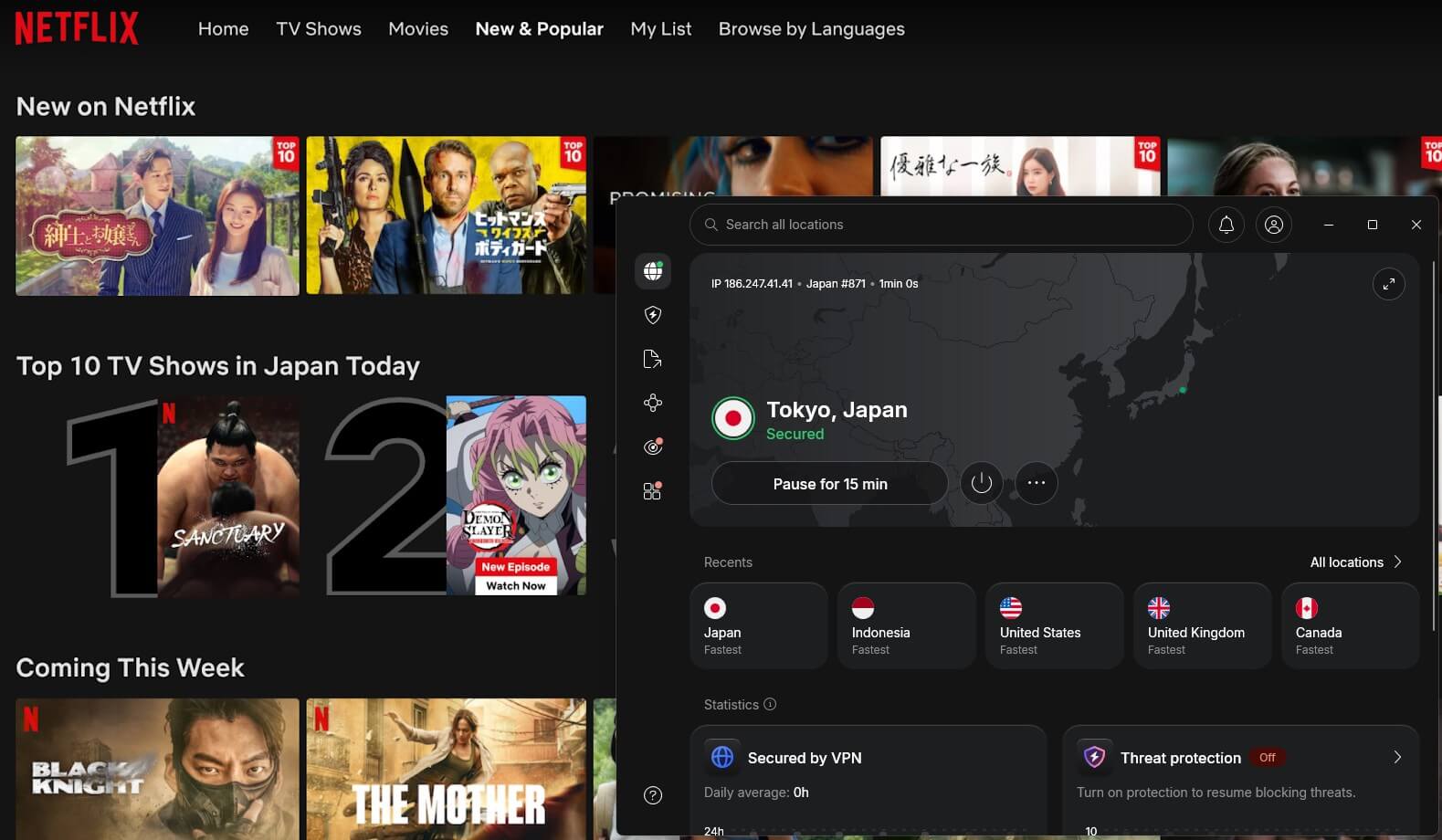
NordVPN’s Chrome extension unblocked the 14th, after that service detected the desktop app. The trick was location spoofing, a setting that makes your browser report the same location as the VPN server. PIA had no working method for that one. The streaming VPN rankings cover each service in more detail.
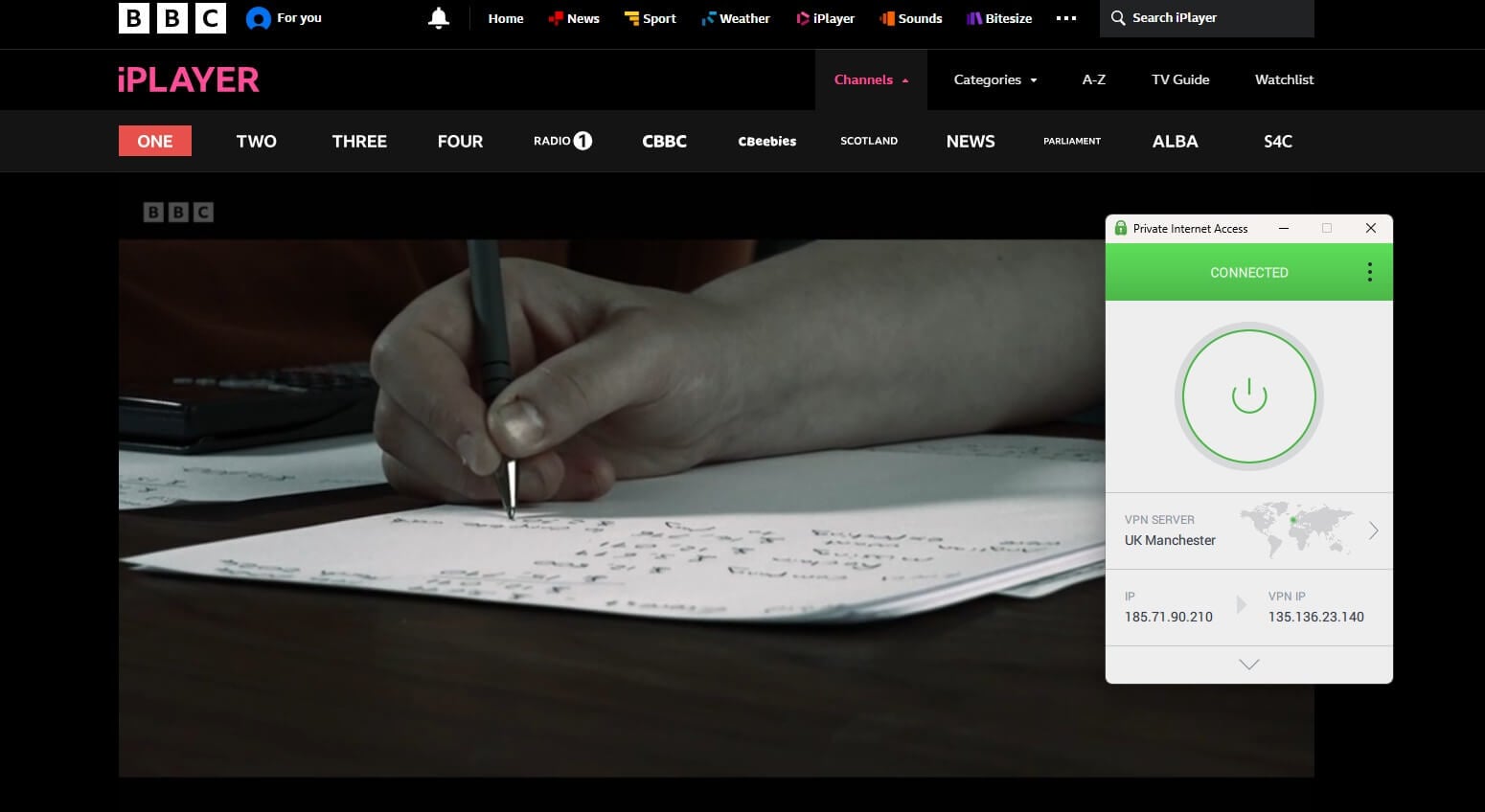
PIA deserves credit for British TV, though. It unblocked BBC iPlayer, ITVX, Channel 4, and Now TV on the first try, every time. If you mostly watch UK channels from abroad, it’s a cheaper way to do it.
Torrenting: PIA Has Port Forwarding
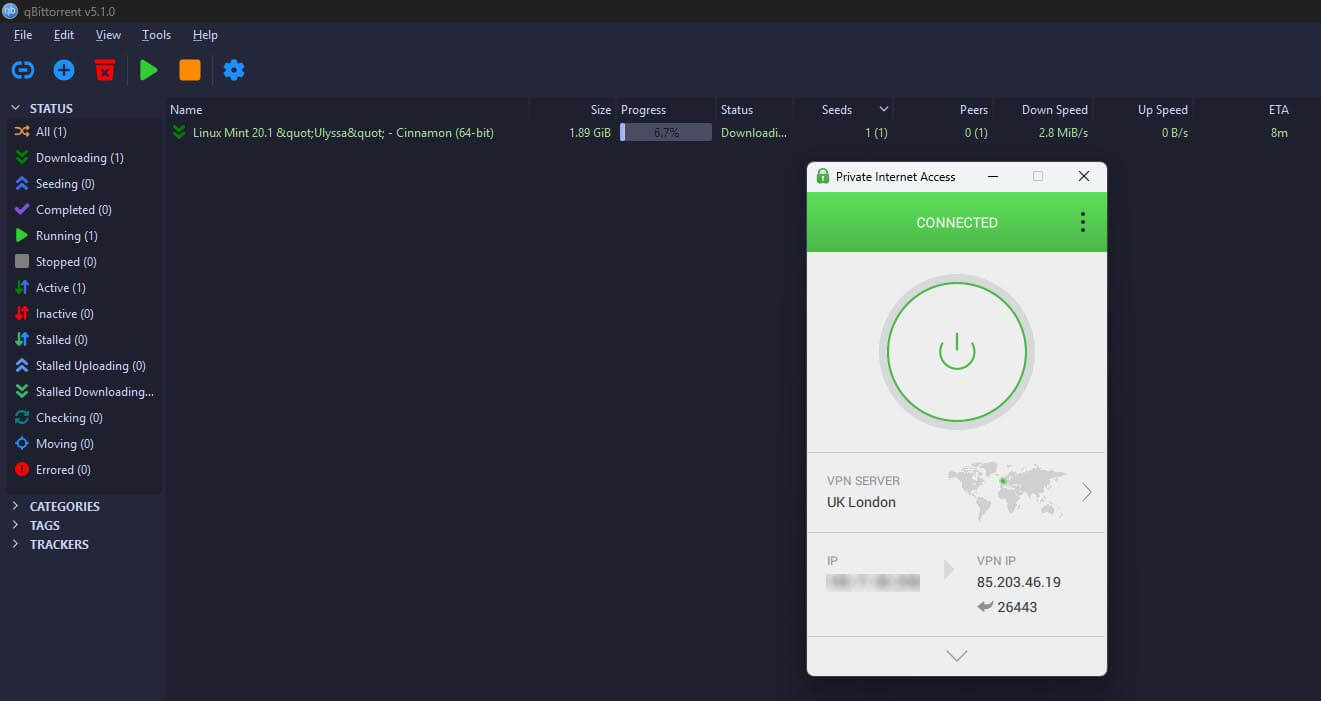
Both VPNs allow torrenting, or P2P traffic, on every server, so you don’t have to look for a special one. NordVPN retired its separate P2P category in 2026. Both also include a SOCKS5 proxy for torrent clients, which hides your IP address from other users but doesn’t encrypt your traffic.
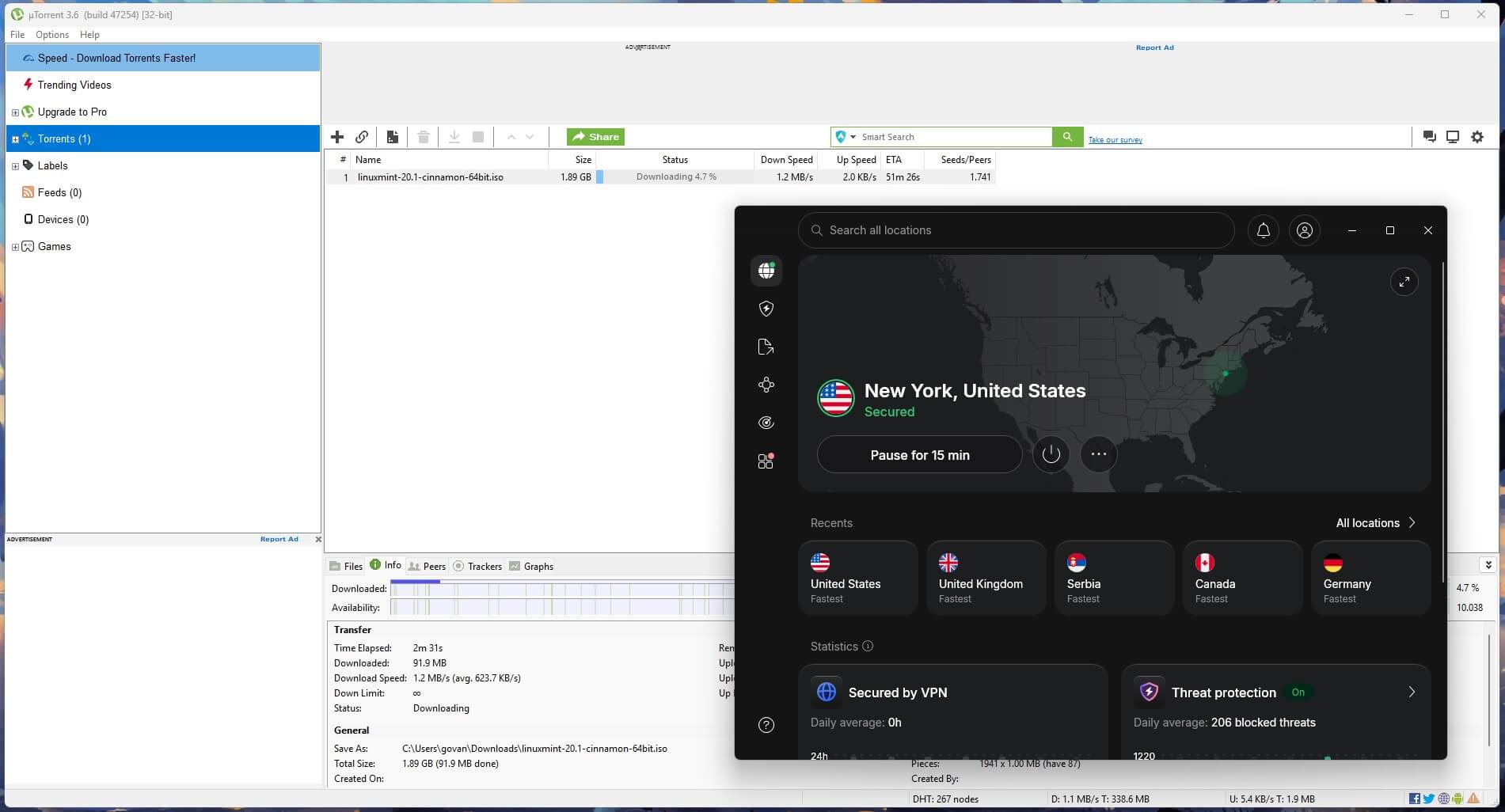
PIA includes port forwarding, and NordVPN offers it only with its paid Dedicated Server add-on. Port forwarding lets other users in a torrent swarm connect to your device directly, so you share files faster. Private trackers, the invite-only torrent sites, reward that with a better upload ratio, as the torrenting VPN guide explains.
Oddly for a US-based VPN, PIA’s app shows the option as unavailable on US servers. It works on Canadian and European ones, so connect to one of those for seeding.
Winner: NordVPN
NordVPN unblocked every streaming service PIA couldn’t. For torrenting on private trackers, PIA is the better choice, with port forwarding at no extra cost.
Restricted Networks: Obfuscation Compared
Some networks block VPNs on purpose, like hotel, school, and office Wi-Fi, or the internet in countries such as China. Obfuscation disguises VPN traffic as ordinary web traffic, so those blocks are less likely to catch it. I tested it for speed only, and I haven’t tested either VPN in China. NordVPN has two methods. Obfuscated servers disguise OpenVPN TCP traffic, and NordWhisper is a protocol built for networks that block VPNs.
NordWhisper cost 12.8% of download speed on the UK server, which is fine for browsing and streaming. Ping was much higher while the connection was busy, though: 180 ms while downloading and 808 ms while uploading, compared to 42 ms at idle. Video calls would lag during a big upload, so I’d use NordWhisper only when a network blocks normal connections and switch back to NordLynx afterward.
PIA has no obfuscation protocol. It relies on the Shadowsocks proxy built into Multi-Hop, which works only on OpenVPN, so switch to OpenVPN first. The China VPN guide covers which VPNs currently work there.
Winner: NordVPN
NordVPN has two built-in ways to hide VPN traffic on networks that block it. PIA has only a proxy, in six countries.
Servers: NordVPN Covers 61 More Countries
| NordVPN | PIA | |
| Countries in the app | 152 | 91 |
| Server count | 9,000+ | Not published |
| US states covered | All 50 | All 50 |
| Dedicated IP locations | 51 in 32 countries | 26 |
NordVPN’s wider coverage helps when you want a less common country’s streaming catalog or a nearby server while traveling. PIA doesn’t publish a server total, but its site describes 10 Gbps, RAM-only servers. RAM-only servers don’t write data to a hard drive, so a restart wipes everything.
Both VPNs cover every US state. That helps with regional sports blackouts on services such as ESPN Plus: connect to a server in a state outside the blackout area. NordVPN labels several of its state locations as virtual, meaning the server is physically in another location but uses an IP address from that state.
Winner: NordVPN
NordVPN covers far more countries and has more dedicated IP locations. Both cover every US state.
Apps, Devices, and Extensions
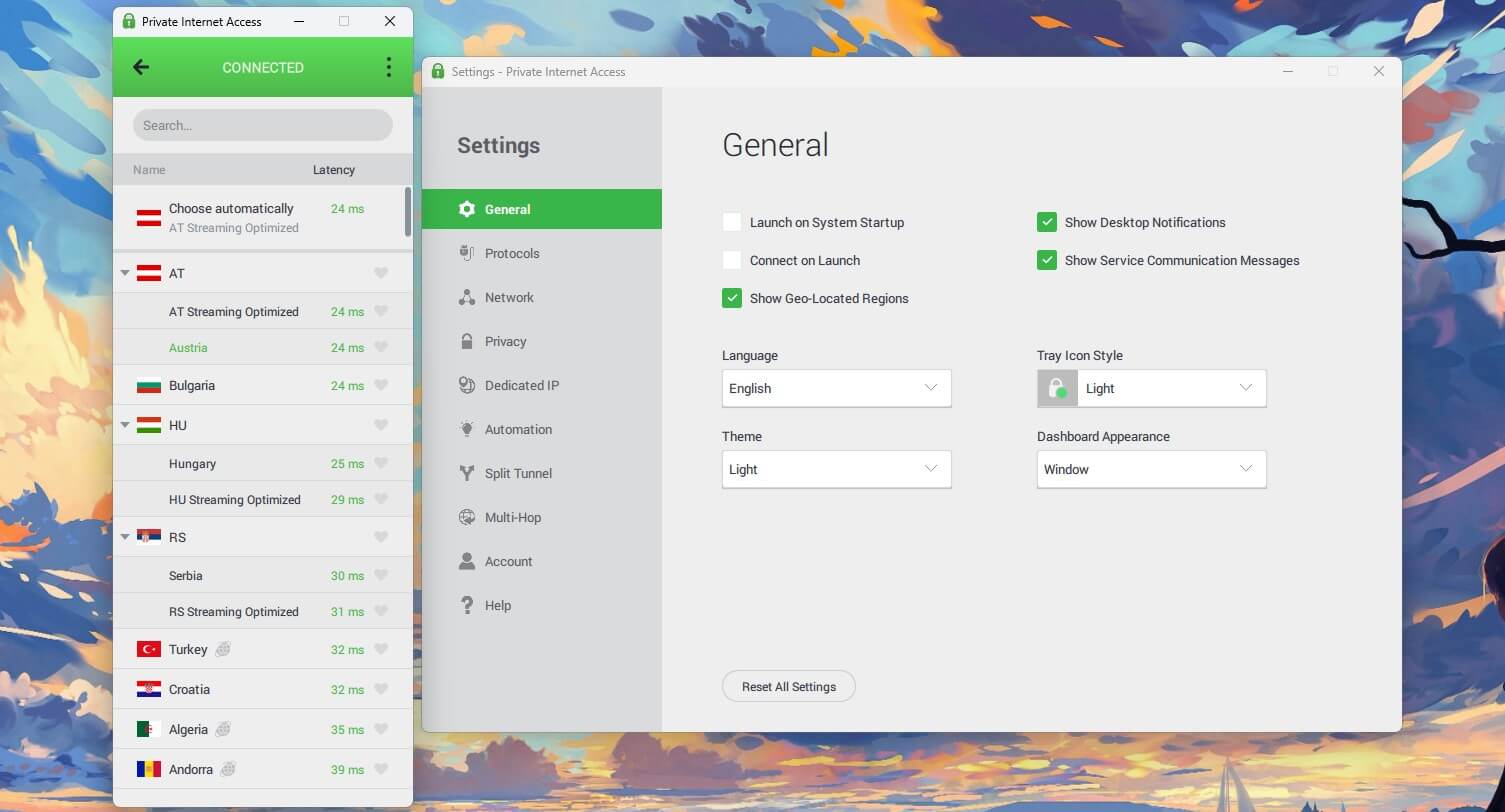
Both VPNs have apps for Windows, macOS, Linux, iOS, Android, Apple TV, Android TV, and Fire TV, and support routers. PIA’s Fire TV app supports Fire OS 6 and newer but not Vega OS, so check your stick’s software first. PIA’s desktop apps were my least favorite. The Windows and macOS layouts look dated, and the settings menus are crowded. PIA still connected in 3 seconds on WireGuard.
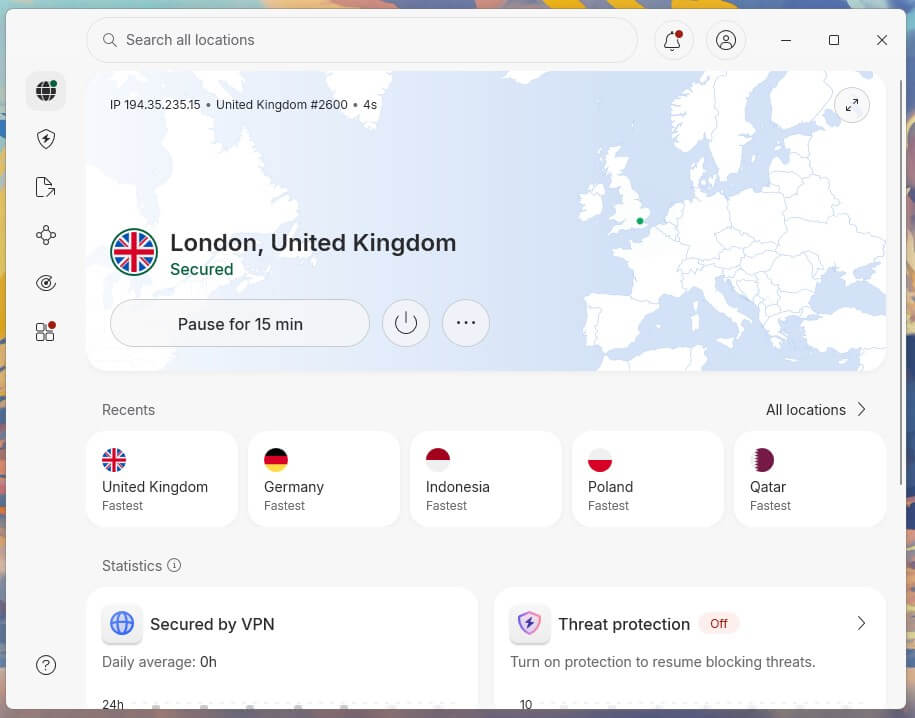
NordVPN’s app is more polished, with a map and server search, and it connected in 2 seconds on NordLynx. On Windows, though, it sometimes wouldn’t connect while another VPN was open in the background, and that annoyed me. It cost me time on several tests, because closing the other VPN didn’t fix it on its own. I had to reset NordVPN’s app, wait a minute or two for it to finish, then sign in and connect again.
That’s only a few minutes, but when it happens a few times a day, it becomes tiresome. It doesn’t happen with every VPN. With PIA open in the background, NordVPN worked normally. On an Apple TV 4K, NordVPN’s tvOS app unblocked Netflix US, Hulu, BBC iPlayer, and Prime Video, and PIA’s unblocked the same services except Prime Video. Only PIA lets you subscribe with an Apple ID on the TV itself.
PIA allows unlimited devices on one subscription, and NordVPN allows ten. Ten covers most homes, but a big family can go past it. In Chrome, NordVPN’s extension blocked 52% of d3ward’s domains, and PIA’s blocked 8% with MACE enabled. PIA’s extension also requests control over camera, microphone, and location access on every site, with no verified publisher badge in the Chrome Web Store. I’d skip it and use MACE in the desktop app instead.
Winner: Tie
NordVPN has the more polished app and the better browser extension. PIA lets you connect as many devices as you like.
Price: PIA Is the Cheaper VPN
| Plan | NordVPN | PIA |
| Longest term | $3.49 a month for 27 months | $2.19 a month for 26 months |
| Renewal | $139.08 a year | $56.94 a year |
| Shorter term | $5.49 a month for 1 year | $7.50 a month for 6 months |
| Monthly | $14.99 | $11.99 |
| Higher tiers | Complete $4.49, Prime $7.49 | None |
| Dedicated IP, 2-year term | $4.19 a month | $2.50 a month |
PIA keeps things simple, with one plan that includes every feature, and it’s one of the lowest-priced VPNs in the cheap VPN rankings. The difference grows at renewal: after the first term, PIA’s yearly price is less than half of NordVPN’s. NordVPN sells three plans. The Basic plan is the VPN alone.
The Complete plan adds next-gen antivirus, the NordPass password manager, and 1 TB of NordLocker cloud storage. The Prime plan adds Coveron identity protection for US subscribers. Double VPN comes with every NordVPN plan. I’d avoid NordVPN’s monthly plan. It increases to about $22 in its second year, and that’s steep for a VPN.
A dedicated IP, an IP address only you use, helps when banks or work networks flag shared VPN IP addresses. On NordVPN, it costs around $6 a month on the annual plan and about $9 on the monthly one. Both VPNs include a 30-day money-back guarantee, so you can try either one first.
Winner: Private Internet Access
Lower prices at signup and renewal, a cheaper dedicated IP, and one plan that includes every feature.
PIA vs NordVPN: Round-by-Round Results
| Round | Winner |
| Speed | NordVPN |
| Security | NordVPN |
| Privacy | Tie |
| Streaming and torrenting | NordVPN |
| Restricted networks | NordVPN |
| Servers | NordVPN |
| Apps, devices, and extensions | Tie |
| Price | Private Internet Access |
NordVPN vs Private Internet Access: Final Verdict
Would you notice what the extra money pays for? If you stream, you would. NordVPN unblocked every service I tried, including Hulu, HBO Max, and Prime Video, and PIA couldn’t unblock any of those three. NordVPN was also faster on distant servers, and it has more privacy tools, like Double VPN. For most people, that makes it my pick, and my NordVPN review has the full test results.
I’d still recommend PIA if you have more than ten devices to connect, seed on private trackers, or want the lowest bill at renewal. Its ad blocker is stronger, too. Skip it if streaming is the main reason you want a VPN. And if you do choose PIA, enable its Advanced Kill Switch on day one. Unlike the standard setting, it kept my PC offline through a restart.
Frequently Asked Questions
Which is better, PIA or NordVPN?
NordVPN is the better VPN for most people, with faster NordLynx connections, broader streaming access, and Double VPN. PIA fits tighter budgets and large households, with unlimited devices and a lower renewal price.
Is PIA faster than NordVPN?
No. NordVPN is faster, because NordLynx keeps more of a connection's speed than PIA's WireGuard setup, especially on long-distance servers such as those in Japan.
Does PIA's kill switch prevent leaks?
Yes, with the right setting. PIA's standard kill switch can let traffic out while a computer restarts, and the Advanced Kill Switch blocks all traffic until the VPN reconnects.
Does NordVPN offer port forwarding?
No, not on its standard servers. Port forwarding on NordVPN requires buying a Dedicated Server add-on, while PIA's regular plan covers it on servers outside the United States.
Can PIA unblock Hulu?
No, not on a computer. PIA’s desktop app doesn’t unblock Hulu, Prime Video, or HBO Max, though its Apple TV app unblocks Hulu. BBC iPlayer, ITVX, and Netflix US play normally.
Is PIA cheaper than NordVPN?
Yes. PIA costs less than NordVPN on every plan length, at signup and at renewal, and includes every feature in one plan.