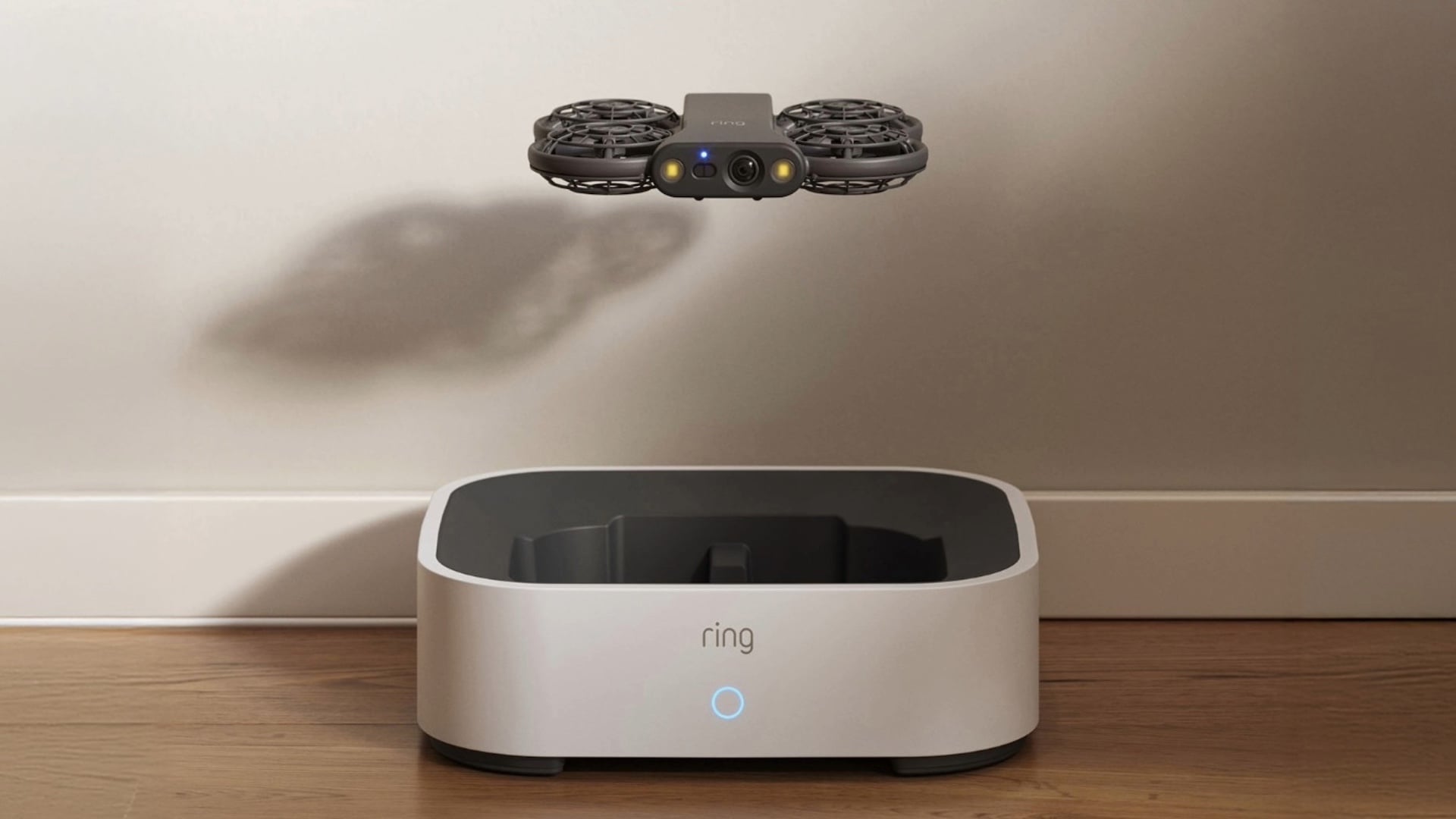
Amazon’s Ring is best known for its doorbell and home security cameras, but now the company is rolling out cameras that can move around on their own.
Ring announced Tuesday a new product category called Ring Robotics, starting with two devices, the Ring Drone Cam and Ring Rover Cam.
“For years, customers told us they wanted eyes in the places a fixed camera couldn’t reach, and peace of mind in the spots they’d never want one,” said Ring Founder Jamie Siminoff in a press release. “The honest answer wasn’t more cameras; it meant reimagining what a security device could be.”
Both devices are powered by Ring’s custom-built AI Pilot system, which allows them to map indoor spaces, suggest patrol points, and navigate around obstacles on their own.
The Ring Drone Cam is designed to fly inside homes, giving users a way to check on rooms and other areas without installing cameras everywhere.
Users can schedule flights along predetermined routes or send the drone to investigate something on demand. It also works with other Ring cameras, sensors, and alarms, allowing it to automatically respond when a connected device is triggered.
The drone records in 2K video and can rotate 360 degrees to capture different angles of a room.
Ring first announced an indoor security drone back in 2020, but the device went through multiple redesigns as engineers struggled to fit all the necessary cameras, sensors, batteries, and propellers into a device that could actually fly, Siminoff told Bloomberg.
And even now, the drone can only fly for about five to eight minutes before needing to return to its dock to recharge, Bloomberg reports.
The Ring Drone Cam is expected to begin shipping on Jan. 27 for $249.99, although it’s still awaiting approval from the Federal Communications Commission (FCC).
Meanwhile, the Ring Rover Cam is designed to patrol businesses.
The wheeled robot can perform scheduled patrols or be sent to specific rooms to investigate disturbances. It can also automatically respond when another Ring device detects something suspicious.
The Rover Cam has a periscope camera that can see over counters and shelves, records up to 4K video, and comes equipped with a siren and flashing lights to deter intruders.
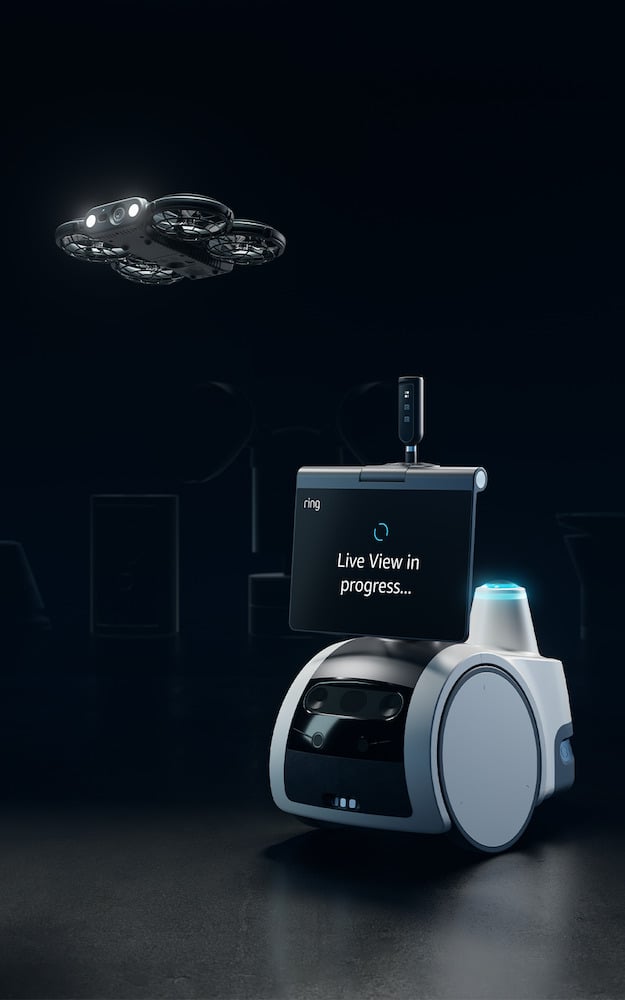
It’s essentially a security-focused successor to Amazon’s failed Astro robot, which the company first introduced in 2021.
Now Amazon is giving the concept another shot with the Rover Cam, which is expected to begin shipping on Dec. 16 for $999.99.
Still, the idea of AI-powered cameras flying around homes and roaming businesses raises some obvious privacy and security concerns.
Ring tried to address some of those concerns in its press release. The company says the drone powers down when docked, with its camera turned off until a flight begins. The Rover Cam has a sleep mode that retracts its camera and turns off its microphone. Both devices also have LED indicators to let people know when they’re recording.
But maybe more importantly, both devices will use Ring’s newish encryption system, called Throw Away the Key Encryption or TAKE.
Under TAKE, Ring videos are protected with unique encryption keys that regularly rotate. A copy of those keys is temporarily held inside a “secure enclave within the cloud,” which Ring says it can only access under limited conditions to execute and process features like Video Search, Video Descriptions, and Smart Alerts. Ring then permanently deletes its copy of the keys after 24 hours. After that, the keys needed to access the recordings are stored on a customer’s authorized devices.
Additionaly, this system may limit how much information Ring can share with law enforcment. Ring says on its privacy page that for customers who enable TAKE or end-to-end encryption, the company can only provide “non-video information, such as basic subscriber information,” in response to valid law enforcement requests such as warrants, subpoenas and court orders.
These privacy concerns aren’t new. Earlier this year, Ring canceled a planned partnership with the controversial surveillance company Flock Safety that would have allowed police to request footage from Ring users during active investigations. The planned intiative was part of Ring’s Community Requests program, which lets users voluntarily share videos with law enforcement through third-party platforms.
Ring stepped away from the partnership days after intense public backlash to a Super Bowl ad promoting its AI-powered “Search Party” feature, which uses Ring cameras to help find lost pets. Critics, including Sen. Ed Markey, voiced concerns that the tech could eventually be used to surveil and identify humans.