Every peer in a torrent swarm can see your IP address, because BitTorrent connects you directly to other people instead of a server. As a result, copyright enforcement companies can join swarms and collect those IP addresses. A P2P VPN puts a server’s IP address in the swarm instead of yours. We’ve tested 40+ VPNs for torrenting, timing the same download and forcing disconnects to check each kill switch.
However, only five made the cut. NordVPN is the best VPN for torrenting. On its nearest server, a 1.89 GiB download averaged 17.1 MiB/s in qBittorrent, against 17.2 MiB/s with no VPN. The catch is port forwarding, though, which only Proton VPN and PIA offer.
Best P2P VPN for Torrenting: Top 5 for October 2026
- NordVPN: Best P2P VPN overall
- Proton VPN: Best for port forwarding on P2P servers
- ExpressVPN: Simplest to set up
- Private Internet Access: Cheapest VPN with port forwarding
- Surfshark: Best for unlimited devices
Best P2P VPN Compared and Tested
Dedicated P2P servers and P2P support are different things. All five VPNs allow torrenting on every server, but only Proton VPN still marks servers specifically for P2P. NordVPN, for example, retired its marked servers once the whole network began handling the traffic.
| NordVPN | Proton VPN | ExpressVPN | PIA VPN | Surfshark | |
| Average speed loss | 7.8% | 10.2% | 7.8% | 12.7% | 9.6% |
| qBittorrent download, nearest server | 17.1 MiB/s | 16.8 MiB/s | 17.1 MiB/s | 16.5 MiB/s | 17.0 MiB/s |
| Port forwarding | No | Yes | No | Yes, except US servers | No |
| P2P servers | All servers | Labeled P2P servers | All servers | All servers | All servers |
| SOCKS5 proxy | Yes | No | No | Yes | No |
| Jurisdiction | Panama | Switzerland | British Virgin Islands | United States | Netherlands |
| Devices | 10 | 10 | 10 on Basic | Unlimited | Unlimited |
| Price | $3.49/mo | $2.99/mo | $2.99/mo | $2.19/mo | $2.49/mo |
1. NordVPN: Best P2P VPN Overall
Pros
- Near-zero loss on nearby servers
- SOCKS5 for torrent clients
- P2P across the network
- Download malware scanning
- App kill switch for qBittorrent
Cons
- Port forwarding unavailable
- Steeper second term
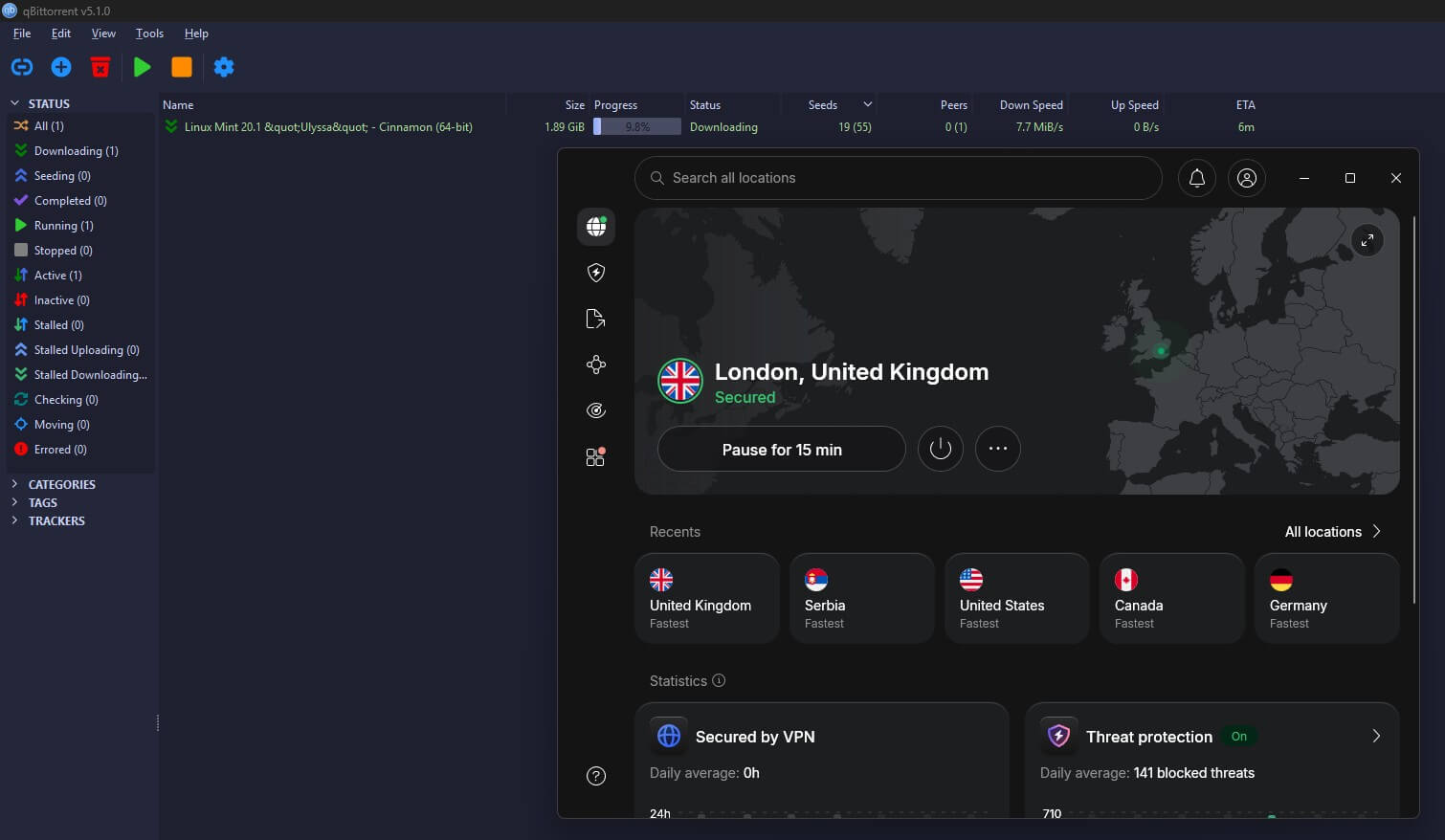
NordVPN tied with ExpressVPN for the lowest average speed loss in our tests, at 7.8%, and its US server measured 181.50 Mbps, the fastest US result we recorded. In qBittorrent, a 1.89 GiB Linux Mint ISO averaged 17.1 MiB/s on the nearest server and finished in about two minutes. Without a VPN, the same file averaged 17.2 MiB/s, so the difference was negligible. P2P is allowed network-wide.
SOCKS5 is the feature torrenters ask about most, since pointing a client at it changes your IP address without the encryption overhead. It’s faster, though your ISP can read the traffic. NordVPN’s next-gen antivirus scans downloads for malware, which helps when files arrive from strangers. Both kill switches are off on a fresh install, so turn them on first. With qBittorrent on the App Kill Switch list, the client closed the moment the VPN dropped.
An ipleak.net torrent check also showed only NordVPN’s IP address. Six independent audits back the no-log policy, and our NordVPN review covers the rest. The Basic plan costs under $3.50 a month on a two-year term.
2. Proton VPN: Port Forwarding and Marked P2P Locations
Pros
- Port forwarding built-in
- P2P-marked locations
- Swiss registration
- Speed recovery feature
- Auditable open-source apps
Cons
- Lower download speeds
- Free plan blocks P2P
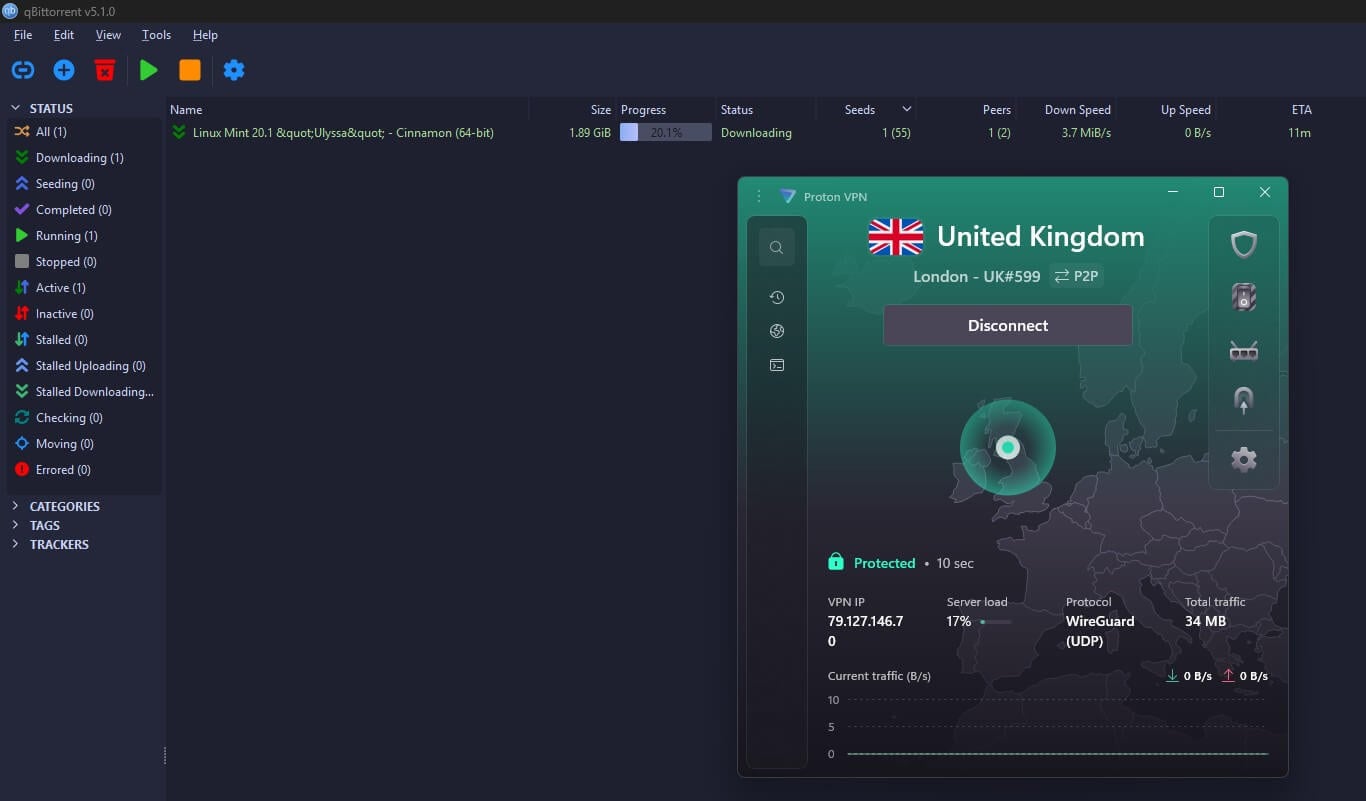
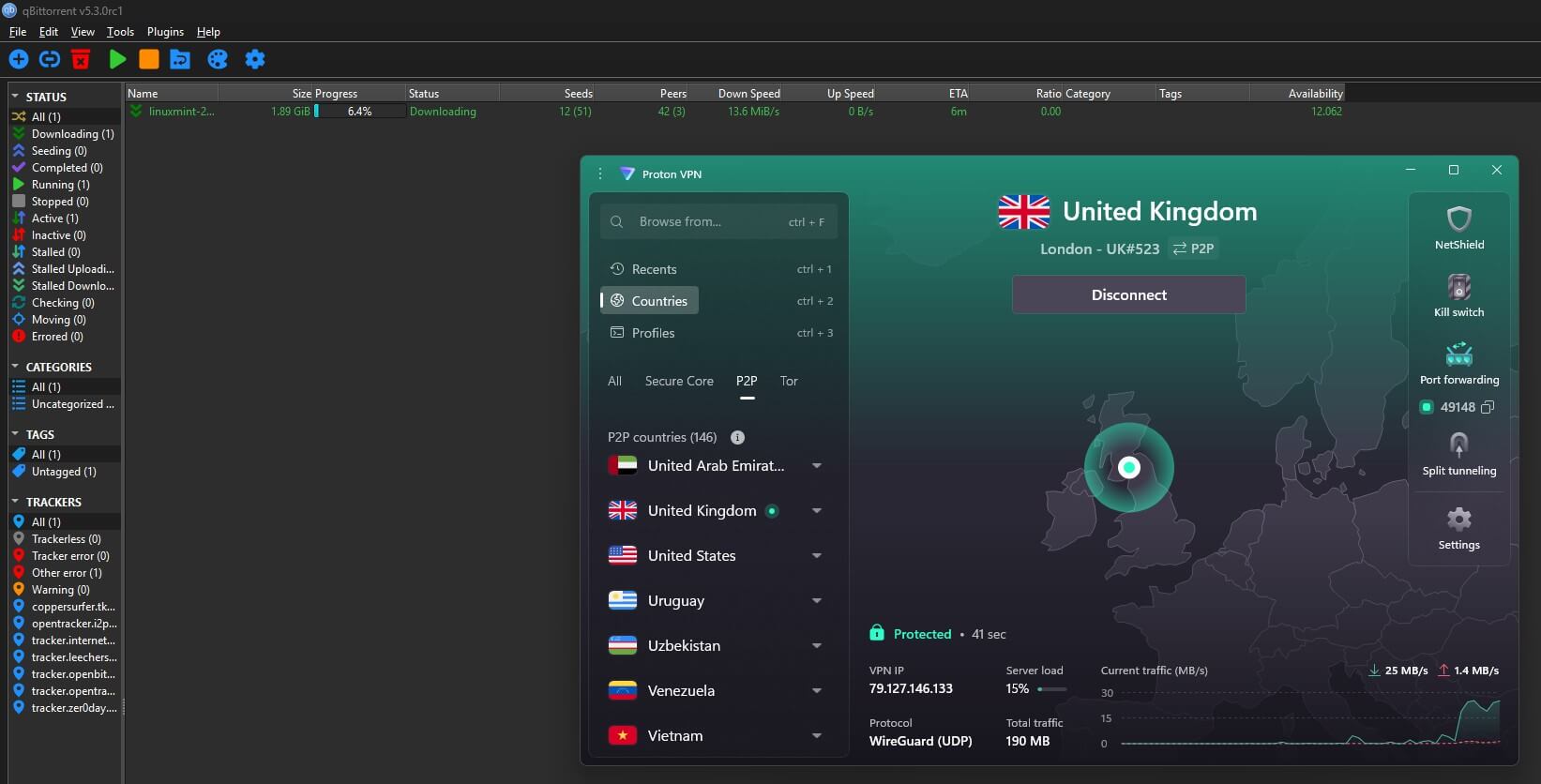
Capability puts Proton VPN second. It lost 10.2% of its download speed, more than NordVPN or ExpressVPN, but it kept the most upload speed, which helps seeding. Our qBittorrent test file averaged 16.8 MiB/s on its nearest server. No other VPN here combines port forwarding with servers marked for P2P. That places it above two faster services, since the difference shows on poorly seeded torrents.
Our port forwarding steps further down cover the setup. Switzerland has no data retention law for VPNs, and the code is published for inspection. Securitum also audits the no-log policy every year. NetShield blocks malicious domains, and VPN Accelerator recovers speed on longer connections.
The free plan blocks P2P, so torrenting requires a paid subscription, at under $3 a month over two years. Our Proton VPN review has the wider picture.
3. ExpressVPN: Simplest to Set Up VPN for Torrenting
Pros
- Fast Japanese server
- Traffic cut on disconnect
- Diskless server fleet
- No bandwidth ceiling
- One-button connection
Cons
- Port forwarding missing
- Few manual controls
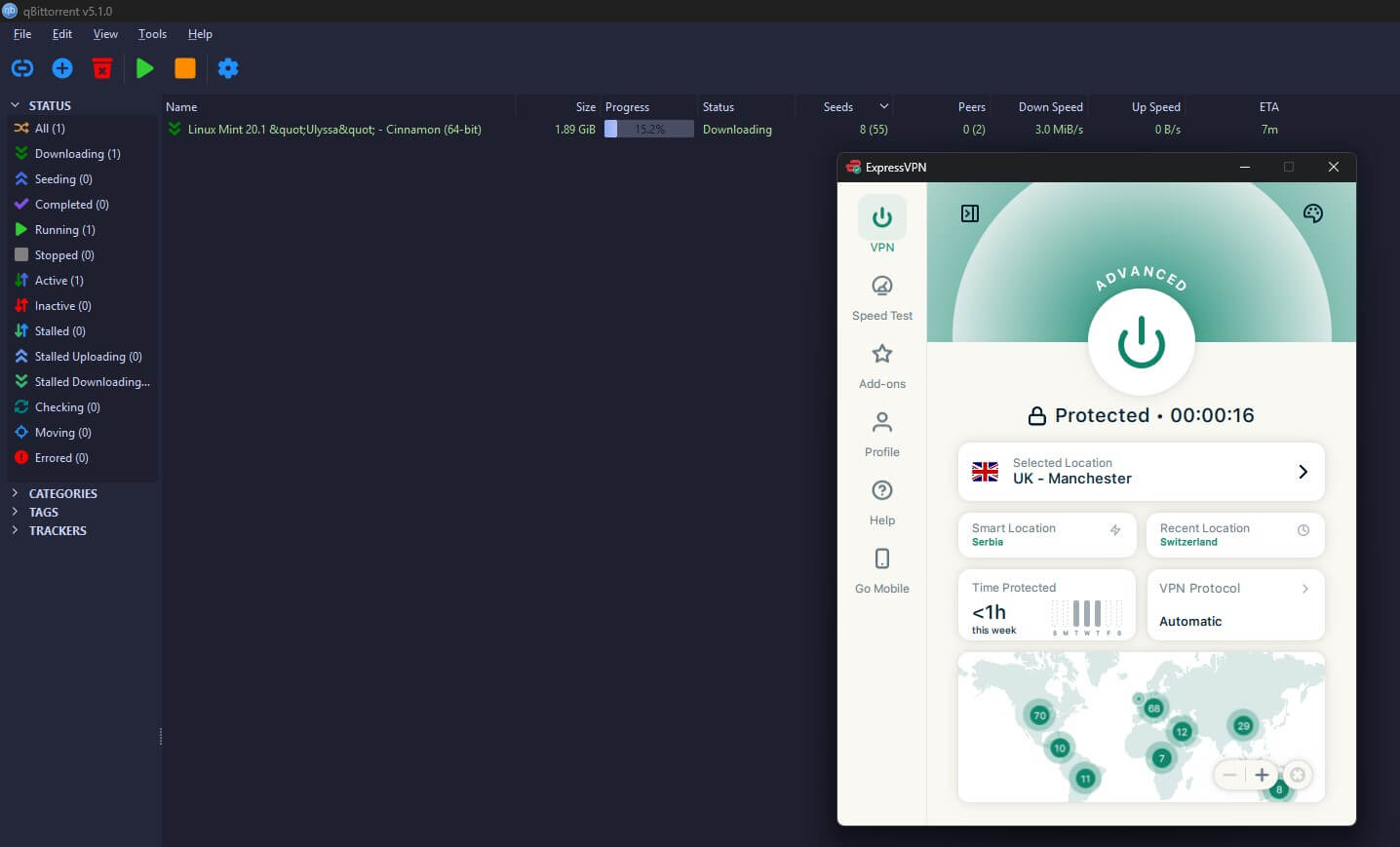
ExpressVPN tied with NordVPN at a 7.8% average speed loss, and it’s also the simplest to use. Open the app, press once, start the client. Every server takes P2P traffic, so there’s nothing to configure and no list to consult. Its Japanese server measured 163.94 Mbps, the fastest Japan result we recorded, on its Lightway protocol.
Windows users also get Lightway Turbo, which uses several parallel connections, though it added nothing measurable on our connection. In qBittorrent, our test file averaged 17.1 MiB/s on the nearest server, the same as NordVPN. Network Lock also stopped every packet the moment we closed the app. The fleet is diskless, and the no-log policy is independently audited. Bandwidth is uncapped too, which a free VPN for torrenting rarely offers.
The Basic plan costs under $3 a month on a 28-month term. Our ExpressVPN and NordVPN comparison covers the speed difference.
4. Private Internet Access: Cheapest Torrenting VPN With Port Forwarding
Pros
- One-click port forwarding
- SOCKS5 support
- No limit on devices
- Traffic obfuscation
- Court-tested logging claim
Cons
- Registered in the US
- No port forwarding on US servers
- Middling streaming record
PIA is the cheapest way to get port forwarding, at about $2.20 a month on the long plans. It’s a single toggle in the app with no paid add-on, though it doesn’t work on American servers. It also pairs with a SOCKS5 proxy for clients that support one. It lost 12.7% of its speed, mostly on the Japanese server, and WireGuard kept it steady across long sessions. Multi-hop through a proxy is available, and Shadowsocks obfuscation makes it usable on networks that block VPN connections.
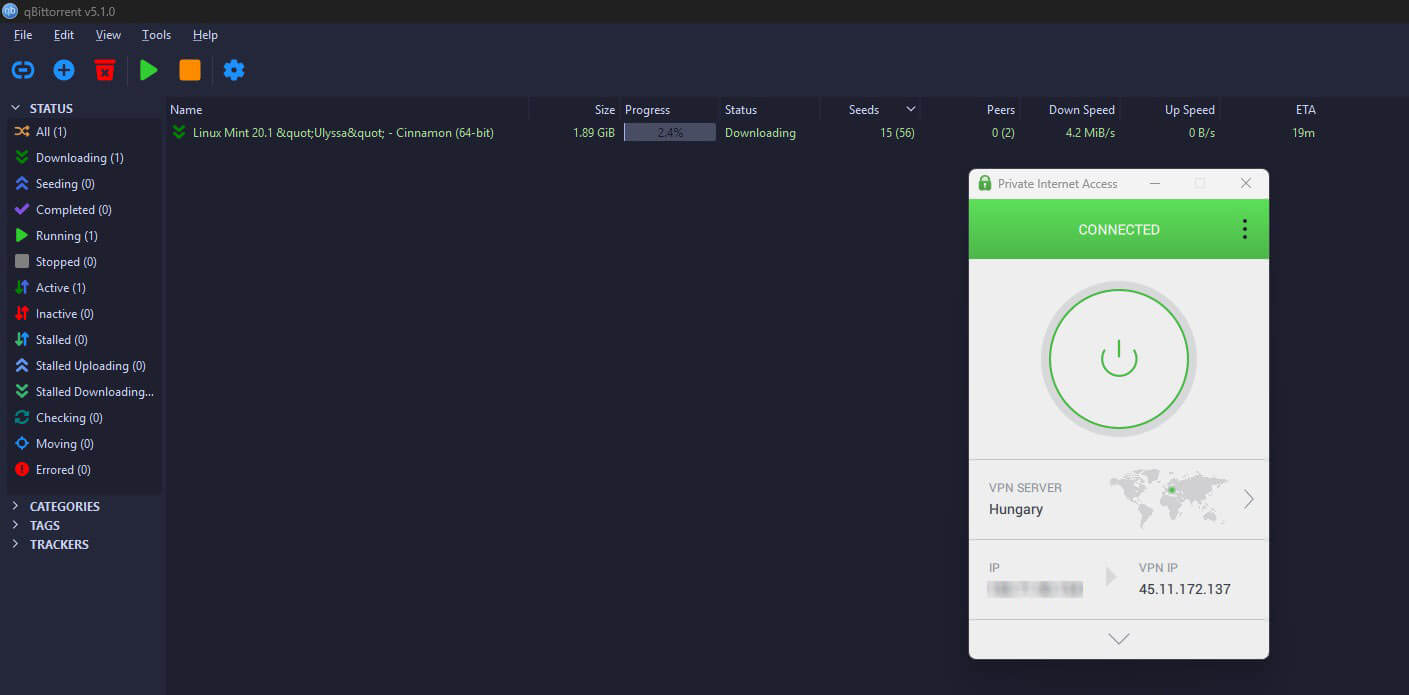
On PIA, the same torrent averaged 16.5 MiB/s, the lowest result in our torrent test but still 96% of our no-VPN speed. US registration is the fair objection. Against it, PIA has a Deloitte-audited no-log policy and US subpoenas that produced nothing because nothing was stored. Meanwhile, in-house DNS keeps requests off third-party resolvers, and the device count is uncapped. A PIA coupon usually brings the price down even more.
5. Surfshark: Unlimited Devices
Pros
- Every device covered
- Malware scanning included
- Custom MultiHop pairs
- IP address rotation
- Dutch registration
Cons
- No port forwarding option
- Distant servers slow down
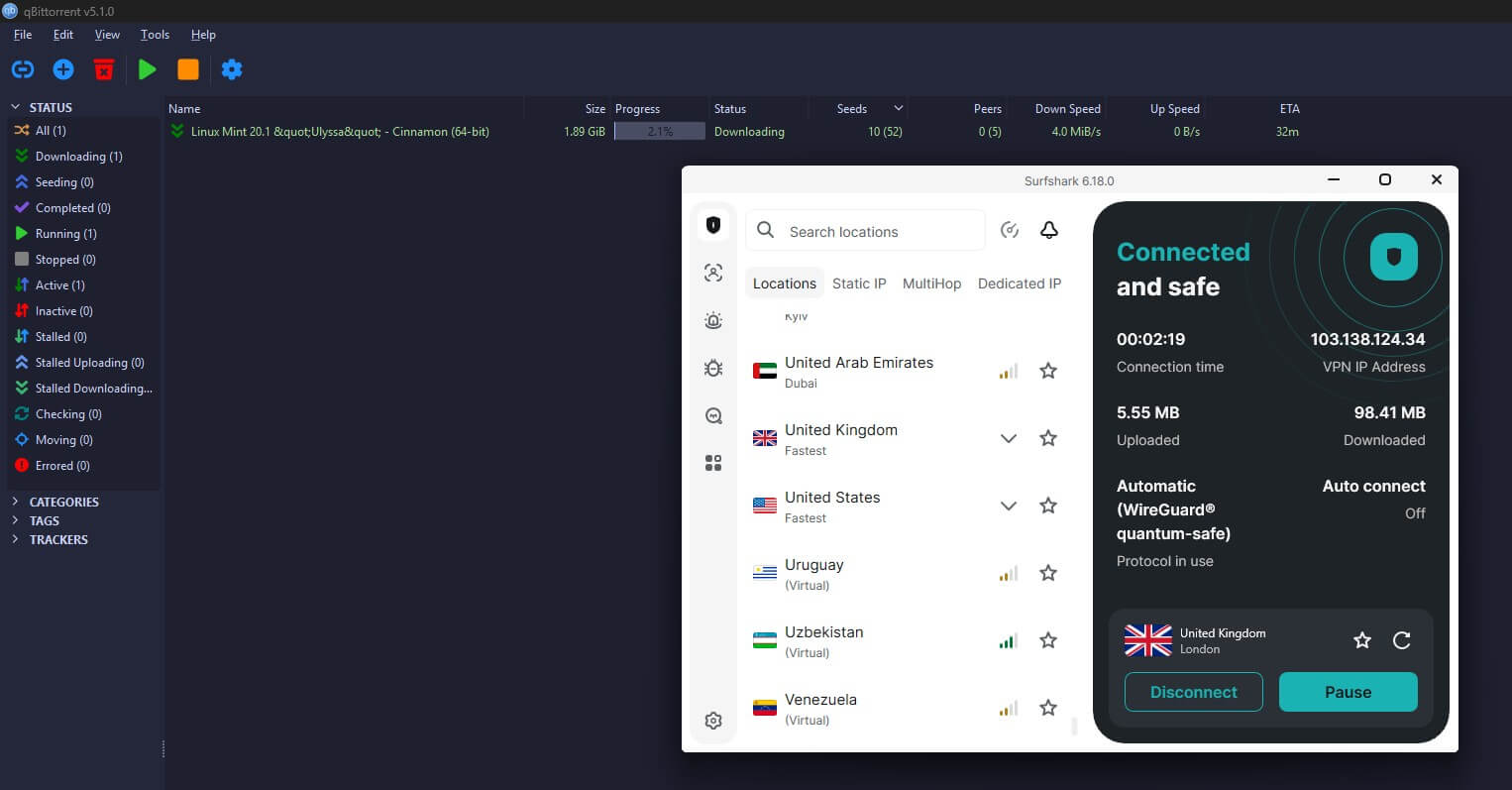
Surfshark’s UK server measured 186.96 Mbps, the fastest nearby result in our tests, and its average speed loss was 9.6%. It loses more on distant servers, so choose a nearby one. A desktop seeding overnight, a laptop, a phone, and a router can share one subscription, since Surfshark has no device limit. Surfshark finished our torrent download at 17.0 MiB/s on its nearest server.
For 30 cents more a month, the One plan also adds antivirus. MultiHop lets you set both servers in a two-server chain, while Rotating IP changes your IP address at intervals without disconnecting. The Starter plan costs about $2.50 a month on a 27-month term, and Deloitte has audited its no-log policy twice.
P2P VPN Speed Test Results
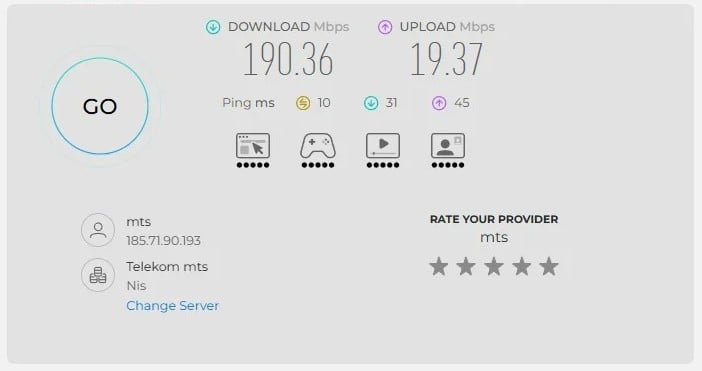
We tested UK, US, and Japanese servers from a wired Windows 11 PC in Europe, three times a day over three days. With no VPN, the connection measured 190.36 Mbps down, 19.37 Mbps up, and a 10 ms ping.
| NordVPN | Proton VPN | ExpressVPN | PIA | Surfshark | |
| UK download | 184.73 Mbps | 178.89 Mbps | 185.74 Mbps | 181.15 Mbps | 186.96 Mbps |
| US download | 181.50 Mbps | 173.68 Mbps | 177.03 Mbps | 175.68 Mbps | 170.38 Mbps |
| Japan download | 160.47 Mbps | 159.99 Mbps | 163.94 Mbps | 141.61 Mbps | 158.84 Mbps |
| Average download loss | 7.8% | 10.2% | 7.8% | 12.7% | 9.6% |
| Average upload loss | 5.5% | 2.7% | 8.9% | 7.4% | 5.9% |
On the UK server, only 8 Mbps separated the five VPNs, so nearby speed won’t decide your downloads. Long distances cost more: PIA lost 25.6% of its speed on the Japanese server. Seeder count still limits a torrent long before the choice of VPN does. For seeding, though, upload counts, and Proton VPN kept the most, losing only 2.7%.
qBittorrent Download Test
We downloaded the same 1.89 GiB Linux Mint ISO in qBittorrent on each VPN’s nearest server, in our own country, and ran ipleak.net’s torrent check during each session.
| VPN | Average speed | Share of no-VPN speed | Finish time | ipleak.net torrent check |
| No VPN | 17.2 MiB/s | 100% | About 2 minutes | n/a |
| NordVPN | 17.1 MiB/s | 99% | About 2 minutes | Only the VPN’s IP address |
| ExpressVPN | 17.1 MiB/s | 99% | About 2 minutes | Only the VPN’s IP addresses |
| Surfshark | 17.0 MiB/s | 99% | About 2 minutes | Only the VPN’s IP address |
| Proton VPN | 16.8 MiB/s | 98% | Just under 2 minutes | Only the VPN’s IP address |
| PIA | 16.5 MiB/s | 96% | Just over 2 minutes | Only the VPN’s IP address |
Every VPN kept at least 96% of our no-VPN speed, so a nearby server doesn’t slow a torrent in practice. The tracker also saw only VPN IP addresses in every session, never our own.
Best VPN Server Location for Torrenting
The short answer is the nearest one, because distance costs speed. To show how distance affects a torrent, we repeated the download on NordVPN’s London, New York, and Tokyo servers. Each figure is the average download speed for the same 1.89 GiB file:
- No VPN: 17.2 MiB/s
- Nearest server: 17.1 MiB/s
- London: 13.4 MiB/s
- New York: 13.2 MiB/s
- Tokyo: 10.2 MiB/s
Every VPN in our speed tests showed the same pattern, losing more speed on the Japanese server than on the UK one. So a user in Berlin should choose Germany or the Netherlands over Singapore, and one in Toronto should choose Canada or the northern US. Connecting through a country with relaxed copyright enforcement doesn’t move you there legally, because local law applies regardless of the server’s location.
The VPN’s registration, on the other hand, decides who can compel it to hand over records. For example, Panama, Switzerland, and the British Virgin Islands leave VPNs free of retention obligations. The US and the Netherlands belong to intelligence-sharing arrangements, so the no-log audit record does more work for PIA and Surfshark.
In short, choose the closest server for speed, and choose the VPN company on its jurisdiction and audit history.
How to Enable Port Forwarding for Torrents
Port forwarding lets peers start a connection with you, instead of leaving you to start every one. On well-seeded torrents, it changes little. On rare ones, it decides whether the transfer moves. Proton VPN and PIA are the two here that support it.
Use Port Forwarding With Proton VPN
- Turn it on in the VPN app. PIA has a port forwarding toggle in Settings, while Proton VPN offers it on P2P locations for paid subscribers.
- Connect to a server that supports it. Proton VPN labels these servers P2P in the app. On PIA, however, choose a server outside the US.
- Note the port number. The app assigns one when the connection comes up. Some VPNs rotate it, so you’d update the client each time.
- Enter it in your torrent client. In qBittorrent, it’s Options, then Connection, then the listening port field. Then replace the random default with the assigned number.
- Bind the client to the VPN adapter. Same menu in qBittorrent. This stops the client from sending traffic if the VPN drops, which is a second layer under the kill switch.
- Test it. Most clients also have a port check built in. If it reports closed, add a firewall rule allowing inbound traffic on that port for the client.
Torrenting Problems and How to Fix Them
- Downloads are slow on every torrent. Check the server first, since a distant one costs far more speed. Then check the protocol: OpenVPN and IKEv2 cost more speed than WireGuard, NordLynx, or Lightway.
- Speeds are still throttled with the VPN on. That’s because some networks slow every connection that looks like a VPN. Obfuscation disguises the tunnel as ordinary HTTPS traffic: NordWhisper on NordVPN, Camouflage Mode on Surfshark, and Shadowsocks on PIA.
- The client won’t connect. Bind it to the VPN network adapter, which forces every request through the tunnel. Every VPN here also publishes a guide for qBittorrent and Deluge.
- Peers won’t connect to you. Without port forwarding, you can only make outgoing connections, which limits you to the peers who enabled it themselves.
If none of that helps across several servers and protocols, the VPN isn’t suited to P2P. Some cheap VPNs limit it without saying so clearly.
Can You Torrent With a Free VPN?
Rarely, and not for long. Most free VPNs block P2P, including Proton VPN’s free plan, even though it has no data cap. PrivadoVPN’s free plan allows torrent clients, but torrents count toward its 10 GB monthly allowance. Once that’s spent, it slows to 1 Mbps, and a single large file can use most of the allowance. For regular torrenting, then, a paid VPN on a long plan costs about $2 to $3.50 a month.
Is Torrenting Legal?
The technology and the use are separate questions. BitTorrent itself is legal. It’s a file transfer protocol, and a lot of legitimate distribution moves over it: Linux and BSD images, game patches, Internet Archive collections, public-domain film and music, and large scientific datasets. Projects use it because it moves the bandwidth cost off their servers. Still, sharing copyrighted material without permission is unlawful across every country signed up to the Berne Convention.
For example, the US works through DMCA notices passed on by internet providers, with occasional lawsuits. Germany, by contrast, relies on law-firm demand letters that produce bills in the hundreds of euros. Japan, meanwhile, made downloading infringing material a criminal matter. Private copying exceptions exist in several countries. They generally cover copies made from a source you obtained lawfully, and the Netherlands closed that door for downloads from unauthorized sources in 2014.
A VPN changes none of this. It hides your IP address from the swarm and stops the ISP from seeing what you transfer. That protects your privacy, but it doesn’t change what’s legal. Our guide to torrenting safely goes further on the practical side.
How We Tested the Best VPN for Torrenting
- Speed: download and upload on UK, US, and Japanese servers, on a 190.36 Mbps connection.
- Torrents: the same 1.89 GiB Linux Mint ISO in qBittorrent on each VPN’s nearest server, compared with a no-VPN run. NordVPN also ran it on London, New York, and Tokyo servers.
- Leaks: an ipleak.net torrent check on every VPN.
- Kill switch: a forced disconnect on each VPN.
- P2P features: P2P on every server, port forwarding, and SOCKS5.
VPNs that throttled P2P or blocked it on most servers didn’t make the list.
Conclusion on the Best VPN for Torrenting
NordVPN is our top VPN for torrenting. It tied for the lowest speed loss in our tests, allows P2P on every server, adds a SOCKS5 proxy, and scans the files you download for malware. Proton VPN comes second because it pairs port forwarding with servers marked for P2P, which helps most on torrents with few seeders.
PIA offers port forwarding for less, though not on US servers. Surfshark covers unlimited devices on one subscription, while ExpressVPN is the simplest to set up and forget.
FAQ About P2P VPNs
What is a P2P VPN?
A P2P VPN allows peer-to-peer traffic, such as BitTorrent, on its servers. Other peers in a swarm see the VPN server's IP address instead of the user's own.
Which VPN is best for torrenting?
NordVPN is the best VPN for torrenting, with P2P on every server and a SOCKS5 proxy. However, Proton VPN is the better choice for port forwarding on P2P-marked servers.
Is torrenting with a VPN legal?
Yes, in most countries. VPNs and BitTorrent are legal, but sharing copyrighted material without permission is unlawful whether a VPN is connected or not.
Is there a free VPN for P2P?
Few are usable. Proton VPN's free plan blocks P2P, and PrivadoVPN's free plan allows it but counts torrents toward a 10 GB monthly allowance, then slows to 1 Mbps.
What's the cheapest VPN for torrenting?
Private Internet Access is the cheapest VPN for torrenting with port forwarding, at about $2.20 a month on its two-year plan. Surfshark costs a little more, at about $2.50, but covers unlimited devices.
Which VPN server location is best for torrenting?
The nearest server, since distance costs speed. In NordVPN tests, a nearby server matched the speed without a VPN, while a Tokyo server cut average download speed by about 40%.
Is port forwarding necessary for torrenting?
Not for well-seeded torrents. Port forwarding lets other peers connect directly, which helps on torrents with few seeders and on private trackers that track upload ratios.