A simple start
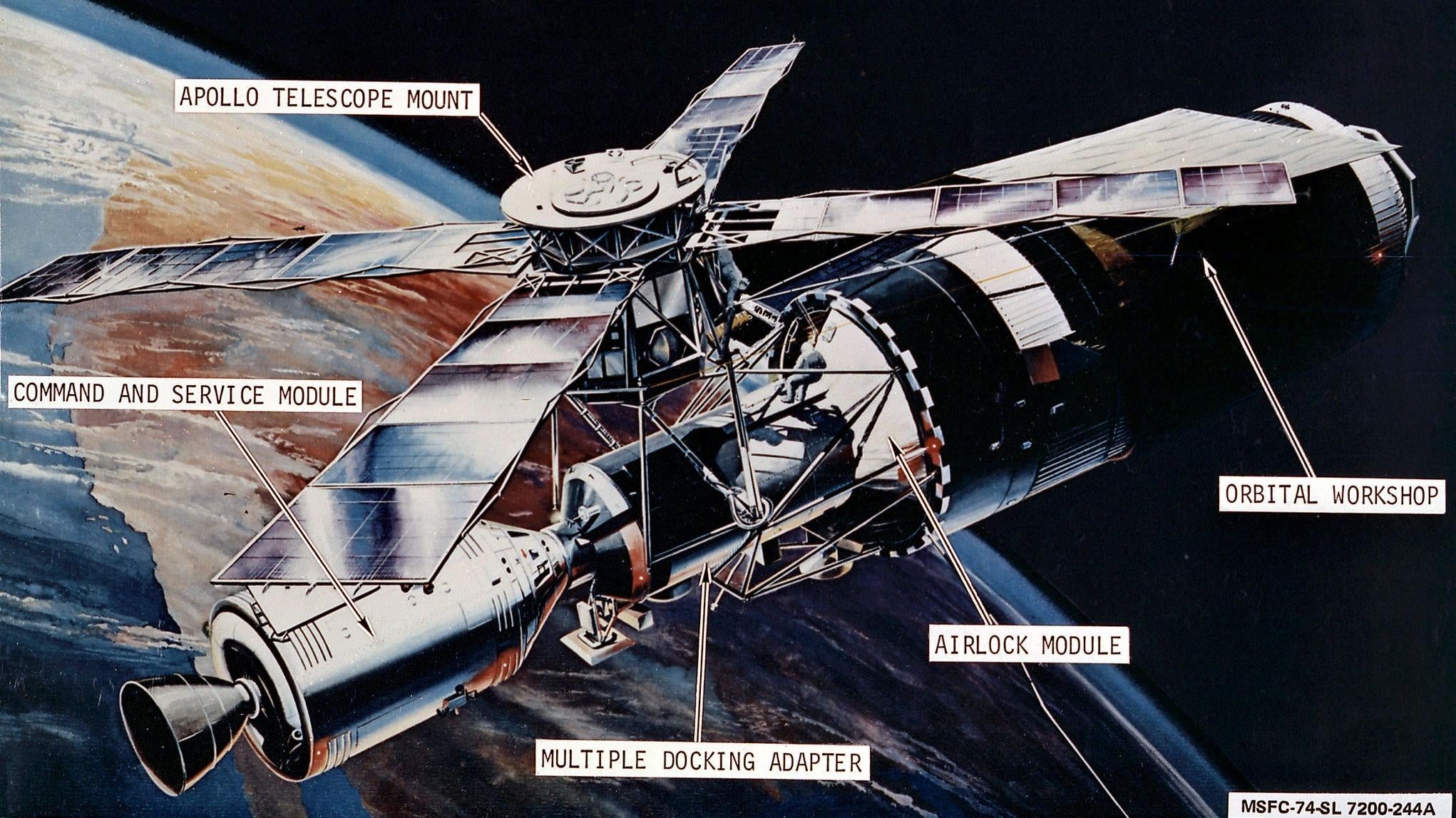
Parked in low Earth orbit and traveling around our planet at 16,000 miles per hour (25,750 kilometers per hour), Skylab allowed for detailed observations of the Earth and Sun, acted as a medical lab, enabled novel microgravity experiments, and served as the first platform for studying the effects of long-duration spaceflight. It consisted of several main elements: the command and service module, multiple docking adapter, airlock module, Apollo telescope mount, and orbital workshop, the latter being a converted Saturn rocket upper stage. A key goal of the Skylab project was to use as much hardware from the Apollo missions as possible.
“The program demanded innovation and ingenuity,” Rocco Petrone, director of NASA’s Marshall Space Flight Center from 1973 to 1974, wrote in a 1977 NASA report. “Experience and knowledge gained from earlier space programs provided a solid foundation on which to build, but the Skylab Program was truly making new pathways in the sky.”