The best eSIM for international travel lets you stay connected even on the go. Years ago, we had to buy physical SIMs to replace our own, which we would inevitably lose. Today, we have access to the best eSIM providers for every international travel need. So, which ones truly work in 2026? Not all are good.
To find out, we retested and compared the best travel eSIM options for you in 2026, separating the wheat from the chaff. In the end, we settled on the five top providers, judged on extensive coverage, generous internet data, affordable prices, and compatibility with all devices. Our overview is right here, and our detailed reviews follow below.
Best eSIM for International Travel: Top 5 Options for Travelers in 2026
Best eSIM for International Travel: The Five Compared
Coverage, extras and pricing, side by side:
| eSIM | Best for | Countries | Hotspot | Calls & SMS | Promo code |
|---|---|---|---|---|---|
| Ubigi | Best overall | 200+ | Unlimited | N/A | GIZMODO (-10% first order) |
| Saily | Security, cruises and travel perks | 200+ | Unlimited | Optional US +1 number | GIZMODO (-15% all plans) |
| Holafly | Uncapped unlimited data | 160+ | Up to 1 GB/day | N/A | N/A |
| Airalo | Global plan and loyalty cashback | 200+ | Unlimited | In some country plans | N/A |
| Jetpac | Frequent flyers and lounge access on delays | 200+ | Unlimited | Voice beta (iOS) | N/A |
Best eSIM for International Travel: Reviews, Pros & Cons
Our top five are set. While we prefer Ubigi for its versatility and low-cost plans, we compared all five on coverage, price, unlimited data, tethering and extras. Here’s what we found in our tests.
1. Ubigi

Pros
- Straightforward setup
- Covers 200+ countries
- Regional and global plans
- Competitive pricing
- Uncapped hotspot on every plan
- 5G support in 65+ regions
Con
- No phone number
Ubigi is the most impressive eSIM provider for international travel and covers more than 200 countries (check out our Ubigi full review here). It’s available on Android and iOS, as long as your model supports eSIM. The setup is straightforward: purchase the plan, download the app, and scan the QR code you receive. Thanks to Smartstart, the plan then activates automatically when you land, so its validity starts on arrival. After that, you keep the same eSIM and top up across all 200+ destinations, with no need to repeat the process. If you run out of data and have no Wi-Fi, Ubigi covers the connection for as long as it takes you to top up, so you’re never stranded.
Ubigi lets you enjoy up to unlimited internet data, with 5G in more than 65 regions. We like it for its reliable connections, especially in 5G areas, where WhatsApp, Viber and Skype calls are buttery-smooth. It also supports data sharing with your other devices or friends, with no cap, which is rarer than you’d think.
Our only complaint is the lack of a phone number, so no calls or SMS. In practice this rarely matters, since VoIP apps run on data, and you get plenty of it with Ubigi.
Ubigi also offers regional plans, so you can buy an eSIM for Europe, the Americas, Africa or Asia and roam an entire continent without buying a separate eSIM for each country.
Then there’s Smart IP: a secure mobile connection with either your home IP or a local one, which keeps your usual content, news, sports and apps available anywhere, without slowing you down.
💸 Plans & Pricing
Our #1 eSIM for travellers is flexible, and that’s what really makes it stand out. No hidden fees, no unexpected costs. You can pay monthly, annually, or take a one-off plan with a set amount of data that tops up easily. So how much does Ubigi cost in 2026?
Sort by price and it starts at $2 for 500 MB of data over two days in Europe. Monthly options begin at $4 for 5 GB. Unlimited plans are far from expensive: $23 for seven days across Europe, or $62 for a full month.
Save 10% off with code GIZMODO! Keep in mind that through Gizmodo, you can also save 10% on your first Ubigi purchase and bring these prices down even further by using the code GIZMODO.
2. Saily
Pros
- The only eSIM that works on cruise ships
- Optional US phone number
- Airport lounge access in the app
- Security extras (virtual location, ad blocker)
- 24/7 customer support
Cons
- Unlimited data throttled to 1 Mbps after 5 GB/day
- No local numbers outside the US
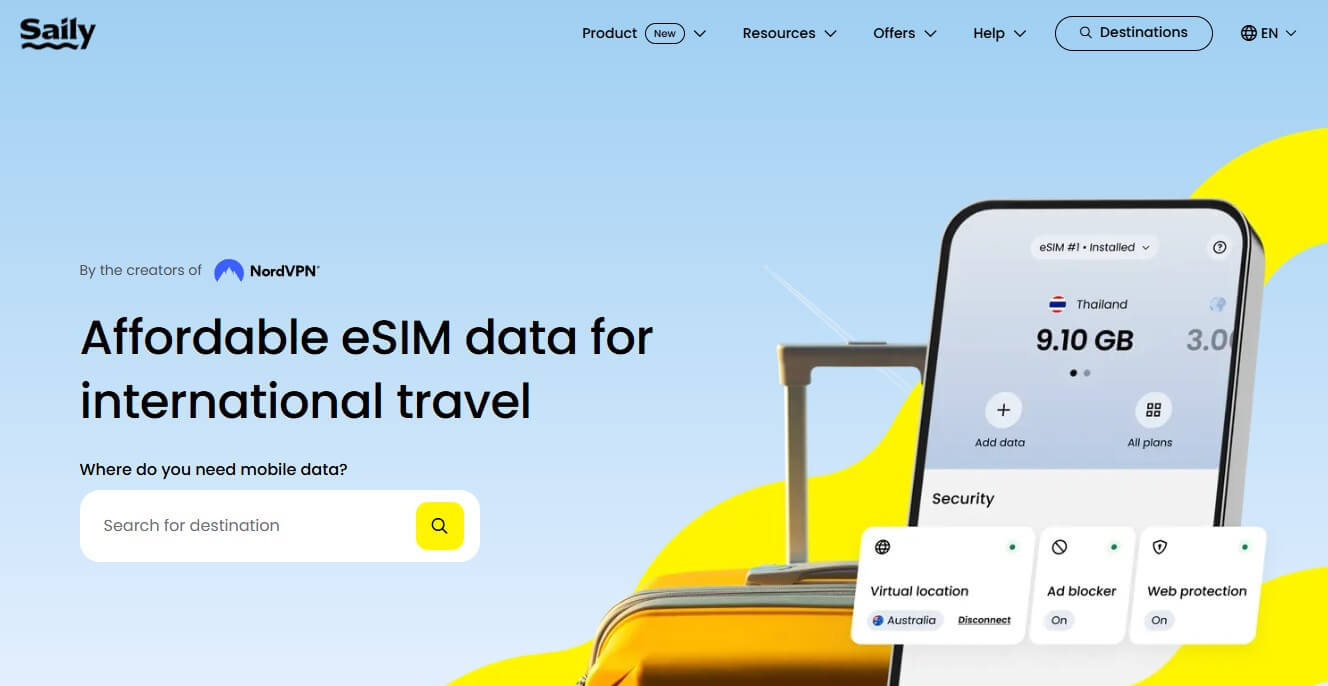
Saily is the best eSIM for international travel when it comes to privacy, security and customer support. It was launched by Nord Security, the team behind NordVPN (we tested it recently), NordPass and NordLocker, and it was named “Rising Star” at the MVNOs World Congress in Amsterdam in June 2026.
Saily supports over 200 destinations, with regional plans for every continent. Like Ubigi, the setup is fuss-free and runs entirely from its iOS and Android app. The standout feature is the security bundle: an ad blocker and a virtual location for a VPN-like experience, on every plan.
Three things landed in 2026 that change the picture for international travellers. First, cruise plans. Once a ship passes twelve nautical miles from shore it drops off land networks entirely and switches to its own satellite system, and every regular eSIM stops working at that moment. Saily now covers more than 200 vessels across Royal Caribbean, Carnival, Norwegian, MSC, Disney Cruise Line, Virgin Voyages, P&O and Cunard. No rival offers anything comparable.
Second, an optional US phone number in +1, from $0.84 a month, persistent and usable worldwide. That fixes the two-factor authentication problem that catches out every traveller sooner or later. Third, airport lounge access and fast-track security passes, bought directly in the app with no subscription. Saily Ultra bundles unlimited global data, lounge access at 1,000+ airports and the full Nord Security suite for frequent flyers.
We also like the data consumption alert, which stops you going over the limit without noticing. Connections were uncongested throughout our tests, with smooth, high-quality video and audio calls.
💸 Plans & Pricing
Saily’s plans are flexible: 5, 7, 15, 20 or up to 30 days, depending on how much data you need. The lowest price we found was $1.99 for 1 GB for 7 days. Unlimited plans, which aren’t available everywhere, start at $18.99 for five days.
One caveat worth knowing, though. Unlimited doesn’t mean unrestricted: you get 5 GB per day at full speed, after which you stay connected but throttled to 1 Mbps. That’s fine for maps and messaging, not for streaming. Holafly is the only provider here whose unlimited data never slows down. The latest deals are on our Saily coupon code page.
Save 15% off with code GIZMODO! Through Gizmodo, you can save 15% on all Saily plans, regional and global plans included, by using the promo code GIZMODO at checkout.
3. Holafly

Pros
- Unlimited data with no throttling
- Wide country coverage
- Fixed, predictable pricing
- 24/7 multilingual support
Cons
- Limited data sharing (up to 1 GB/day)
- No phone number
Holafly markets itself as the best eSIM for international travel, and on unlimited data it has a real case. Plans with limitless data, no roaming charges, and a simple setup through user-friendly apps on Android and iOS.
Holafly lists over 160 supported countries, with regional plans for North America, Europe and other major destinations. You get unlimited data almost everywhere, 4G and 5G in select regions, and the ability to share your connection. That said, sharing is capped at up to 1 GB per day, which can still push a couple into buying two plans.
Its real advantage in 2026 is that the unlimited data is genuinely uncapped. No 5 GB daily allowance, no drop to 1 Mbps, no fair use asterisk. Saily throttles, Holafly doesn’t. If you stream on the move, that one difference is worth the higher price.
Holafly is data-only, so there’s no phone number for SMS or 2FA. Its customer support, on the other hand, is among the best in the industry, available 24/7 and in multiple languages.
💸 Plans & Pricing
Holafly is one of the most popular names among the best eSIM providers, and that comes at a slightly higher price. Depending on the country or region, unlimited data starts at around $3.90 per day. You can pay by the day or take 30 days upfront, which costs about $74.90.
The good thing about Holafly’s pricing is that it stays fixed. We checked, and the same entry rate applies to an eSIM for the USA, Bulgaria, the UK and many other destinations.
4. Airalo

Pros
- Affordable global plan
- Phone number in some country plans
- Loyalty cashback up to 10%
Cons
- Higher prices in Africa
- Can’t buy voice minutes separately
An eSIM provider with a genuine global plan can’t be bad. We like Airalo mainly for its country support (200+) and its global plan, which works in over 137 countries and includes data, calls and texts. Getting started is quick: download the app, create an account, choose your destination.
Follow the steps and you’re activated within a minute. Airalo covers individual countries and regions, and prices vary but stay reasonable. Some plans include a phone number for calls and texts, though that depends on the destination.
For instance, an eSIM for the USA is data-only, with metered and unlimited options. The limitation we ran into is that you can’t buy voice minutes on their own, which is inconvenient if you call a lot. You’ll rely on VoIP instead. Airalo is also the safest bet in regions rivals skip, like the Balkans, where our best eSIM for Montenegro comparison found several providers simply don’t operate.
💸 Plans & Pricing
Airalo’s flexible plans don’t cost much. Depending on the country, you can choose 1 GB to 50 GB for three to 30 days. The general price is $4.00 for 3 GB, while 50 GB for 30 days runs $32 to $40. Unlimited plans still undercut Holafly’s, with a 30-day Europe plan at $71.
Some regions, like Europe (including France, Spain and Italy), have unlimited plans, but at a steep $35 for 10 days. It’s a shame the global plans aren’t unlimited: you get up to 20 GB plus 200 minutes and SMS for $79 annually. The silver lining is the loyalty program, with cashback of up to 10% on every purchase.
5. Jetpac

Pros
- Cheap subscription plans
- SmartDelay lounge access
- Limitless data sharing
Cons
- Expensive in Africa
- No phone number
Jetpac is the best eSIM for international travel if you’re always on the go. It supports over 200 destinations and has regional plans for intracontinental flights. Like the others, it’s simple to set up from its app.
Its standout feature is SmartDelay, which grants free airport lounge access if your flight is delayed or cancelled. Saily now sells lounge access outright, but the automatic, delay-triggered version is still unique to Jetpac. It also lets you share your data without restrictions, and keeps WhatsApp, Uber, Google Maps and Grab running even after your data runs out.
Jetpac runs a subscription model too, with JetFlex and JetPro, both covering over 100 countries and offering up to 10 GB of global data plus the extras above. 24/7 live chat support is always available.
The gap is telephony: no phone number, so no 2FA codes or SMS. That doesn’t stop it being one of the best eSIM services for international travel in 2026.
💸 Plans & Pricing
Jetpac’s plans are very affordable, with frequent discounts for seasoned travellers. Occasional users can get at least 1 GB, and up to unlimited data, for about $1 for four days, while unlimited plans run for up to 30 days. Variants from 5 GB up to 40 GB fill out the range.
African destinations are the exception, and far more expensive: 1 GB for four days in Nigeria costs $6, six times more. Otherwise Jetpac offers solid 4G and 5G coverage and performs well.
✈️ Why Should I Buy an eSIM for International Travel?
The reason is simple: to stay connected worldwide.
A SIM card lets you make calls, send messages and go online. But abroad, you’d have to buy another one and physically slot it in. An eSIM for international travel removes all of that, with instant activation and as much data as you need across your devices.
With up to unlimited data, you can chat, call and browse as if you were home. eSIMs work in almost every country and generate no roaming costs, since you’re not using your home plan abroad. In 2026, travelling without one makes little sense.
📶 What to Look for in an eSIM for Traveling Abroad?
It doesn’t matter whether you need an eSIM provider for Asia, Europe, or one specific country. Here’s what to check:
- Value for money. Look for enough data at a fair price. Ubigi and Saily are strong, and Jetpac is worth a look for frequent travelers.
- Fair use policies. Unlimited rarely means unlimited. Saily throttles to 1 Mbps after 5 GB a day. Holafly doesn’t throttle at all. Read the fine print before you assume.
- Setup and ease of use. The best providers get you online in minutes from an app. Skip anything more complicated.
- Compatibility. Check your device on the provider’s website before paying. Every one of them has a checker.
- Global coverage. The best options support 150 to 200+ destinations. If your country isn’t listed, move on, and consider a regional plan covering several countries at once.
- Customer service. Essential if your eSIM ever stops working. All five offer 24/7 support.
⚖️ Local SIM Cards vs eSIM for International Travel
So which is better? Having tested both, we side with eSIMs every time.
Buying a local SIM is far more involved: you have to choose a carrier, find a shop, and get past the language barrier. With an eSIM you pick the plan before you leave and land with it already working.
In our experience travelling across Europe, Africa, Asia and North America, these are the advantages that really hold up:
- Better security. An eSIM can include extra security tools (Saily’s virtual location and ad blocker, for example), and since there’s no physical card, a thief can’t simply remove it. You can also deactivate the profile remotely if the phone is lost.
- Multiple eSIMs. Most phones can store several eSIM profiles at once, which helps when you’re crossing between countries.
- Improved connections. Physical SIMs can get damaged or degrade with use. An eSIM has nothing to wear out, so the connection stays consistent.
The main downside is the lack of a local phone number on most plans. That’s changing: Saily now sells a US number in +1, and Airalo includes one in some country plans, so you can replicate most of what a physical SIM offers.
The Bottom Line
The best eSIM for international travel in 2026 is ultimately up to you. The five that impressed us most are Ubigi, Saily, Holafly, Airalo and Jetpac. Each offers wide coverage, easy setup and generous data. Pick our favourite, Ubigi, and you get 10% off your first purchase.
Saily is the one that has changed most in 2026. Cruise coverage, a US phone number and lounge access, on top of a product that was already the best on security. If you’re sailing, or if 2FA codes have ever left you stranded abroad, it’s the one to buy.
Frequently Asked Questions
Do eSIMs work with all phones?
No, eSIMs do not work with all phones, especially older models. eSIM compatibility is best on Samsung and Apple phones, but you'll also find them working on various Google Pixel, Motorola, and Huawei phones.
Are eSIMs cheaper than local SIMs?
No, they're not, but in some instances, they are. It all depends on the destination. In some countries, it's better to get an eSIM than to pay for a local SIM with outrageous data prices. Most notably, people use eSIMs in Canada, where they're more affordable, but it's also the case in the USA, with higher data prices.
Is an eSIM for international travel safe?
Yes, it is safe. It can't be stolen, as it's not physical, and some providers, like Saily, include a few security extras, like a VPN and an ad blocker. In general, eSIMs are safer than traditional SIM cards in many ways.
Can I use more than one eSIM provider simultaneously?
Yes, you can, and the maximum depends on your phone. iPhones typically support eight, and Android phones (primarily Samsung) can store up to 20.
When should I buy a regional or global eSIM?
When you want to visit multiple countries. If you're traveling to France, Italy, and Switzerland, get a regional Europe eSIM. Meanwhile, if you're traveling to different parts of the world, it's wiser to get a global eSIM with superior coverage.