Mandalorian and Imperial Super Commandos
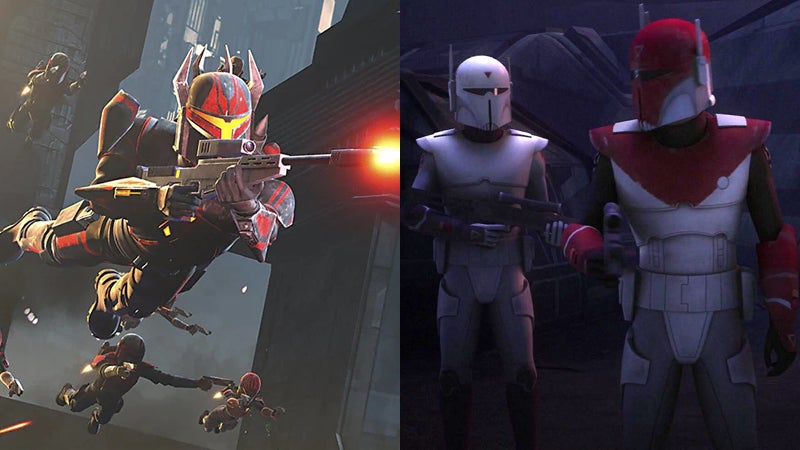
As the Clone War came to an end, Mandalore was brought into turmoil by a coup spearheaded by elements of the Death Watch faction working with former Sith apprentice Maul and his criminal syndicate, the Shadow Collective. Mandalorians who proved their loyalty to Maul were formed into groups of “Super Commandos,” and while their armor stayed largely similar to that template worn by Death Watch in years prior, its color palette was replaced with designs emulating Maul’s own black-and-red skin striping and accompanying tattoos. Some would go even further and modify their helmet with organic spikes—not as a nod to the Crusaders of long ago, but the bone protrusions on a Zabrak’s head, to emulate their new master.
The New Mandalorians petitioned the Republic for aid in liberating their world from Maul’s coup—and the death of Duchess Satine—in the Clone War’s final hours. Although the Republic was successful, the execution of Order 66 and the perceived betrayal of the Jedi Order lead to its rapid transformation into the Galactic Empire, and Mandalore quickly became occupied Imperial territory. The Imperial regime and Mandalorian collaborators that helped maintain its control would take a page from the Death Watch and the Shadow Collective and maintain the Super Commandos as a fighting force—this time with new, specialized armor. Inspired by real-life alternate concept art for Boba Fett from Empire Strikes Back, Imperial Super Commando design more closely emulated the armor of the Clone Army, with sharp angular chest pieces and a predominantly white color scheme and smaller jetpacks. Their helmets largely remained the same, except for the addition of two small sets of antennae on either side of the helmet.