Turtle Rescue and Recovery
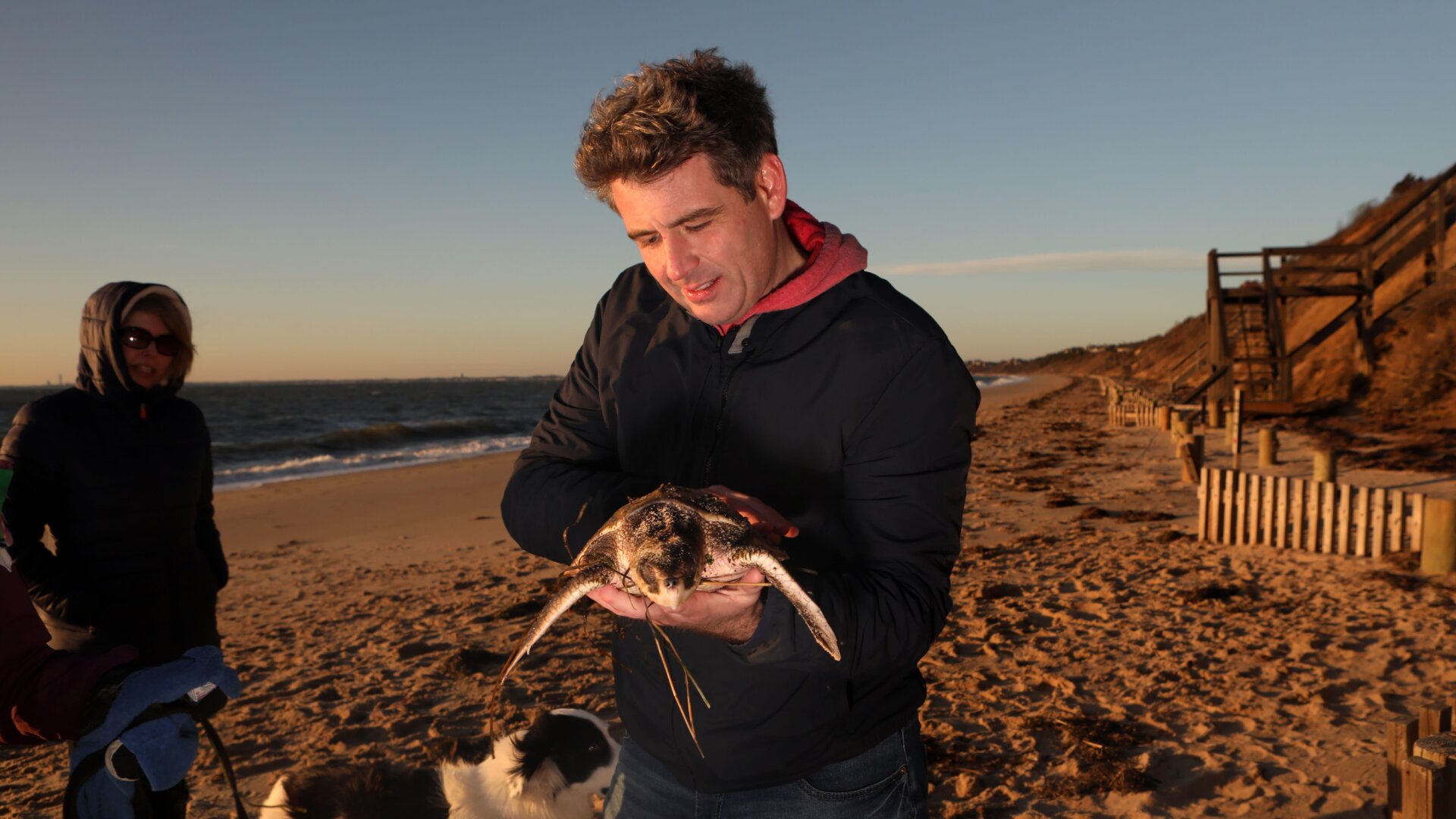
Luckily, these turtles get help from Prescott, Mass Audubon staff, and volunteers, who receive specific turtle rescue training.
While wind and water temperature are the key enemies, the other key factor is high tide. There are two high tides in a day, one during the daytime and another one at night. That’s when the turtles usually wash up on the beach, blown there by the wind. During high tide, Mass Audubon volunteers walk up and down their assigned stretch of beach looking for turtles. Volunteers sometimes walk up and down the beach two or three times if it’s the start of a wind episode, Prescott said.
Once the group finds the turtles, the three-step process for recovery begins. The turtles that end up on the shore can sometimes have an alarmingly low internal body temperature of 40 or 50 degrees Fahrenheit (4.4 to 10 degrees Celsius) because that’s the temperature of the water they’re in. Prescott explained that staff and volunteers put them in a 55-degree Fahrenheit (12.7 degrees Celsius) room and hold them there for between 12 and 24 hours. The goal is to get the turtles’ body temperature up to 55 degrees. After they reach that temperature, the group sends them off to aquariums, Prescott said, where they’re put in incubators and further warmed slowly. All the while, the aquarium staff is stimulating the turtles by putting them in water, giving them medicine if needed, and moving them.
When turtles obtain a temperature of between 72 and 75 degrees Fahrenheit (22.2 degrees to 23.9 degrees Celsius), aquarium staff ship them off to the south to 20 to 30 other aquariums who help the Kemp’s ridleys finish recovering. Flying the turtles to their next destination isn’t always a smooth ride, though. Prescott recalled a recent flight this year that saw 30 turtles rescued from Cape Cod Bay get stranded in Chattanooga, Tennessee, while on their way to their new home in New Orleans the night before Thanksgiving. Nonetheless, thanks to some last-minute help from the Tennessee Aquarium, the turtles were able to get to their destination safely.
In total, the recovery process can range from a few months to two years, Prescott said, adding that most turtles recover in six to nine months. After they recover, they are released into warm Atlantic waters or the Gulf of Mexico.



