What to expect during totality
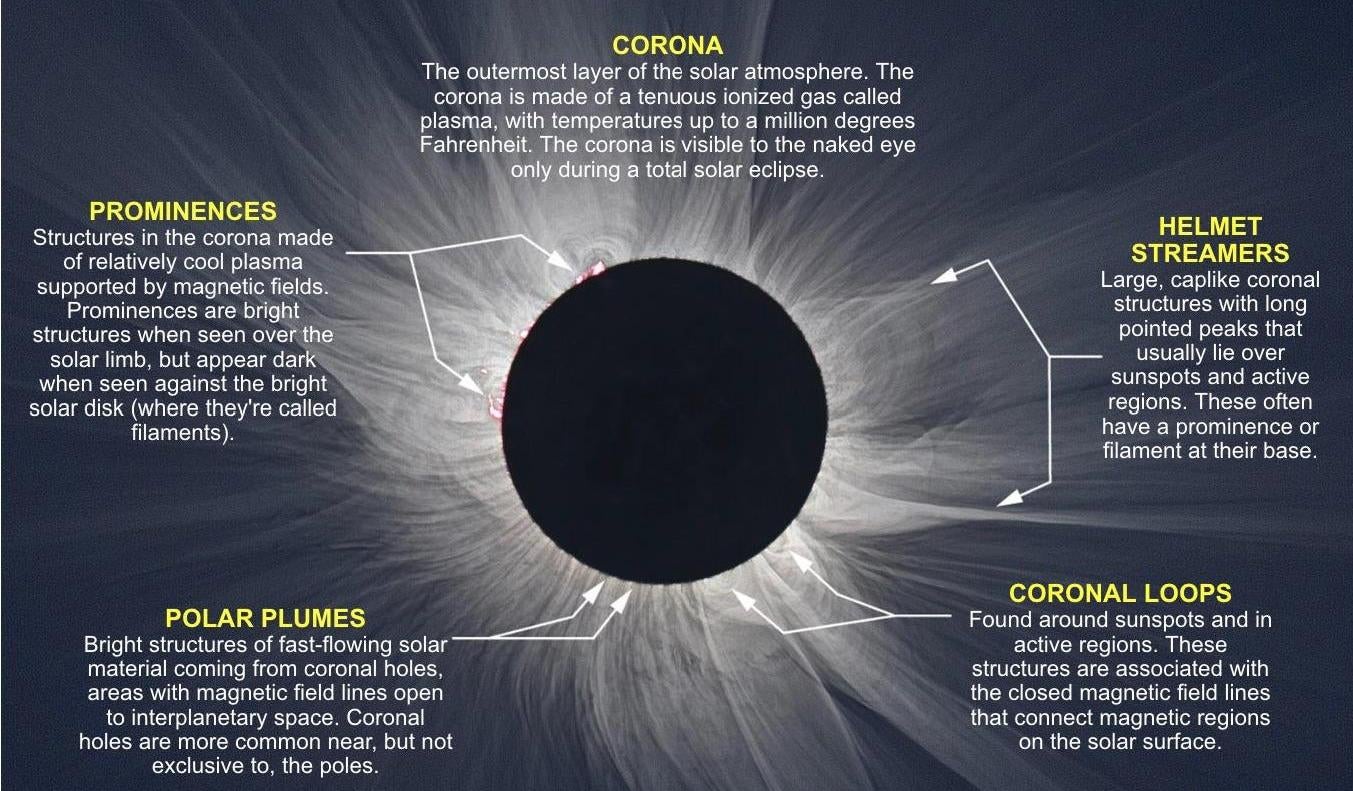
During totality, the Moon completely covers the Sun, revealing the star’s solar corona. The corona will appear as a glowing halo around the obscured Sun. Our star is currently in the active stage of its 11-year cycle, raising the possibility of flares or other solar phenomena, which could greatly enhance the experience.
Related article: Streamers and Loops: What the Sun’s Hyperactive Phase Means for the Upcoming Solar Eclipse
Many people take off their eclipse glasses at this point to view the spectacle, but some experts advise against it, saying it’s simply not worth the risk. Here’s what NASA has to say on the matter:
Once the diamond ring disappears and there is no longer any direct sunlight, you may remove your eclipse glasses and look at the total eclipse safely with the naked eye. This moment is also called second contact. During totality, viewers may be able to see the chromosphere (a region of the solar atmosphere, appearing as the thin circle of pink around the Moon) and the corona (the outer solar atmosphere, appearing as streams of white light). Be vigilant to protect your eyes and put your eclipse glasses back on before totality ends. Totality may last only a minute or two in some locations.
During this time, you’ll notice a dramatic drop in temperature, and it’ll appear as though it’s dusk, but with the sunset all around you. Be on the lookout for Jupiter and Venus towards the horizon, and possibly even some stars.



