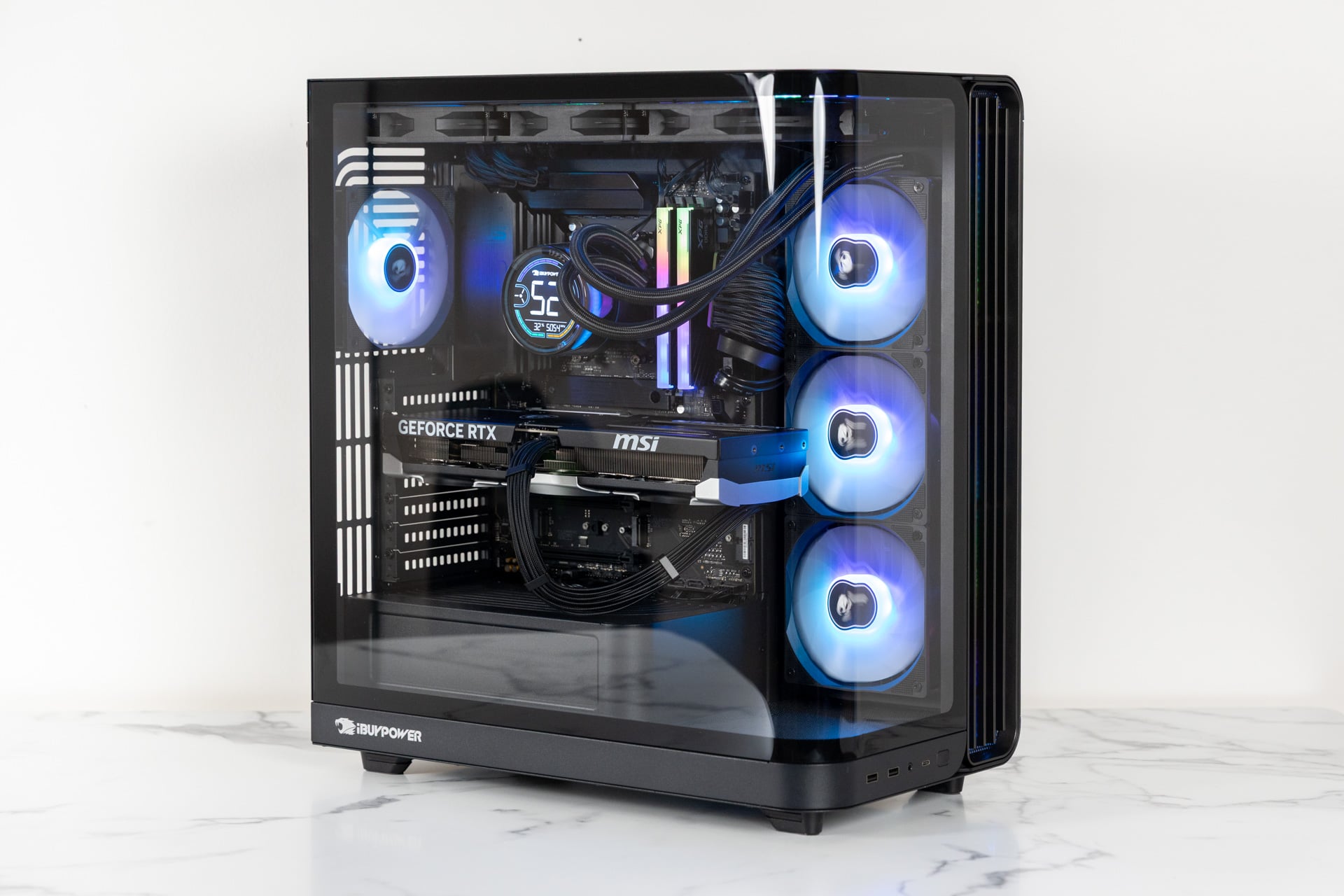
A river of RGB light runs through the iBuyPower Trace X case, piercing up from the bottom of the gamer PC tower’s side panel through the top exhaust vents. Through the looking glass, shrouded in glow, this jumble of glass, aluminum, and silicon is like a fish tank swimming with light.
This variety of elegant “fishbowl” PC cases has become popular these past few years. The Trace X, in particular, is the kind that would make the preteen version of me swoon. Then, you open up the side panel, expose the RGB light strips underneath, and find it nearly impossible to access the power supply cables underneath. That’s not to knock iBuyPower’s latest tower too hard. It’s likely the most appealing of its 2026 Gen 10 prebuilt gaming desktops and a solid PC in its own right. It’s just a reminder that the Trace X is made to be ogled first and fiddled with second.
iBuyPower Trace X
This prebuilt PC may not be as easy as other pre-configured desktops, but its certainly more beautiful because of it.
Pros
- Beautiful look
- Clean cable management
- Powerful with the right specs
- As expensive as all PC parts separately
Cons
- Need to install GPU
- PSU difficult to access
- A fingerprint magnet
With the supplied components, including a top-end AMD Ryzen 7 9850X3D gaming CPU, 32GB of RAM, and an Nvidia GeForce RTX 5080 GPU, the iBuyPower Trace X (RGB R01) would cost $3,450 as of early May 2026. Who knows if the cost of RAM will push the price of this PC even further. Just half a year ago, you could have built a similar PC for less. When I put the same components into BuildCores, I come out with a PC that costs about the same.
The end result is that preconfigured PCs are now not only easier on the end user; they may also save you money as well as time. That’s the kind of statement that seems anathema to the entire notion of PC gaming, but that’s where we’re at. At the very least, the Trace X will look far better on your desk than most other metal or plastic towers.
Practice installing your own GPU
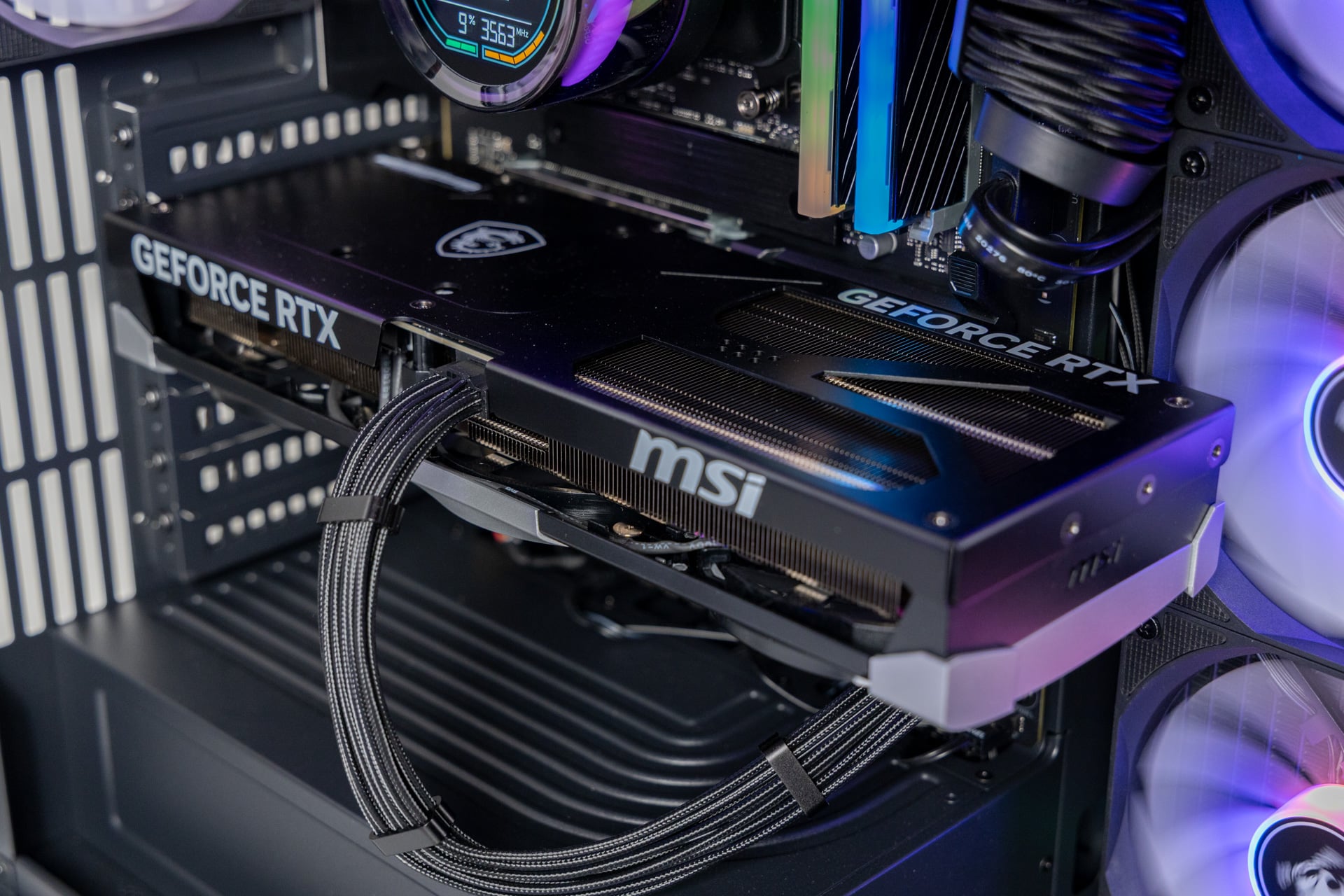
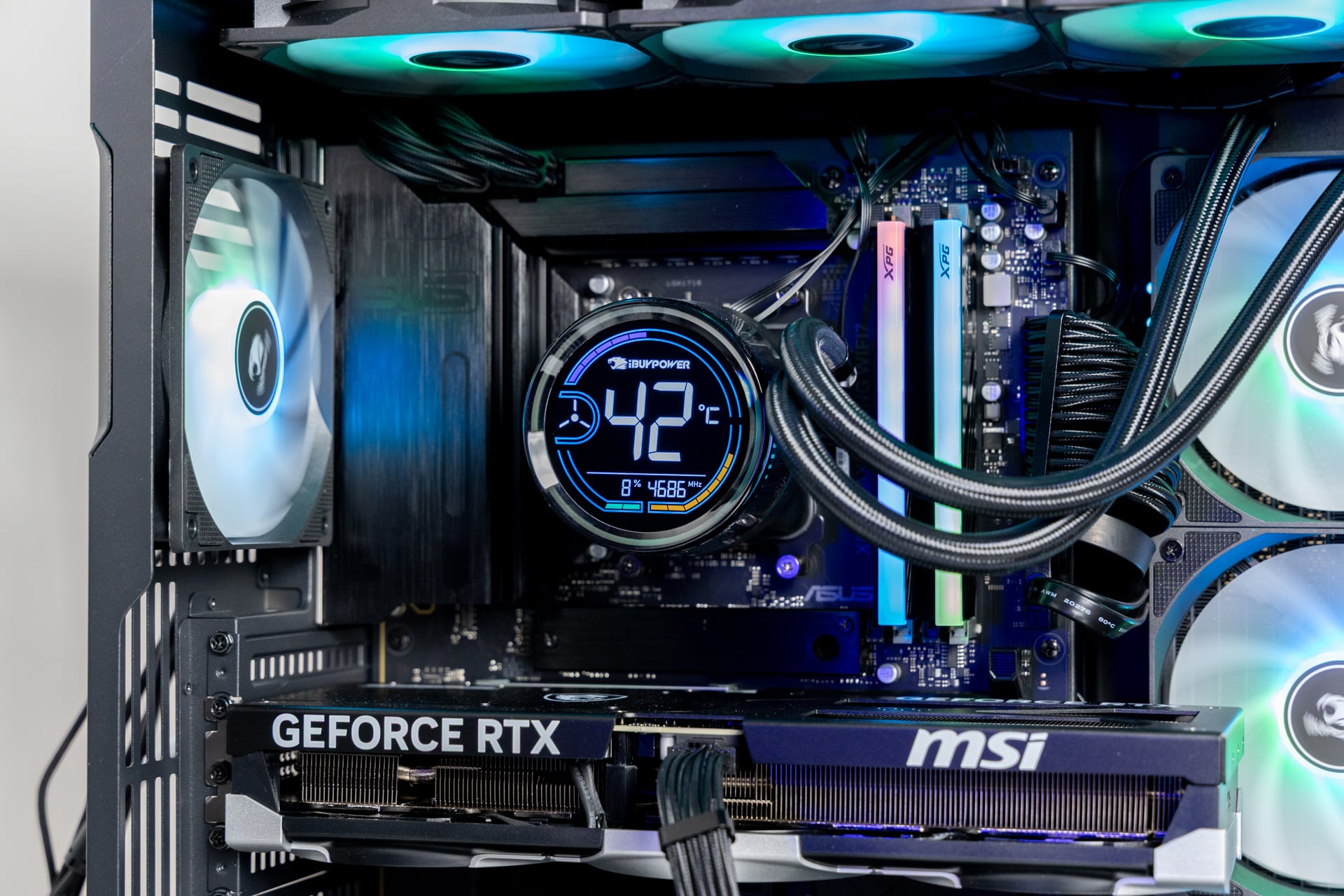
There are many prebuilt PC brands that focus on creating a seamless package. You spend a heap of money, and you don’t have to do anything but excavate it from the box, plug it in, and start playing. iBuyPower is more traditional, necessitated by the shape of the case. There is no GPU bracket to keep the GPU stable during transport. Instead, the RTX 5080 GPU came in its original MSI-branded packaging. This means you’ll need to slot it into the top PCIe Express slot on the motherboard yourself, then plug it into the awaiting 12VHPWR cable.
That doesn’t actually take much effort. If this is your first PC, you should learn the kind of skills you’ll need to upgrade your tower. The case is pretty enough that you could potentially stick with this design over several generations, so long as AMD keeps supporting the AM5 CPU socket (the chipmaker recently promised support for AM5 in the “long term”).
You don’t have to do anything more than setting up your PC as normal—which will require spending too much time shepherding Windows 11 through its myriad settings and updates.
When all is said and done, this PC is a looker. The soft glow from iBuyPower’s branded side fans and the company’s AW5 360mm AIO liquid cooler provided a calming gamer ambiance to my work desk. If you don’t mind the appearance of that screen-filled CPU cooler’s power and connection cables snaking up and behind the motherboard, the Trace X presents as a clean fishbowl of a PC (so long as you clean off your fingerprints from the glass).
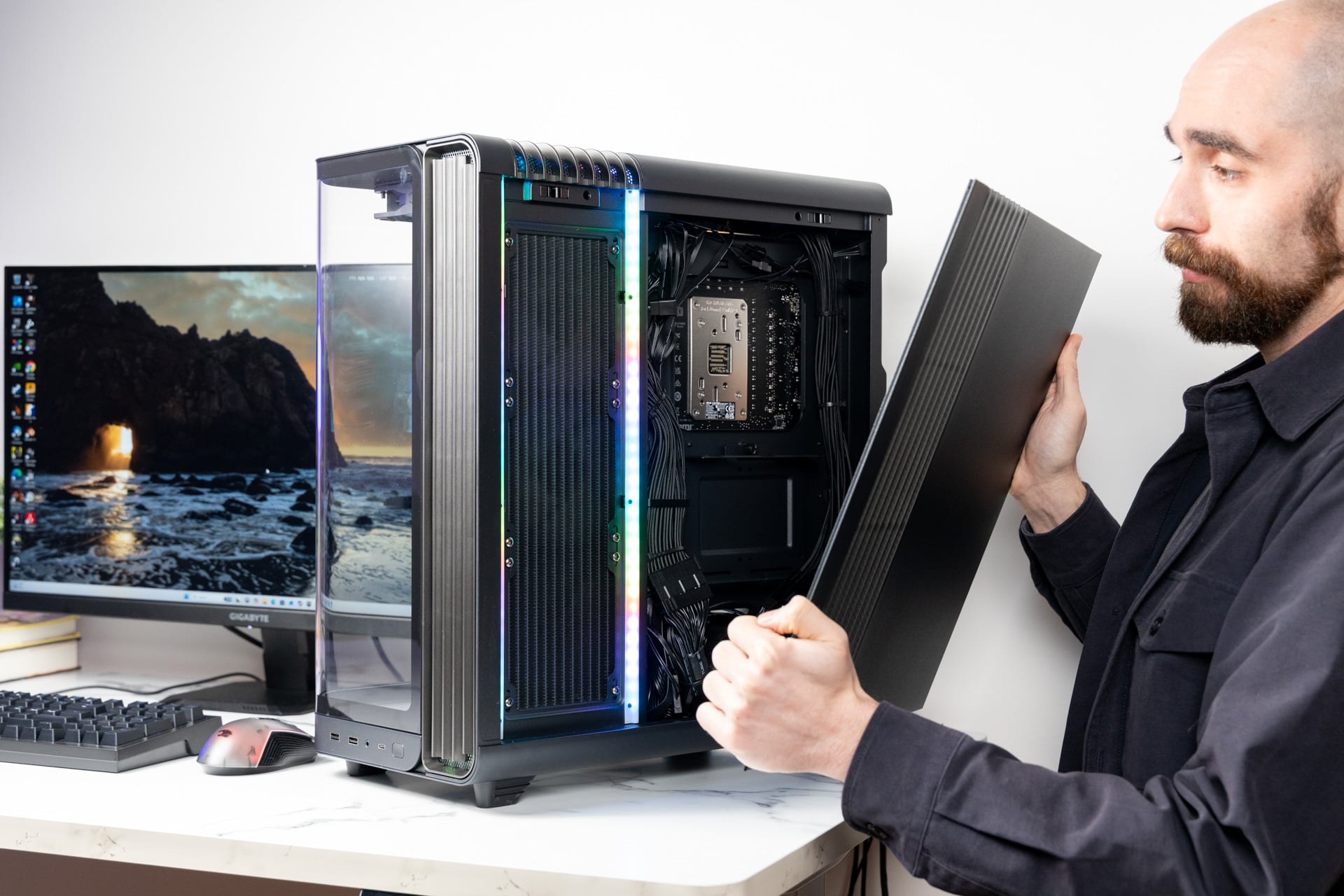
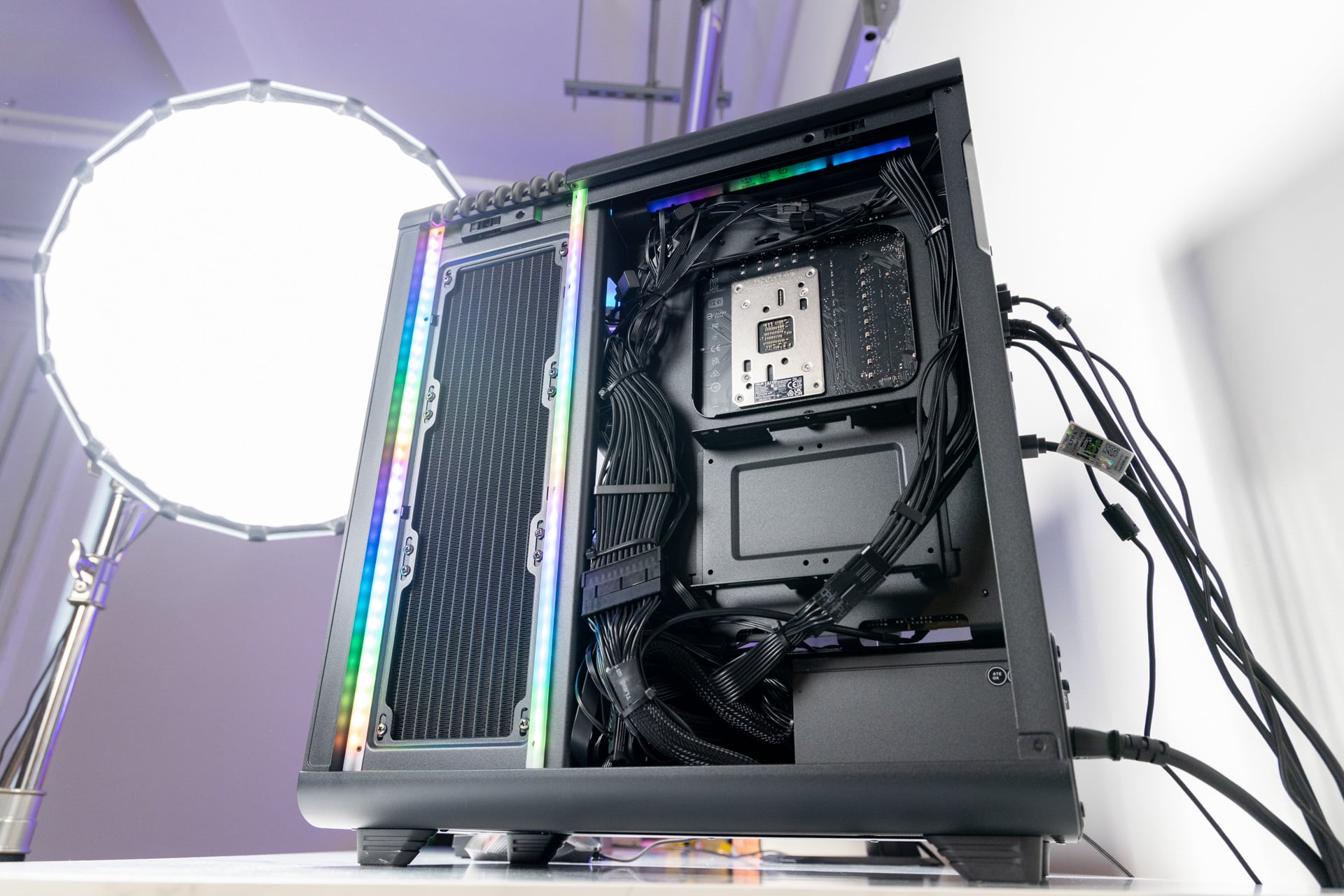
And the case is similarly simple to access. There are two thumbscrews keeping the front panel in place. The rear panel is even easier to access with just an ounce of effort. Even the rear cable management is relatively efficient. Most of the power cables are all running in the same stream down toward the power supply along the left side of the motherboard. You’d have to cut the zip ties and piecemeal every cord out to identify any future issue.
The major complication with this case design is how tight all the cables are squeezed into the power supply unit (PSU). It’s not easy to access any of those sockets with it screwed into the aluminum PSU shield. Just keep that in mind if you ever intend to change up your GPU in the future.
Loud, but at least there’s motherboard HDMI
The Trace X doesn’t seem like some utilitarian computer built to protect sensitive electronics and move cold air in and hot air out. It’s also—in some circumstances—less practical than a traditional PC case. So if I compare the Trace X tower to Hyte (iBuyPower’s sister brand) and its X50 case, the cutesy, bubble-like design will promise far more airflow. But which one would you rather have accompanying you on your desk, honestly?
Once those fans get up to speed, this can be a relatively loud PC. In my benchmark tests pushing the CPU as far as it would go, the PC picked up quite a racket, far more than other recent PCs I’ve tested, such as the HP Omen Max 45L. The case design necessitates a unique airflow. The three side-panel fans suck in air, while the rear and top-mounted CPU cooler expel that heat up and out.
The imbalance of four exhaust fans to three intake fans creates a negative pressure environment. That means there is more air going out than coming in. Ostensibly, this is better for keeping components cool, though it means that you may have air seeking ingress (which is likely why there’s a front vent next to the front glass panel). That could account for some of the noise, but it’s something to consider if you’re planning to have this case featured prominently on your desk.
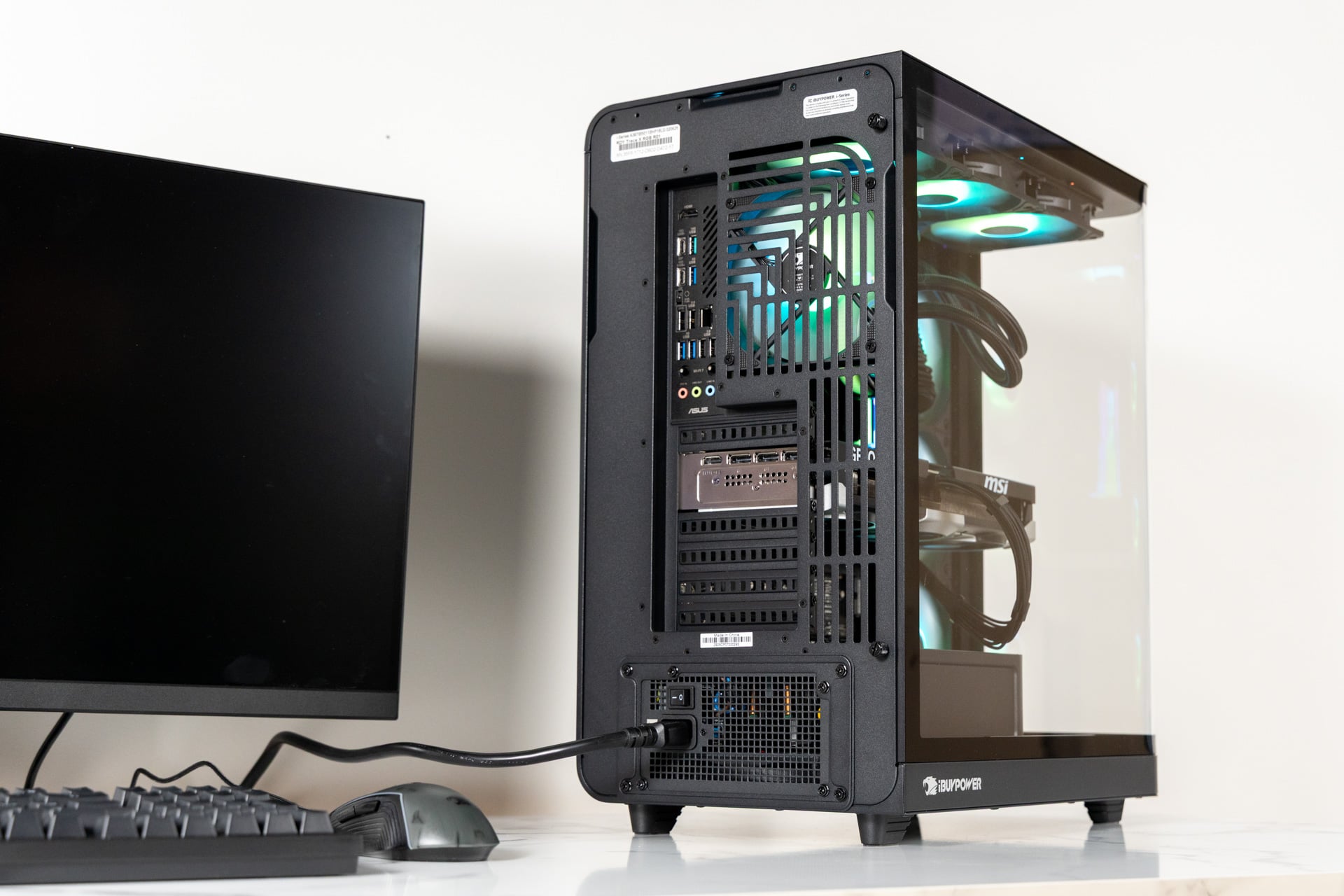
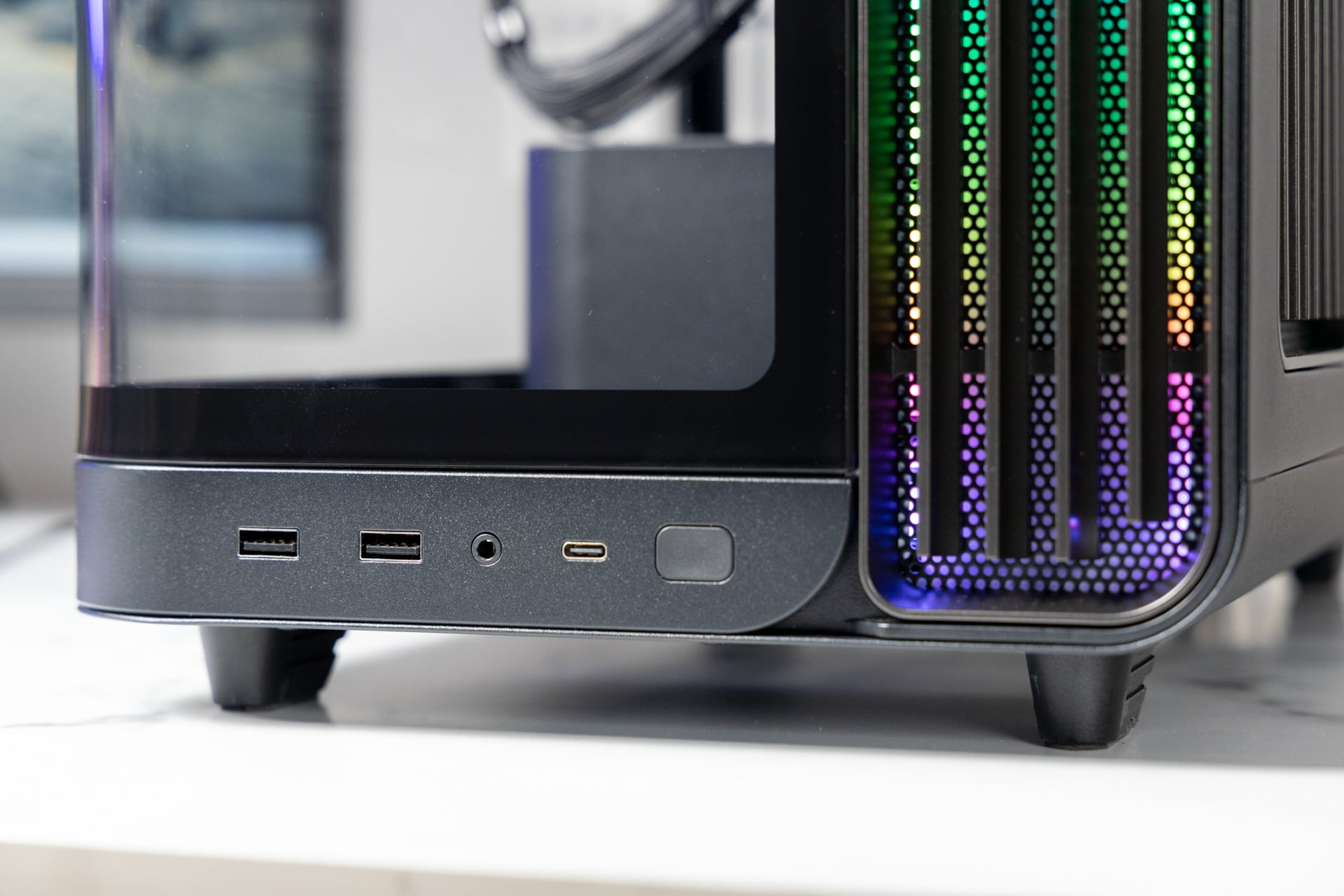
And despite my quibbles about noise, I may prefer this case to many that I’ve tried lately. It’s not just looks. The Trace X comes stock with an Asus X870 Max Gaming ATX motherboard. It features a wealth of rear I/O ports, including two 40Gbps USB-C, three USB-A 2.0 (plus another one for flashing BIOS), three 5G USB-A, a 10G USB-A, ethernet, and a freaking HDMI, so you don’t have to depend on a graphics card for monitor output in case something goes wrong. It even includes a few old-school line-in audio ports for wired headsets. The bottom of the front panel is where you’ll also find a single USB-C, two USB-A, and a headphone jack.
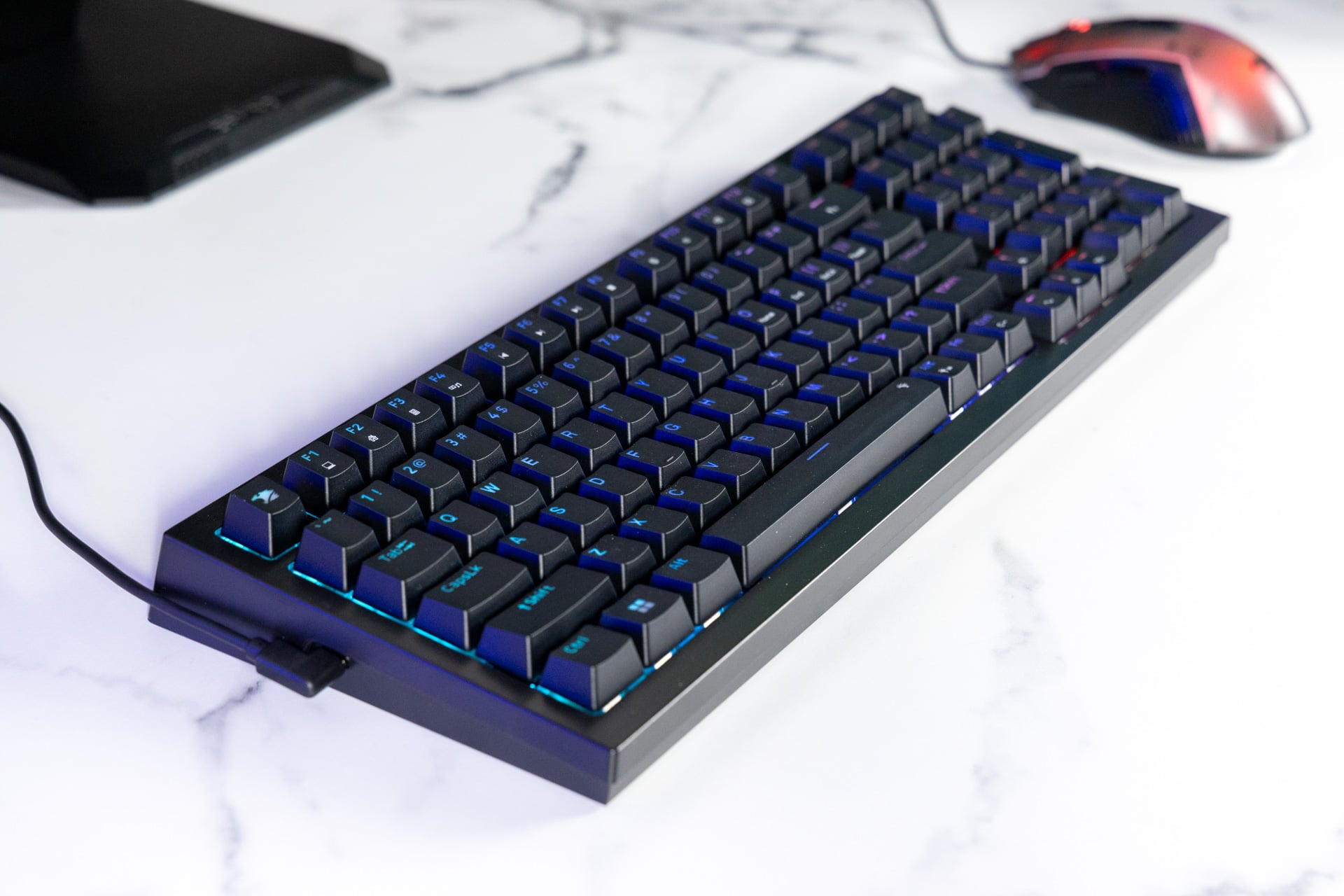
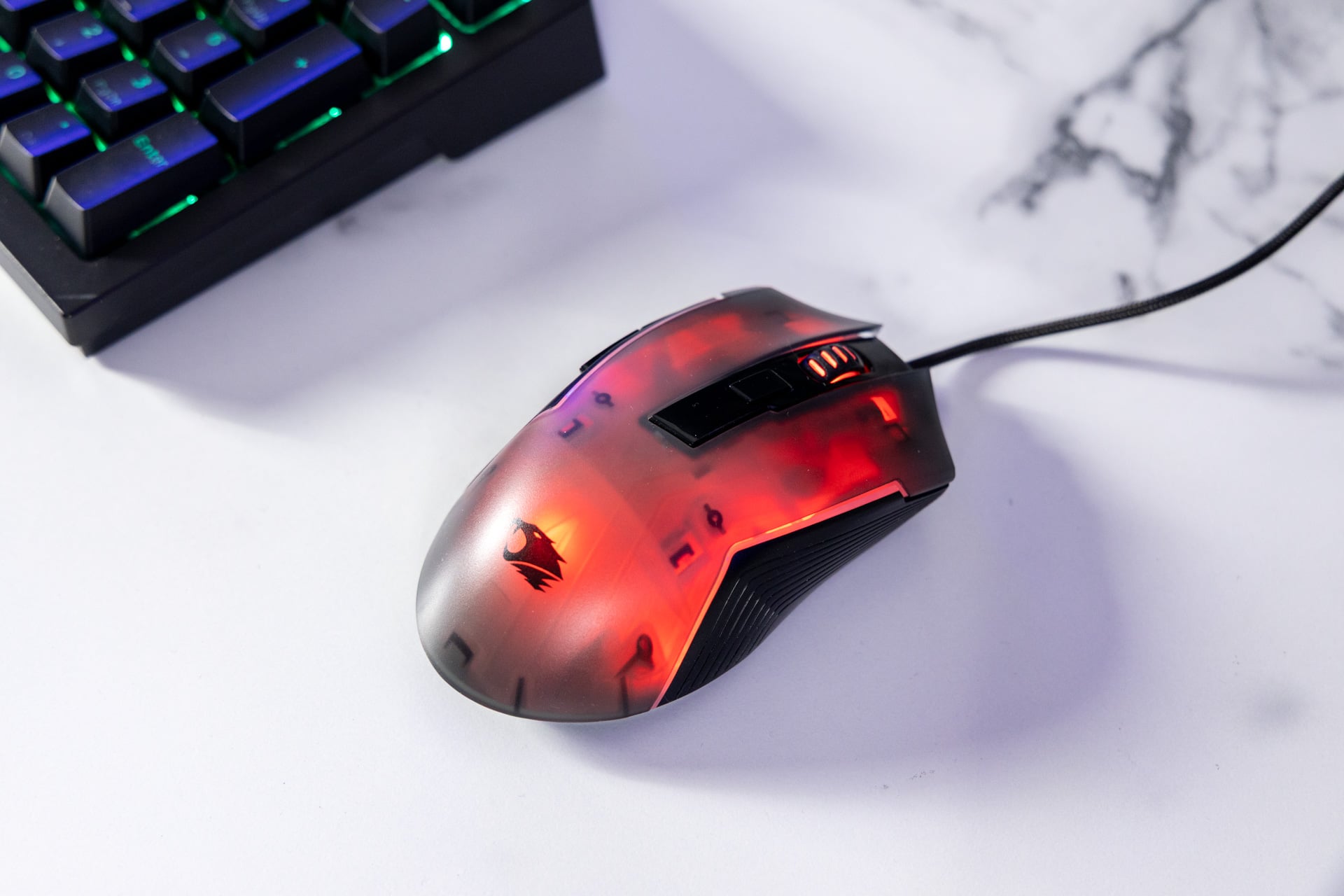
As far as other accoutrements, the iBuyPower PC also comes with a basic keyboard and mouse. These are not what you could consider cream of the crop components. They’re good enough to keep you occupied until you inevitably spend more on better peripherals.
A toasty, potentially powerful fishbowl
You should already have a fair idea what to expect with performance from an Nvidia RTX 5080 GPU and AMD’s Ryzen 7 9850 X3D CPU. The GPU is the more sensible choice for 4K-ready gaming compared to the RTX 5090. The higher-end card can now cost thousands of dollars more than it did at launch in 2025. AMD’s best gaming CPU is merely a slightly overclocked version of the Ryzen 7 9800X3D. You can eke out a few more frames in some games with the extra “50” attached to the name. But that’s about it.
That plays out in my Geekbench 6 tests. Compared to a Maingear Rush desktop PC from 2025 that’s running the 9800X3D CPU, an RTX 5080 GPU, and similar specs, this configured Trace X managed just 1% better on average. In rendering tasks, the newer CPU was essentially equivalent in our Cinebench 2024 benchmarks. It’s the CPU choice for gamers who love to squint at numbers in benchmarking scores. Any gamer should feel safe opting for a PC with the 9800X3D or 9850X3D, whichever is cheaper.
When Gizmodo tested the HP Omen Max 45L last month, I got used to the unlocked CPU performance of a 12-core AMD Ryzen 9 9900X3D alongside the unmatched power of an RTX 5090. In terms of CPU performance, that means you’ll see upgraded rendering capabilities. That equaled 24% better multithreaded performance in Cinebench 2026. Taken as a whole, that may not matter nearly as much as you think. In our Blender tests, where we time how long it takes the PC to render a scene of a BMW on the CPU, the Maingear Rush was just six seconds faster than this version of the iBuyPower Trace X.
So it’s really no slouch for more high-end tasks, like rendering. You’re going to be using the GPU for any sort of graphics tests or other high-end workloads. Besides, you really want to know how this thing is for gaming. In 3DMark, the iBuyPower Trace X managed similar or even better scores than even the HP Omen Max 45L in lower-power benchmark tests, like 3DMark’s “Fire Strike” and “Wild Life.”
In any kind of higher-end GPU tests, like 3DMark’s “Steel Nomad” or “Steel Way,” I didn’t see any real performance uplifts above an AMD Ryzen 7 9800X3D on the Maingear Rush. At peak load, I saw it reach close to 80 degrees Celsius (176 degrees Fahrenheit). That’s still well within the range of safety for CPU health. It is higher than I expected it to be with the bulky 360mm fans connected to the liquid cooler apparatus.
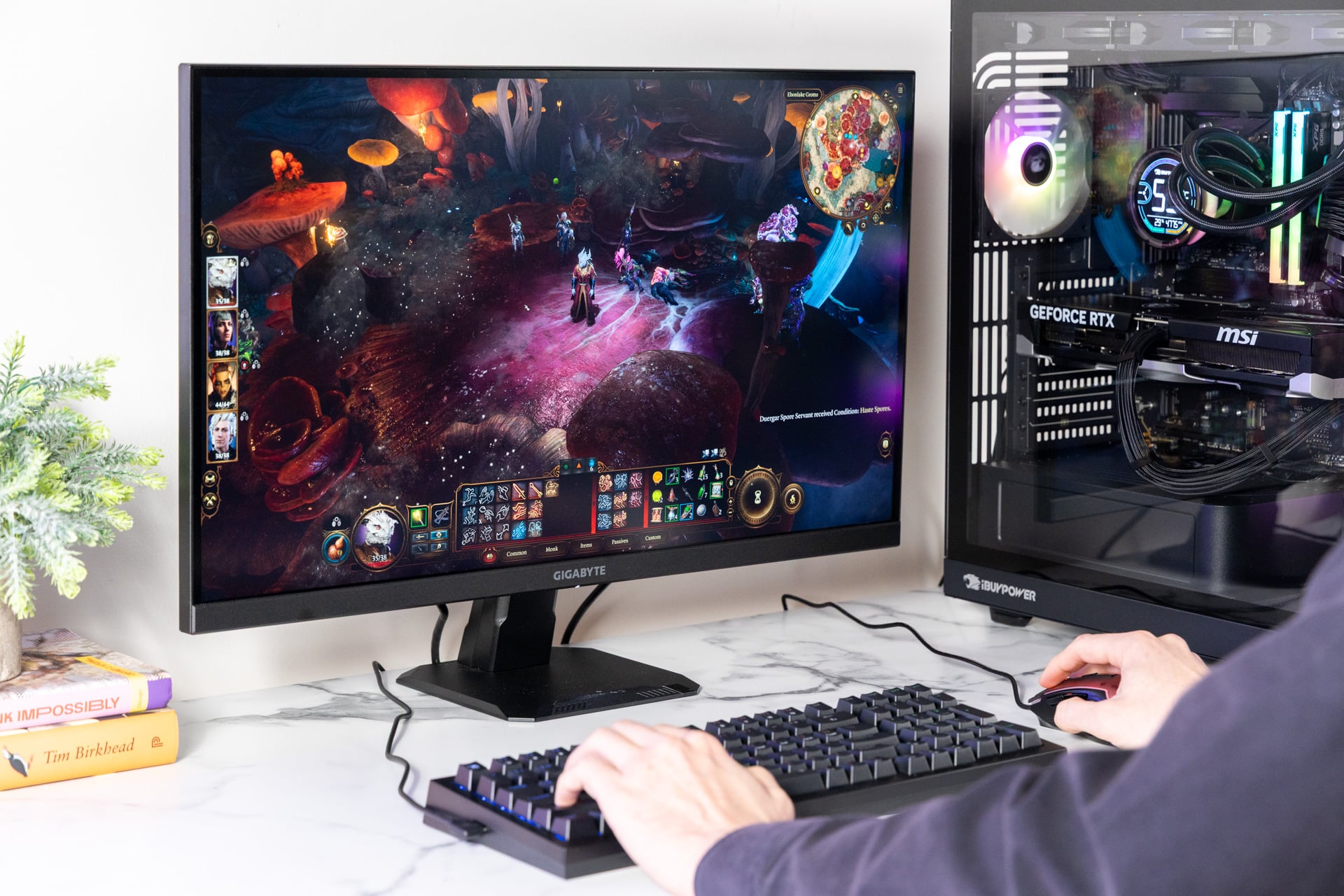
Thankfully, temperatures never became a problem in any gaming scenarios. For 4K gaming, this PC can handle its own across titles like Cyberpunk 2077, Black Myth: Wukong, Horizon Zero Dawn Remastered, and more benchmark-ready titles. I even saw the iBuyPower Trace X beat the HP Omen Max 45L in Black Myth at 4K, with or without Nvidia’s DLSS upscaling running.
What I find more interesting is that while an AMD Ryzen 9 9900X3D will beat the Ryzen 7 9850X3D in the same games at 4K, it offers diminishing returns for games at lower resolutions. The iBuyPower PC performed 20% better in Cyberpunk 2077 at 1080p compared to the $6,000+ HP Omen Max 45L with the RTX 5090 GPU. The story is flipped for 4K gaming, where HP’s PC with max specs can perform 20% to 22% better than the Trace X with lower-end components.
In a CPU-demanding game, like Total War: Warhammer III, the Trace X struggles more for 4K, especially in the taxing “Mirrors of Madness” benchmark, only hitting around 69 average fps at best. Then, if you hope to push every game to its max, just know you’ll need to make a compromise somewhere. If you want to push path tracing in a game like Cyberpunk 2077, you’ll need to rely on DLSS to even hope to get close to 60 fps.
Looks aren’t all that matters
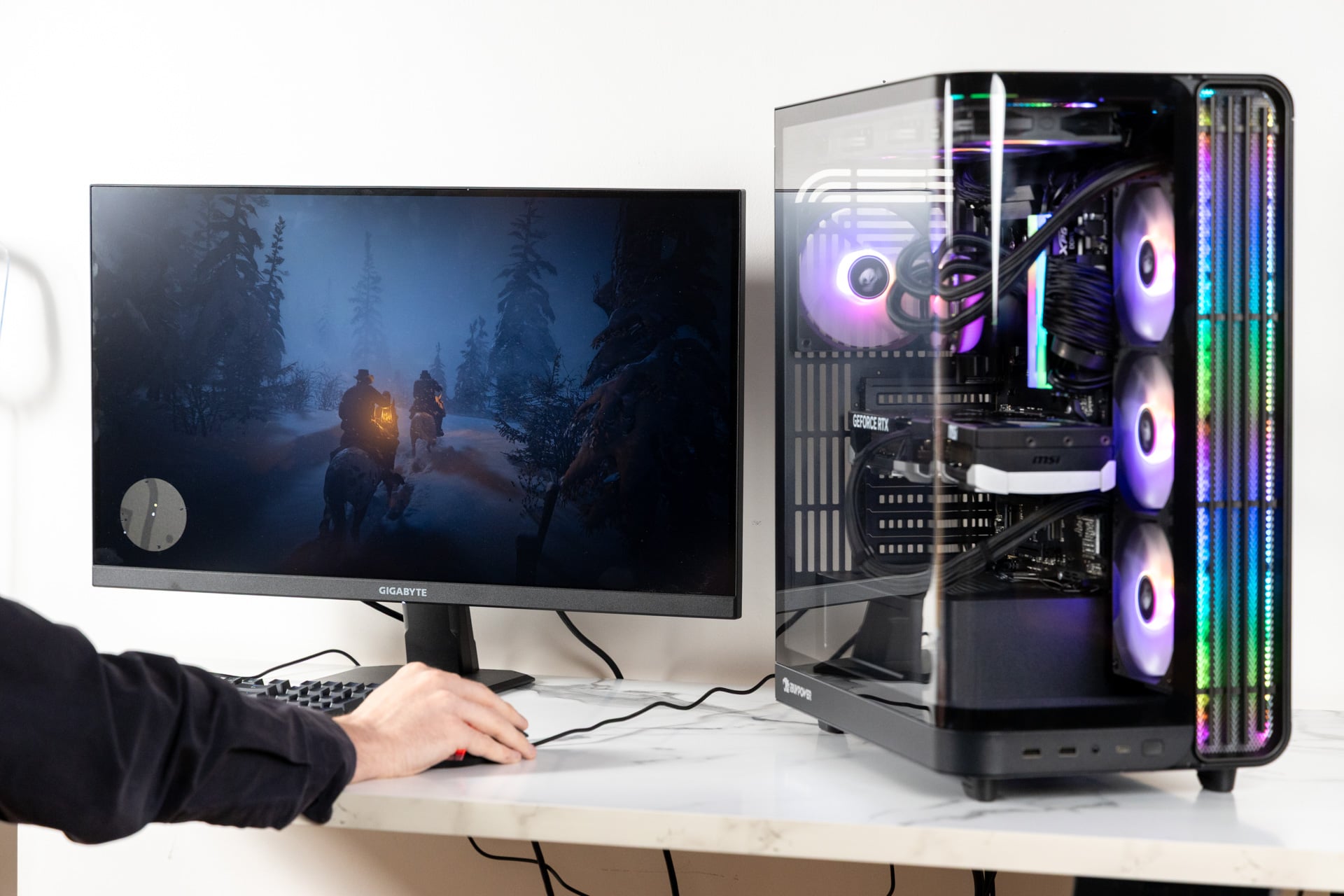
Installing your own GPU really isn’t a big deal. It keeps the PC from needing to come packaged with annoying expanding foam on the inside. As for everything else, the iBuyPower Trace X performs just fine. Is it the pinnacle of airflow design? Probably not.
At nearly $3,500 when opting for all the options I had tested, you won’t be disappointed by looks or performance. There’s another higher-end “RDY” preconfigured model with an older Intel Core i9-14900KF CPU installed that’s going for $2,900. Anything with 32GB of RAM and an RTX 5080 will be pricey, whether you’re buying from a prebuilt PC maker like iBuyPower or not.
For what you get, the Trace X is a solid all-around PC. It certainly drew some second looks and at least one “ooh” from a colleague on Gizmodo’s consumer tech team. Is your friends’ envy worth upwards of $3,000? That’s for you to decide.