After breaking the sound barrier for the first time, NASA’s X-59 supersonic jet flew faster and at higher altitudes in preparation for its most crucial test.
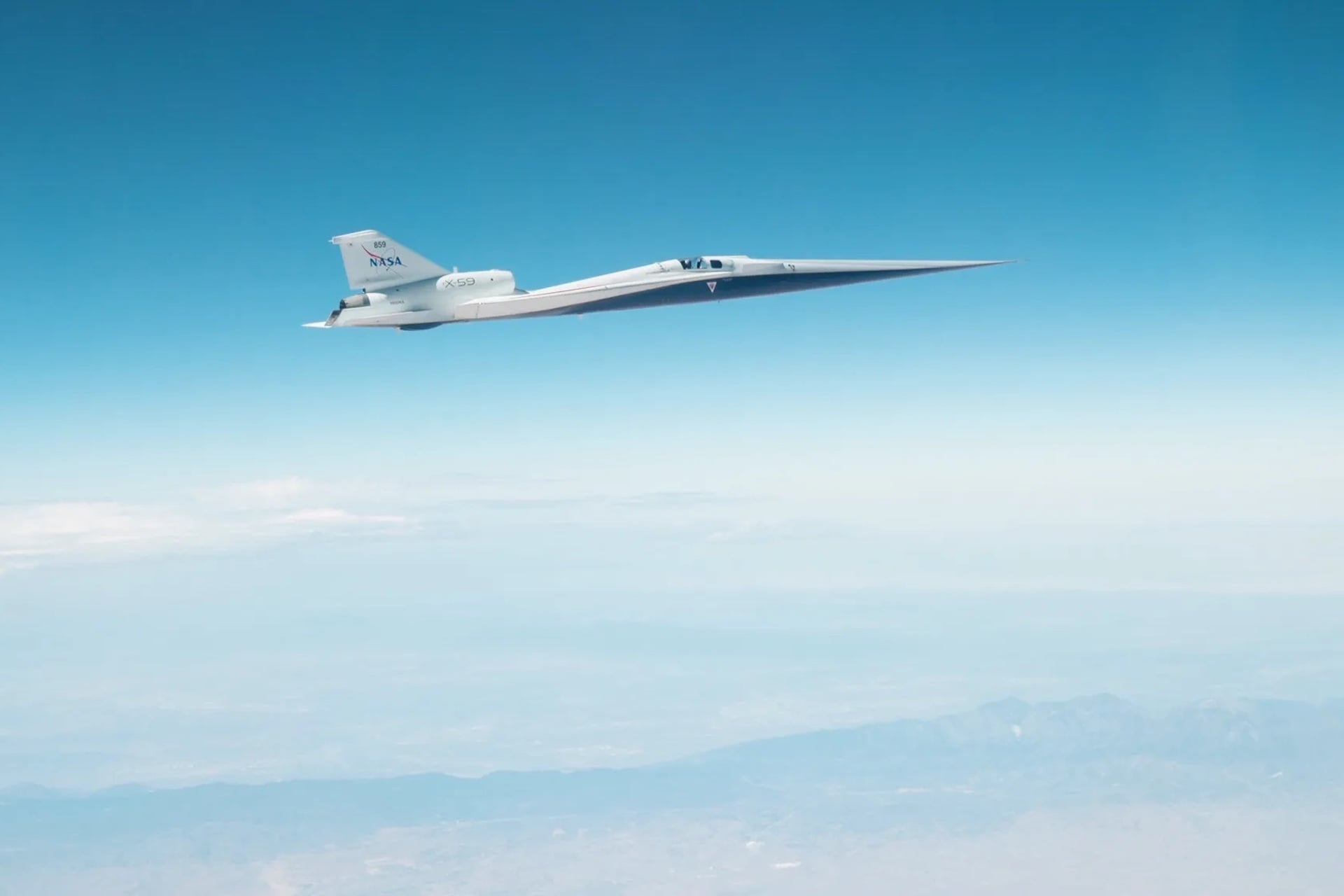
The experimental aircraft reached a speed of Mach 1.4 during a test flight on Friday, June 12, flying at the same conditions NASA will use to gather data from the public on the aircraft’s noise, according to the space agency. The X-59 is designed to break the sound barrier without producing the loud, explosive sound known as a sonic boom.
NASA is preparing to fly the aircraft above selected U.S. communities to gauge public response, aiming to use X-59 to pave the way for supersonic jets to fly over land without their audible disruptions.
Full speed ahead
The X-59 broke the sound barrier for the first time on June 5, reaching a top speed of approximately Mach 1.1, or 713 miles per hour (1,147 kilometers per hour), as it soared above California’s Mojave Desert.
A week later, the aircraft conducted a mission conditions flight, an even more critical step that brings the X-59 closer to operational use. During Friday’s test flight, X-59 flew at 925 miles per hour (1,488 km/h) and at approximately 55,000 feet (16,764 meters). The aircraft will fly at the same speed and altitude over several parts of the U.S. to collect data on public perception of its quiet sonic thump.
The aircraft’s sonic thump, as NASA refers to it, has not been heard just yet. During these early supersonic flights, X-59 was accompanied by a NASA F-15 chase plane, a traditional supersonic jet that produces sonic booms at supersonic speeds. The chase plane monitored X-59 during the test flight and simultaneously drowned out its noise.
During upcoming flights, the F-15 will carry a shock-sensing probe to gather measurements of the X-59’s shock wave signature and collect early data on its supersonic performance, according to NASA.
The road ahead
X-59 still has months of performance testing before it debuts its sonic thump to the public. The team at NASA will continue to test the aircraft at a variety of altitudes and conditions to complete a process known as envelope expansion, whereby engineers test a new vehicle beyond its validated limits.
Afterward, X-59 will enter its acoustic validation phase. That’s when researchers thoroughly measure the aircraft’s supersonic acoustic signature to confirm X-59 is indeed performing as intended, producing a sonic thump rather than a boom.
NASA began developing its quiet supersonic aircraft nearly a decade ago, awarding Lockheed Martin with a $247.5 million contract to build X-59 in an effort to lift a longstanding ban on supersonic flights of nonmilitary aircraft over land.
NASA will use X-59’s upcoming flights over U.S. communities to gather data on how people perceive the aircraft’s quiet thump. The data from X-59’s test flights will be used to help establish new data-driven noise standards for commercial supersonic flights.
“Each flight brings NASA one step closer to flying the X-59 over communities and gathering feedback that could help shape the future of commercial supersonic flight over land,” the space agency wrote.