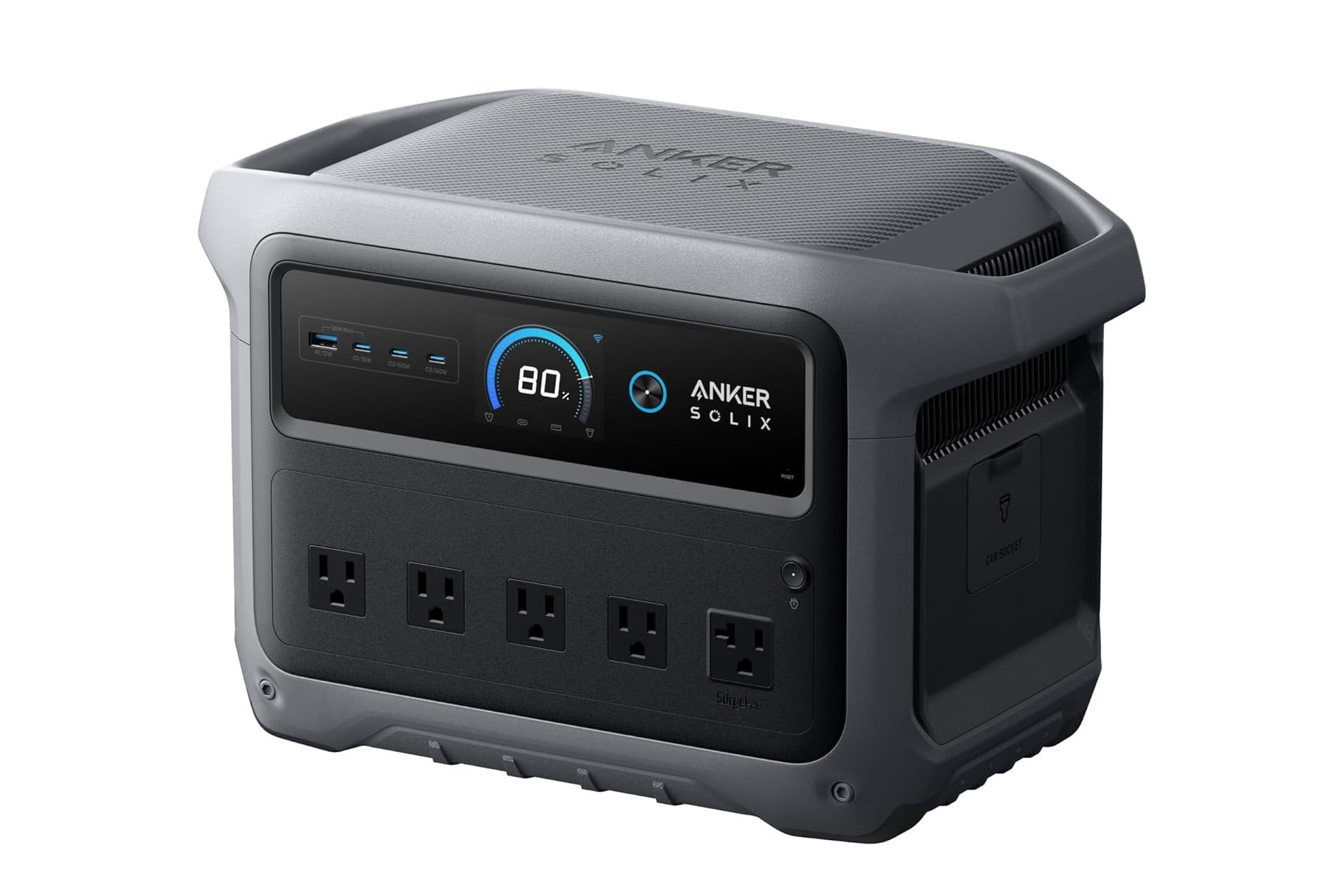
Ice on the power lines tends to take the grid down at the worst possible hour, usually on a dark evening with the fridge full and half the family’s phones under 20%. Anker’s SOLIX C1000 Gen 2 is built for exactly that kind of night, and right now Amazon sells the 1,024Wh power station for $469 instead of $799, cutting its price by 41% just as winter storm season gets going.
The C1000 Gen 2 sits in the middle of Anker’s SOLIX lineup: big enough to keep the essentials running through an outage, still small enough to carry from the garage to the kitchen. Anker says it’s 14% smaller and 11% lighter than comparable models, which matters when you’re moving it around a house in the dark.
Recharged Before the Next Storm Hits
The headline feature is charging speed. With HyperFlash switched on in the Anker app, the C1000 Gen 2 pulls 1,600W from a wall outlet and goes from empty to full in 49 minutes. If the forecast calls for another storm tomorrow, that’s an hour between power coming back and the station being ready again, instead of an entire evening plugged in.
Output is rated at 2,000W continuous, with peaks up to 3,000W, across 10 ports. That’s enough to keep the refrigerator and the Wi-Fi router going while everyone charges their phones, and the 1,024Wh battery decides how long it all lasts. To give an idea, a fridge drawing around 150W on average would run for several hours on its own, while a 1,500W space heater would drain it in well under an hour, so I’d save the heater for short bursts and let the station handle the smaller loads.
The UPS mode is the part I find most reassuring for winter. Leave the C1000 Gen 2 plugged into the wall with a device connected to it, and if the grid drops, it takes over in under 10 milliseconds. That’s fast enough for a CPAP machine, a desktop computer or a home office setup to keep running without a restart, which is the difference between losing a night’s sleep or a work file and not even noticing the outage.
Anker uses LiFePO4 cells, a chemistry known for stability and long life. The company rates the battery at 4,000 cycles before it drops to 80% capacity, which it translates into roughly 10 years of regular use. The station also accepts up to 600W of solar input (60V max) and recharges in about 1.8 hours from panels, handy for longer outages or camping trips once the snow melts. The Anker app adds a time-of-use mode that charges when electricity is cheap and runs your devices from the battery during peak hours.