When disaster looms, timing is everything. Without enough warning to effectively implement emergency planning, even the most well-resourced cities can be devastated by extreme weather.
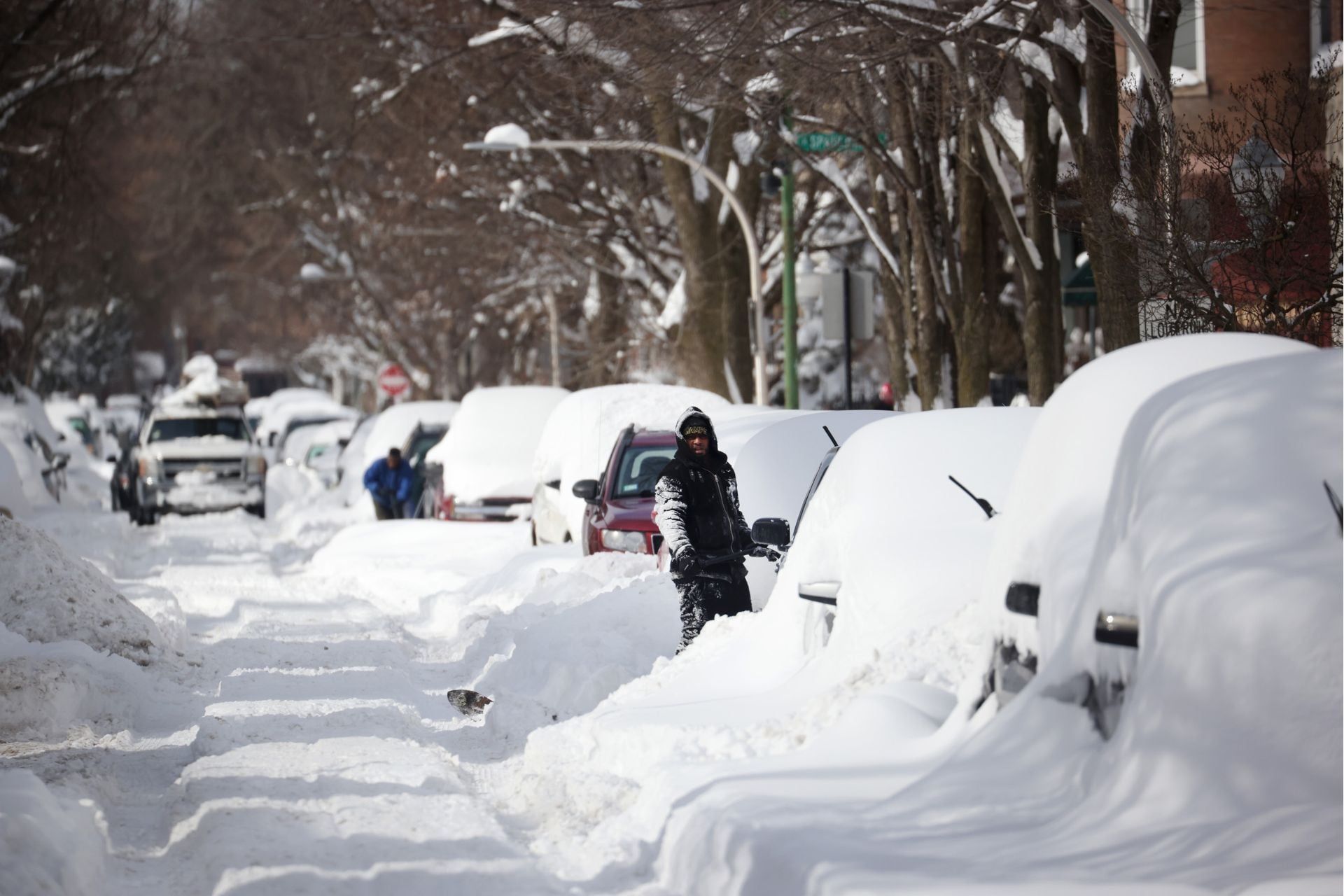
Take the power crisis that struck Texas in February 2021 for example. Three back-to-back winter storms—including winter storm Uri—knocked out electricity and heat for millions, contributing to 246 deaths. If utilities had had more time to shore up natural gas supplies, reinforce infrastructure, and warn their customers, the toll may not have been so high.
The problem is that predicting the weather two to six weeks out is notoriously difficult. Past the two-week mark, small differences in current atmospheric conditions can lead to dramatically different weather outcomes, making a single, deterministic forecast unreliable. Meteorologists instead rely on probabilistic forecasting, which uses multiple model simulations to estimate the likelihood of different outcomes.
But these forecasts have their own limitations. As models simulate weather over successive time steps, errors can accumulate, reducing their accuracy over several weeks. Even the gold-standard numerical models from the European Centre for Medium Range Weather Forecasts (ECMWF) and standout AI models like Google DeepMind’s WeatherNext family struggle with this “subseasonal” range.
A new “wrapper” could help with that. This post-processing tool, detailed in a paper published today in the journal Nature, uses machine learning to correct systemic errors in forecast models and improve the accuracy of their subseasonal outlooks.
In ECMWF’s 2025 real-time forecasting competition, the tool produced the most accurate global forecasts for all weather variables and forecast periods, outperforming numerical models from six operational forecasting centers, an international ensemble of numerical models, ECMWF’s own AI model, and forecasting systems from 34 competing teams around the world.
“It’s model agnostic, and the paper shows that whether it’s a more traditional model or a newer AI model, we can correct these errors that are systemic to the model,” Judah Cohen, a climatologist and research scientist at the Massachusetts Institute of Technology, told Gizmodo. “Just by correcting them, we can take an unskillful model and make it skillful.”
Innovating more actionable forecasts
Cohen built the probabilistic bias correction (PBC) tool alongside Lester Mackey, a statistical machine learning researcher at Microsoft whom Cohen credits with the initial idea of using machine learning to reduce errors in forecasting models. The pair collaborated for over a decade to bring this idea to fruition.
Their work, supported by MIT students, postdocs, and other researchers at Microsoft, clearly paid off. When tested on ECMWF’s leading numerical and AI models, the PBC wrapper doubled the subseasonal accuracy of the AI system and improved the numerical model’s skill for 91% of pressure, 92% of temperature, and 98% of precipitation targets.
In the new Nature study, Cohen, Mackey, and colleagues demonstrate that the PBC tool can improve land forecasts in most regions of the world. They also showed significant improvement to other models, putting them on par with the ECMWF’s state-of-the-art systems. But in Cohen’s opinion, the most significant finding was that the PBC tool improved subseasonal extreme weather forecasting.
“Extreme weather has the largest impact on our society and improved forecasts of these events can yield large societal benefits,” he said. “Interestingly, previous bias correction schemes actually made forecasts of extreme weather worse, and our model showed clear improvement of extreme weather forecasts.”
For forecasts made three weeks ahead, the PBC wrapper significantly improved the ECMWF numerical model’s ability to predict extreme heat, extreme precipitation, and unusually high sea level pressure. The researchers also tested the tool on real-world floods that occurred over the last decade, finding that it improved flood prediction skill by 76% to 92%. For severe floods—those that caused more than 100 deaths or displaced at least 80,000 people—it improved forecasting skill by 86% to 150%.
Cohen hopes that the tool will lead to more actionable extreme weather forecasts. One key benefit of this PBC framework is that it is open-source and doesn’t require a supercomputer to run, making it accessible even in places where funding and infrastructure for weather forecasting are limited. The meteorological office for the Republic of Kenya is already experimenting with the tool to improve monsoon forecasting, he said.
As climate change leads to more extreme and anomalous weather, giving communities more time to prepare for these events will be invaluable. Pushing the boundaries of subseasonal forecasting through tools like PBC could eventually save lives and reduce damages.