In the year 2026, predicting hyper-local weather is still tricky, even though it impacts everything from supply chains and sporting events to tourism and energy production. Now, Google says its latest AI model is getting a lot better at it.
Google DeepMind and Google Research rolled out WeatherNext 3 on Thursday, which the company calls its most advanced and accurate global AI weather model yet.
“Our model learns directly from real-time observations, enabling it to provide timely and more localized predictions for the weather events that impact people the most,” the company said in a press release. “By using raw satellite data to produce a forecast every hour in high resolution, our model makes reliable forecasts accessible across Google products worldwide.”
The use of real-time, hourly satellite images appears to be the big breakthrough for this model.
For context, traditional weather models rely on what is known as numerical weather prediction. These models take atmospheric observations gathered from sources like satellites, weather stations, and weather balloons and run them through complex physics simulations on supercomputers to predict what the weather will look like.
AI weather models, on the other hand, can generate forecasts much faster, but still mostly rely heavily on data produced by those traditional systems. Google says that can result in a roughly six-hour lag, making it harder to predict rapidly changing conditions.
WeatherNext 3 takes a different approach by feeding real-time satellite observations directly into the AI model alongside traditional weather analysis data. It is also trained directly on sparse weather station observations. That allows it to generate a new global forecast every hour and provide much more localized predictions.
For some surface variables, including temperature and moisture, WeatherNext 3 produces forecasts at up to 5-kilometer resolution. That means it can show how weather conditions are different across areas five kilometers apart. At 25-kilometer resolution it make wind speed forecasts.
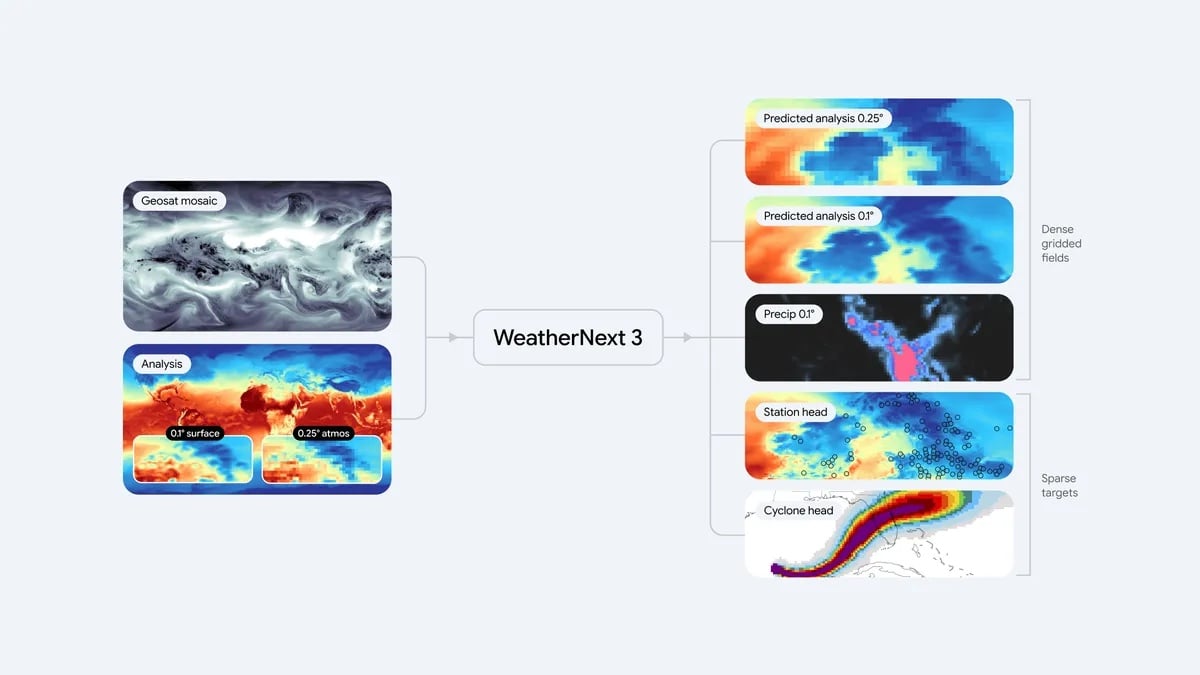
This is especially important in places where weather can change significantly over short distances, like coastlines and mountain ranges.
Additionally, Google also claims WeatherNext 3 can deliver up to 50% more accurate precipitation forecasts when users are looking a day or more ahead
Google says those improvements could be especially important across parts of Latin America, Africa and Asia-Pacific, where high-resolution forecasting has historically been limited by the enormous cost of the supercomputers needed to run traditional models.
WeatherNext 3 is already taking the top spot on Operational WeatherBench, an independent leaderboard run by AI weather forecasting startup Brightband that compares the accuracy of leading AI and traditional weather models.
WeatherNext 3 is also adding forecasts aimed specifically at renewable energy production. The model predicts wind speeds 100 meters above the ground, roughly the height of a wind turbine, along with cloud cover and solar radiation, which could help wind and solar operators estimate how much electricity their facilities will generate.
Starting Thursday, Google says WeatherNext 3 will begin powering weather experiences across Google Search, Gemini, Google Maps, the Google Maps Platform Weather API and Google Earth Engine.
Despite those claims, Google still directs users to their local meteorological agency or national weather service for official forecasts, severe weather warnings and public safety advisories.
Google did not immediately respond to a request for comment.