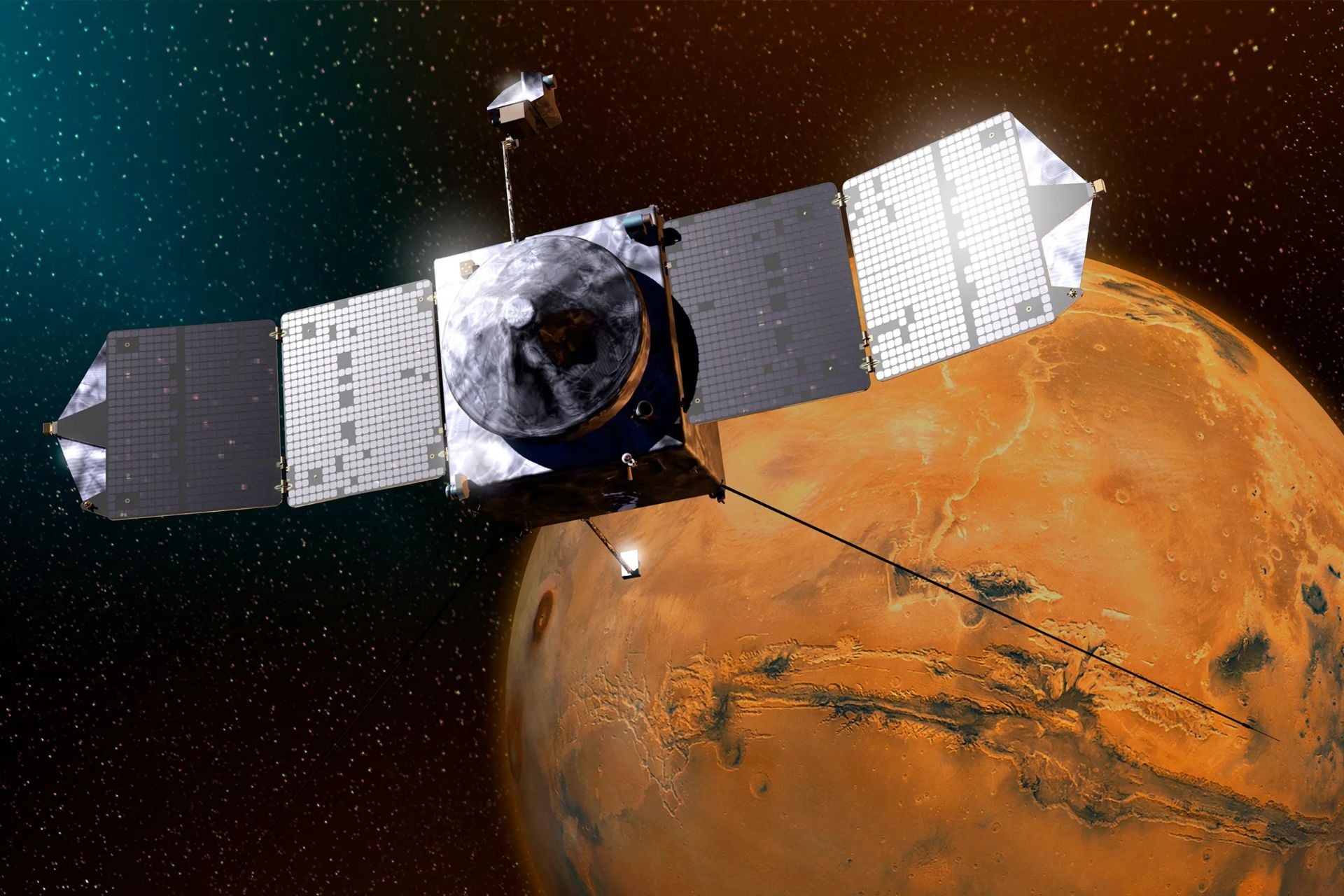
After more than a decade in space, a vital Mars satellite suddenly went dark in December. NASA has spent the last six months trying to reestablish contact with the orbiter, but now, the agency has finally thrown in the towel.
NASA formally ended the Mars Atmosphere and Volatile Evolution (MAVEN) mission on Wednesday, explaining that the spacecraft is “not recoverable” and is “no longer capable of performing its science and data relay mission.” This is the update the planetary science community has been dreading for months. The data MAVEN collected over its 11 years in Mars orbit significantly advanced our understanding of the Red Planet, helping researchers unravel the mystery of how its ancient water and atmosphere depleted.
“The science MAVEN has given us is key to informing what kind of radiation protection and safety measures we must take before sending humans to Mars,” Louise Prockter, director of the Planetary Science Division at NASA Headquarters in Washington D.C., said in an agency statement. “The data collected from MAVEN will continue to provide valuable insight into Mars for decades to come.”
Gone but not forgotten
MAVEN launched in November 2013 and reached Mars less than a year later. Its mission was originally supposed to last one year, but the orbiter remained operational for a decade longer, gathering copious observations of the Martian atmosphere and its evolution.
According to NASA, the spacecraft launched with enough fuel to keep it running until 2030, but the agency lost contact with MAVEN after it emerged from behind Mars on December 6. Telemetry data showed that all its subsystems had been working normally prior to the loss of signal, but attempts to reestablish contact were unsuccessful.
A brief fragment of tracking data indicated that the spacecraft was in safe mode and rotating at unusual speed when it went dark, leading investigators to believe that this rotation drained MAVEN’s batteries and caused its communications system to fail. While NASA is still working to determine the root cause of the anomaly, the review board has deemed the mission unrecoverable.
MAVEN’s scientific legacy
Scientists believe that over billions of years, the Red Planet transformed from a potentially habitable world with a thick atmosphere and abundant surface water into the desolate wasteland it is today. Before MAVEN, the processes driving that transformation remained a mystery. But last year, the mission team announced that the satellite had directly observed an elusive atmospheric escape process called “sputtering” for the first time, offering clear insight into where Mars’ water went.
Sputtering occurs when atoms are knocked out of the atmosphere by charged particles. Because Mars lost its magnetic field early on in its history, its atmosphere is directly exposed to solar wind, meaning it is constantly bombarded by charged particles. MAVEN’s direct observation of sputtering confirmed that this process was a key driver of atmospheric loss back when Mars was still a young planet and solar activity was more intense.
Data gathered by MAVEN led to other groundbreaking discoveries too, including a new type of Martian aurora and that erosion of the planet’s atmosphere increases during solar storms. The satellite also served as a communications relay for NASA’s Mars rovers, beaming data from those surface explorers back to the Deep Space Network on Earth.
While MAVEN’s operational lifespan has come to an end, scientists will continue to learn from the trove of data it gathered over the past 11 years. Their findings will deepen our understanding of Mars as humanity strives to reach it, helping NASA design safe crewed missions to the Red Planet.