
Whenever you hear someone discussing an SEO strategy, the term backlink always comes up. You then start wondering what are backlinks in SEO and why they’re so important. SEO backlinks are links found on other websites that point to your website. Simple, right?
The same goes in reverse — if you place a link to the other website, that’s also a backlink.
Their importance goes multiple ways. However, the most essential perk is sending organic traffic to the website in question, which drastically improves its visibility on Google or other search engines. As you can already assume, this aspect is crucial for properly realized SEO.
If you find these short explanations sufficient, feel free to click off. However, we wouldn’t do that because there’s much more to learn. We’ll delve deeper into the meaning of SEO backlinks, their effects, and most importantly — how to get more of them. Stick around.
What Are SEO Backlinks?
The definition of a backlink is simple — as said, it’s a link on a website that points to another website.
On the contrary, an internal link points to another page or post on the same website. Now, in terms of SEO or Search Engine Optimization, a backlink has tremendous value. If you link to another website, the search engine will see this as a recommendation. That’s great.
It’s like going to a doctor and then recommending him to your friend. Once your friend goes to the same doctor and is satisfied, he will then recommend him to another friend. The circle continues and your doctor gets more patients, resulting in more income — good for him!
Let’s get back to backlinks now. Not all backlinks are equal, so you want to acquire as many credible ones as you can. The more you have them, the more you have the chance to rank higher in search results of search engines like Google, Yahoo, Bing, Yandex, and more.
Why Are Backlinks Very Important in SEO?
This segways into another discussion about the importance of these potent metrics.
As said, a backlink in SEO acts as a recommendation, which increases the linked website’s organic traffic, so you want plenty of them. Such “recommendations” signal to the search engine that your website and its content are credible, which propels it higher in SERPs.
To do this, the search engine evaluates both the quality AND quantity of the backlinks. If you have plenty and they come from authoritative websites, we say “Bravissimo!” because you’re set on a path of success. If you have plenty but from non-reputable websites, that’s bad.
The same goes for having very few backlinks but poor quality or vice versa.
Authoritative websites tend to have a high Domain Authority score. You want this to be as high as possible for your domain, and to achieve this, you want us to say “Bravissimo!” i.e. to have authoritative sites link to it.
Google has its PageRank algorithm, which measures the page authority based exactly on this aspect.
It’s worth noting that more than a dozen factors influence your website ranking in search engines. However, roughly half of them are backlink-related, which speaks volumes about the importance of proper link-building.
Get More Quality Backlinks With Semrush
Backlink Quality — The Most Valuable Parameter
So, to digress on what are backlinks in SEO. These are links that point to another website and directly and positively influence its visibility, bringing more organic traffic to the given domain. Good enough? Okay.
But now, we need to define what exactly is a quality backlink.
Because, as stated, this is the make-or-break factor that can either propel your website to great heights or glue it to the ground and not allow it to spread its wings. Here’s what makes a quality backlink that positively influences your website and its search engine visibility.
Domain (Page) Authority Score
Let’s be real — this is one of the most important aspects of a quality backlink. If a referring domain or page has a high authority score, you’re in for success. Let’s take a reputable website like the New York Times. Imagine getting a backlink from it. It’s invaluable!
Now, switch over to a small blog or any “random” site (no offense to random sites), and you’ll find that this type of backlink carries less “weight”. Of course, every website has a combination of the two and that’s how natural link-building works — nothing new about it.
Still, as part of your SEO strategy, you want to aim for more valuable ones, and later on, we’ll explain how you can do this using Semrush or any other established SEO tool.
Since we touched on domain and page authority, it’s good to know what the metric actually is. With Semrush, for example, it’s a combination of its link power, organic traffic, and the degree of naturality of the backlink profile. The last one explains how natural the backlink profile is — if it’s spammy, the score goes down.
The Authority Score can be found in any SEO tool. Here’s an example of Semrush:
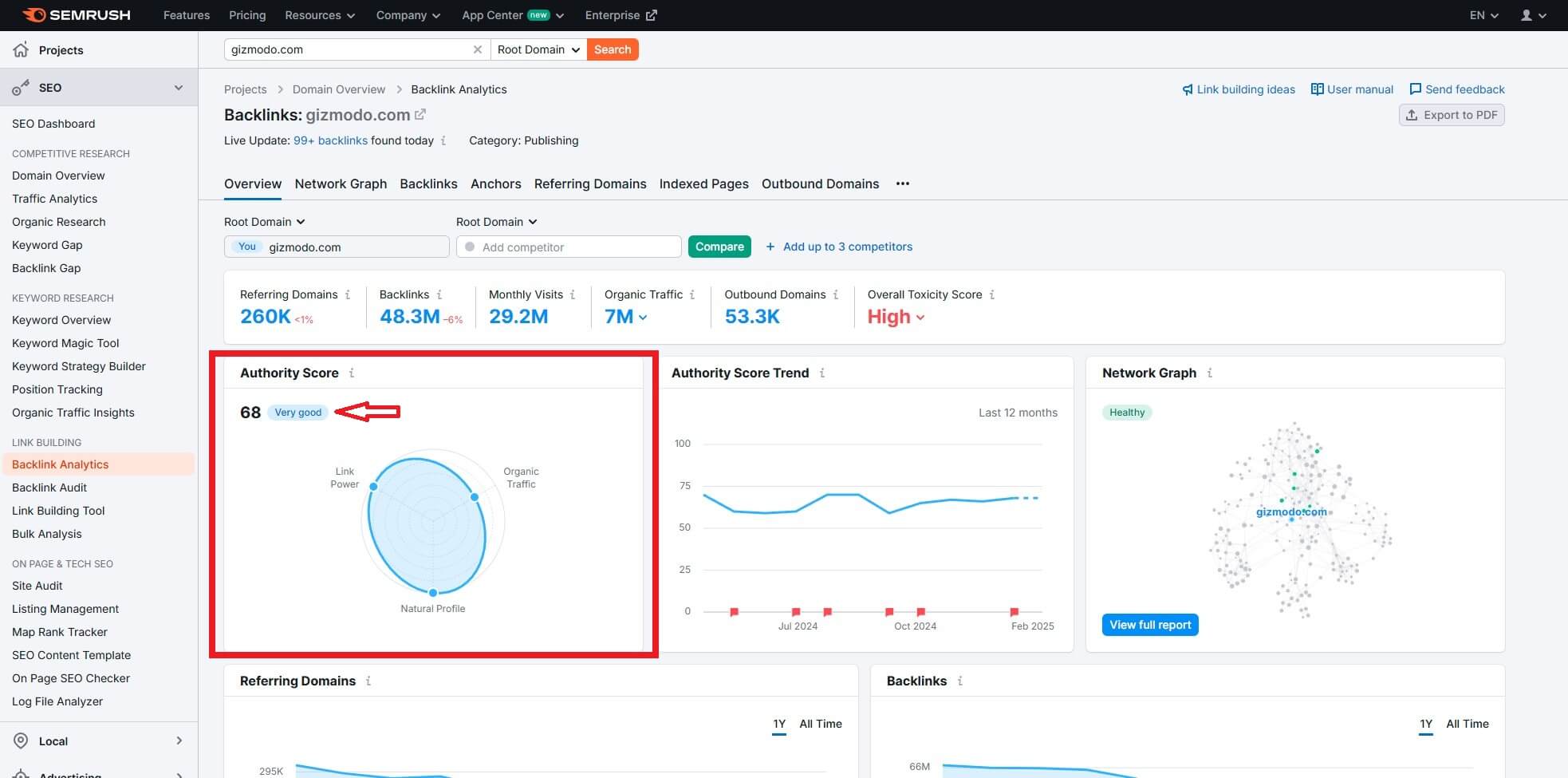
You can use this Backlink Analytics tool to gauge the Authority Score of the referring domains you want to pursue. Again, we’ll explain HOW you can actually pursue them later.
Backlink Type (Follow Attribute)
Another extremely important aspect is the follow attribute or follow status. We have:
- Follow
- NoFollow backlinks
The first backlink is the one you want. It tells Google to “follow” them, which is how you get link equity. However, the NoFollow type of backlink tells Google the opposite — to NOT follow the link, making it less valuable.
If someone doesn’t want Google to follow the link, a link’s HTML code can be altered in the following ways:
- rel=”nofollow” — this is the most typical link attribute, which tells Google not to follow the link if one website doesn’t want to “support” or endorse the other one.
- rel=”sponsored” — as the HTML code implies, it indicates that the website has paid for the link, hence the word “sponsored” in the code.
- rel=”ugs” — these are user-generated content links usually found in forums, blog comments, product reviews, etc.
If you want to endorse the website you’re referring to, simply don’t add any of these attributes. However, this sometimes isn’t a guarantee of success because some types of links, like those in blog comments, won’t be followed by Google or another search engine.
In general, however, you want to have as many Follow (also known as DoFollow) backlinks to your website. To check if this is the case, you can use any SEO tool or try Semrush risk-free, use Backlink Analytics, and locate this section:
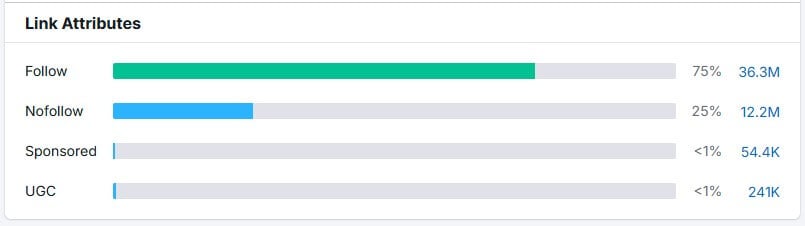
As you can see, we have many Follow, some NoFollow, and very few sponsored/UGS links.
Anchor Text (Very Important!)
Anchors are important for ships but they’re invaluable for SEO. You don’t need to use any paid or free SEO tool to craft proper anchors but you do need some SEO knowledge. First of all, what the heck is an anchor? It’s a text that you attach your link to — see the “free SEO tool” part above? That’s an anchor.
From this anchor alone, you know where the link leads to. Probably to a page where we divulge our favorite free SEO tools. Well, Google also loves to understand what the linked page is about, which is why it’s vital to use concise anchors like the one above.
If the anchor is “the sweetest types of apples”, you can’t link to a page about the best action movies or whatever. This practice is well-known even by SEO enthusiasts, let alone experts. However, we found that many inexperienced users tend to sort of abuse it and be spammy.
Remember — it’s all about being NATURAL. While you should include a target keyword in the anchor, don’t overdo it. Have you heard about Google Penguin? It’s an advanced algorithm that detects unnatural anchor texts and guess what? Marks them as spam — voila!
With that said, backlink anchors should be descriptive, natural, and varied. Instead of always using a “free SEO tool” to link to the said page, go with things like “SEO tools you can use for free”, “complimentary SEO tools”, etc.
We know this is internal linking talk but a spammy link is a spammy link, be it internal or external.
Topical Similarity
Another sign of a quality backlink is topical similarity. Google appreciates when the two websites are topically related, and while the opposite can work, the former is always recommended.
Let’s think logically for a second, or a minute, perhaps.
We’ll take a fishing website as an example. How can a fishing site link to a soccer website naturally? How would that anchor look and better yet — WHY would a fishing site even link to a soccer website?! But a fishing site can link to, let’s say, a fishing restaurant website.
It’s a trivial example but you get the point. If the two websites are similar topic-wise, backlinks will be more natural, which, as said earlier, is very important. Not to mention the “weight” of the backlink will be higher in Google’s “eyes”, making the endorsement more valuable.
Backlink Uniqueness
One thing we don’t hear many talk about is backlink uniqueness. Let’s go back to the doctor and imagine a scenario where only you recommend him. Every recommendation comes from one John Doe and no one else. Something stinks, right? Now, let’s go to backlinks.
Imagine only one website links to your website and it does so a hundred — no, a thousand times! Each consecutive backlink is less valuable, and can, in fact, produce a diminishing return effect, where each consecutive backlink is DETRIMENTAL instead of beneficial.
So, it’s just as you think it is. It’s better to have 200 different sites link to your site once rather than 50 websites, each linking to you five or ten times. That said, unique backlinks will always be better for your website, just as varied keywords can also help it rank higher.
If you’re struggling to find unique keywords, by the way, check out our favorite keyword research tools.
One more remark. When you analyze the backlink profile of a website, you see this “number of referring domains” which is a metric that displays your backlink uniqueness.
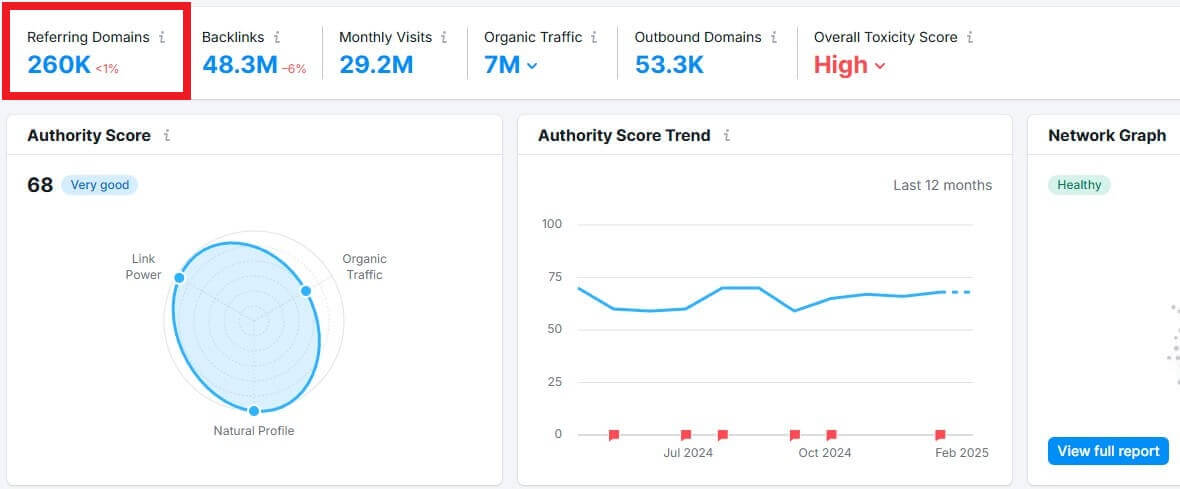
You can see that we have 260K referring domains at the moment. WHO’s website, for example, has 704K at the moment and an Authority Score of 96, making it extremely credible and authoritative.
How to Get More SEO Backlinks? Five Essential Tips
Now that we know what are SEO backlinks and which metrics you need to “chase” to improve your website’s backlink profile, it’s time to see what you can do about it. We have five essential tips for link-building — all tested and proven to work by our experts.
Generate Linkable Content
Linkable content is key for general link-building. For someone to recommend you, you must have certain skills and qualifications. In the same fashion, other websites will link to your website if you provide quality and informative content. How to achieve that, however?
Well, it depends on your niche but generally, you want content that’s hard to improve upon, which will make other people more inclined to simply link to it.
It can be an in-depth list or ranking, a well-done guide on doing a specific task, and so much more. You can also draw some inspiration from your competitors. For example, using Semrush, you can open Backlink Analytics and see which pages have the most backlinks.
From here, you can try to improve upon the existing content and then use Semrush’s Link-Building Tool to reach out to your competitor’s referring domains and ask for a backlink.
Reach Out to Other Websites
Speaking of that, we want to address that Semrush has a dedicated link-building tool, which works incredibly well for reaching out. In fact, both Semrush and SEO PowerSuite have this tool, allowing you to get in touch with the website owner and collaborate more easily.

How does it work? In both cases, you’ll get a list of prospects i.e. the websites that the SEO tool recommends. From there, once you select the specific site, you have the option to contact the owner and politely ask for a backlink or even request a guest post, for instance.
Once you’re in contact, it’s easy to negotiate and find a common language. You can agree on a product review, a guest post, or a simple backlink that would endorse your website. Conversely, you can also provide a valuable backlink to that website as a sign of appreciation.
Use Broken Link Building
Normally functioning backlinks are great and if they’re quality enough, you’re all set. However, broken backlinks are your dead weight because they’re there but don’t work! It’s like a road that leads to nowhere. You step on the throttle and fall from the cliff at the end.
Broken backlinks are a bottleneck to your website’s visibility and produce a famous “404 error”. But how to find broken backlinks? Well, you can use Semrush and its Backlink Analytics tool. Simply go to Indexed Pages and then tick “Broken Pages” to locate those.
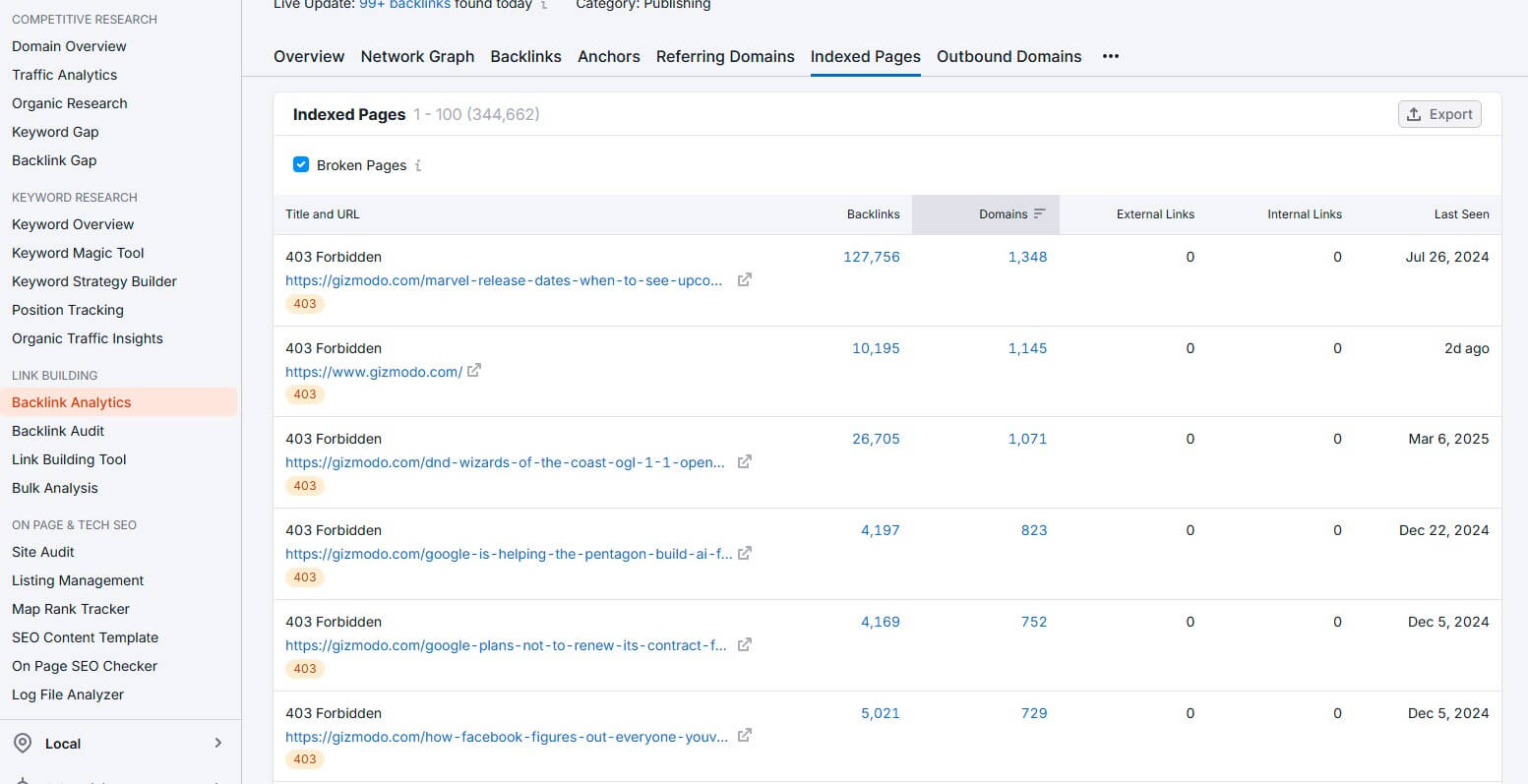
Carefully examine your broken pages and if there are suitable link replacements, consider recovering them. Keep in mind you’ll also have to reach out to the referring domain’s owner to let him know that the link should be replaced — both of you will benefit from it.
You’ll have a valid SEO backlink and the other website will have a link that actually leads somewhere.
Broken link building also works with SE Ranking which we also use, and it’s quite similar to Semrush. You can use any SEO tool, as long as it serves its purpose.
Capitalize on Your Competitors’ Backlinks
A compelling SEO strategy is often about replication. You look at what others do and if that’s working for them, you do the same! To get more SEO backlinks, you can use the Backlink Gap tool found in many SEO tools to look for “gaps” between your and competitor’s sites.
Semrush has a handy tool, which does just that.

As you can see, it displays all the referring domains that link to their sites but not yours. Now, you have several options. You can replicate and improve upon the content on these pages and hope they’ll link to it, too. If you think you already achieved this, simply use the Link-Building Tool and reach out to them.
Send Your Product(s) for Reviews
Lastly, you can get more recognition by sending your products for reviews — if you have some, that is. Be it a digital or physical product, you can send your product to relevant bloggers who can test it and then link to your website for people to learn more about it,
It doesn’t even have to be a review — it can simply be a guide on doing something, which requires your product. This type of backlink will be even more natural and, thus, more valuable.
Just try not to be too pushy. Be polite and kindly offer the product to a relevant blogger. If he or she accepts it, great. Just don’t offer your product for a good review — otherwise, you’ll violate Google’s Webmaster Guidelines. Let them be completely honest about it.
Conclusion
By this point, you should already know what are SEO backlinks.
With this knowledge, you can take on the complex task of managing and improving your backlink profile, which you can spice up with a rank-tracking tool to have a full picture of your results. While Semrush and SE Ranking are excellent options, you can use any other SEO tool you deem appropriate.