Making your website stand out is difficult if you don’t improve your SEO first. Putting hours, days, and even months in vain to see mediocre results is as painful as it gets. If we just described your situation, you’re in good hands. Our experts will gladly help you. SEO stands for Search Engine Optimization.
It’s the #1 factor that influences your website ranking. This broad term encompasses many things, from backlinks and keyword optimization to content quality, UX, and dozens of other factors.
These must “click” like LEGO pieces to make the website functional and, more importantly, dominant in SERPs (Search Engine Results Pages). In today’s guide, we’ll provide helpful tips on improving SEO and elevating your website above the fierce competition.

Improve SEO With These 15 Helpful Tips
Before we proceed, we’ll clarify that our experts crafted all 15 SEO improvement tips. As long-time website and business owners, our experts have tested hundreds of techniques to optimize search engine rankings and drive more traffic and conversions.
We found that in 2026, doing these 15 things will generate more attention and skyrocket your site to the top of SERPs quickly:
1. Improve Your Best-Ranking Pages
Honing your strengths can boost your website’s SEO. Find the pages with the most potential and optimize them further. If you’re unsure how to do this, use Semrush and its Position Tracking tool.
Open this tool, select the “Overview” menu, and under “Top Position & Changes“, select “#4-10” and then press All. You’ll now see all pages that appear in the 4th to 10th position in Google SERP. Perhaps, you might not have any pages in these positions.
Don’t worry – you can always select “#11-20” in the menu above. Either way, the most “potent” pages can be updated and optimized further to gain more traction.

How to optimize them? You can use some of the tips listed in this article. You can add more text, improve formatting, include better internal linking, shorten the article to remove more fluff, etc.
2. Update Outdated Content on Your Site
A bottleneck, such as outdated content, is handy to reduce to a minimum. Outdated pages won’t improve your SEO – they will do the opposite. For instance, check your product reviews and see if they’re accurate at the given time. Let’s take our NordVPN test as an example.
This review was updated several times to reflect the ever-changing VPN service. To clarify, we’re not discussing only reviews. Outdated content will be present in blog posts or on any other page. Inspect your website for outdated content and make sure the information is up-to-date.
One more thing. When updating your outdated content, it’s smart to set the date to the present day. That will tell Google that the page has new content, helping it rank it higher and register the change.
3. Improve Your Website’s Performance & UX
Improving your SEO also comes down to website performance and UX. By performance, we mean loading times. Henceforth, speeding up your site is always great. You can do this in various ways, such as:
- Compressing your on-site images
- Further reducing file size on your website
- Get rid of unnecessary scripts that slow things down
You can use Semrush again for this purpose. Its Site Audit tool crawls your website for errors and optimization problems and advises solutions. The On-Page SEO Checker is also helpful for checking individual pages and optimizing SEO to rank specific pages higher.

We must mention Google PageSpeed Insights. You can use this platform to check your website’s Core Web Vitals. It’s also found in Semrush and SE Ranking. Three metrics characterize Core Web Vitals:
- LCP (Largest Contentful Paint). This is the loading speed of the main page.
- FID (First Input Delay). This parameter tells how quickly the page reacts to the user’s input or action.
- CLS (Cumulative Layout Shift). Finally, this parameter informs you about the page’s visual stability.

If the website performs well, all three should be in a green area (screenshot above). Again, you can use Semrush’s Site Audit or opt for PageSpeed Insights—both accurately evaluate your website’s performance.
Audit your website with Semrush
An Optional Tip: Get a Powerful Hosting Service
Google’s 2021 algorithm update focuses on the user experience, also known as UX. Improving it also boosts your SEO. Getting a reliable hosting provider with no downtime, powerful servers, and ample performance is essential.
Our list of the top-rated hosting services includes ten excellent picks. Hostinger is our recommendation at under $3/mo. Consider SiteGround and InMotion as well. All three allow you to effortlessly migrate your website if your current hosting service is insufficient for optimal performance.
4. Optimize Content on the Targeted Keywords
Improving SEO is all about keywords and backlinks – the majority of it. Not including targeted keywords is a mortal sin and will decrease your Google ranking immensely. You can always anticipate the targeted keywords for the topic you’re covering.
If you’re reviewing Semrush, the keywords like “Semrush review”, “Semrush test”, and others are obvious favorites. However, plenty of other keywords can be found with a tool like the Keyword Magic Tool from Semrush.

Enter the main keyword, and it’ll display keyword suggestions based on difficulty, CPC, volume, intent, etc. This tool also comes with LSI keyword suggestions, helping Google understand what your page is about.
An important tip to improve SEO is to include keywords in meta titles, H1 titles, meta descriptions, and at the start of your pages! The keyword should already be present in the first or second sentence of the page – don’t miss this opportunity to boost your website SEO.
5. Fix Your Broken Links
Outbound and inbound links on your site must function correctly. “Empty” or “broken” links that lead to nowhere ruin your SEO dramatically. Broken links are annoying. You can click on it to find more information as a reader, only to be met with the “Error 404” message.
Knowing this, we can conclude that broken links also negatively affect dwell time, increasing the bounce rate, which prevents SEO improvements.
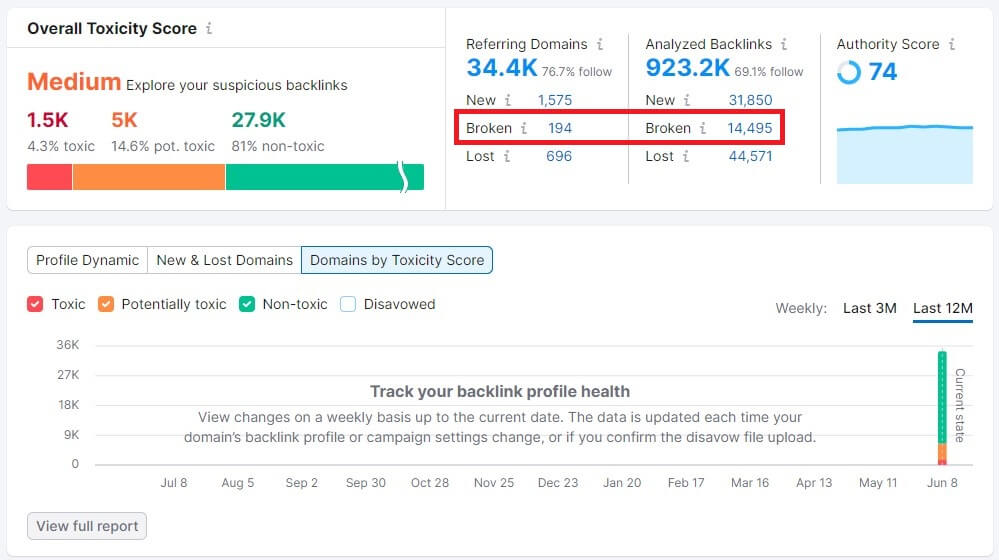
Worse yet, Google is fast to catch up with lazy website owners. An array of broken backlinks tells Google the domain is unattended or inactive. Such a domain gets “rewarded” by the drop in SERP ranking. How to check for broken links?
You can use the Semrush Backlink Audit tool to detect broken backlinks promptly. We also found SE Ranking helpful with its iteration of the Site Audit tool. Once you find the broken backlink, it’s easy to patch or remove it if necessary.
6. Include Meta Titles & Meta Descriptions
Meta titles and descriptions tell Google what your content is about, allowing it to rank the page accordingly. Take a look at the screenshot below. The page title highlighted in red is called the meta title, and below is the meta description.

Both should be included and have the main keyword displayed in the image. Moreover, users shouldn’t neglect alt tags that can be added to each video or photo you put on any of the pages. Images and videos can also rank on Google.
For that to happen, they must be adequately described, letting Google understand them better. If the image can’t be loaded because of a technical issue, the alt tag will be visible, telling the reader what’s in the image.
7. Answer All Relevant Questions
Think about your competition and look at their best-ranking articles.
Are they thorough? Do they answer all your questions? Chances are you’ll answer yes if you’re willing to be open to yourself. Well, that’s because your competition knows how to boost the SEO of their pages.
When covering the topic you’re working on, do it entirely. You can use the Keyword Magic Tool from Semrush to find keyword suggestions and learn what readers are looking for. Here, you can take a look at Intent.
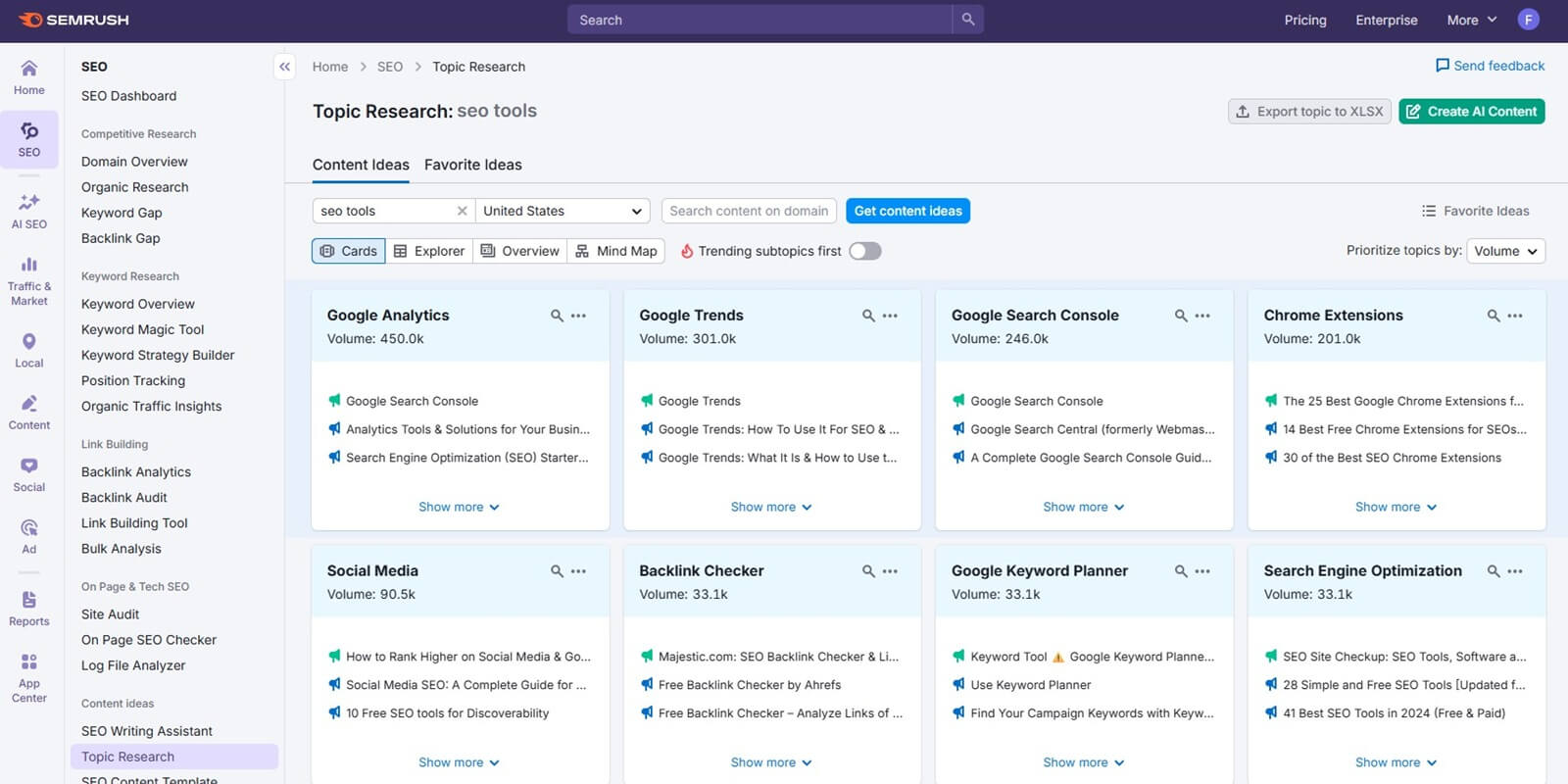
This is why readers search for a keyword, which can also be helpful. Its Topic Research tool is useful for gathering sub-topics for the provided term. You can find more keywords and suggestions to keep you going.
Above all, don’t forget to compare your page to the competition using the Keyword Gap tool from SE Ranking or Semrush. It’ll tell you more about missing keywords you can implement, many of which are questions you can answer on your page.
8. Focus on Exceptional Content Quality
Content quality can’t be beaten if you’re eager to improve your website’s SEO. It comes down to many factors, including covering the topic in depth. However, writing quality is also essential because it separates engaging and boring pages.
Focus on shorter sentences, remove fluff, and optimize your paragraphs to be easily readable. We love using Semrush’s SEO Writing Assistant, for instance. It functions like Grammarly and analyzes your text, giving you information about readability, originality, SEO, and tone of voice.

It’ll advise you on adding more text, explaining the topic better, improving SEO through keyword optimization, etc. We also like its Originality metric, which checks for plagiarism that negatively impacts SEO.
For those wondering, it also detects grammar errors to ensure your content meets the highest quality standards.
9. Obtain Authoritative Backlinks
Once your content quality is top-notch, you can consider your backlink strategy. Not all backlinks are great – some are valuable, some less. You want to focus on the most authoritative and respected sites, but they won’t link to your site if its quality is poor.
Once Step 8 has been fulfilled, you can use Semrush’s dedicated Link-Building Tool to reach out to websites and request a backlink or a guest post. If your content is great and you rank high on Google, some websites will naturally link to your content.
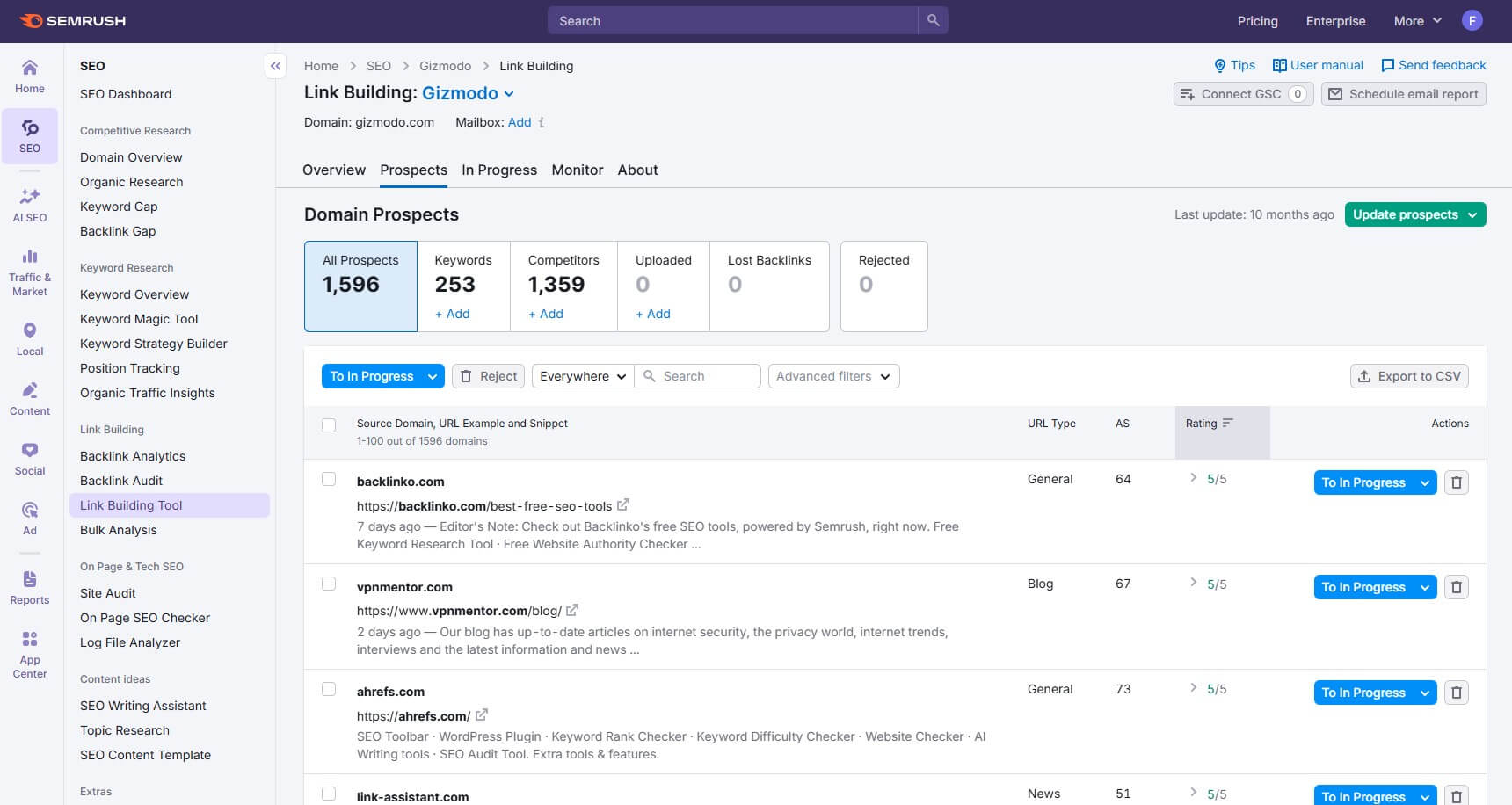
This can happen if your content is informative, includes genuine statistics, etc. To further improve your backlink strategy, you can also focus on marketing your website across social media, boosting its SEO, and making it more popular.
Improving SEO through backlinks is difficult and requires plenty of time. However, as said, quality content and proper optimization will naturally “attract” websites that will link to one or more of your pages.
10. Improve Your Internal Linking Strategy
In our guide about the best link-building tools, we explained the importance of backlinks. Internal links are also critical. An internal link leads to another page on your site, which is the opposite of an external link that leads to another site.
Optimizing your internal linking isn’t a big challenge as long as it “makes sense.” Overdoing it kills your SEO, but doing it right improves it. Google will quickly register a bad or toxic link, ranking your site accordingly—lower. How do you place internal links?
Use a part of your blog post or page as an anchor to link to another page. This guide has plenty of examples, so you can fathom what we’re talking about. When improving your internal linking strategy, think about this:
- Ensure the anchor text reserved for the internal link is optimized properly. It must be clear enough that the reader knows where they’ll be next. If the anchor is “the best VPN,” the page shouldn’t point to hosting services or anything else.
- Don’t overoptimize it. Internal linking should be natural and not forced. If it’s forced, Google will pick up on it, and your SEO will suffer. No one likes pushiness. It isn’t very pleasant, and Google wholeheartedly agrees.
- Link to the most “potent” pages on your site. We do this often, which is a good way to increase SEO scores tremendously.
- Don’t neglect low-ranking pages. These pages deserve attention, too. While you should focus on the best-ranking pages, low-ranking ones shouldn’t be overlooked. Remember that the number of internal (and external) links to the page can improve the page’s SEO and drive more traffic. It is one of the critical factors.
11. Optimize Your Website for Mobile Platforms
Over 60% of all internet users go online on their phones. Such a high number means your website should be properly optimized for iPhones, Android phones, iPads, and other handheld devices. Google tends to agree with this, too.
Mobile-friendliness is one of the top criteria for ranking higher on Google. The statistic we mentioned explains why. How do you know if your website is mobile-friendly? You can use Site Audit from Semrush to examine it promptly.
Semrush will give you an optimization score for mobile devices with issues that must be resolved. Best of all, you’ll get solutions to these problems that you can apply immediately. Don’t forget Semrush’s Core Web Vitals, where you can check how fast the website is on mobile platforms.
Better yet, you can use your phone to see how satisfied you are with your site.
Our final tip for mobile optimization is to use a mobile website builder. You can make fantastic mobile websites with little effort. Simultaneously, they’ll be optimized appropriately, and you’ll have to use Semrush for the final touches or not use it at all, at least for mobile optimization.
12. Aim for Long-Tail Keywords
Long-tail keywords include more words and are longer than “main keywords.” They’re more specific and usually have lower difficulty as a result.
For example, the main keyword is “the best phones for gaming,” but a long-tail keyword is “the best iPhone for playing Apex Legends Mobile.” See the difference?
The latter aims specifically at Apex Legends mobile and iPhones. Such a keyword is more straightforward to rank for but more complicated to discover. You can get long-tail keyword suggestions through Mangools KWFinder or Semrush’s Keyword Magic Tool.
Conduct Keyword Research with Semrush
The point is to set the search results accordingly. Use a higher word count – usually from 3 to 7. You’ll quickly see long-tail keywords with lower difficulty that you can rank for. The keyword “SEO tools” is challenging to rank for, with a difficulty of above 90 in Semrush.
However, in the Keyword Magic Tool, we set the keyword suggestions to 5-7 words and look at this:
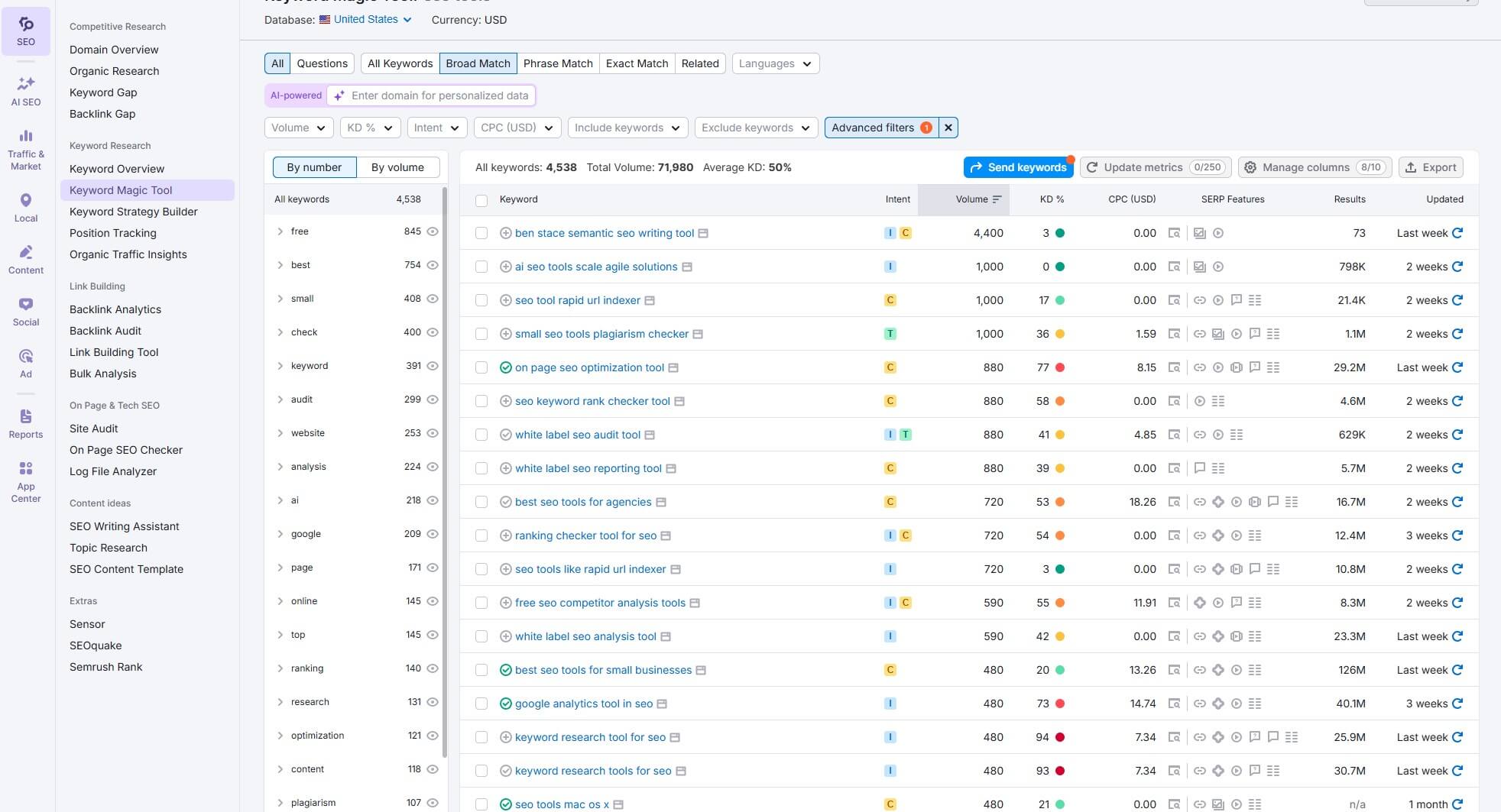
Now we have keywords like “small SEO tools plagiarism checker”, “white label SEO audit tool”, and so forth.
13. Improve SEO Locally (Local SEO)
This SEO improvement tip isn’t for everyone. Reviewing your SEO strategy might be good if you have a website targeting local customers. Take advantage of Google’s Local Pack, which you surely know about. Type in the search query and you’ll get this:
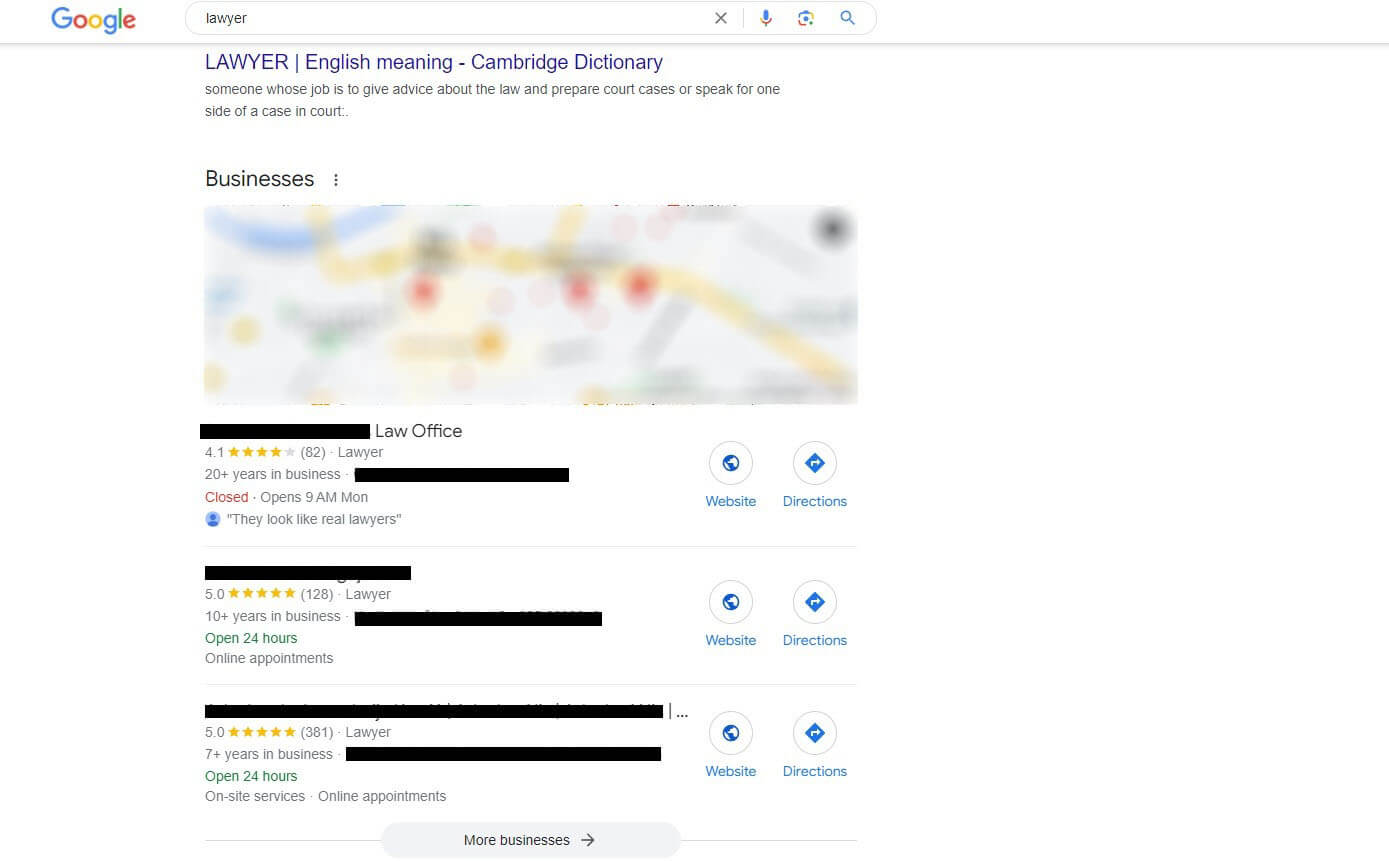
These are the top 3 lawyers in our region. Their websites have proper SEO to hit the local market and attract more customers. If this is your goal, you can improve your keyword optimization for the targeted location using KWFinder, Semrush, or SE Ranking.
Another way to improve local SEO is through Google My Business. Create an account on GMB and add your business. Content should also be optimized for local customers. Again, you can use Semrush and its Topic Research to cover relevant topics for your market.
14. Diversify Your Content
Boosting SEO can be done through content diversification, increasing dwell time, and keeping visitors longer. This consequently sends a “signal” to Google that your website is valuable so that it can rank higher.
How to diversify your content?
Avoid being boring! Walls of text without end sound like a nightmare. You can permeate your pages with helpful images, graphs, and videos. Long-form content is also great, and so are infographics that help the reader understand what you’re discussing.
We love videos, particularly, because they can be more interesting than reading the blog post. If you’re in a hurry, run the video and listen to it on your headphones instead of reading the article. We also value quizzes and polls, as we sometimes participate in them.
A reader will naturally want to vote for something, so it’s another incentive to interact with your site and linger around for longer.
15. Optimize Your Content for a Featured Snippet
We can spend days talking about featured snippets and how they function. However, we’ll simplify things by saying that content in a featured snippet usually answers the search query the most efficiently.
Here’s an example:
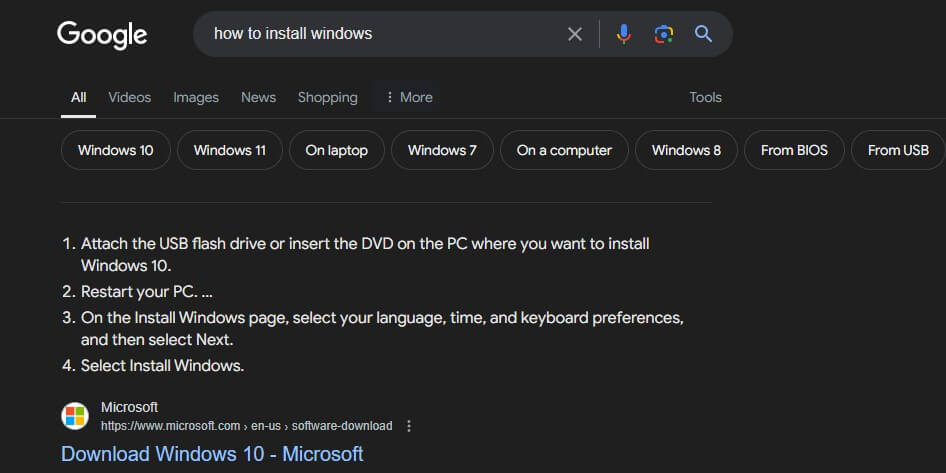
Microsoft answers the question of how to install Windows best, as expected. This site has a high Authority Score, which is another reason it’s there. In a featured snippet, Google checks the top 10 websites in the niche and uses the best one for the search query.
As you can see, making it to this point is difficult because your site needs to be high-ranking and have authority. For this to happen, you must follow our SEO-boosting tips from above. In addition, you can improve optimization in other ways.
Adding lists, definitions, tables, and other simple-to-read content improves your chances of appearing in the featured snippet. Your content should be suitable for it, so explanations on your page must be clear, fluff-free, and without vagueness.
SEO Optimization Guide Summary
With the 15 tips on optimizing SEO and improving your search engine ranking, you have plenty to think about. Consistency is the key, and so is tracking your ranking and results. This will explain whether your SEO strategy is effective.
We can’t discuss the most critical tips because they are all important and, when combined, make for a perfect blend of success strategies. However, we can point you to some of the best SEO tools for this purpose: Semrush, SE Ranking, and Mangools.
Semrush is the best option because of its all-around tools for SEO improvement. As you saw, this tool has everything you need to optimize keywords, improve site-loading times, and improve your writing quality. Semrush, as well as the other two, is risk-free.
We believe you need these tools to maximize your effectiveness. Manually micro-managing all aspects of your website is nightmarish and, above all, impossible. That’s it. Enough lecturing for today. Get to work. We expect to see your website on Google’s first SERP in a few weeks or months!