LIGO
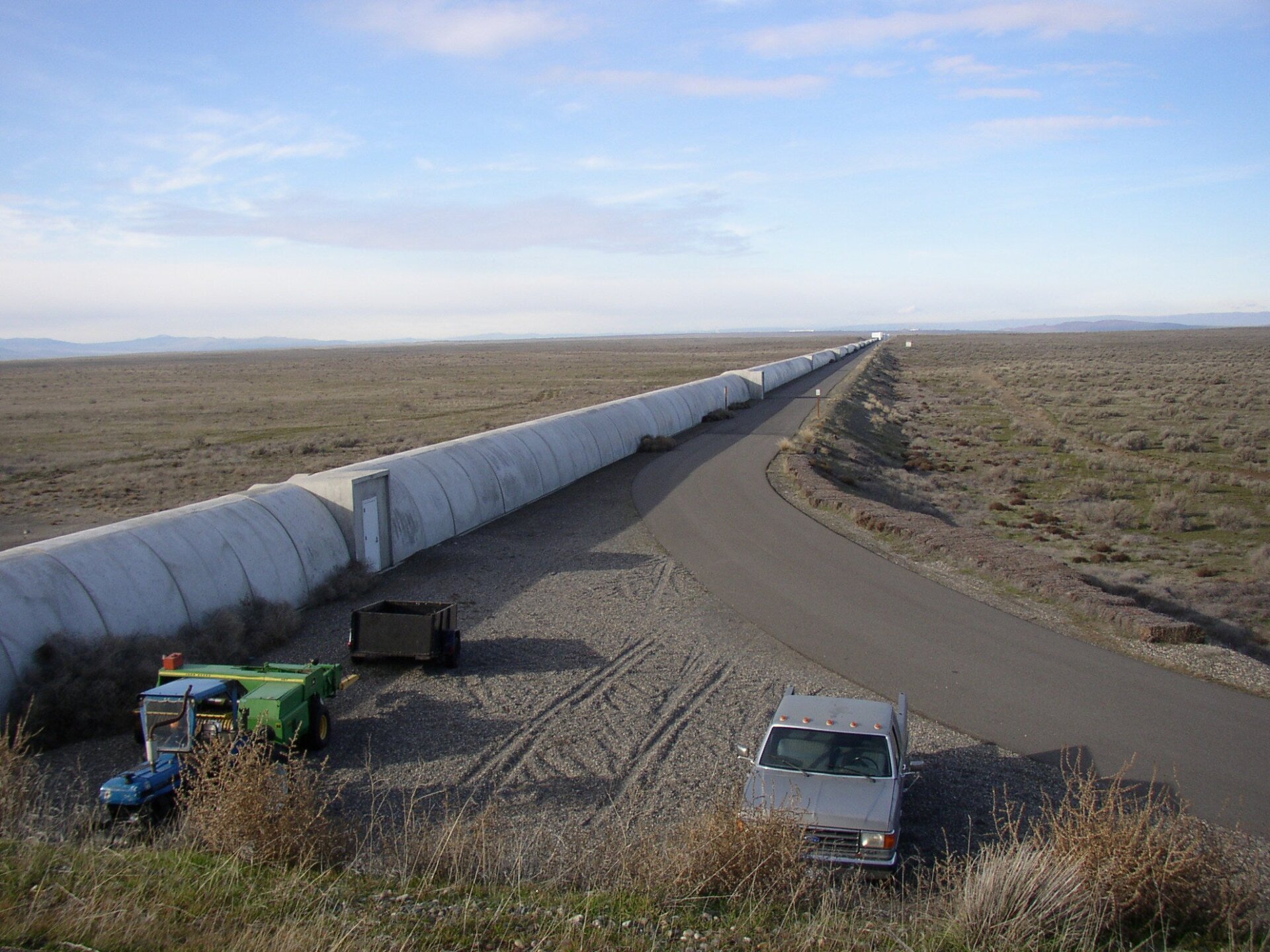
In 2016, scientists announced that they had observed ripples traveling at the speed of light through space-time, the result of two black holes slamming together. The experiment behind the discovery, LIGO, is a pair of tunnels arranged in an L-shape, where a laser is split, sent into both tunnels, and then re-joined in a detector. Passing gravitational waves cause the two beams to travel in-and-out of phase with each other, creating a pattern containing information about the ripples.
The two LIGO observatories, plus the Virgo observatory in Italy, have continued to measure gravitational waves and even spotted the gravitational waves accompanying a flash of light from a pair of neutron stars colliding. Ultimately, these observations might provide information on the rate of the universe’s expansion or the true nature of dark matter.