A recent LIGO catalog update more than doubled the number of confirmed gravitational wave signals—ripples in spacetime caused by cataclysmic events. And already, astronomers are arriving at some shocking conclusions from picking apart the revamped dataset.
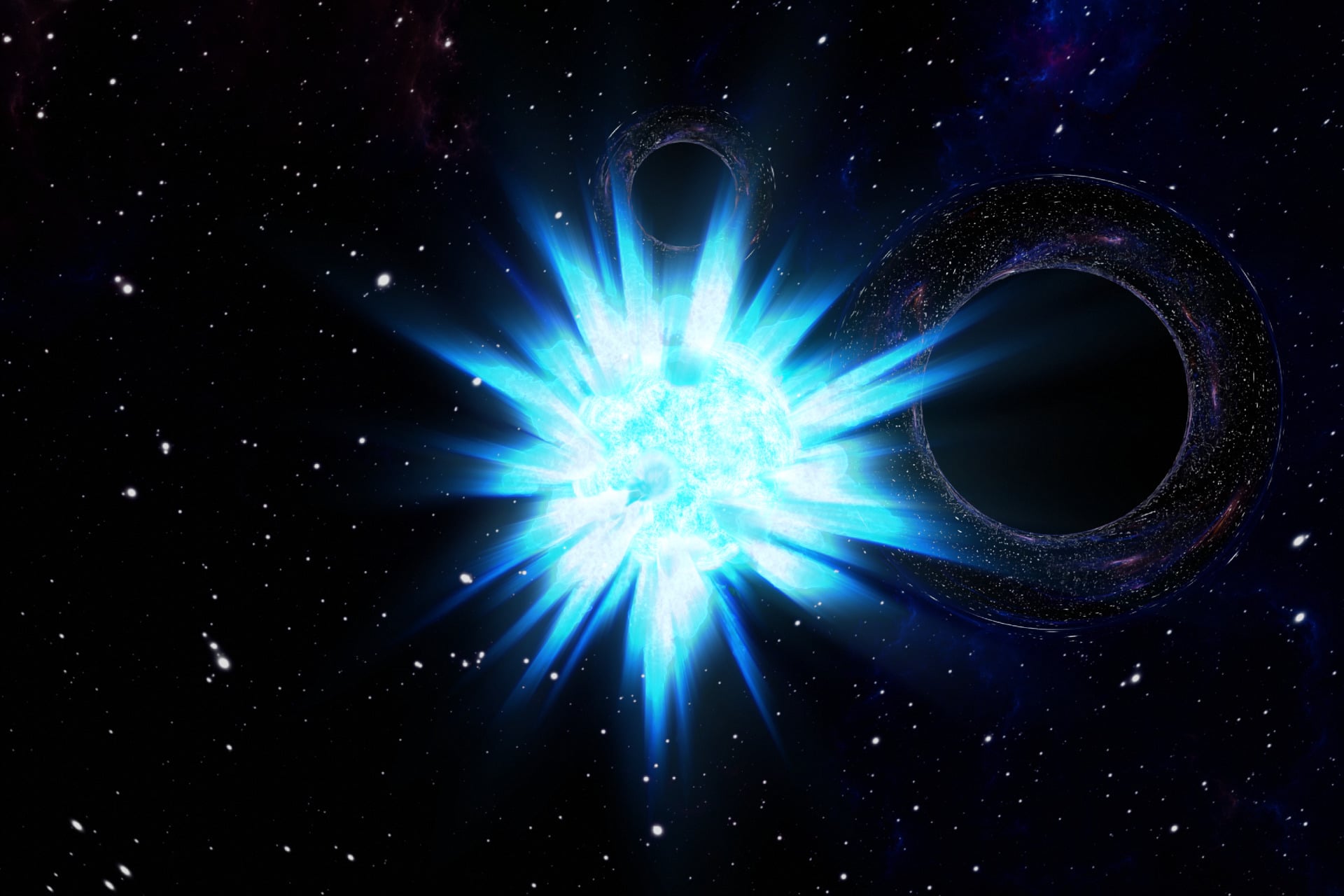
In a Nature paper published today, researchers confirmed the first evidence for pair-instability supernovas, doing so with gravitational waves. These unique supernovas emerge when very massive, steaming-hot stars go out in a thermonuclear explosion that eradicates the star, leaving nothing behind for anything else to form nearby, let alone black holes. Scientists long theorized that black holes could not form within this “pair-instability gap,” predicted to range from 50 to 130 times the mass of the Sun. But finding solid evidence for these explosions proved to be difficult—until now.
“Pair-instability supernovas have been hard to confirm through direct light-based observations because they are rare, distant, and leave little direct trace that can be uniquely identified,” Hui Tong, the study’s lead author and a PhD student at Monash University in Australia, told Gizmodo.
Gravitational waves, on the other hand, allow for an “indirect” tracing of stellar explosions, Tong added, meaning researchers now have a way to “reconstruct the outcomes of stellar explosions indirectly, through the population of black holes they leave behind.”
Tracking the invisible
Since its Nobel-winning discovery of gravitational waves in 2015, the LIGO Collaboration has consistently picked up on some truly perplexing signals. Last summer, it announced the detection of the most colossal merger ever found, the final product of which was a gigantic black hole more than 225 times the mass of the Sun.
Other than its sheer size, the monster black hole’s parents appeared to lie within the pair-instability gap, at 103 and 137 times the mass of the Sun, respectively. The discovery demonstrated to astronomers the potential of gravitational waves in studying “invisible” phenomena like black holes, as well as the need to reevaluate our understanding of the theoretically impossible in black hole astronomy.
“The detection of gravitational waves allows us to ‘hear’ the violent collisions of the most compact objects in the universe,” Tong explained. That has “opened a new window on the universe,” he added, “revealing populations of black holes that were previously inaccessible and reshaping our understanding of how massive stars live and die.”
(The video below isn’t directly related to the new findings, but shows what Tong means by gravitational waves allowing us to “hear” violent collisions in the universe.)
Surveying ripples across spacetime
To be clear, the latest study addresses the feasibility of pair-instability supernovas altogether. The announcement from last year discusses a black hole of two black holes with masses within the gap presumably created by pair-instability supernovas. So the two findings slightly differ in focus but are inherently related in our quest to understand the many unknowns of stellar evolution.
For the new study, Tong and colleagues performed a statistic analysis of the “cosmic census” of black holes based on LIGO data. According to Tong, their primary goal was to “test whether there is a shortage of black holes in merging systems at certain masses, as predicted by pair-instability physics, and what this might tell us about how black holes and their parent stars form and evolve.”
Their investigation presented an “unambiguous” gap in the distribution of secondary masses—the smaller of two black holes in mergers—between roughly 44 and 116 times the Sun’s mass, according to the paper. Fascinatingly, this observation allowed the team to indirectly trace its way back from the remnants (black holes) to the dying star (supernovas).
Stay tuned (literally)
Tong told Gizmodo that the new findings still need to be tested further for astronomers to understand the gap’s exact shape and physical mechanisms. For Tong, the most remarkable aspect of the findings is how quickly things are progressing in gravitational wave astronomy. Before 2015, “we had no direct way of knowing whether black holes with masses of tens of times the mass of the Sun existed at all because these systems are essentially invisible in light,” he said.
But now, LIGO and its partners pick up on hundreds of gravitational wave candidates—almost daily, at that—giving researchers a constant stream of information to test hypotheses like never before. When the next generation of gravitational wave observatories fire up in the 2030s, we could be looking at tens of thousands of signals per year.
“This would be a major leap forward,” Tong said. “With this much richer view, we will be able to compare different ideas for how massive stars live and die and connect the observed black hole population directly to the physics of stellar structure and nuclear reactions. In this way, gravitational waves will become a powerful tool for understanding how the most massive stars shape the universe.”