What was going on before the Big Bang? (Anything interesting?) Well, one astrophysicist now proposes that the mysterious “little red dots” first detected by the James Webb Space Telescope and dated to a few hundred million years after the Big Bang might just be evidence of an older universe before our own, one now lost to time.
In reality, of course, these very early “little red dots” are enormous, each one its own massive galaxy, with enough stars in its primordial swirl to rival the Milky Way as it exists today. Some astronomers took to calling these dots “universe breakers,” because their very existence has complicated older models of how the early goo of the universe first coalesced into being as young planets, stars, and galaxies.
But now, according to Enrique Gaztanaga, a professor at the University of Portsmouth’s Institute of Cosmology and Gravitation, these seemingly premature and very complex galaxies might actually be proof that the Big Bang was something more like a recurring “Big Bounce.”
“In this picture, the universe undergoes a phase of contraction before the big bang,” Gaztanaga argues in a piece for The Conversion explaining his new study. “Instead of collapsing into a singularity, it rebounds, beginning a new expanding phase.”
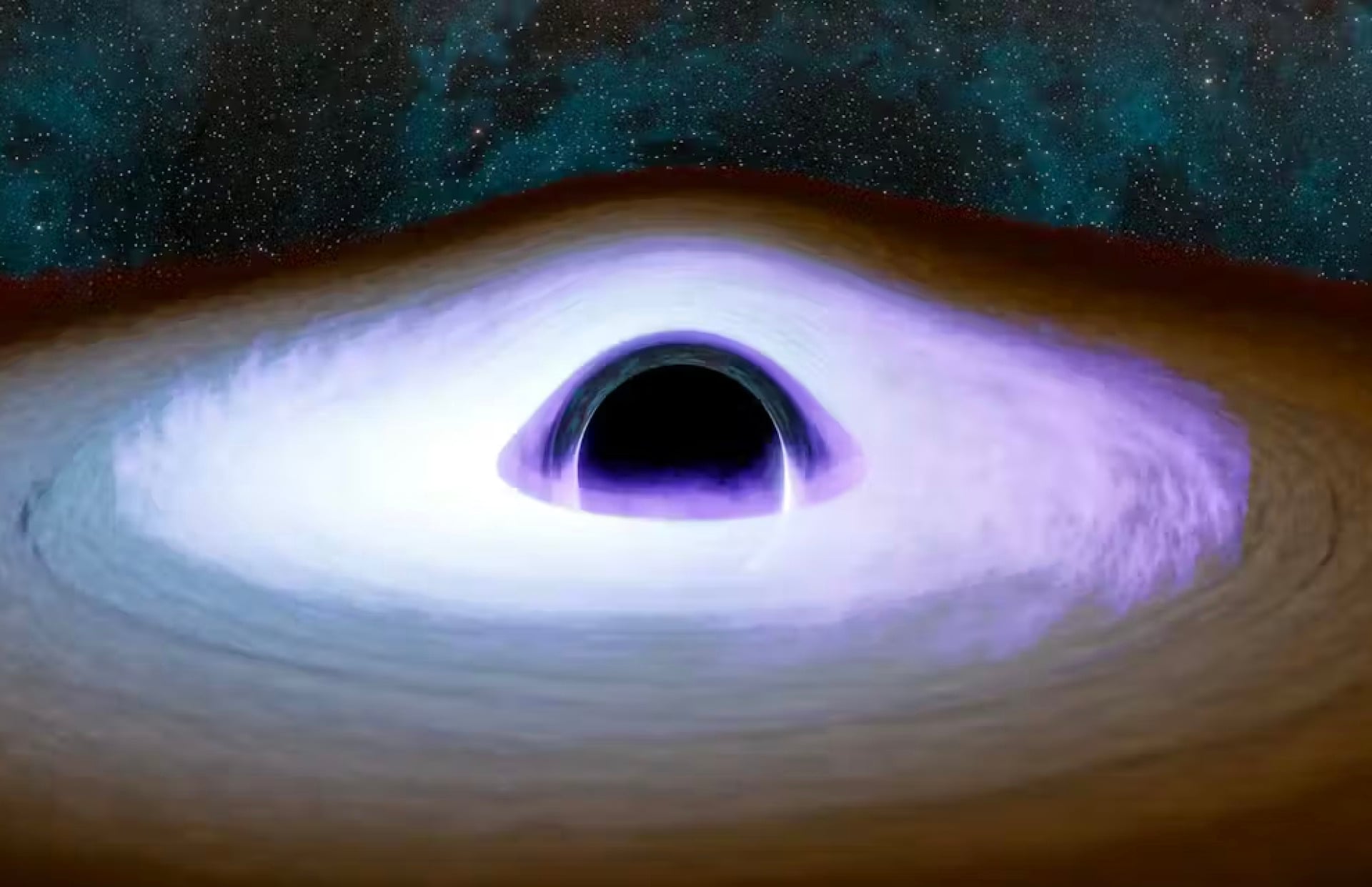
Gaztanaga contends that, swept up in this vast and impossibly old cycle, like eldritch buoys rocked back and forth by the cosmic tide, are a phenomena he calls “relic” black holes.

Relics from lost galaxies
Gaztanaga’s argument in favor of his relic black hole theory rests on the idea that these dense balls of matter, which (as you know) exert a vacuum-like pull on matter all around them, would have had enough resistance to counter any opposing pull towards the epicenter of a Big Bounce.
The time-tested Pauli exclusion principle, developed a century ago by physicist Wolfgang Pauli (and still in use today to help explain the formation of neutron stars), details how these interactions might go down. Subatomic “neutron degeneracy pressure,” which prevents certain highly dense supermassive stars from collapsing into even denser black holes, under certain conditions, could mirror similar density limits that would protect these relic black holes.
According to Gaztanaga’s calculations, published this February in the journal Physical Review D., a variety of celestial phenomena, including black holes, could “survive the bounce as relics” so long as they are larger than 295 feet (90 meters). “These relics,” he wrote in The Conversion, “can include black holes, gravitational waves and density fluctuations.”
Relic black holes, Gaztanaga also determined, could theoretically be formed in another way, too. As large diffuse halos of matter and once swirling galaxies are caught in the tightening pull of a universe contracting for another Big Bounce, those celestial bodies might instead collapse into a black hole that then resists any further pull toward the bounce’s epicenter.
Dark matters
If it turns out that the mechanisms that might create and preserve relic black holes are common enough, more of them might be out there than those at the center of the “little red dot” galaxies observed by the James Webb Space Telescope. The dense, light-absorbing mass of myriad orphaned, solitary, or otherwise hidden relic black holes, in fact, might even be the missing gravitational pull that physicists have long attributed to so-called dark matter.
“Relic black holes offer a compelling alternative,” according to Gaztanaga. “If the bounce produces enough of them, they could make up a significant—perhaps dominant—fraction of dark matter.”
Many astrophysicists have held out hope that dark matter would one day prove to be a fundamental particle distributed across the universe, ideas that have included dark photons, axions, and Weakly Interacting Massive Particles (or WIMPs). But in the absence of conclusive proof, others have also broached alternative hypotheses focused on black holes, searching for evidence of miniature primordial black holes, which would be small, very old, and honestly not all that conceptually dissimilar from Gaztanaga’s relic black holes.
“Much work remains to be done,” Gaztanaga admitted. “But the possibility is profound: the universe may not have begun once, but may have rebounded. And the dark structures shaping galaxies today could be relics from a time before the big bang.”