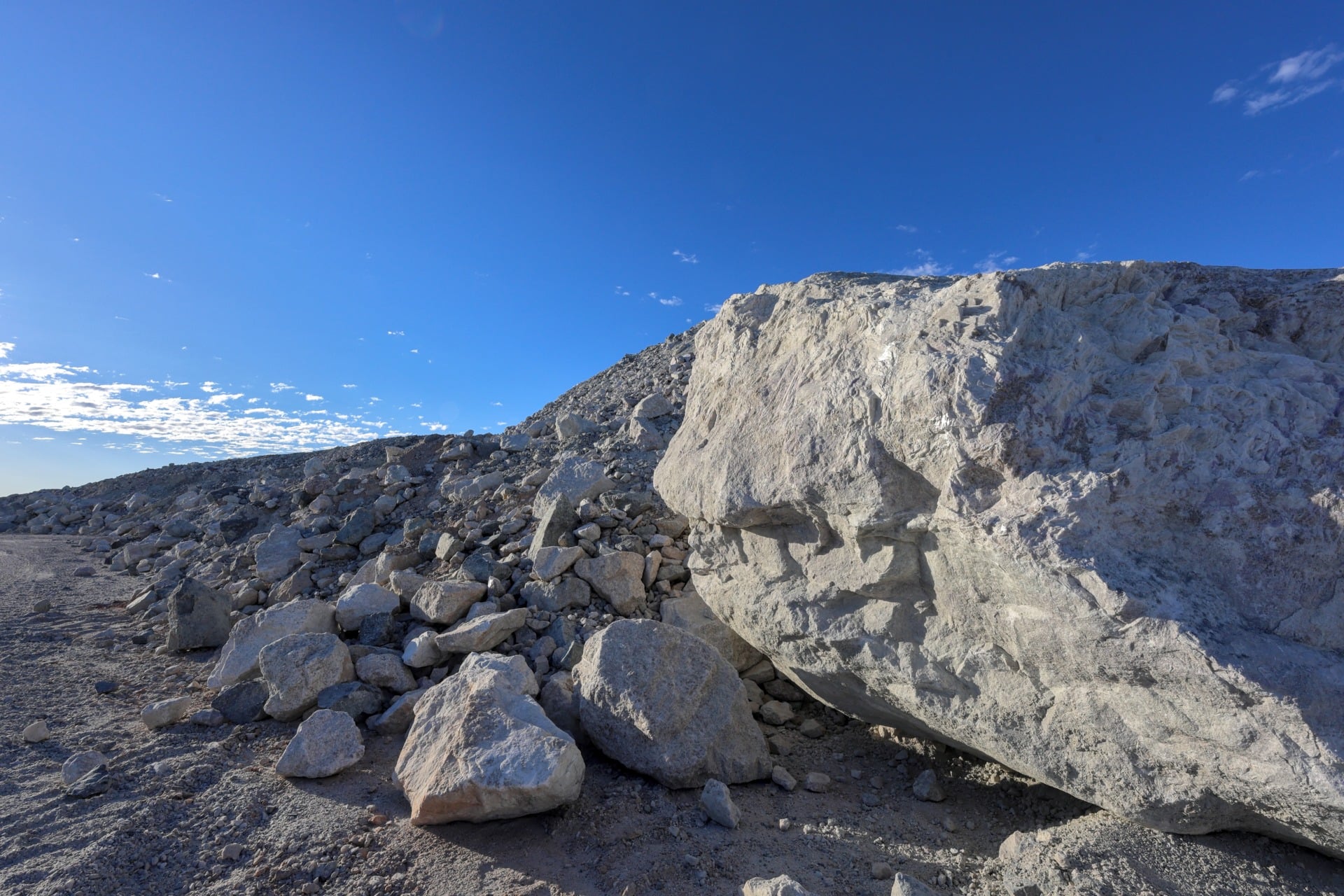
For all its contribution to clean energy tech, lithium is a tricky, not-so-eco-friendly resource to retrieve. As such, scientists have sought more sustainable ways to meet the rising demand for lithium, including a new proposal for a safer, lower-cost strategy for tapping into hard rock containing the valuable element.
The new process, detailed in a new study published today in the journal Science, chemically separates a mineral called spodumene into lithium, aluminum, and silicon, which are then separated and purified for their respective industrial uses. Unlike conventional methods, the latest alternative is a low-temperature, acid-free approach that pulls the most valuable products from the main mineral components of spodumene.
Deployed at scale, this would be the “lowest-cost way of obtaining lithium from any natural resource,” Yet-Ming Chiang, co-author on the study and Kyocera Professor of Materials Science and Engineering at the Massachusetts Institute of Technology (MIT), told Gizmodo.
The lithium lore
According to the MIT Climate Portal, lithium is retrieved either by evaporating brine pools or through hard rock mining. In the former, salty brine is pumped from underground deposits and left in pools to evaporate, leaving behind lithium and other elements. Hard rock mining “looks more traditional” and uses heavy machinery to dig up and crush spodumene. Both types of mining use a lot of water and have rather large carbon footprints.
The global lithium industry also faces significantly high supply and geopolitical risks, a report by the International Energy Agency (IEA) notes. The report assessed the lithium industry’s “ability to respond to supply disruptions” at a measly 3%, whereas 57% of lithium refining would depend on China by 2030.
Finding an alternative
The new process uses ammonium flouride to “safely dissolve the silicate matrix in hard rock, thereby liberating the lithium as well as the aluminum,” Chiang explained to Gizmodo. This removes the need to “roast” spodumene before acid leaching, a step that generates carbon dioxide emissions.
The team tested its method on 17 different sources of spodumene concentrates, successfully recovering more than 95% of lithium stored in the mineral. The process is also a “closed-loop” approach that recycles and reuses the chemical reagent, as opposed to conventional methods that produce different wastes at each step.
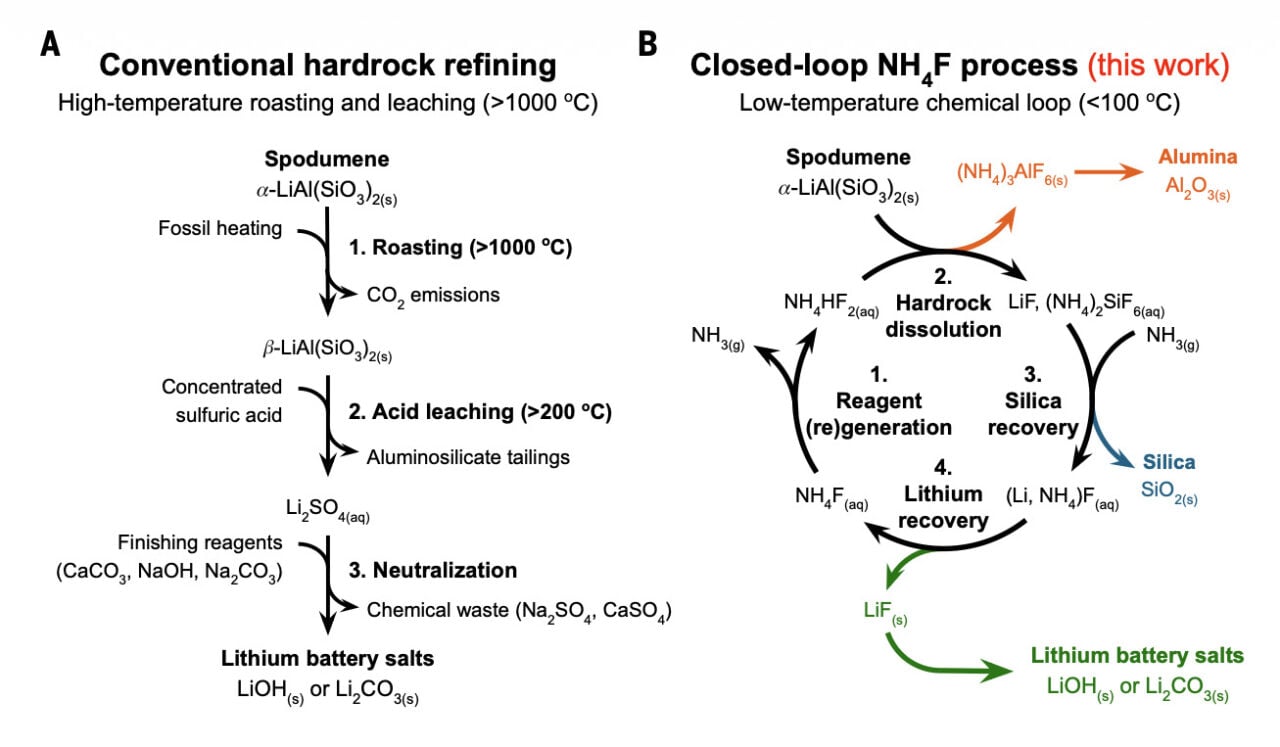
The trick was to invert familiar processes in hydrometallurgy—obtaining metals from ores—where “silicate is normally the most resistant to dissolution and is the last component left,” Chiang said. “Here, we flip that on its head and take out the silicate first. It makes me ask what other minerals we could process in this manner.”
Concept to reality
This could bring important shifts to the lithium industry, Gangsan Lee and Karthish Manthiram, chemical engineers at the California Institute of Technology (Caltech) who are uninvolved in the work, wrote in an accompanying Perspective article.
For instance, the closed-loop process removes the need for large-scale waste treatment plants that escalate infrastructure costs. Because it’s low-temperature, it’s easier to “integrate with renewable power,” which is significant as “major lithium hardrock mines geographically overlap with abundant solar and wind resources,” they added.
These benefits substantially lower hurdles for lithium mining—addressing “both the surging demand for lithium and the carbon footprint that undermines the sustainability of the energy transition that lithium is meant to enable,” added the Caltech engineers.
All that said, Chiang told Gizmodo that the process still needs to be tested at an industrial scale. The research team founded a spinout, Rock Zero, to focus on launching pilot demonstrations for the new method.
“Mining is essential to technology and therefore to society, yet it is perceived negatively by much of the public as a destructive, polluting industry, in some cases with good reason,” Chiang concluded. “We hope to help change that perception by showing that there are cleaner, more sustainable ways to do it.”