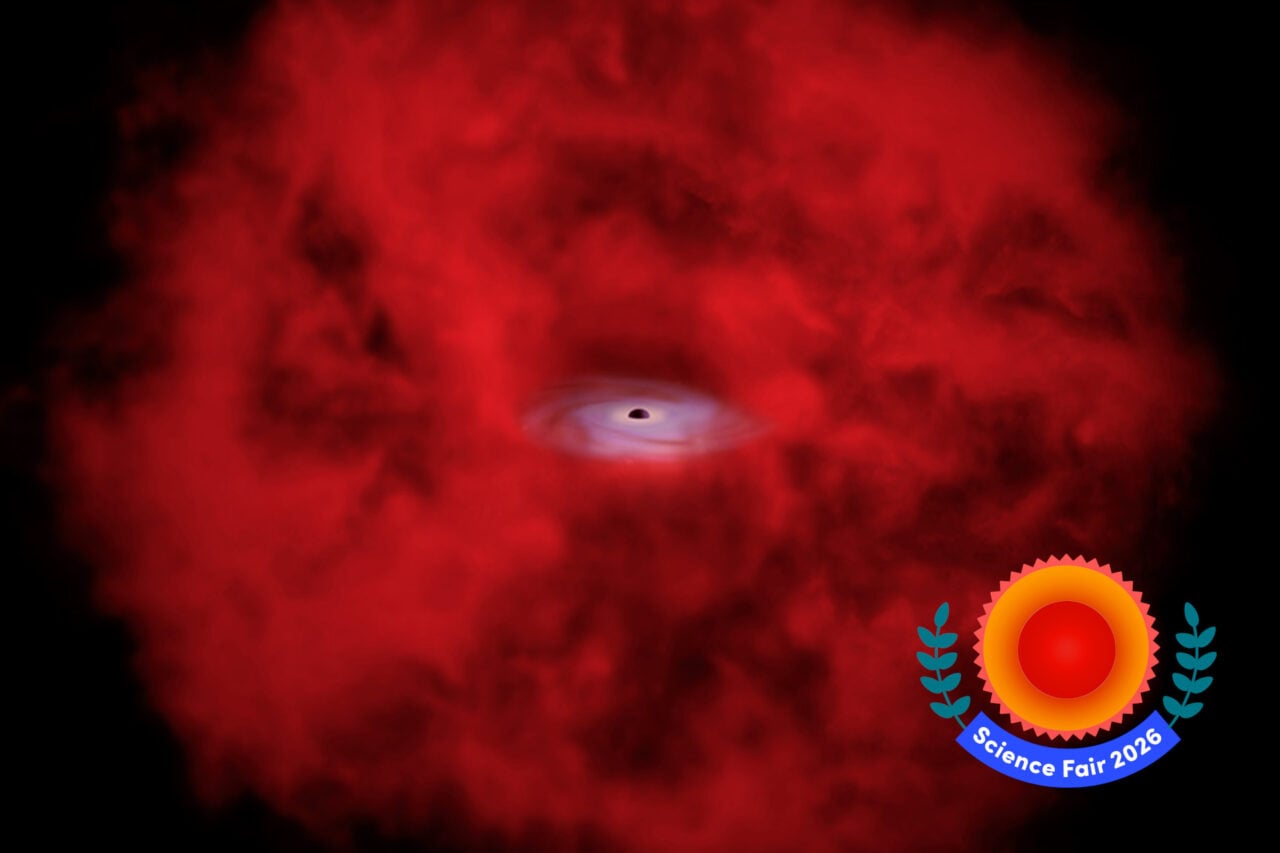
It’s no question that supermassive black holes are cosmic big boys, reaching millions to billions of times the mass of the Sun. How they achieve their behemoth status, however, is still up for debate. Scientists believe black holes merge with one another to grow to their enormous masses, but they haven’t yet been able to detect a close pair. Now, observations collected over 23 years may finally help solve the mystery of the universe’s notorious beasts.
A team of astronomers may have found direct evidence of the first pair of supermassive black holes orbiting closely at the center of a galaxy. The two black holes may be on the verge of an epic collision, which would merge them together as one. The findings have been accepted for publication in the Monthly Notices of the Royal Astronomical Society.
Seeing double
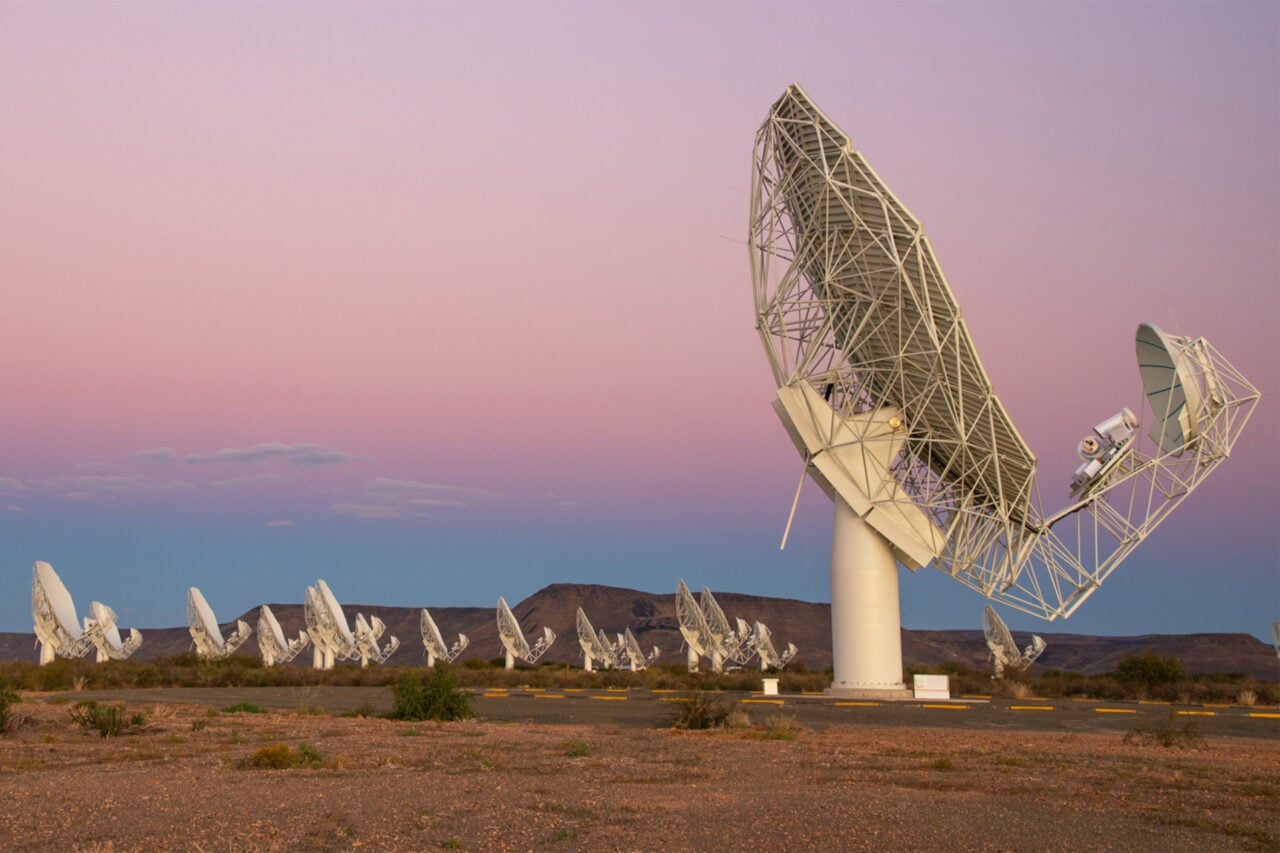
The team behind the discovery, led by Silke Britzen from the Max Planck Institute for Radio Astronomy, analyzed high-resolution observations of the galaxy Markarian 501. The observations cover various radio frequencies that were collected on several days over a period of 23 years.
The data revealed something intriguing: black holes emit powerful, narrow beams of matter and energy that travel into space at nearly the speed of light. Scientists had already imaged one jet emerging from the center of the Markarian 501 galaxy, but the data revealed something intriguing. There was not one, but two powerful jets of particles shooting out of the galaxy.
Zeroing in on a direct image of two jets being launched from one galaxy indicates there are two supermassive black holes at its center. “We searched for it for so long, and then it came as a complete surprise that we could not only see a second jet, but even track its movement,” Britzen said in a statement.
Orbital dance
The first jet is pointed toward Earth, which is why it appears brighter. The surprising second jet is oriented differently, making it harder to detect.
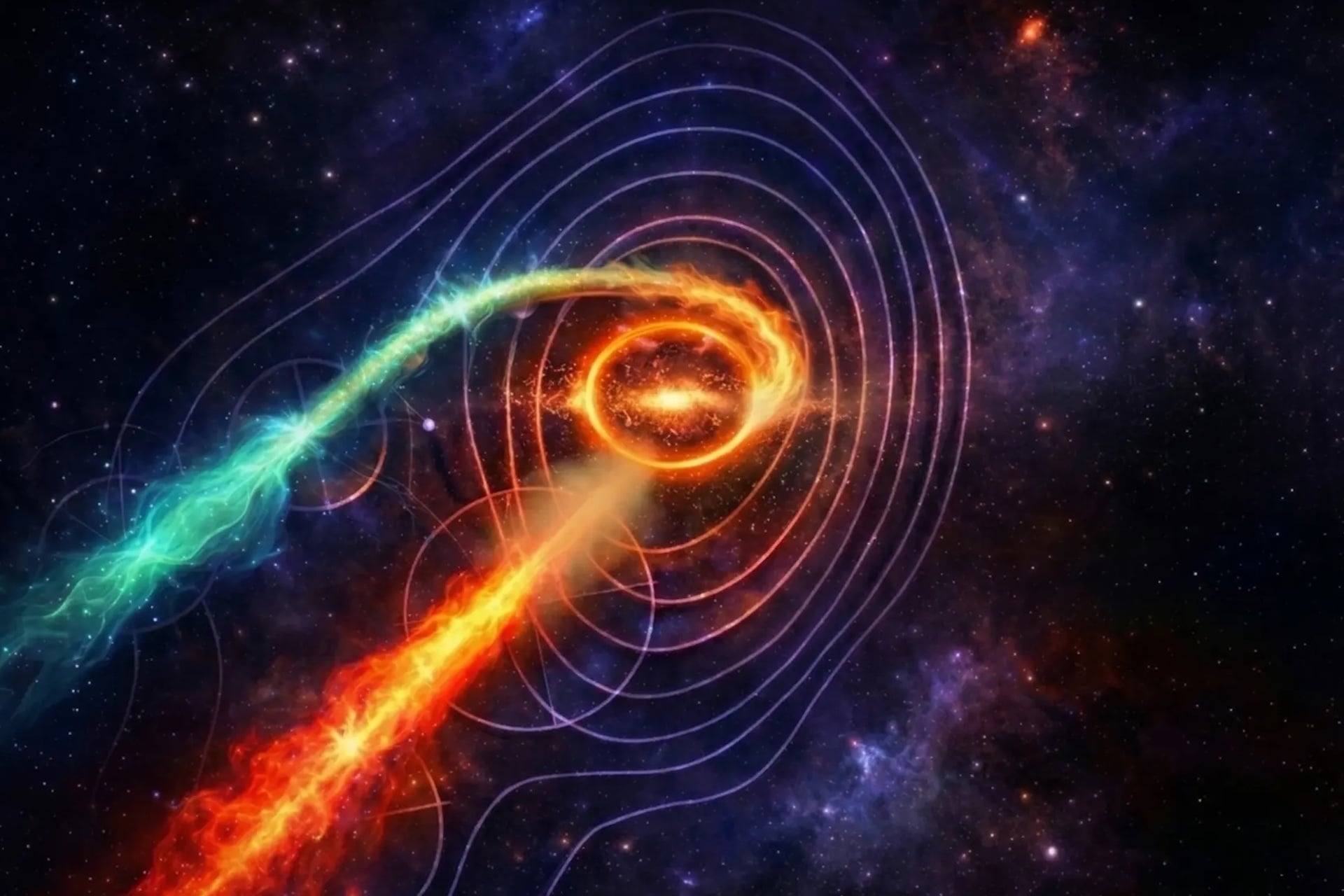
In just a few weeks of observations, the astronomers noticed significant changes to the jets. The second jet starts behind the larger black hole and moves counterclockwise around it, repeating this process over and over again. “Evaluating the data felt like being on a ship,” Britzen explained. “The entire jet system is in motion. A system of two black holes can explain this: The orbital plane sways.”
In June 2022, the radiation being emitted by the system appeared in the shape of a ring, also known as an Einstein ring. The phenomenon occurs when light from a distant object is bent into a near-perfect circle. This also helped confirm the existence of two black holes, as gravitational lensing by the black hole in front shaped the light of the second jet behind it, according to the researchers.
The two black holes likely orbit each other within a period of roughly 121 days and are about 250 to 540 times farther apart than the distance between Earth and the Sun. That may seem incredibly far, but it’s a relatively small distance between two objects of their size.
Based on the data, the researchers believe the black holes could merge within roughly 100 years. When, and if, they do, their collision will produce gravitational waves at very low frequencies. Those gravitational waves can be detected by super-sensitive radio telescopes like the Pulsar Timing Array.
“If gravitational waves are detected, we may even see their frequency steadily rise as the two giants spiral toward collision, offering a rare chance to watch a supermassive black hole merger unfold,” Héctor Olivares, a researcher at the Max Planck Institute and co-author of the study, said in a statement.