Deeper at its deepest than Mount Everest is tall, the Tonga Trench, northeast of New Zealand, is still only the second-deepest ocean trench on Earth. Shouldering ambient pressures roughly around 15,000 pounds per square inch at its deepest, the trench is surrounded by an eldritch-sounding ocean formation called an “abyssal plain.”
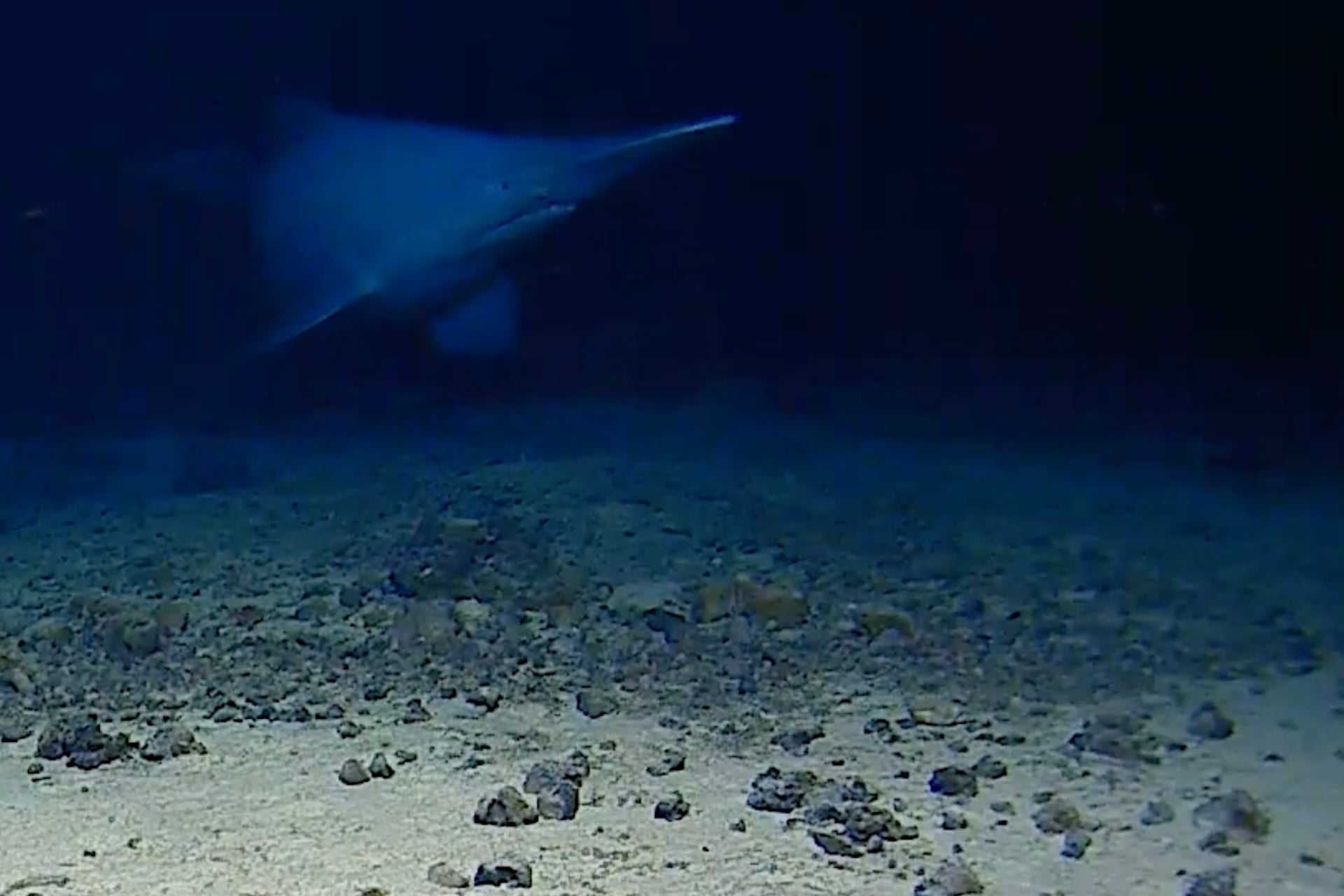
It’s exactly the kind of place, in other words, where one might expect to see an ancient creature named the goblin shark. And, in fact, this May, marine biologist Alan Jamieson, director of the Minderoo-UWA Deep-Sea Research Centre in Australia, and his colleagues have reported capturing the first-ever footage of this elusive shark lurking in the dark depths of its natural habitat. But, more significantly, this rare documentation expands upon what marine science knew about this rare species—widening its known territorial waters and plunging its known depths by thousands of feet.
The team jointly published two confirmed instances of the shark alive and swimming: footage captured in 2019 along an unnamed seamount north-west of Jarvis Island at 4,058 feet (1,237 meters) below sea level and 2024 footage taken at an astounding 6,552 feet (1,997 m) deep within the Tonga Trench.
The shark—which is beautiful, sensitive, and regal and neither “ridiculously horrendous” nor “like something out of a horror movie,” as one so-called expert has claimed—had previously only been seen alive after fishing accidents, dragged to its death each time on the surface above.
“The goblin shark is a deep-sea charismatic animal,” Jamieson said (accurately) in a statement, “and I never thought we’d see one alive.”
The last living Mitsukurina
The goblin shark is sometimes called a “living fossil,” as it is the last living example of the long-extinct family of sharks known as Mitsukurinidae as well as the only known living member of its genus, Mitsukurina. It has incredible and admittedly unusual-looking jaws with the power to protrude out, expand, and crush its prey (everything from deep-sea fish to crustaceans). And, like its fellow lamniform, the great white, the goblin shark has been known to indiscriminately eat trash discarded by humans on occasion.
Prior to Jamieson and his coauthors’ latest discoveries, the goblin shark had only ever been recorded inhabiting narrow patches of ocean off the coasts of Japan, Australia, and of the western U.S., as well as a few small spots within the Atlantic and Indian Oceans.
“These observations extend its known geographic and depth range considerably, and extend the depth range of lamniform sharks by [354 feet] 108 m,” the researchers noted in their study, published in the Journal of Fish Biology.
Compared against themselves, however, goblin sharks have mostly been dredged up from depths much closer to the surface, between 890 and 3,150 feet (270 to 960 m). And, prior to these discoveries, the deepest known evidence of a goblin shark was an errant tooth left behind after one chomped on a deep-sea cable at a depth of 4,495 feet (1,370 m).
Protect the goblins
Lead author and oceanography PhD student Aaron Judah at the University of Hawaii was the first to notice the 2019 footage of the goblin shark, which had been recorded on the camera on the remotely operated vehicle Hercules. Jamieson’s later but deeper sighting was recorded during an expedition to the Tonga Trench in 2024 while onboard the research vessel (R/V) Dagon. The expedition spotted the shark via a baited camera dropped to the ocean floor.
“On that expedition we filmed over 50 days of continuous footage between depths of [2,625 and 35,433 feet] 800 and 10,800 metres and this observation was a little over 20 seconds long which is testament to how elusive this species is, and how special it is to have two observations in the same study,” Jamieson said.
That rarity and the expansiveness of the shark’s true territory, Judah noted, are all the more reason for fishermen and governments to be more careful. “Given the newly expanded geographic range of the goblin shark, this species can be included in regional management and a nation’s biodiversity list,” he said.