Incogni Review: The Short Version
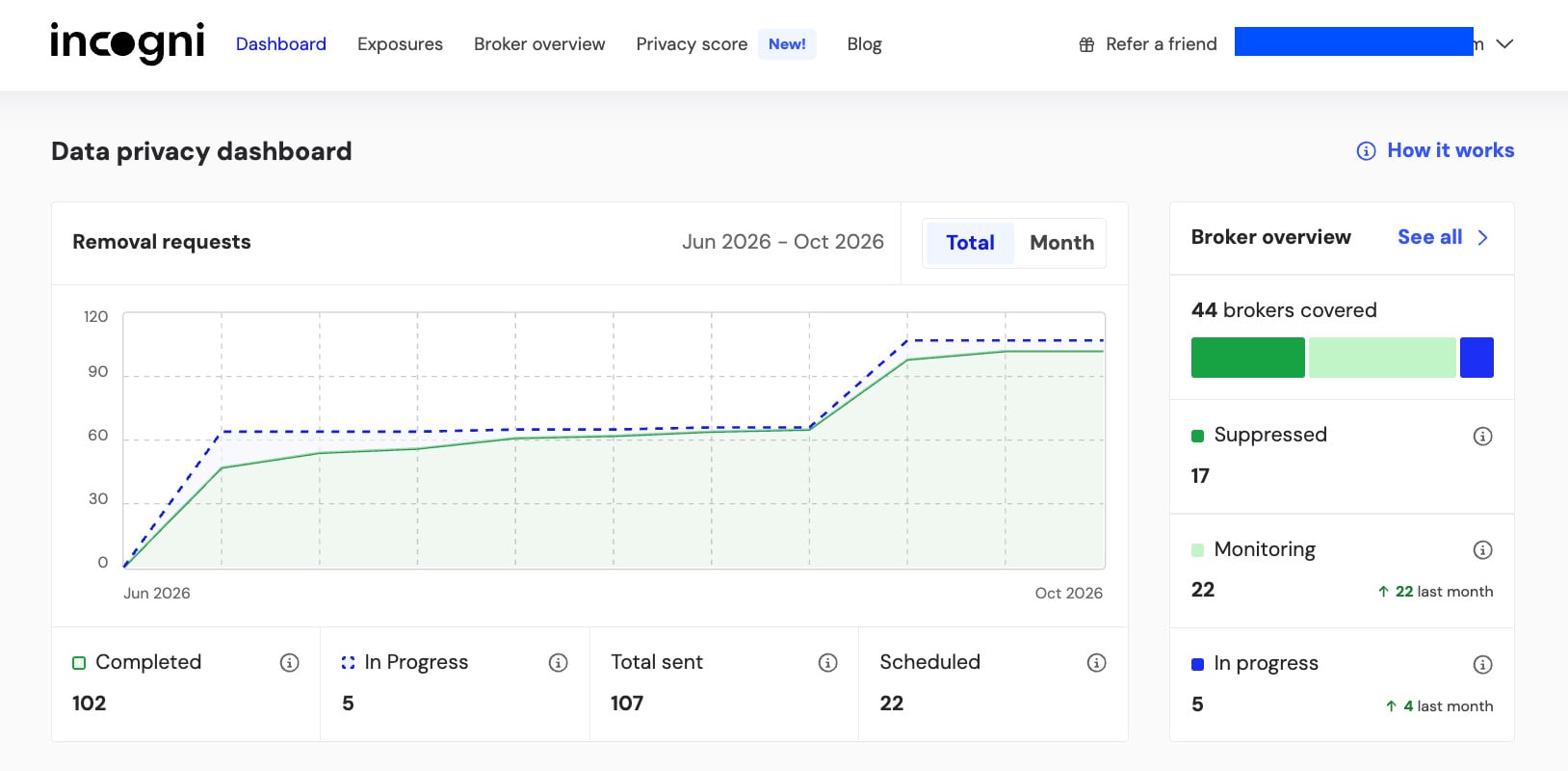
Incogni is one of the easiest data removal services to live with: after almost four months on the Unlimited plan, it had sent 107 removal requests to 44 data brokers for me and closed 102 of them. Setup was short, and the service ran on its own after that. The dashboard shows more detail than most rivals, and a new privacy score now sums up your exposure in one number.
The rest of this Incogni review explains where those numbers come from. Incogni contacts data brokers and people-search sites on your behalf, asks them to delete your records and repeats the request on a schedule: It cannot erase you from the internet and it does not handle social media accounts, blogs, forums, court records, government records or reports on criminal cases.
Incogni
Incogni automates removal requests to data brokers and repeats them on a schedule.
Pros
- Automated, recurring removal requests
- Detailed dashboard with per-broker resolution times
- Requests checked by a Deloitte assurance report
- Highest removal rate of four services in a peer-reviewed study
Cons
- Only one name per profile
- No before-and-after screenshots of removals
- No free trial, only a 30-day money-back guarantee
Incogni Plans and Pricing
Incogni sells four plans in every market: Standard and Unlimited cover one person, and the two family plans cover up to five. US residents can also pick Incogni Protect ($20.74 per month, billed annually), which adds identity theft insurance through Incogni’s partner Coveron, or the new Incogni Concierge service. Every plan includes the same automated removals, which Incogni says reach more than 420 data broker sites, and 24/7 live chat support. The Unlimited tiers and Protect add custom removals, the exposure scanner, the privacy score and live phone support.
| Plan | People Covered | Annual Billing | Monthly Billing | Custom Removals |
|---|---|---|---|---|
| Standard | 1 | $95.88 per year ($7.99 per month) | $15.98 per month | No |
| Unlimited | 1 | $179.88 per year ($14.99 per month) | $29.98 per month | Yes, unlimited requests |
| Family | Up to 5 | $191.88 per year ($15.99 per month) | $31.98 per month | No |
| Family Unlimited | Up to 5 | $275.88 per year ($22.99 per month) | $45.98 per month | Yes, unlimited requests |
Paying month by month costs exactly twice as much as paying for the year and because brokers can take weeks to answer and often list people again later, a single month rarely makes sense.
There is no free trial: Incogni has a 30-day money-back guarantee instead which means you pay first and ask for a refund if you change your mind. The pricing page does not show a separate renewal price so check the checkout page for the renewal terms before you pay. Incogni also runs a free, one-off exposure scan on its site which shows in under a minute where your details appear in public listings, without opening an account.
Which plan? Standard is enough if you only want the automated broker removals. I would pay for Unlimited in two cases: you have already found your name on a site outside Incogni’s list, or you want someone to call when a request stalls.
Compare Incogni’s Annual and Monthly Prices
Who Owns Incogni?
Incogni started as a feature inside Surfshark, the VPN company, before it became a product you can buy on its own. Surfshark merged with Nord Security which is the company behind NordVPN, in 2022. So Incogni sits inside one of the largest consumer privacy groups which matters when you hand a company your name, addresses and phone numbers.
The group grew again in September 2026, when Surfshark announced that it had bought a majority stake in Optery, a US data removal service. Optery is the rival that reviewers most often measure Incogni against mainly because it shows before-and-after screenshots of each removal: Surfshark says Optery will keep its own team, product and technology, alongside Incogni and Ironwall (a service for public officials and executives).
Setting Up Incogni
Signing up on Incogni takes a few steps: You pick a plan, confirm your email address, then enter your full name, date of birth, home address and phone number. Incogni uses those details to find matching records and to prove to each broker that the request comes from you.
The profile has limits: You can add up to three home addresses, three email addresses and three phone numbers, but only one name. If you changed your name, or use a different one at work, records under the other name can slip through. Several competitors accept name variants so this is the first real weakness I noticed.
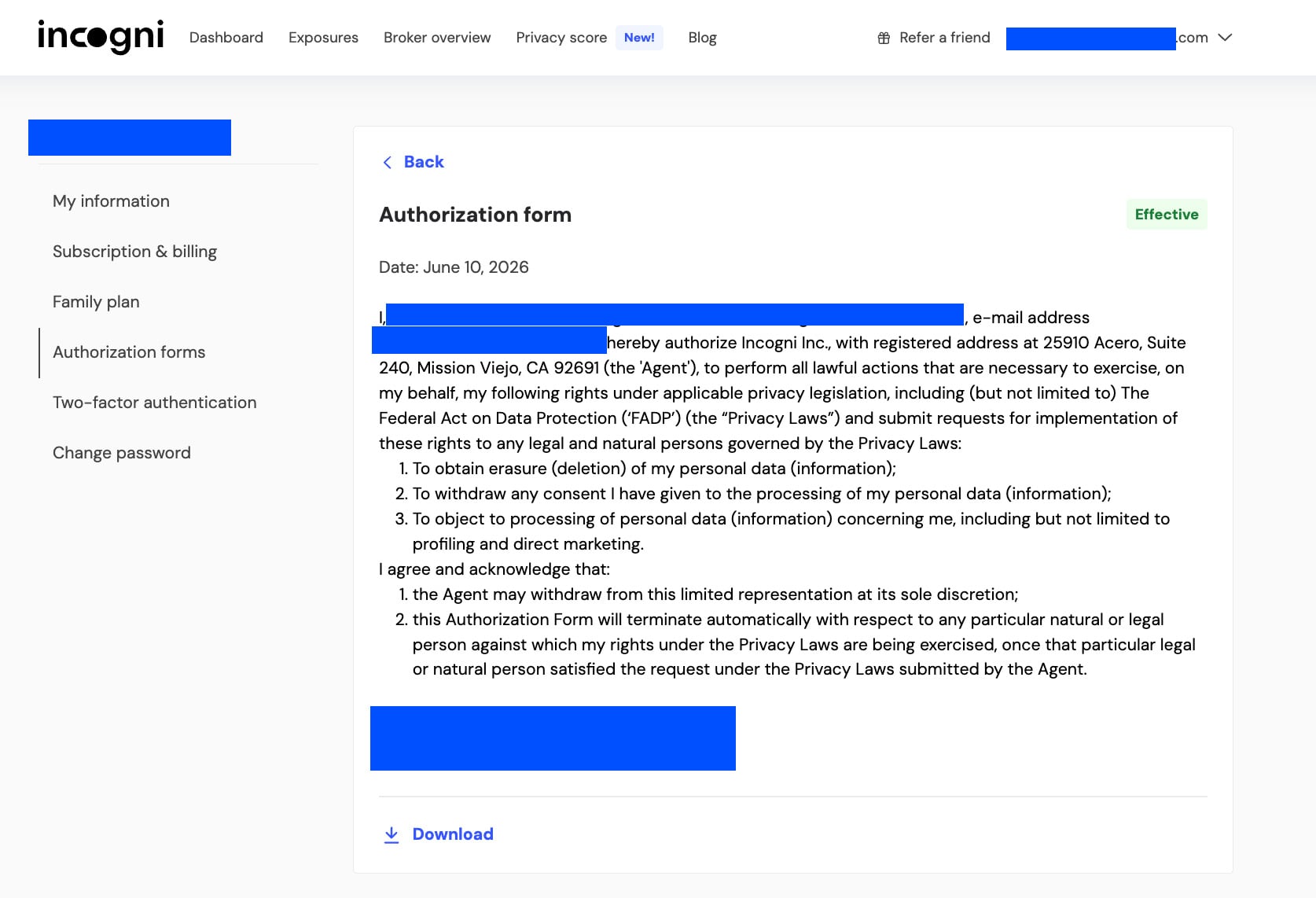
The last step is the authorization form and it is a limited power of attorney: you appoint Incogni as your agent to request deletion of your data, withdraw consent and object to processing (see screenshot below). Once I signed, Incogni started sending requests without any further input. That is the appeal of the service: you do not choose brokers, write emails or fill out opt-out forms.
My Results After Four Months
Here is what my dashboard, also available in Incogni’s iOS and Android apps, showed on October 2, 2026, a little under four months after I signed up.
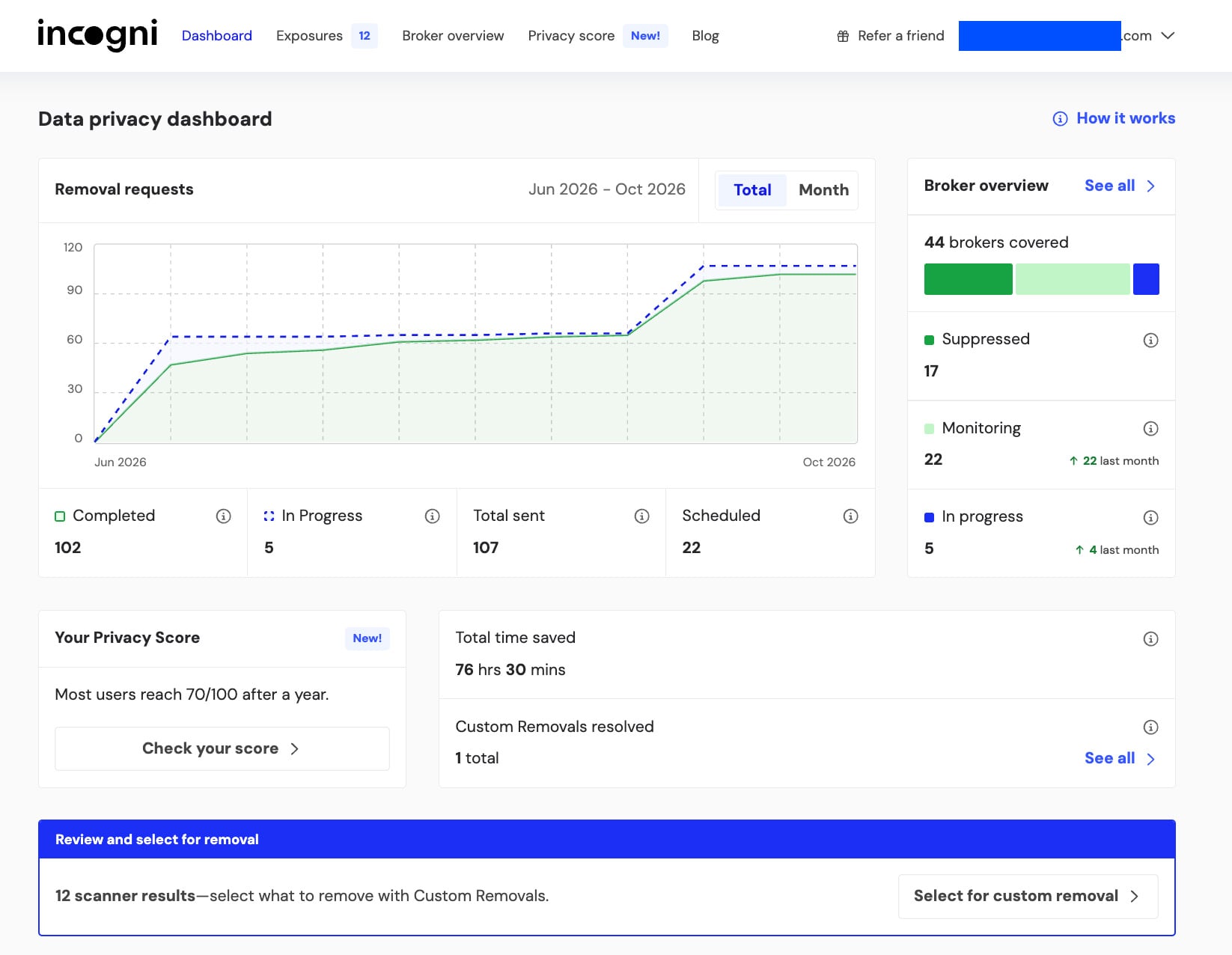
- 107 removal requests sent, of which 102 were completed and 5 were still in progress
- 22 more requests scheduled
- 44 brokers covered: 17 suppressed, 22 in monitoring and 5 in progress
- 76 hours and 30 minutes saved, by Incogni’s own estimate of what the manual work would take
- 1 custom removal resolved
The graph shows two waves: About 65 requests went out in the first weeks, then a second round in September lifted the total to 107. That second round matches the recurring requests Incogni describes: it goes back to brokers that already answered (every 60 days for people-search sites, every 90 days for other brokers), because many of them collect the same data again.
My numbers are modest next to other published tests where reviewers report between 200 and more than 1,000 requests on their accounts during the same timeframe. Incogni does not contact every broker on its list for every profile, and the count depends on the details you give it: My footprint with brokers turned out to be small and expect your own figures to differ from mine, in either direction.
The gap between 107 requests and 44 brokers has a simple explanation: Some brokers receive several requests on the same day. In my log, one ad-tech company appears three times on September 16, each with its own request ID. My guess is one request per email address or phone number on the profile, though the dashboard does not say so.
What “Completed” Really Means
One thing that you need to understand: 102 completed requests are not 102 deletions. Incogni’s help center defines a Completed request as one where the broker either removed your data or confirmed that it had none. Private brokers do not publish their records so Incogni sends the request and relies on the broker’s answer. Privacy laws carry fines for false answers which is a reason to trust them but it is not the same as proof. I would like the dashboard to separate the two cases in its totals: As it stands, the headline figure flatters the service a little, and you have to open individual requests to see what happened.
Suppressed, Monitoring and In Progress
The broker overview sorts the 44 brokers into three groups: Suppressed means the broker has put you on its suppression list and should not rebuild your profile. That is the best outcome, and 17 of my brokers reached it. Monitoring means the first removal is done and Incogni will keep sending requests on a schedule. In progress means the broker has not answered yet. Seventeen suppressions out of 44 is a useful result. A one-time deletion solves the problem for a few months while a “suppression” entry is meant to solve it for good, at least with that broker.
Try Incogni With a 30-Day Money-Back Guarantee
The Broker Overview and Request Log
The detail screens are where Incogni stands out: The Exposures tab lists every request with an ID, the broker’s name, the date of the last update, the average resolution time and the status. In my account, the average resolution times ran from 2 days for the fastest broker to 15 days for the slowest.
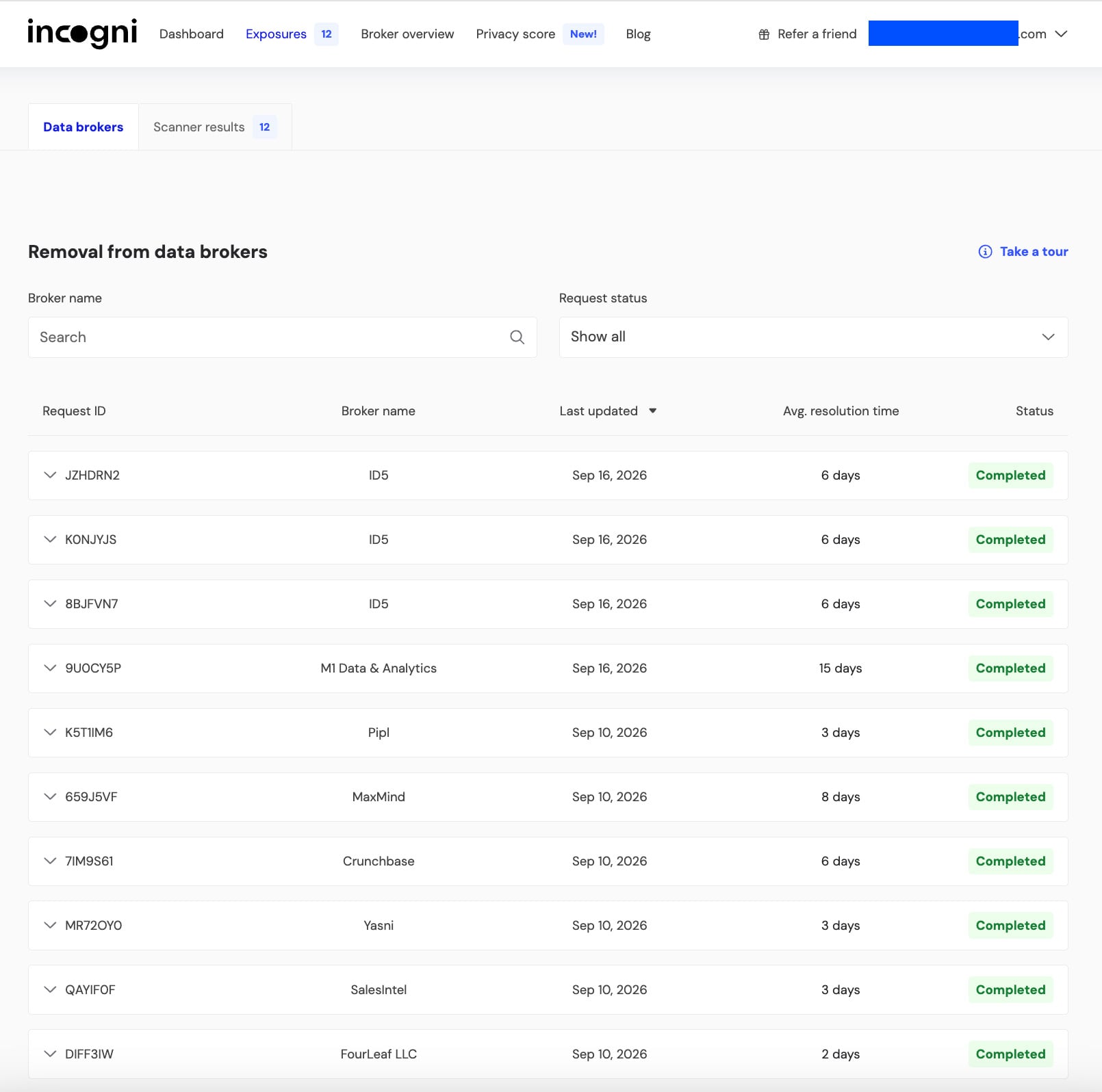
Those times are averages across Incogni’s customers and not a measure of my own requests. When a request sits in progress for three weeks, you can see at a glance whether that broker is slow with everyone.
The Broker Overview tab adds two ratings for each company: The compliance score tells you how reliably the broker answers removal requests. Most of mine were rated Compliant, and two were rated Inconsistent (a marketing data firm and an IP geolocation company). The severity rating (low, medium or high) reflects how sensitive the data held by that broker is.
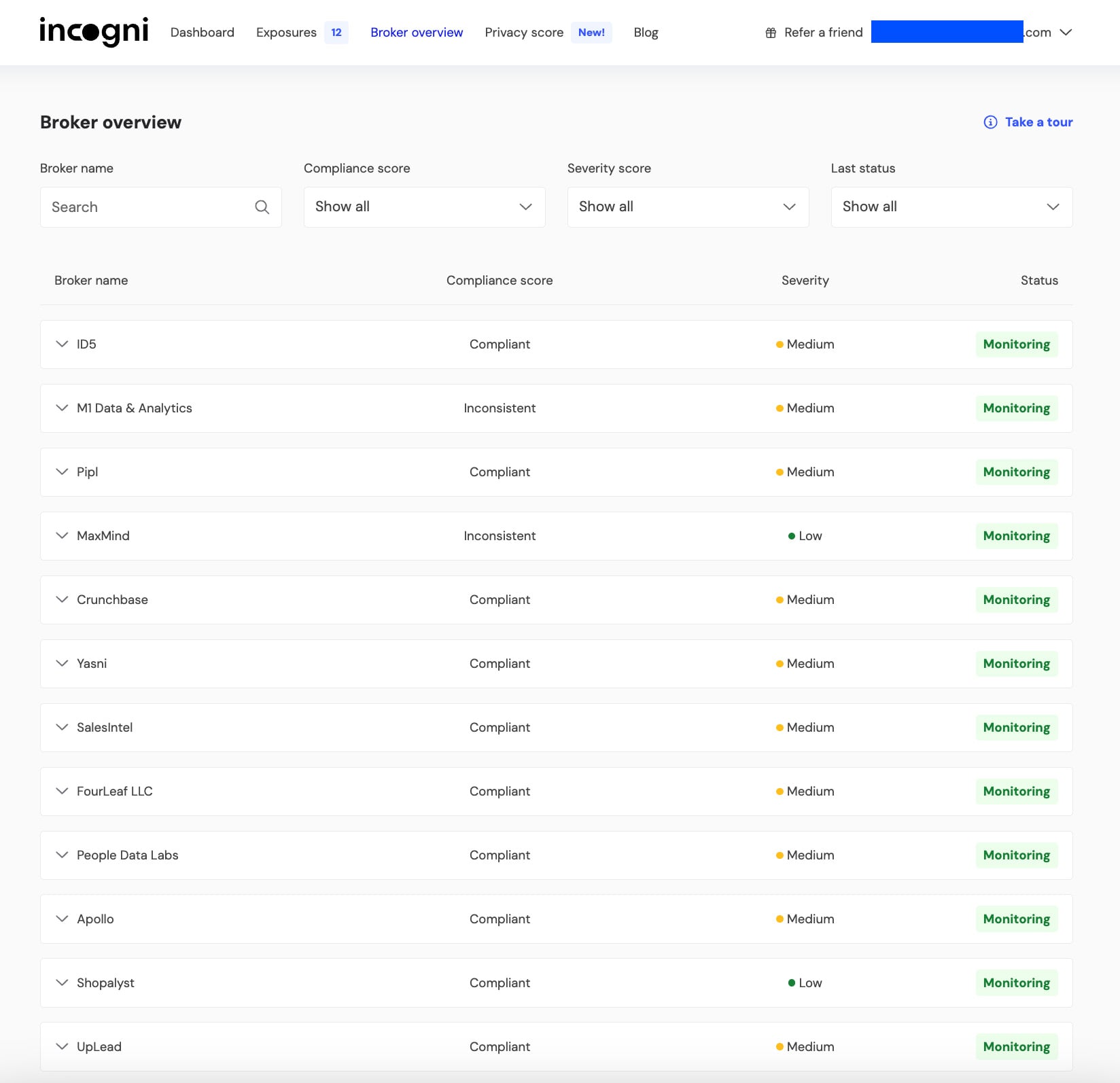
Almost all of my brokers were rated medium severity, with two rated low and none rated high. Clicking a broker opens a short description of the company, the risks tied to its data and the history of your requests. And to be honest, I learned more about who trades my details from this screen than from any privacy policy.
What is missing is visual proof: Incogni tells you a broker removed your record, but it does not show a screenshot of the listing before and after. Optery does, and that remains the clearest difference between the two services.
Custom Removals and Scanner Results
Automated removals only reach the brokers on Incogni’s list: Custom removals, reserved for the Unlimited and Protect plans, cover the rest. You paste the address of a page that shows your personal data, and a member of Incogni’s team takes it from there, working on up to three requests per user at a time. Incogni says the feature has worked on more than 3,000 additional sites.
I submitted one request on June 10, 2026 for a business directory page that listed my name. Incogni says most requests take 7 to 30 days, and the dashboard gave an average resolution time of 30 to 60 days for that site – but Incogni marked the request completed on September 9, which is 91 days. The status note also said the website should remove my data within 72 hours of that date. So the feature worked, but it took half as long again as the upper estimate: Custom removals are handled by real people and depend on the goodwill of the site and no service in this category guarantees them.
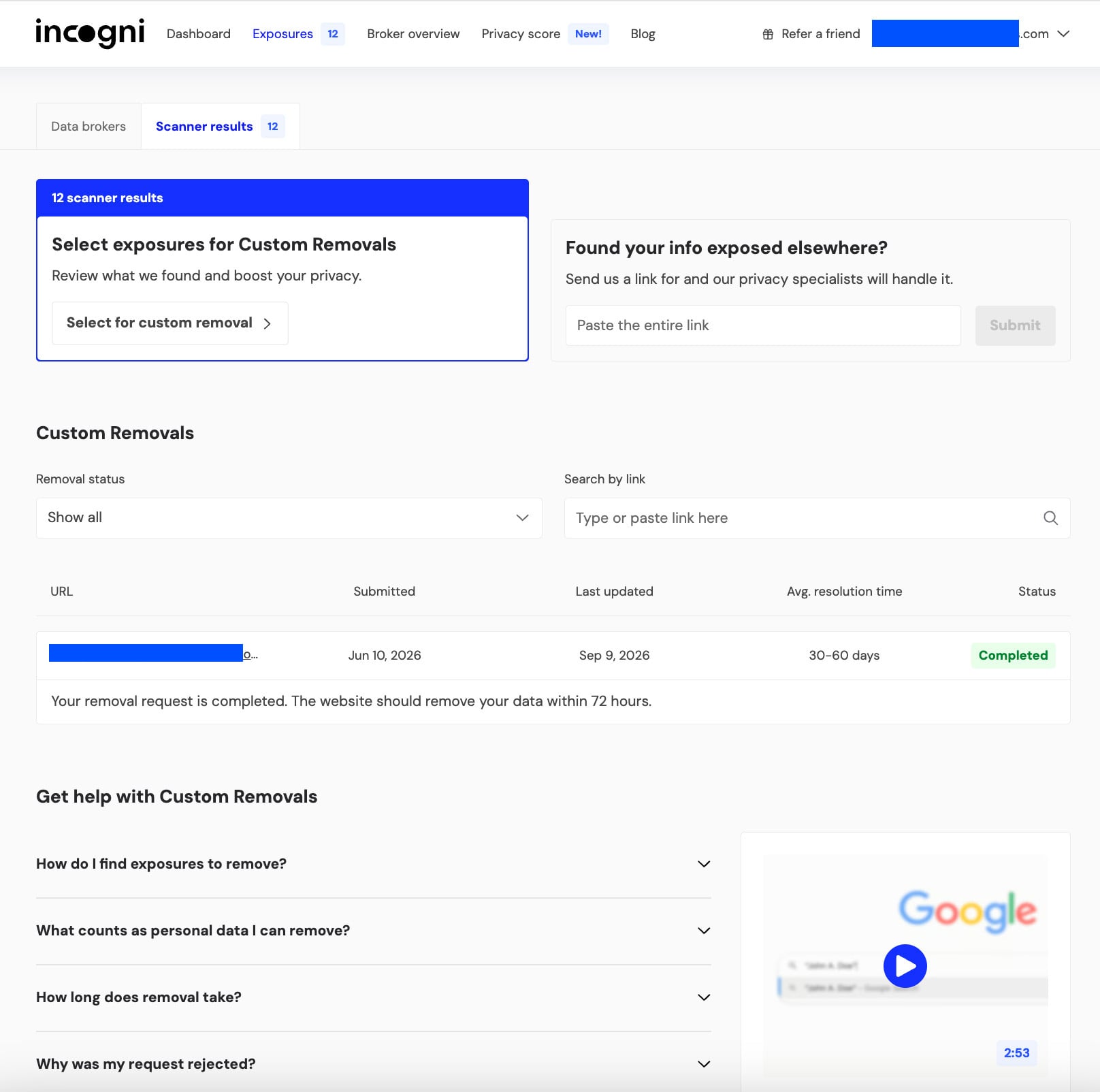
The same tab holds the scanner results: Incogni searches the web for pages that mention you and lists them for review, and you choose which ones to send to custom removal (mine showed 12 results). I like that nothing is sent without my approval: It also means the feature is not hands-off, and not every result is removable. A contact database is a fair target but a newspaper article that mentions you is a different matter, and I would not expect a removal service to get it taken down.
Get Custom Removals With Incogni Unlimited
The New Privacy Score
The privacy score is the newest part of the dashboard, available on the Unlimited and Protect plans. My first report is dated October 2, 2026, and the next update is scheduled a month later. The score runs from 0 to 100: Mine was 54 out of 100, labeled “Well protected.” Next to it, Incogni shows a second figure, 24, for my score “without Incogni.” The page also says most users reach 70 out of 100 after a year.
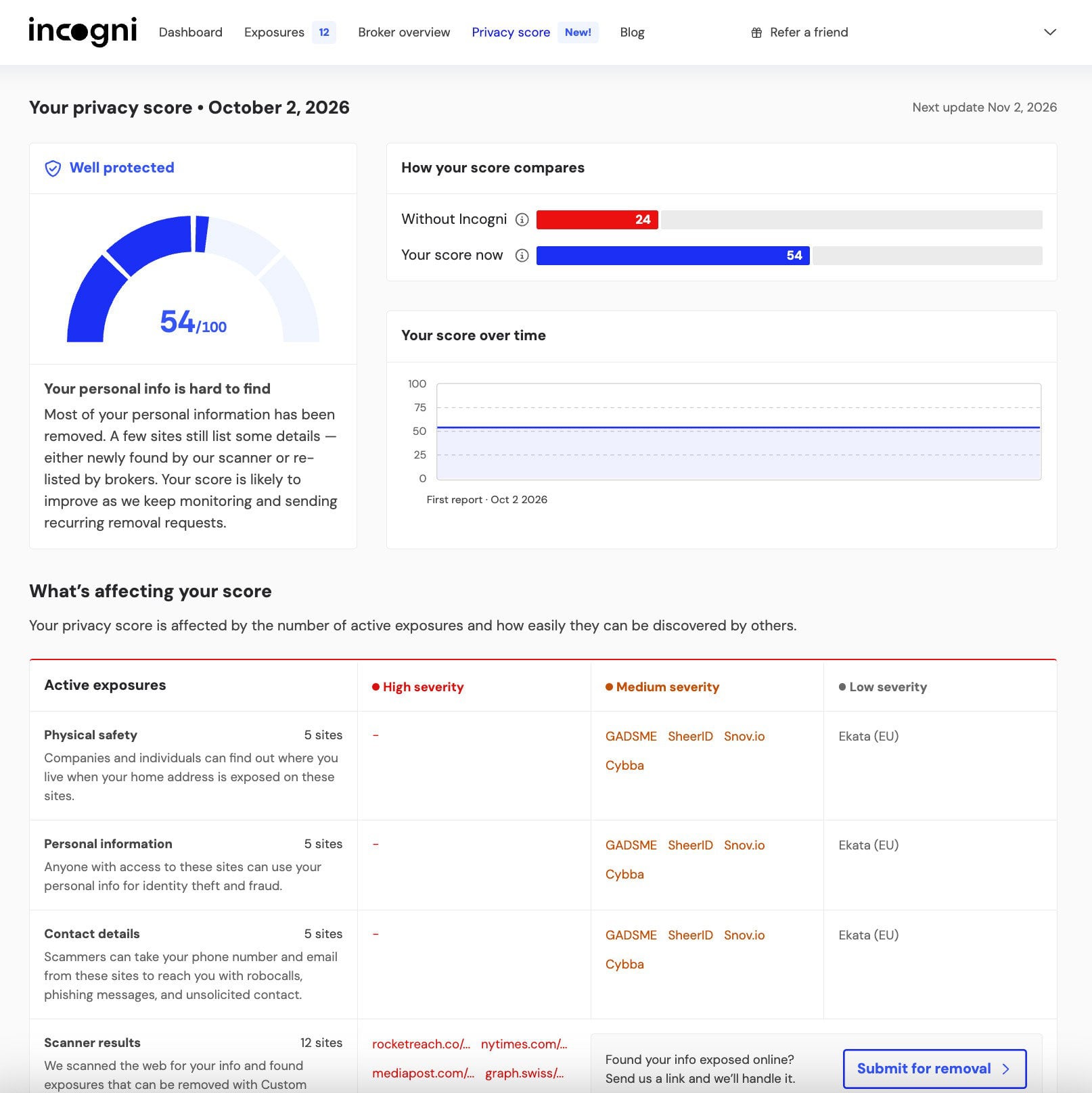
According to Incogni, three things feed the score: how many of your exposures have been cleared from data broker sites, how easily the remaining ones can be found by others, and how long Incogni has been working on your removals. The score rises as removals are confirmed but it can also drop when the scanner finds new exposures or when Incogni adds brokers to its list.
Incogni gives no fixed timeline for a top score: It says most users are rated “well protected” within about a year, and “strongly protected” after one to two years. I got the first label in under four months, probably because my exposure was low to begin with. Below the score, a table lists what still drags it down: In my case, five sites still held my home address, personal details and contact details. Four were rated medium severity and one low.
What My “54” Tells Me, and What It Does Not
The table of active exposures is the most useful part of the page and it answers the question the main dashboard avoids: where is my data still listed today? It names the sites and groups them by type of risk, from physical safety to spam and fraud.
The number itself deserves more caution: Incogni designed the score and Incogni is the one being graded. One of the three inputs is the time you have been a subscriber, so part of the score goes up simply because you keep paying. The “without Incogni” figure is an estimate that I cannot check.
The label also runs ahead of the facts: “Well protected” at 54 out of 100, with five brokers still holding my address, is a generous reading. I would treat the score as a progress bar for your own account. It tells you whether things are moving in the right direction. It is not an independent measure of your privacy, and it should not be compared with scores from other services.
Track Your Own Privacy Score With Incogni
Audits and Independent Evidence
Data removal services ask for a lot of trust, and most of them back their claims with little more than a number on a homepage. Incogni has two outside sources to point to. The first is a limited assurance report that Incogni commissioned from Deloitte. According to Incogni and to reviewers who read the report, it confirmed that the service covers more than 420 data brokers, that it sends and receives removal confirmations, that it repeats removal requests on a schedule, and that it had not sold customer data as of August 6, 2025. Incogni says a new assessment is underway.
The second is academic: A peer-reviewed study presented at the 2025 Privacy Enhancing Technologies Symposium had 71 US participants subscribe to four removal services for 30 days. Incogni had the highest removal rate of the four, at 76.6% of records per participant, against an average of 48.2%.
Two caveats come with that result: The same paper judged the four services “relatively ineffective” as a group and it also found large gaps between users of the same service. Being first in that study means Incogni did better than three competitors, and that about a quarter of the records it found were still in place after a month.
Verdict: Who Should Choose Incogni?
After almost four months, Incogni did what it said it would: It sent the requests, followed up without being asked, got me onto 17 suppression lists and showed its work in more detail than I expected. The weak points are real but narrow: one name per profile, no visual proof of removal and slow custom removals in my case.
Choose Incogni if you want the broker side of your privacy handled with almost no effort, and you are willing to pay for a year. The Standard plan covers that need. Choose Unlimited if your name appears on sites outside the main broker lists, and accept that those removals can take months.
Look elsewhere if you have used several names, if you want screenshots of each removal, or if you prefer to start with a free tier. And whatever you choose, keep expectations realistic. A removal service reduces how easy you are to find but it does not make you invisible, and the new privacy score should be read with that in mind.
Start Removing Your Data With Incogni
FAQ
Is Incogni Legit?
Yes. Incogni belongs to the Surfshark group and has published a limited assurance report from Deloitte on its coverage and recurring requests. A peer-reviewed study also ranked it first among four removal services for removal rate. In my own account, it sent 107 requests and closed 102 of them.
How Much Does Incogni Cost?
The Standard plan costs $95.88 per year, or $15.98 if you pay month by month. Unlimited costs $179.88 per year, Family costs $191.88 per year for up to five people, and Family Unlimited costs $275.88 per year. In the US, Incogni Protect costs $20.74 per month, billed annually. Tax may apply.
Does Incogni Have a Free Trial?
No. Incogni has a 30-day money-back guarantee, so you pay first and can request a refund within that period. It also runs a free, one-off exposure scan that shows where your details appear in public listings.
How Long Does Incogni Take to Remove Your Data?
It depends on the broker. In my account, average resolution times ranged from 2 to 15 days for automated requests. My one custom removal took 91 days, longer than the 30 to 60 days the dashboard estimated.
What Is the Incogni Privacy Score?
It is a score from 0 to 100 on the dashboard of the Unlimited and Protect plans. Incogni bases it on how many exposures have been cleared, how easy the remaining ones are to find and how long you have used the service. Treat it as a progress indicator for your account, not as an independent rating.
Who Owns Incogni?
Incogni was created by Surfshark and later became a standalone product. Surfshark is part of the same group as NordVPN, and it also holds a majority stake in Optery, another data removal service that runs separately.