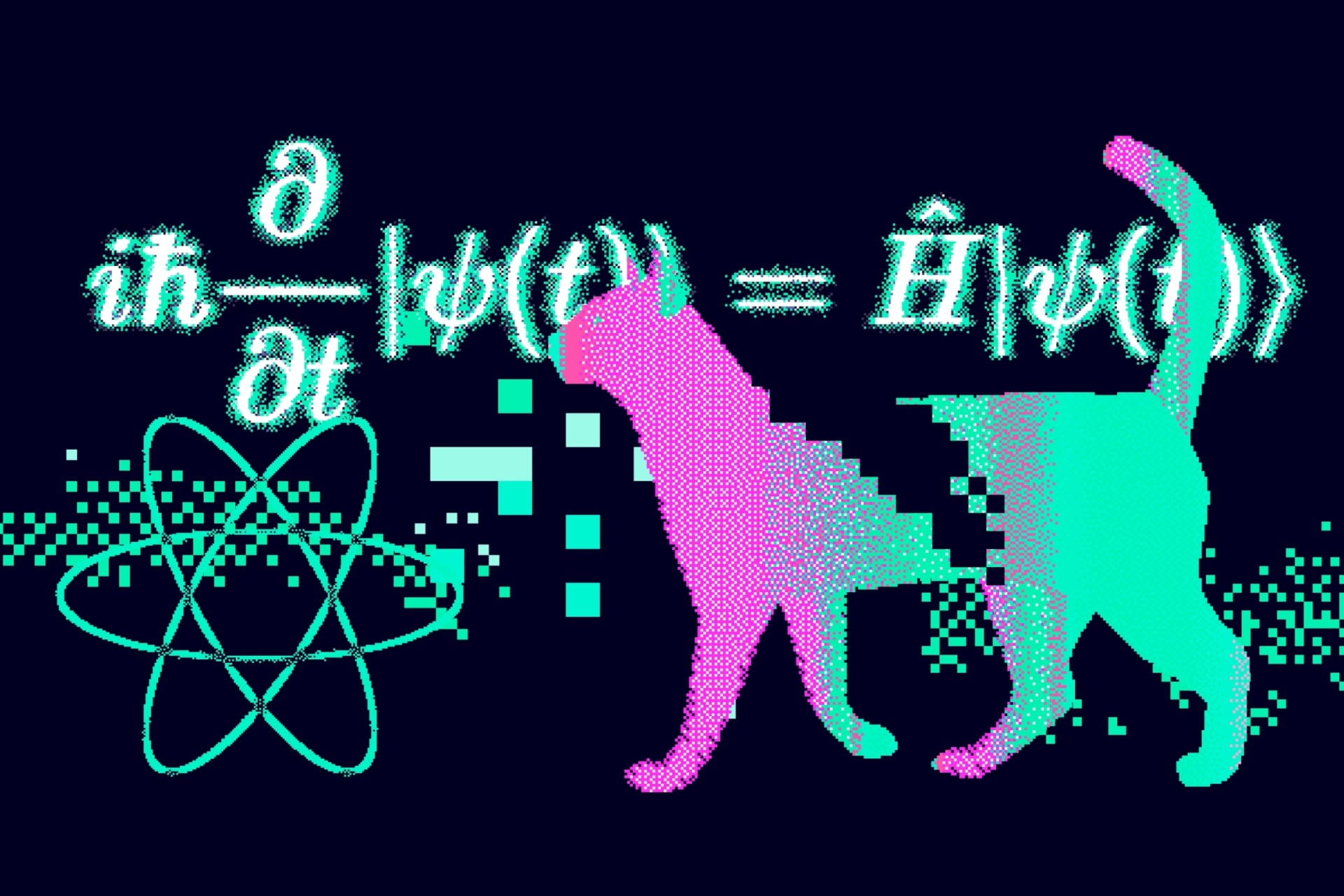
In an iconic thought experiment, Austrian physicist Erwin Schrödinger imagined a cat that could be dead or alive—a clever analogy to the quirkiness of quantum superpositions. Nearly a century after Schrödinger’s cat, physicists have created a new family of exotic “cat states” in the quantum realm.
Quantum superpositions refer to how quantum systems can exist in more than one state at the same time. The act of observation determines the system’s “final” state, so to speak. In a recent Physical Review X paper, physicists report the development of a new way to create and control quantum superpositions in the motion of a trapped ion system. As a result, the team created a variety of states with “distinctive interference patterns, rotational symmetry, and clear signatures of nonclassical behavior,” study lead author Sebastian Saner told Gizmodo.
In other words, physicists built an expanded family of quantum superposition based on exotic quantum states. What’s more, the new method gives researchers a greater degree of freedom in working with the quantum world.
“Even though physicists have been thinking about quantum superpositions for more than a century, we are still finding new ways to create, control, and understand them,” said Saner, physicist at Oxford University in the U.K.
Either or neither
According to an explainer by the California Institute of Technology, Schrödinger intended the cat experiment to “demonstrate what he saw as the absurdity of quantum science.” Indeed, there’s something odd about the idea of anything—never mind a cat—being dead and alive at the same time, just because we can’t “see” and confirm it’s either one.
“It is obviously a dramatic example, but it captures something real about quantum mechanics,” Saner said. “The important point is that a superposition is not just ordinary uncertainty. It is not simply that we do not know which state the system is in.”
These possibilities are linked according to “very precise” patterns in quantum mechanics, he added, and they can interfere with one another like waves. This property is central to experiments in quantum optics, in which a “cat state” typically refers to a superposition of two distinct oscillator states.
The theory is alive
For the experiment, Saner and colleagues used a single ion of strontium inside an ion trap. According to a university statement on the findings, the team engineered the trap so that the ion’s internal state was entangled in different possible states of motion. Then, a mid-circuit quantum measurement of the state projected the ion’s motion into a particular superposition.
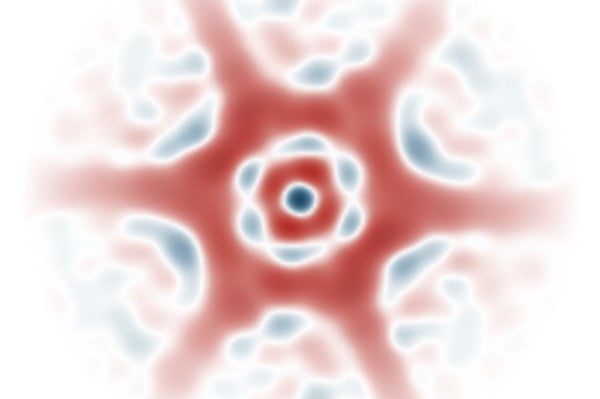
“In our system, the ion has two important parts: an internal quantum state, which we often call the spin, and its motion, which behaves like a quantum oscillator,” Saner explained to Gizmodo. Via the new method, the team found that the “spin was no longer just helping mediate the interaction; it had become a tool for sculpting the quantum state itself.”
Saner added that some of these “cat states” had been theoretically predicted more than 30 years ago, but the real challenge was in “creating them in the lab and proving that they were really there,” he said.
From the cat to reality
But the implications of the findings stretch beyond being fundamentally interesting. For instance, trapped ion systems are a popular component of quantum computing. As the new method offers precise, versatile ways of manipulating quantum systems, its potential could extend to quantum computers, simulations, and sensing systems, Saner said.
“The textbook image of a quantum system being in two places at once is only the beginning,” he added. “There is a much larger landscape of possible quantum states, and we are still learning how to access it experimentally.”