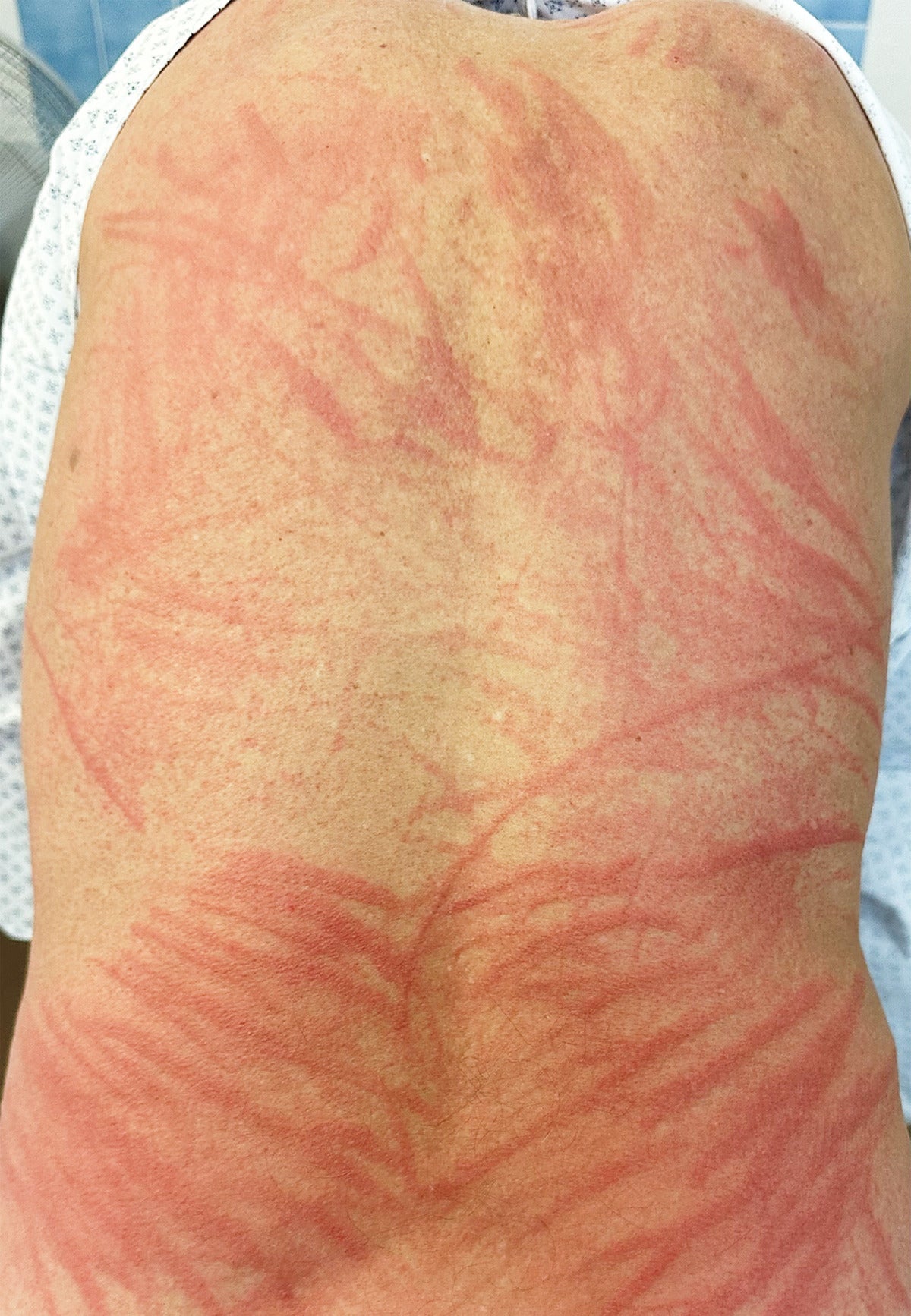
A man’s love of mushrooms left him with bizarre red streaks across his back. In a case study released this week, doctors describe how the unlucky fellow developed a rare skin condition from eating undercooked shiitake mushrooms. The condition is only temporary, thankfully, and he recovered with no issues.
The case is detailed in a paper published Wednesday in the New England Journal of Medicine. According to the report, the 72-year-old man visited a local emergency department in Geneva, Switzerland two days into having an itchy rash across his back and upper buttocks. The itch became so intense that he couldn’t sleep.
The striking appearance of the rash—featuring whip-like streaks of reddened skin—made it easy enough for doctors to identify it as something called flagellate erythema. There are several potential causes for this kind of rash, such as exposure to the cancer drug bleomycin. But when the man revealed that he had cooked and eaten a meal containing shiitake mushrooms two days earlier, doctors quickly surmised his problem to be a case of “shiitake dermatitis.”
This skin condition usually occurs a day or two after eating undercooked or raw shiitake mushrooms (Lentinula edodes). It’s not completely clear why it happens, but the leading theory is that it’s a toxic or hypersensitivity reaction to lentinan, a complex carbohydrate abundantly found in shiitake. Lentinan breaks down with enough heat, which is why consuming well-cooked mushrooms doesn’t cause the rash. It’s thought to be an uncommoncomplication even for raw or undercooked shiitake mushroom lovers, though, perhaps affecting 2% of people who indulge in the habit.
Despite the stark look of the rash, shiitake dermatitis doesn’t seem to cause a more severe or life-threatening allergic reaction, known as anaphylaxis. And it goes away on its own in due time. In this case, the man was advised to start fully cooking his mushrooms from now on; he was also given topical steroids and oral antihistamines to help alleviate his symptoms. At a follow-up visit two weeks later, his skin still had some residual areas of hyperpigmented skin (a common and usually fading symptom seen after having an inflammatory condition), but the itchiness had disappeared.
“Our objective was to bring attention to a lesser-known condition that may initially raise concerns among general practice physicians but is, in reality, self-limiting,” study author Eglė Janušonytė, a doctor at Geneva University Hospitals, told Gizmodo.
Shiitake dermatitis is rarely seen outside of Asian countries where the mushrooms are most commonly eaten. But the growing worldwide popularity of this fungi has led some doctors, including Janušonytė, to caution that this condition will become a more regular occurrence elsewhere.
“With shiitake mushrooms currently ranking as the second most consumed mushroom globally, we anticipate a growing number of cases in Europe. Therefore, it is crucial for healthcare professionals to be well-informed about this condition,” she said.
This article has been updated to include comment from one of the study’s authors and to correctly note that the case took place in Switzerland.