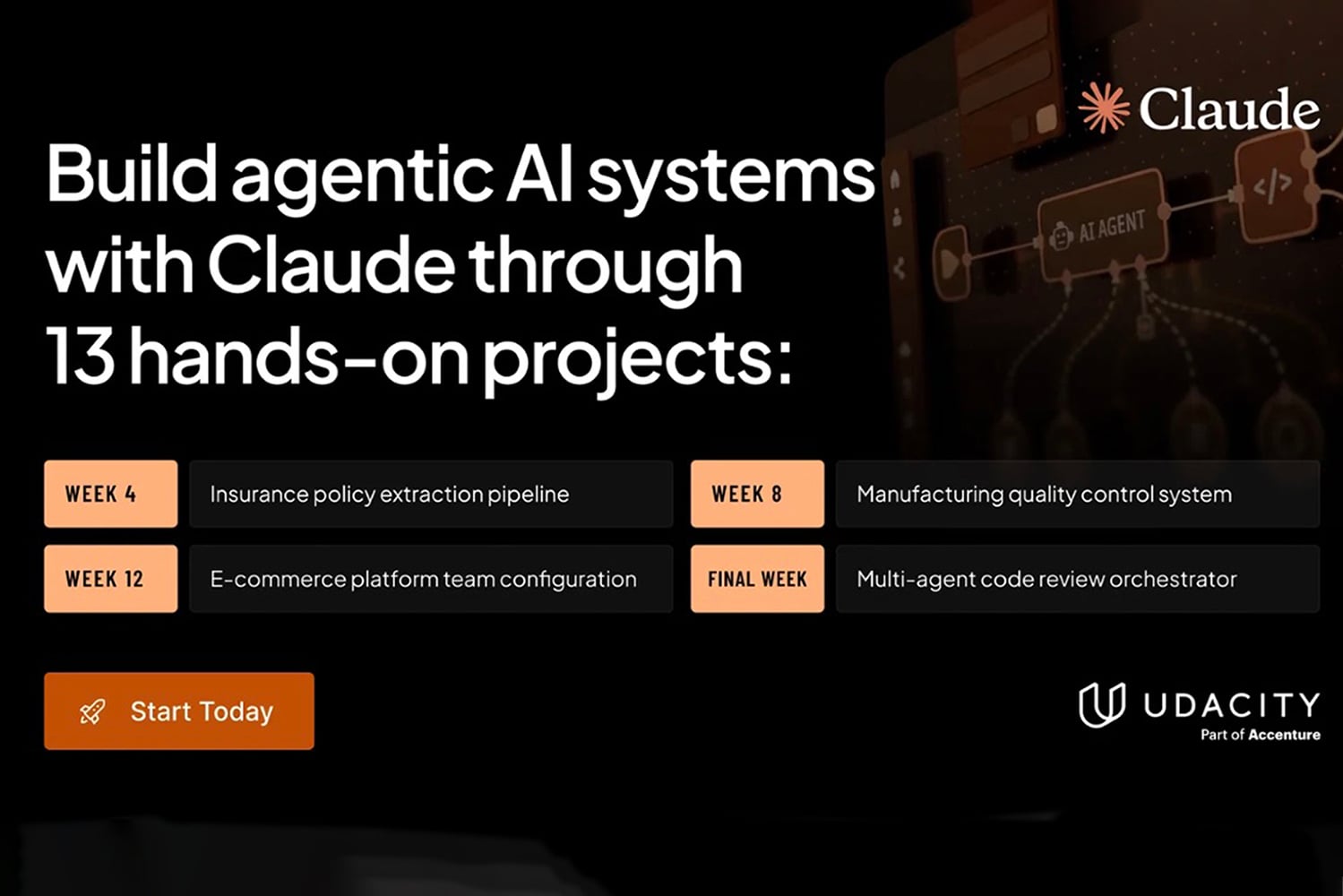
Udacity’s new AI Engineering with Claude Nanodegree program helps developers go beyond demonstrating their ability to build working AI agents and deliver them to end users in the real world. This self-paced, intermediate-level training program covers approximately 38 hours of instruction based on Claude, Claude Code, the Claude Agent SDK, and the Model Context Protocol (MCP). It focuses on the engineering skills businesses need after moving beyond prototypes for testing. An experienced mentor reviews all your projects, and when you complete all requirements, you receive a certificate of completion and a portfolio of production-focused work.
Enrollment for Udacity’s AI Engineering with Claude Nanodegree program is open now, and you can buy it as an individual course for a one-time payment of $999. You can also get it through a Udacity subscription for $249 per month, or $212 per month with the bundle plan. Both subscription options let you cancel anytime and include unlimited access to hundreds of Udacity courses, along with hands-on projects with expert feedback and personalized career coaching.
A self-paced program covering Claude, the Agent SDK, and MCP
Many programs let you learn to create a model prompt or build a simple chatbot, but this program starts where those leave off. Udacity refers to developing “the harness,” which provides the control an agent needs to operate successfully in production. That includes managing the agentic loop, defining the tools available to an agent via the Model Context Protocol (MCP), detecting silent failures before customer use through evaluations, and implementing rules in your code through bounded autonomy and human-in-the-loop guardrails.
The program includes four project-based courses and 39 lessons. The first course focuses on harness engineering in Claude and Claude Code. In this course, you choose the best available Claude model for a particular task by considering factors such as intelligence, processing speed, and cost. You then use the Claude Agent SDK to build an agent and Claude Skills to author reusable components you can use multiple times. After completing the first course, you move into using MCP in action, then evaluate agents and determine ways to make them observable, and you conclude with bounded autonomy and guardrails for multi-agent systems.
You spend most of your time participating in hands-on exercises. The program includes 13 hands-on projects, each presented as an industry scenario in insurance, retail, financial services, or manufacturing. As you progress through the program, you develop a variety of solutions, including a claims intake agent, a context strategy for a long-running retail support copilot, validated document extraction pipelines for insurance policies and mortgages, and a banking agent wrapped in deterministic compliance hooks.
Your portfolio includes two capstone projects. PriceScout is an MCP-powered agent that identifies competitor pricing by using custom scrapers and database servers to gather and reason over that information. The second is an enterprise multi-agent code review orchestrator that directs pull requests across specialized agents while providing deterministic guardrails to ensure that each agent remains within its defined boundaries.
This program targets software engineers who use Claude to build applications but want to move from demonstration environments to systems that real users depend on. Before enrolling in this program, you should have a foundational understanding of Python, some experience with TypeScript, and familiarity with generative AI and agentic AI concepts. Since this program is self-paced, you can integrate the coursework into your current schedule as needed.
Udacity’s technical content team created the curriculum to prepare you for the knowledge and skills measured by the Claude Certified Architect – Foundations (CCA-F) exam. Udacity developed the program independently, and it isn’t officially endorsed by or affiliated with Anthropic.
Udacity, part of Accenture, provides project-based online learning in AI, data, cloud, and other emerging technologies. Its programs pair relevant industry curricula with personalized mentor feedback. The AI Engineering with Claude Nanodegree is another example of this approach, offering a structured progression from experimenting with Claude to building production-ready agentic systems.