Highly elliptical orbits (HEO)

A highly elliptical orbit, or HEO, is common for comets coming in from the Kuiper Belt, but satellite operators can benefit from having their spacecraft travel along elongated orbits.
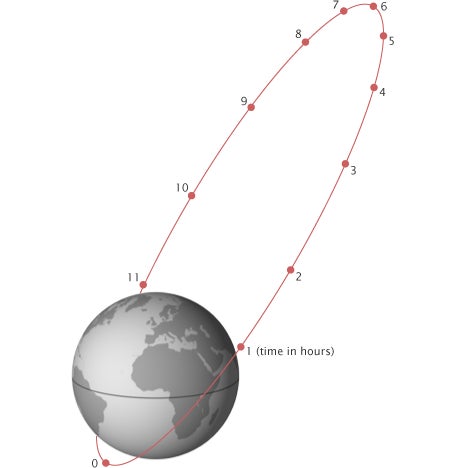
Satellites in HEO are guaranteed to spend “most of the time at an altitude outside the Earth’s radiation belt, making long periods of uninterrupted scientific observation…possible,” according to a 2019 research paper. What’s more, satellites in HEO spend the vast majority of their time either heading toward or returning from apogee (the point at which an orbiting object is farthest from Earth), allowing them to hone in on ground sites for protracted periods of time. For its initial system, Sirius Satellite Radio placed its three satellites in HEO for this very reason, allowing them to stay positioned over North America.
As an aside, Molniya orbits are highly elliptical, and because they work well at the higher latitudes, the Soviet Union used HEO to gain coverage over polar regions. Two satellites in HEO can provide continuous coverage, but unlike GEO, these satellites don’t stay in a fixed position relative to Earth’s surface.