Transfer orbits
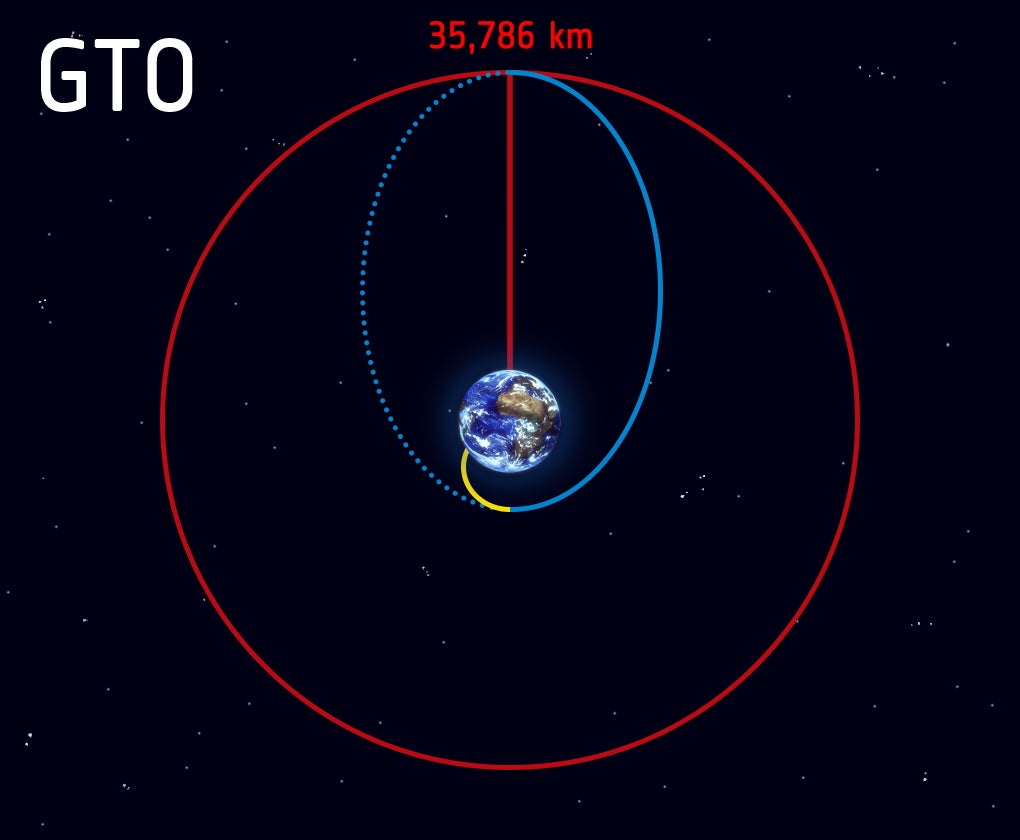
It’s not always possible to launch a satellite directly to its operational orbit, requiring the use of transfer orbits—temporary and elliptical circuits from which satellites can migrate to their desired orbits. When in transfer orbits, satellites or other spacecraft require very little energy from their thrusters or apogee motors to maneuver from one orbit to another, such as when using a geostationary transfer orbit to reach a geostationary orbit. An advantage of transfer orbits is that a payload doesn’t require a jumbo rocket to reach its operational orbit.
As a recent example, SpaceX used its Falcon 9 rocket to launch an Egyptian communications satellite to a transfer orbit some 28,000 miles (45,000 km) above Earth on June 8, 2022. The spacecraft used its own propulsion system to reach its operational orbit in GEO, where it’s now providing TV broadcast and internet services.