
Disclaimer: This page is written for adults. Gizmodo supports Greece’s effort to keep children under 15 off social media, and from January 1, 2027, Greek law doesn’t allow them to use these platforms. Our interest is the privacy of legal adults, whose age may soon be checked by platforms and third-party verification companies.
Picture a family holiday on a Greek island. The parents scroll Instagram by the pool, while the 13-year-old’s TikTok account stops working overnight. From January 1, 2027, the Greece social media ban makes that second part law, blocking social media for children under 15.
For adults, little changes on paper. Still, age checks leave open questions: what happens when a platform guesses your age wrong, and how the checks work for visitors with no Greek government login. Here’s what the law says so far, and where a VPN fits in.
Greece Social Media Ban at a Glance
- Starts: January 1, 2027.
- Who’s affected: Children under 15 (born 2013 or later), including existing accounts, with no parental override.
- Covered so far: Facebook, Instagram, TikTok, and LinkedIn. Messaging apps are outside the law.
- How checks work: Platforms estimate ages first, with Kids Wallet as the fallback. There’s no general ID upload.
- Adults and tourists: No restrictions and no penalties. A flagged adult confirms their age through the platform’s method.
- Privacy on the trip: A VPN like NordVPN protects logins on hotel Wi-Fi, but it doesn’t change the age limit.
What the Greece Social Media Ban Changes
Greek lawmakers approved the ban in an overnight vote that ended on October 23, 2026, with only the governing New Democracy party in favor. It still has to be published in the Government Gazette before it formally becomes law. The age rule works by calendar year.
The law treats every child as born on January 1 of their birth year, so a whole school year group crosses the line together. On the first day, that covers children born in 2013 or later, and the next group follows each January. Parents can’t consent on a child’s behalf, and accounts created before the ban have to be closed.
The government’s examples of covered services are Meta’s Facebook and Instagram, TikTok, and LinkedIn, with Snapchat still under review. However, the law describes covered services by what they do, with no fixed list, and it leaves private communication and educational use outside its scope.
Enforcement targets platforms only, so children and parents face no fines. Most large platforms have their EU base in Ireland. Complaints filed with EETT, Greece’s telecoms regulator, therefore go to the Irish regulator or the European Commission, which can fine a platform up to 6% of its global turnover under the EU Digital Services Act.
Age Checks: Platforms First, Kids Wallet Second
The law requires age checks that are appropriate, proportionate, and reliable, so a birth date typed into a sign-up form won’t count. In practice, platforms start with their own age-estimation systems, which look at signals from the account itself. When a platform can’t tell with reasonable certainty, it shows a QR code.
A parent scans it with Kids Wallet, a government app that answers one question: is this user over or under 15? According to the government, the platform learns nothing else. Gov.gr Wallet, the state’s digital document app, is the other tool the law names, and platforms can also use any method that meets EU standards.
There’s no general requirement to upload an ID document, though the government’s own Q&A admits that adults may sometimes face identity checks.
How the Greece Social Media Ban Affects Adult Visitors
If you’re 15 or older, the law doesn’t restrict you, and tourists face no penalties for using social media in Greece. What can change is the experience, because a platform’s age estimate can misjudge an adult. The fallback tools are built for Greek residents.
Kids Wallet and Gov.gr Wallet sign in through TAXISnet, the tax portal Greek citizens and residents use, and a visitor from the US or the UK has no such login. A flagged visitor would confirm their age through another EU-approved method the platform offers.
Meta, TikTok, Google, and LinkedIn hadn’t published their plans for visitors as of October 2026. Since the law doesn’t single out visitors, families traveling with children under 15 should assume the same rules apply. Messaging apps are unaffected, and a Greek eSIM keeps the family connected between hotels.
What a VPN Can and Can’t Do Under the New Rules
A VPN won’t change the age a platform assigns to your account. Age estimation looks at the account and its activity, which a new IP address doesn’t change. The Greek government’s Q&A says the same, adding that VPNs and false ages complicate enforcement. For adults, a VPN helps with everything around social media.
It encrypts your connection, so the owner of a hotel, airport, or ferry Wi-Fi network can’t see which sites you visit or intercept your logins. Connecting to a server back home also helps with online banking. Your bank sees a login from your usual country, which avoids the extra checks a sudden foreign login can trigger.
As age checks spread across Europe, more of what you do online is tied to verified accounts. A no-logs VPN hides your browsing from your ISP and the local network, and keeps no record of it.
Greece’s Ban Next to Australia, France, and the EU
Greece has company. Australia’s under-16 ban took effect in December 2025. France passed an under-15 law in July 2026. However, its Constitutional Council struck the ban down in August, arguing it would force adults to prove their age too.
At EU level, the Commission proposed the KIDS Act in September 2026. It would keep children under 13 off social media and allow parent-managed accounts for 13- and 14-year-olds, a middle ground Greece chose not to offer. If an EU regulation on the subject is adopted, the Greek rules stop applying.
At home, the criticism focused on privacy. Opposition parties questioned how verification and data protection would work. Meanwhile, 25 civil society groups warned that universal age checks could end anonymous social media use for adults.
Three VPNs to Install Before Your Trip
Setting up a VPN before you fly takes a few minutes:
- Subscribe to a VPN such as NordVPN.
- Install the app on your phone and laptop, then sign in.
- Enable the kill switch, which cuts your internet if the VPN connection drops.
- Connect to a server in your home country, or to a Greek server for local sites.
For Greek TV and local server speeds, our Greece VPN guide goes further.
NordVPN: Best for Hotel and Airport Wi-Fi
Pros
- Next-gen antivirus for risky networks
- Meshnet links your own devices while away
- Athens servers for local sites
- Independently audited no-logs policy
- Kill switch on desktop and mobile
Cons
- Higher price after the first term
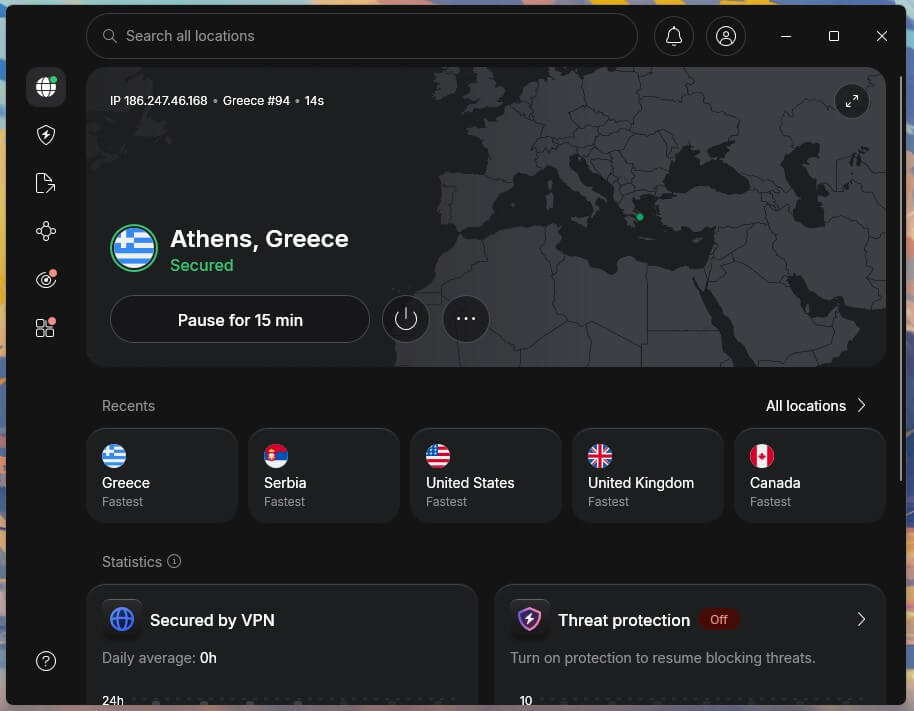
We’d set up NordVPN for a trip. Its next-gen antivirus stops fake login pages, trackers, and infected downloads, a common risk on café and hotel networks. With servers in 152 countries, a server near home is easy to find, and there are Greek servers in Athens for local sites. Meshnet adds something useful on holiday.
It links your own devices, so you could browse through your home computer or send photos from your phone to your laptop without a cloud service. Independent auditors have confirmed that NordVPN keeps no record of your activity.
Proton VPN: Best for Swiss Privacy
Pros
- Swiss privacy laws
- Free plan with no data cap
- Open-source, audited apps
- NetShield blocks ads and trackers
- Secure Core double-server mode
Cons
- Free plan chooses the server for you
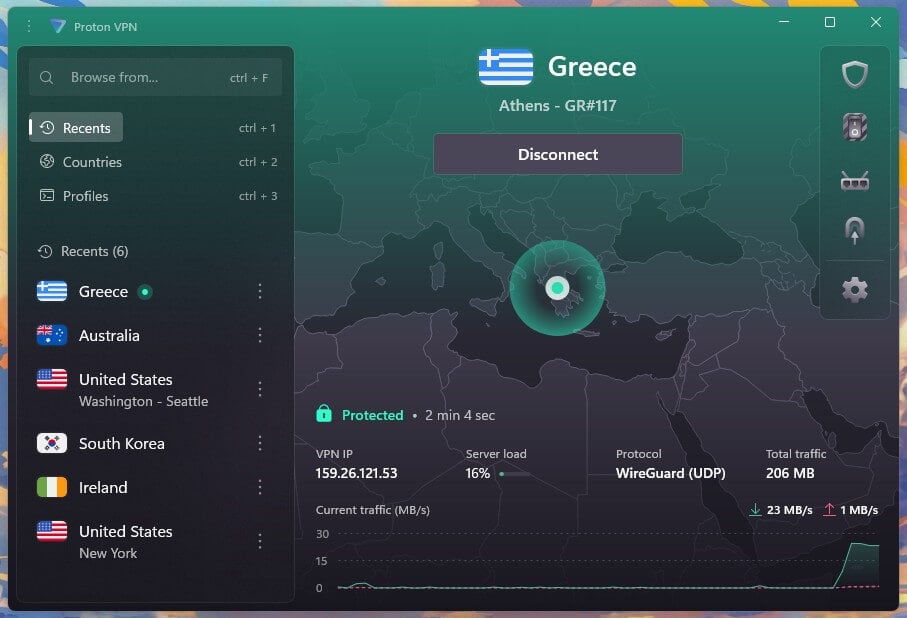
Proton VPN comes from the Swiss company behind Proton Mail, and Swiss law offers strong protection against foreign data requests. Its apps are open source, so outside experts can check what the code does, and its no-logs policy has passed independent audits.
NetShield blocks ads, trackers, and malware domains, which keeps feeds and news sites lighter on a slow hotel connection. For a short trip, the free plan is a practical start, with no data cap and an automatic connection to the fastest free server.
Proton VPN Plus adds servers in 149 countries, including Athens, plus Secure Core, which sends traffic through a privacy-friendly country such as Switzerland or Iceland first.
ExpressVPN: Best for Simple One-Tap Use
Pros
- One-tap connection
- Lightway protocol for quick reconnects
- RAM-only servers
- Audited no-logs policy
- Apps for phones, laptops, and routers
Cons
- No free plan
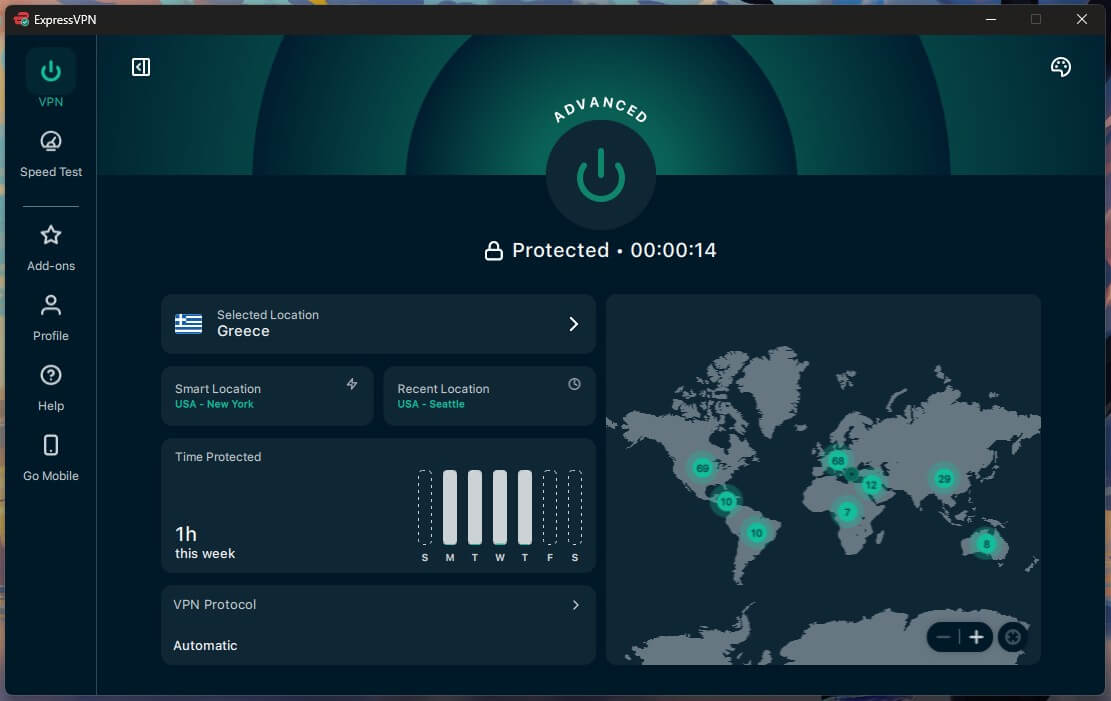
ExpressVPN is simple enough to hand to a less technical travel companion. The app starts on a single connect button. Its Lightway protocol, the method it uses to build the encrypted connection, reconnects in seconds when your phone moves from hotel Wi-Fi to mobile data. And that happens often during travel.
Its servers use RAM only, so data is wiped with every restart, and independent firms have checked its no-logs policy several times. Servers in 113 countries cover most home countries, and the Greece location works for local sites. The app also installs on tablets and home routers.
Final Thoughts
Greece’s ban targets children, and adults can keep using Facebook, Instagram, and TikTok as before. The open question is how platforms will apply their checks from January, especially to tourists with no Greek tax login. Until the companies explain, a flagged adult should expect a short age check through the platform’s own method.
A VPN won’t change that process. It protects the rest of a trip: hotel Wi-Fi logins, a bank that recognizes your home country, and streaming apps from home. Install NordVPN before you travel, so its kill switch and next-gen antivirus are ready the first time you connect at the airport.
Frequently Asked Questions
Is social media banned in Greece?
No. Adults and teenagers aged 15 and over can use social media in Greece. The new law only requires platforms such as Instagram and TikTok to block children under 15.
Is WhatsApp affected by the Greek social media ban?
No, WhatsApp isn't covered. The law targets social networking services, and private messaging apps such as WhatsApp and Viber fall outside that definition, so children under 15 can keep using them.
Is it legal to use a VPN in Greece?
Yes. VPNs are legal in Greece and widely used for privacy on public Wi-Fi, with NordVPN and Proton VPN among the most popular. A VPN doesn't change the social media age limit.
Will adults have to prove their age on Instagram in Greece?
No, usually not. Most adult accounts pass on account history and activity alone. A formal age check comes up only when an adult's account looks younger than the person behind it.