The Thought Recorder (1919)
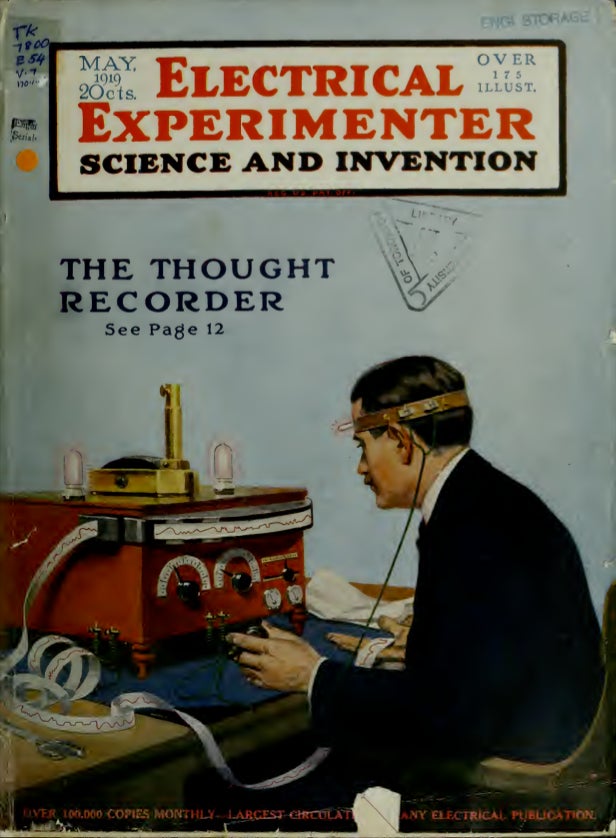
After the invention of the Audion, the tool in radio that allows for tremendous amplification of radio waves, Gernsback imagined it could be used to record a person’s thoughts.
From the May 1919 issue of Electrical Experimenter magazine:
The business man of tomorrow will dictate his correspondence on the thought recorder, while his stenographer, who is perfectly familiar with his “thought writing,” will type out the correspondence from the tape, which is kept moving by electric motors, in front of her eyes.
Gernsback presented his ideas to inventors like Nikola Tesla, Greenleaf W. Pickard, and Lee De Forest, who apparently seemed skeptical at first. But Gernsback said that Tesla eventually came around and that it might be possible.
“There is a possibility that we may finally succeed in not only reading thoughts accurately but reproducing faithfully every mental image,” Tesla reportedly said, according to Gernsback.
“It can be done thru the analysis of impressions to the retina, which is instrumental in conveying impressions to the nerve centers and, in my opinion, is also capable of serving as an indicator of the mental processes taking place within,” Tesla continued.
We’re obviously seeing all kinds of cutting-edge developments in the world of “mind-reading,” but this was another idea way ahead of its time in 1919.