The Isolator (1925)

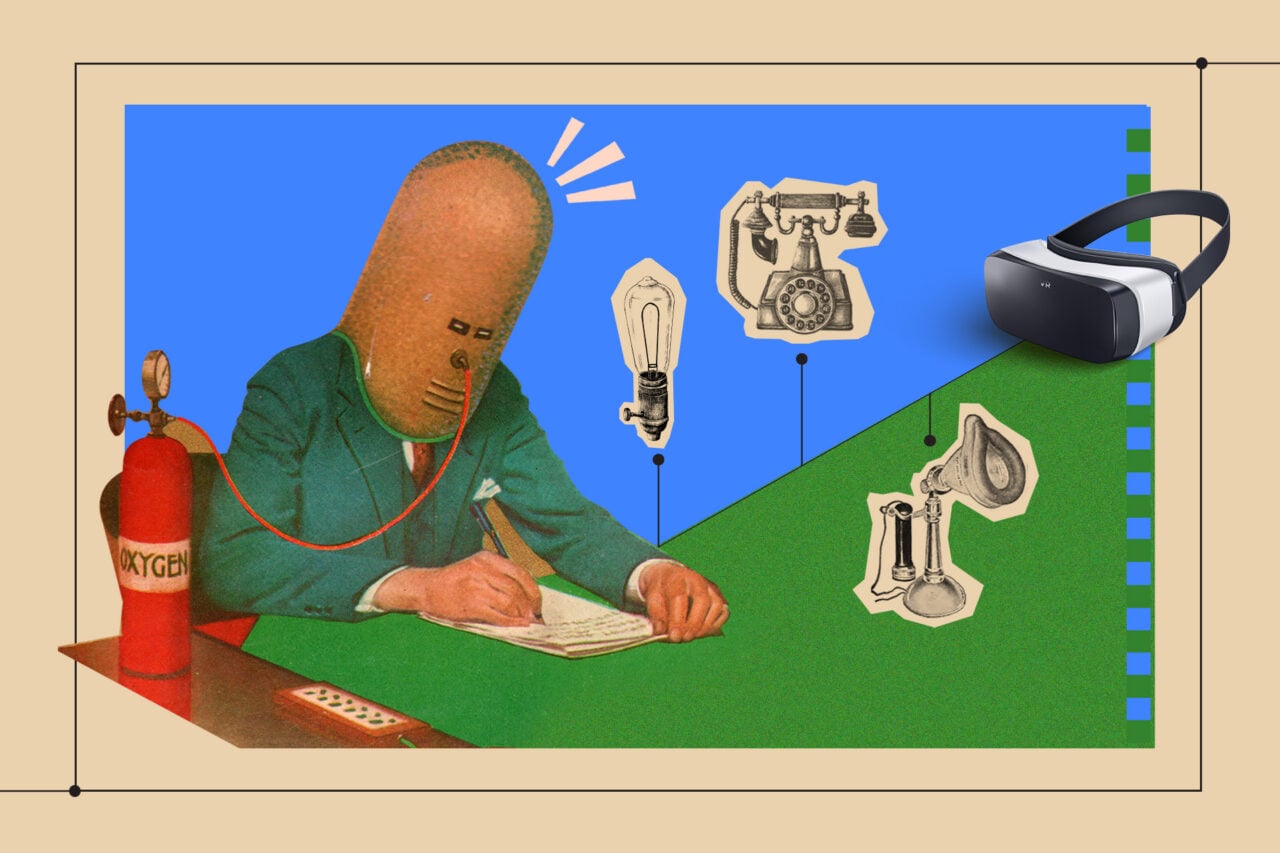
Last but not least, we have the invention we started with. Gernsback really did imagine that a new gadget might help people focus on the task at hand by creating a kind of isolation chamber for their heads.
From the July 1925 edition of Science and Invention magazine:
The writer, who has to perform almost daily, in connection with his editorial duties, many tasks that involve considerable concentration, has found out that it is almost impossible to keep his mind on a subject for five minutes without disturbance. For that reason, he constructed the helmet shown in the accompanying illustrations, the purpose of which is to do away with any possible interferences that prey on the mind.
Gernsback even explained how he built the device by trying different materials:
The problem was first to do away with the outside noise. The first helmet constructed as per illustration was made of wood, lined with cork inside and out, and finally covered with felt. There were three pieces of glass inserted for the eyes. In front of the mouth there is a baffle, which allows breathing but keeps out the sound. The first construction was fairly successful, and while it did not shut out all noises, it reached an efficiency of about 75 per cent.
Gernsback went on to explain that with some alterations he was able to construct a helmet that knocked out roughly 90-95% of all sound. The only problem? Gernsback said that after about 15 minutes, the wearer would become “drowsy.” The solution was to add an oxygen tank, which “increases the respiration and livens the subject considerably.”
Gernsback finished the article by calling the isolator “a great investment,” though I haven’t found any evidence he tried to sell any of these contraptions. The idea, it seems, was to put his idea out into the world so that people could build their own.