Solar energy is great in theory, but the problem is that panels need to face the sun, which is frequently behind clouds or shining down at some less-than-optimal angle. The solution? Put solar panels in space, of course! Duh!
That's just what the Japan Aerospace Exploration Agency (JAXA) has begun working on, actually. They are currently working on the hardware, and plan to have a Space Solar Power System (SSPS) up and running by 2030.
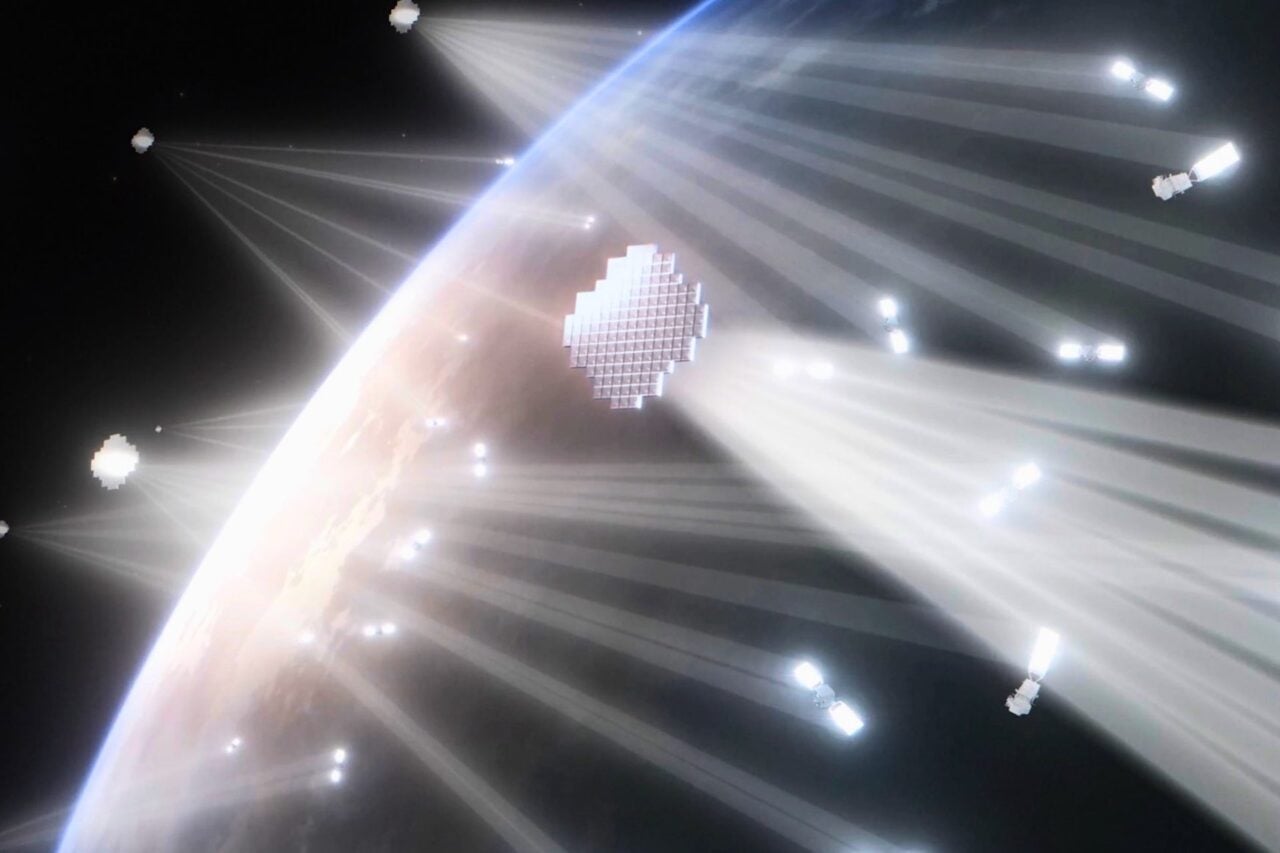
The setup would consist of a satellite-type object in orbit about 22,400 miles above the surface of the Earth. Terrifyingly, the satellite would convert the sun's rays into laser beams and shoot them down to base stations on Earth. Yes, lasers would fire down from space. But friendly lasers, so, you know, it's cool.
On February 20th, JAXA is going to begin testing these crazy laser beam transmitters designed to send the precious energy down from orbit. It's a long ways away from this actually being put into use, but researchers claim that when all is said and done, one of these things in orbit can provide basically free power to a whopping 500,000 homes, so we say take all the time you need. Sounds great to us. [Hokkaido Shimbun via Pink Tentacle]




Comments
He was shot at a downward angle...
How does this solve the problem of clouds? I get that it makes some sense, but the light reflected would only be the total amount that hits the space panels, not to mention any panels that get cracked, chipped, smash by debris. I'm figuring it would need to be HUGE to produce that much energy.
I wouldn't want to live next to the base station just incase its targeting is off by a milimeter.
Won't be economical until they get space elevators though...
I remember this from Sim City 2000. It always misfired and destroyed the city.
(NY Times 7-19-2033) Japan used it's laser energy beams to attack the world powers from space by the time anyone realized they weponized the Solar Energy Death ray it was too late.
And I wouldn't be suprised that the first time they involuntarily cause a massive EMP pulse or ionize/deionize the atmosphere they come whining and say "we didn't see it coming."
I can just hear it now:
"Wait, aren't we using metric?"
"No, I mean yeah, I err"
"Oh crap"
Did we forget the lessons that the evil Largo taught us about space-based weapons?
If one of those beams carries enough power for 500,000 homes, what would it do to an unsuspecting airplane? Nothing like having your internal organs melted into jelly at 5000 feet to put a damper on your day.
Can't help but wonder how much of the energy would be required to convert the solar energy into laser energy.
This graphic has to be somehow related to Randy Quaid going nutso recently. Perhaps he is preparing to revise his role as a drunken pilot that saves the world from BIG LASER BEAMS?
Interesting idea... I wouldn't want to be anywhere near the receiving end of it. But anything to cut down on coal and oil consumption.
www.dontsaynothing.com.
Sounds kinda like the laser weapon from The bond movie, Die Another Day. And also aren't Japanese's homes stereotypically smaller than here in a America? Either way I'm pretty sure the average home over there uses less power than here, maybe, whatever I'm just saying. And won't this thing block out the sun somewhere, even if only a little bit.
Not too far from the Deathstar now...If only ATT started funding this
Clue, get a.
The SPS uses masers (which transmit microwaves), not a laser, as can clearly be seen at the Hokkaido Shimbun site. JAXA and predecessors have tested the basic tech for decades.
Relax, DARRONE: The wavelengths chosen to transmit power beam through clouds, no problem.
RAZTA, chill; passive reflectors on the edge of the receiving antenna will warn the transmitting system if the beam drifts, and decollimate the beam in milliseconds, spreading the beam out to harmlessness.
As far as HOOKED-ON-TRONICS' concern about 'unsuspecting airplanes', well, that's why pilots carry maps that tell them where NOT to fly, but at the power densities planned for the system, it might disturb avionics but won't kill, not even if flying in a fabric-covered sailplane. Your metal dental fillings might get hot, though.
So when do we hear about the first person or plane getting shot by one of these beams
I don't think targeting will be a problem. What do we usually use for targeting?? A fricken laser beam!
Gives new meaning to vaporware.
"is there a discount if say...we buy more than 1 of your laser thingy???". George Bush.
YAY!
It's like something out of SeaQuest, but at least they used their lasers to destroy buildings.
Givin' me all kinds of memories of SimCity 2000, there was a Microwave Power Plant option in there that used this exact concept. And of course, the risk was that it could miss the base station and fry a few zones. Never had that happen though...
@K7AAY:
Thanks for the intelligent well-researched comment clearing up a poorly written Gizmodo post.
@Darrone:
"How does this solve the problem of clouds?"
Well, glad you asked.
We, here on earth, must revisit the awesome orgone accumulator technology developed by the scientist Wilhelm Reich: basically a unit to harvest the potent energy given off by orgasm, which when pointed skyward in the cloudbuster device, busts clouds... so the light can shine through.
Sadly, he was a complete luddite and even today in the school system based on his theories, The Waldorf Schools, NO computers, just pen and ink allowed.
Reich was aimprisioned by the US government and died there.
His story is amazing...
[en.wikipedia.org]
I've got an idea like this in a book I'm working on. The trick is to have your collectors in very wide orbits, with a single aggregator satellite (or more, if you're impatient) in a geo-stationary orbit. Laser transfers between collectors and aggregators occur at a tangent to the aggregator's orbit, and are therefore always parallel to the Earth's surface. Then you only have a single satellite beaming energy to a single base-station directly below it on the Earth's surface, which enormously simplifies the aiming issue. If you're clever, you also design your collector to aggregator wavelength to be one absorbed or reflected by the Earth's atmosphere, so it would cause no harm in the event of a gross mis-aim.
If you happen to have a space elevator, your collectors can be extraordinarily cheap to build and launch (since they wouldn't have to be robust enough to survive the acceleration stresses of a rocket launch,) and would practically pay for themselves within a few years.
If you were especially ambitious, you could put your collectors in extra-lunar orbits, and use the same system to power lunar-based research facilities. A telescope on the far side of the moon could be enormously beneficial to astronomy.
@Geisrud: If my pocket laser pointer can be powered by a watch battery....
@Darrone: You pick a wavelength for the laser that will be least affected by the atmosphere.
@Razta: wouldn't be so bad, all you can eat roast goose and other fowl. And you could keep some cattle in your backyard and get the occasional surprise steak supper without having to to turn on the BBQ.
I'm surprised Doc Kagan hasn't chipped in with a plug for his book yet?
Alot of work for visible light
How about the guy that developed super-cheap IR solar collectors
U know IR, the stuff that goes through clouds
Solar power usually falls well within the "green" side of energy sources, but wouldn't this thing presumably be sending energy to Earth that would otherwise pass us by otherwise, adding to the net heat energy of the planet? What does that do to global warming?
Even better would be to place them so they block some of the sunlight that would be hitting the earth (Ideally arround the poles, but that orbit would be a pain)...
Then in addition they would provide carbon free power AND act as a solar shade at the same time... Nice global warming offset...
@ANoel: That bit on Wilhelm Reich was interesting and new to me, but it was Rudolf Steiner who came up with Waldorf education (and biodynamic agriculture incidentally). Steiner wrote his first book on education in 1907, and he setup the first Waldorf school around 1919, well before Reich started his crackpot work in the 30's.
[en.wikipedia.org]
@HoboZero: If someone takes a large magnifying glass over earth, does the planet receive more sunlight than it does without the magnifying glass?
Instead of beaming power back to earth, why not just drop an "extension cable" from the satellite down to the ground?
@ripfire4: Yes, if the magnifying glass captures sunlight that would otherwise miss the earth.
My GDI sky laser is in prime position to take out your Brotherhood of Nod Nuclear Missile Silo. Everyone likes a joke from 1995! Huzzah!
@RIPFIRE4: Even a space elevator uses lasers for power: the current along a 62,000 cable would be terrifying if it were to be effective.
[en.wikipedia.org]
62,000 mile cable, that is.
@ripfire4:
skyhook != feasable using anything other than diamond carbon nano structures, the weight of the cable itself would rip the cable in half.
@Ni Tsu Alien: Doesn't have to be straight from the collector; it could be just from the geo-stationary aggregator as you mentioned.
@nutbastard: Heh. Yeah, I know. Worth a shot though :)
@DocGratis: "Miss the earth"? Umm. How big of a collector were you thinking?
File this under "what could possibly go wrong". Actually this is a great idea. Build in some safety features and there is a great potential for green energy. Of course fixing a problem and restoring power if the satellites goes awry would be an expensive and time consuming proposition. This type of system would need terrestrial / conventional backups.
@K7AAY: I am aware of this, a buddy of mine is a pilot in the airforce. Just having a laugh and whatnot. Still, until the satellite can be constructed and tested in a true, real world environment, the effects of the transmission won't be fully known.
@superbad:
Ya, ya you're SUPERbad, I'm MYbad!
Steiner, the Theosophist.
Thanks!
@Juggrnott: :) "(NY Times 7-19-2033) Japan used it's laser energy beams to attack the world powers from space but by the time anyone realized they weponized the Solar Energy Death ray it was too late." nice but for the brits it would be 19-7-2033 and the newspaper heading would be something like "dark day in britain" or "japan has bright idea" "or something funny...that is a play on words" etc
@hooked-on-tronics: Why does it have to come from space to test the transmission effects? Couldn't you just simulate it from the ground?
@Scotland: Actually, Japan was only able to use laser beams once when they tried to finish off Tetsuo. Unfortunately, it only got him by the arm didn't have a chance for a second shot when he retaliated.