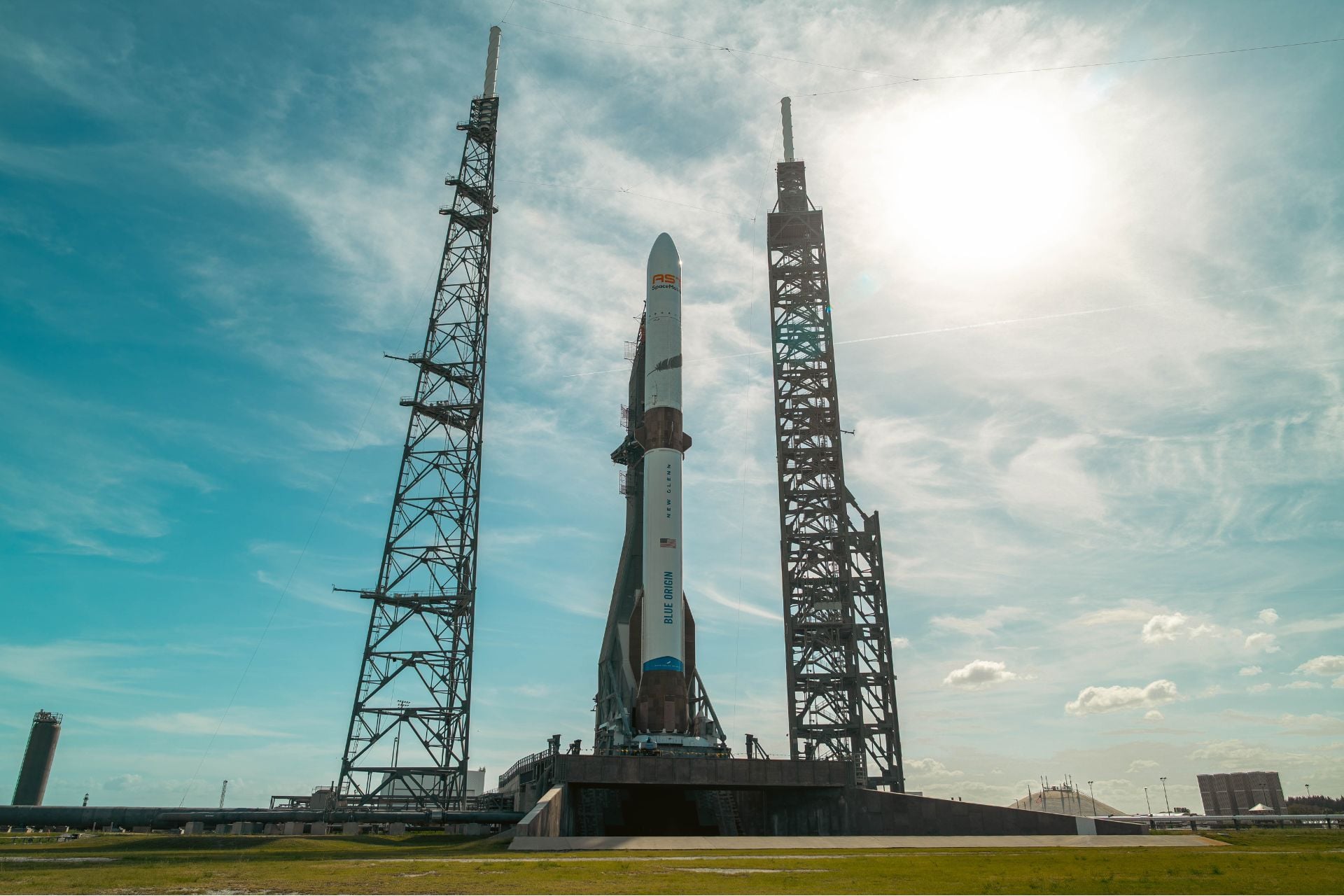
Blue Origin is getting ready for the third flight of New Glenn, taking another step toward ramping up its heavy-lift launch cadence.
According to a Federal Aviation Administration advisory, Blue Origin plans to launch New Glenn no earlier than 6:45 a.m. ET on Friday. The company said Tuesday that it had completed a successful launch rehearsal and planned to conduct a static fire test on Wednesday. The NG-3 mission will be an important one: This time, the Jeff Bezos-owned company aims to demonstrate rapid reusability by flying with the same booster used for New Glenn’s second flight in November 2025.
The news of this pivotal launch comes as SpaceX is struggling to get Starship Version 3 (V3) off the ground. CEO Elon Musk has been saying the inaugural launch of this next-generation rocket is four weeks away since early March. Just last week, a V3 engine burst into flames during testing at the company’s McGregor facility in Starbase, Texas.
To be clear, comparing New Glenn’s launch cadence to that of Starship V3 amounts to apples and oranges. This brand-new version of Starship will be the biggest and most powerful rocket ever built, so there’s bound to be technical challenges ahead of its first flight. New Glenn is smaller, has less payload capacity, and has been flying since the start of 2025. Still, SpaceX should be concerned about Starship V3 falling behind.
Racing to the Moon
With NASA’s Artemis 2 mission safely back on Earth, the agency is already looking ahead to Artemis 3. That mission—slated for 2027—will launch the Orion spacecraft and a crew of astronauts to space atop a Space Launch System (SLS) rocket. In Earth orbit, Orion will rendezvous with at least one (but ideally both) of NASA’s Human Landing Systems to test the docking capabilities needed for Artemis 4 to land astronauts on the Moon.
These two landers are being developed by SpaceX and Blue Origin, respectively. Starship V3 and New Glenn are intrinsic to their designs. SpaceX’s Starship HLS will be a modified version of the V3 upper stage, and Blue Origin’s Blue Moon lander will be made to launch aboard New Glenn.
During an Artemis 2 mission briefing on April 7, NASA Administrator Jared Isaacman said the launch cadences of these commercial providers will be a determining factor for the Artemis 3 mission. Indeed, SpaceX won’t be able to move forward with Starship HLS until V3 demonstrates reliability and on-orbit refueling. And if Blue Origin can’t significantly shorten New Glenn’s turnaround time, NASA won’t have the means to send its Blue Moon lander to space.
Endurance has successfully completed thermal vacuum chamber (TVAC) testing! We're now preparing for our lunar lander's return to Florida. pic.twitter.com/MGABuZPXYP
— Blue Origin (@blueorigin) April 9, 2026
Right now, it looks like Blue Origin is closer to hitting the necessary milestones to support its role in NASA’s next lunar mission. Not only is New Glenn on the cusp of its first launch with a previously flown booster, but the first iteration of Blue Moon—the Endurance Blue Moon Mark 1 lander—recently cleared a key spaceflight readiness hurdle.
If SpaceX wants to keep its Artemis 3 contract, it needs to get Starship V3 off the ground soon. NASA hopes to test both human landing systems during that mission, but if Blue Moon is ready on time and Starship HLS isn’t, it’s unlikely the agency will wait for SpaceX to catch up.