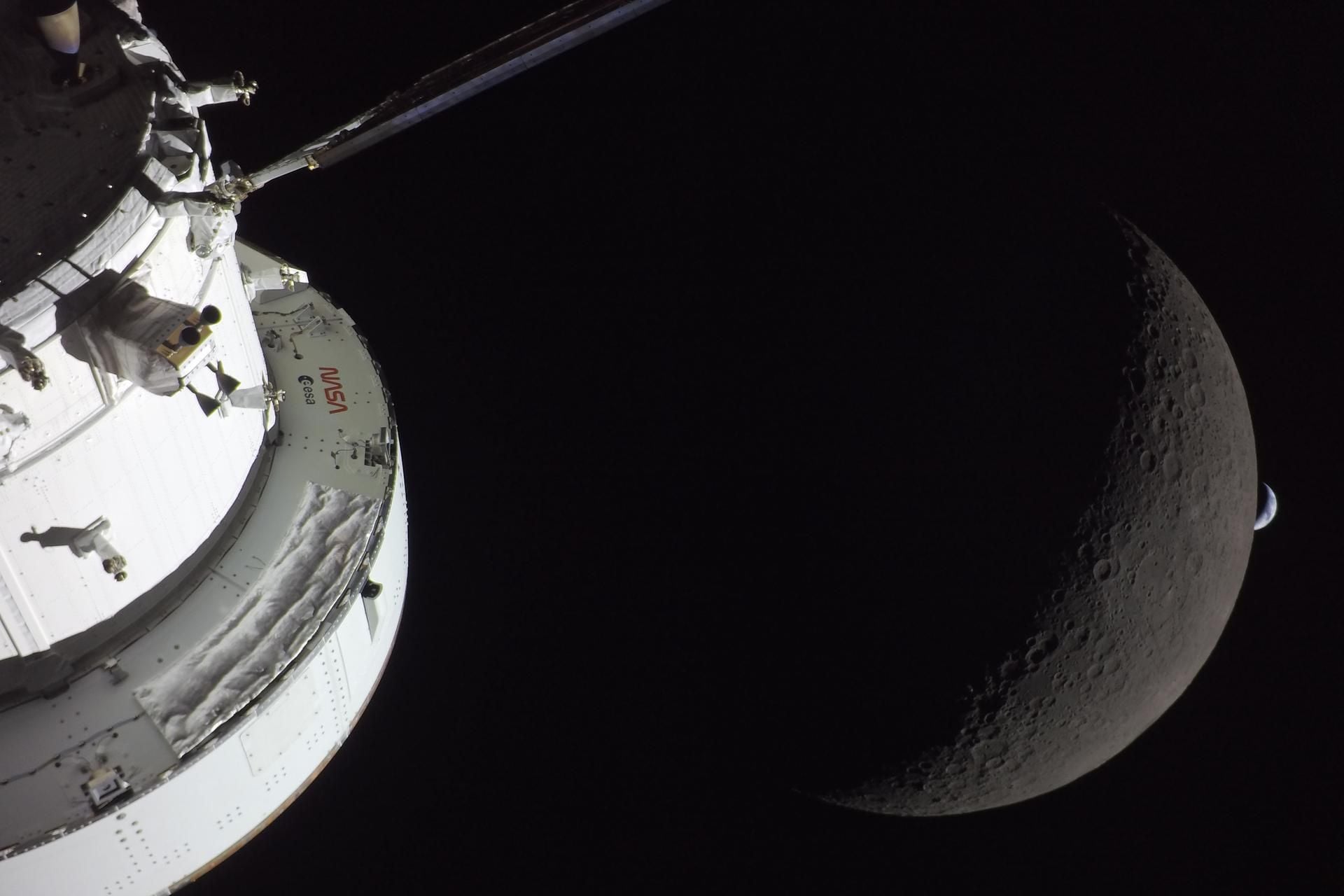
NASA’s Artemis 2 mission is hurtling back to Earth, targeting a splashdown off the coast of San Diego, California, on Friday. As the agency prepares for its return, officials are already discussing the next Artemis mission.
Artemis 3, slated to launch in 2027, will send the Orion spacecraft and a crew of astronauts to space atop a Space Launch System (SLS) rocket. In Earth orbit, Orion will rendezvous with one or both of NASA’s Human Landing Systems to test the docking capabilities needed to land astronauts on the Moon. These two landers are being developed by SpaceX and Blue Origin, respectively.
During Tuesday’s Artemis 2 mission briefing, NASA Administrator Jared Isaacman said officials convened for the first senior-level Artemis 3 mission design discussion earlier that day. Reports this week also suggest that the crew selection process is underway, though NASA has not verified those claims.
“We can undertake—again—world-changing missions like Artemis 2 right now and get ready for the next ones at the same time,” Isaacman said.
Artemis 2 paving the way
Artemis 2 is the first crewed test flight of the SLS and Orion, and it’s been remarkably smooth so far. The SLS had a sparkling clean launch after engineers spent weeks addressing hydrogen leaks and a helium flow issue. Aside from some pesky plumbing problems aboard Orion, the spacecraft has been performing beautifully.
“The things that we’re going to have to improve upon for Artemis 3 are relatively small and incremental in nature, as opposed to wholesale redesigns of spacecraft subsystems,” NASA Flight Director Rick Henfling said during Tuesday’s briefing.
One of the biggest hurdles standing in the way of an Artemis 3 launch is finalization of the mission design. According to Isaacman, a key question NASA is currently grappling with is whether the mission’s initial orbit will be in low-Earth orbit or high-Earth orbit.
There are pros and cons to both scenarios, but the launch cadence of NASA’s commercial HLS providers will also be a deciding factor, the administrator said, adding that both SpaceX and Blue Origin have launches coming up within the next month.
A long road to Artemis 3
Lander readiness is another big hurdle. SpaceX and Blue Origin have been racing to deliver their lunar landers since October, when NASA reopened SpaceX’s HLS contract due to significant developmental delays.
The agency hopes to test both SpaceX’s Starship HLS and Blue Origin’s Blue Moon Lander during Artemis 3. Ultimately, only one of these vehicles will deliver astronauts to the lunar surface for the Artemis 4 mission, currently planned for 2028. That is, if either of them is ready on time.
Starship HLS will be a modified version of the Starship V3 upper stage. This iteration of Starship is the biggest and most powerful yet, and it’s currently undergoing final testing before a debut launch in about four to six weeks, according to SpaceX CEO Elon Musk.
During Tuesday’s briefing, Isaacman said Blue Origin’s Blue Moon Mark 1 cargo lander—which will lay the foundation for a crewed lander—is “wrapping up” vacuum-chamber testing at NASA’s Johnson Space Center in Houston.
Both companies still have a long way to go. In March, NASA’s Office of the Inspector General published an alarming report revealing critical gaps in testing and crew survival analyses for both SpaceX and Blue Origin’s prospective landers.
As these companies race to develop these vehicles and increase the launch cadences of their respective heavy-lift rockets, NASA hopes the Artemis 3 architecture and timing will come into clearer focus.