A one-way trip to Mars takes somewhere between seven and 10 months, following a fairly direct route between Earth and our neighboring planet. But what if we could cut that journey by more than half, reaching the Red Planet and returning back to Earth in less than a year?
Using the early orbital data of asteroids, an astronomer may have found the ultimate spacecraft shortcut through the solar system. In a new study, Marcelo de Oliveira Souza of the State University of Northern Rio de Janeiro followed the predicted route of asteroid 2001 CA21 to look for a new path to reach Mars. The results, published in the journal Acta Astronautica, identify a course that would take approximately 153 days for a round trip to the Red Planet and back.
Earth to Mars
To set a course for Mars, scientists behind interplanetary missions calculate precise data based on the planets’ movements through space. The distance between Earth and Mars is in constant flux due to their orbits. The two planets are closest together when they’re both on the same side of the Sun and are farthest apart when they are on opposite sides of the host star.
Every 26 months, Earth passes directly between the Sun and Mars. This alignment, known as the Mars opposition, is when spacecraft set a course for the Red Planet. The astronomer behind the recent study, however, wondered whether there could be hidden shortcuts en route to Mars during the planet’s closest approach to Earth.
To find said shortcut, Souza followed the early predicted path of a near-Earth asteroid that crossed the orbit of both Earth and Mars.
Asteroid maps
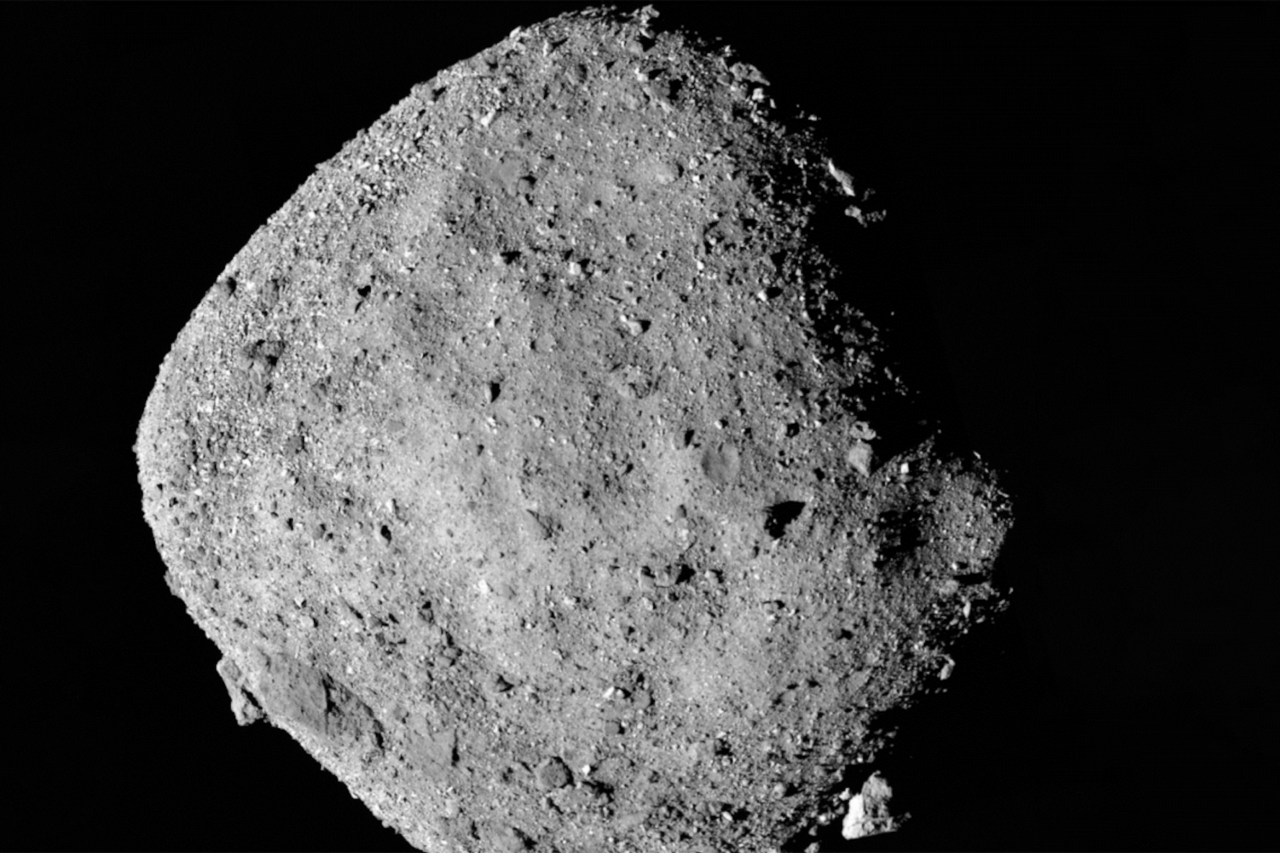
When asteroids are first detected, astronomers track their motion across the sky to model their orbits around the Sun. With further observations, their orbital path becomes more refined.
That was the case for asteroid 2001 CA21, but its initial orbital path can still prove useful. The asteroid’s early orbital predictions describe a highly eccentric trajectory with a well-defined sub-ecliptic orbital plane, or the plane that contains Earth’s orbit around the Sun.
The researcher looked for a route to Mars that stayed within five degrees of the asteroid’s tilt, which would allow a spacecraft to take a more direct flight to the Red Planet. Souza then looked at three possible launch windows to Mars during the planet’s opposition in 2027, 2029, and 2031 to see which one offered the best conditions for a shorter trip.
By combining the analysis of the launch windows with the asteroid’s early orbital predictions, the researcher found that 2031 was the only year in which the Earth-Mars geometry aligned favorably with the asteroid’s orbital plane. During the 2031 launch window, the study identifies two possible round-trip Mars mission profiles with total durations of approximately 153 and 226 days.
The new research aims to highlight a possible tool for planning interplanetary routes across space, with the potential to shave hundreds of days off the itinerary. While scientists generally keep a close watch on asteroids to ward off potential threats to our planet, these space rocks could also help us navigate through the solar system.