NASA’s Perseverance rover is living up to its name as its total distance traveled approaches the length of a marathon. Over the past five years, this intrepid explorer has traversed more than 26.05 miles (41.92 kilometers) of Martian terrain, and it’s now closing in on the distance record.
The current record-holder is NASA’s Opportunity rover, which traveled a total of 28.06 miles (45.16 km) over the course of its nearly 15-year mission. Perseverance has been exploring the Red Planet for a third of that time, and it’s already just 2 miles (3.2 km) from breaking Opportunity’s record.
“Having the benefit of four previous rover missions, the Perseverance team has always known our mission was a marathon and not a sprint,” Steve Lee, acting Perseverance project manager at NASA’s Jet Propulsion Laboratory, said in an agency statement. “Perseverance is in great shape as we continue our explorations and extend into ultramarathon drive distances.”
Venturing beyond the Jezero Crater
Perseverance landed in the Jezero Crater in February 2021 and spent the next three years exploring the interior of this 28-mile-wide (45-km-wide) impact zone. It took more than three months for the rover climb up the western wall of the crater, reaching its rim in December 2024.
Now, Perseverance is exploring an area just beyond Jezero’s rim called “Lac de Charmes.” According to NASA, this region represents some of the most scientifically compelling terrain the rover has visited yet. Scientists believe that billions of years ago, Lac de Charmes hosted a lake and river delta, meaning this area could contain signatures of past microbial life. And because the region is located on the plains beyond Jezero’s rim, it’s unlikely that it was significantly affected by the crater’s formation.
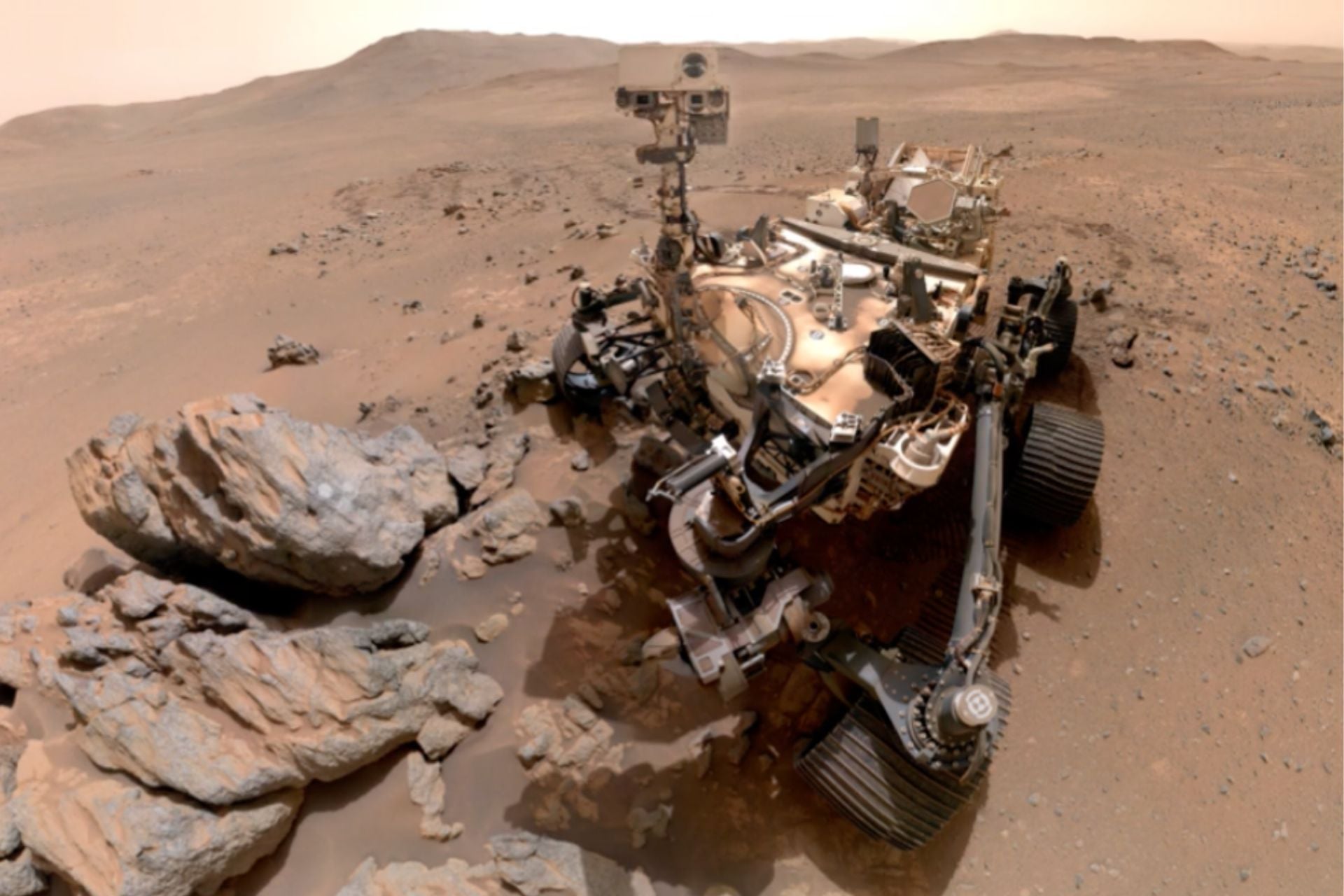
On Monday, Perseverance snapped a selfie while training its mast on a rocky outcrop it had just abraded. That’s when the rover grinds down part of a rock’s surface to allow the science team to analyze its composition. This revealed that the outcrop, called “Arathusa,” is mostly composed of igneous materials and is likely older than the Jezero Crater.
In its selfie, composed of 61 different images, Perseverance also captured other intriguing surface features.
“There is a sharp ridgeline visible in the mosaic whose jagged, angular texture contrasts starkly with the rounded boulders in the foreground,” Ken Farley, Perseverance’s deputy project scientist at Caltech, said in the statement. “We also see a feature that may be a volcanic dike, a vertical intrusion of magma that hardened in place and was left standing as the softer surrounding material eroded away over billions of years.”
Next stop: Gardevarri
With its investigation of Arathusa complete, Perseverance headed northwest to the Arbot area, where it has been analyzing other rocky outcrops. From there, the rover will drive south to “Gardevarri,” a site with exposed olivine-bearing rocks. These rocks formed in cooling magma and contain information about Mars’ volcanic history, providing context for large-scale geological processes, according to NASA.
After Gardevarri, Perseverance will head southeast to the “Singing Canyon” region, where the science team hopes to uncover insights into the Red Planet’s early crust.
The rover will likely pass the marathon finish line later this month as it continues its exploration of the terrain surrounding the Jezero Crater’s rim. NASA has no plans to terminate Perseverance’s mission anytime soon, so the distance record is certainly within its reach. Even more exciting are the new clues scientists will uncover about Mars’ ancient past as the rover travels farther than any have gone before.