We know Mars to be many things: dusty, cold, and missing a global magnetic field. In a recent discovery that baffled scientists, a space weather phenomenon previously associated with powerful magnetic fields was observed on Mars for the first time.
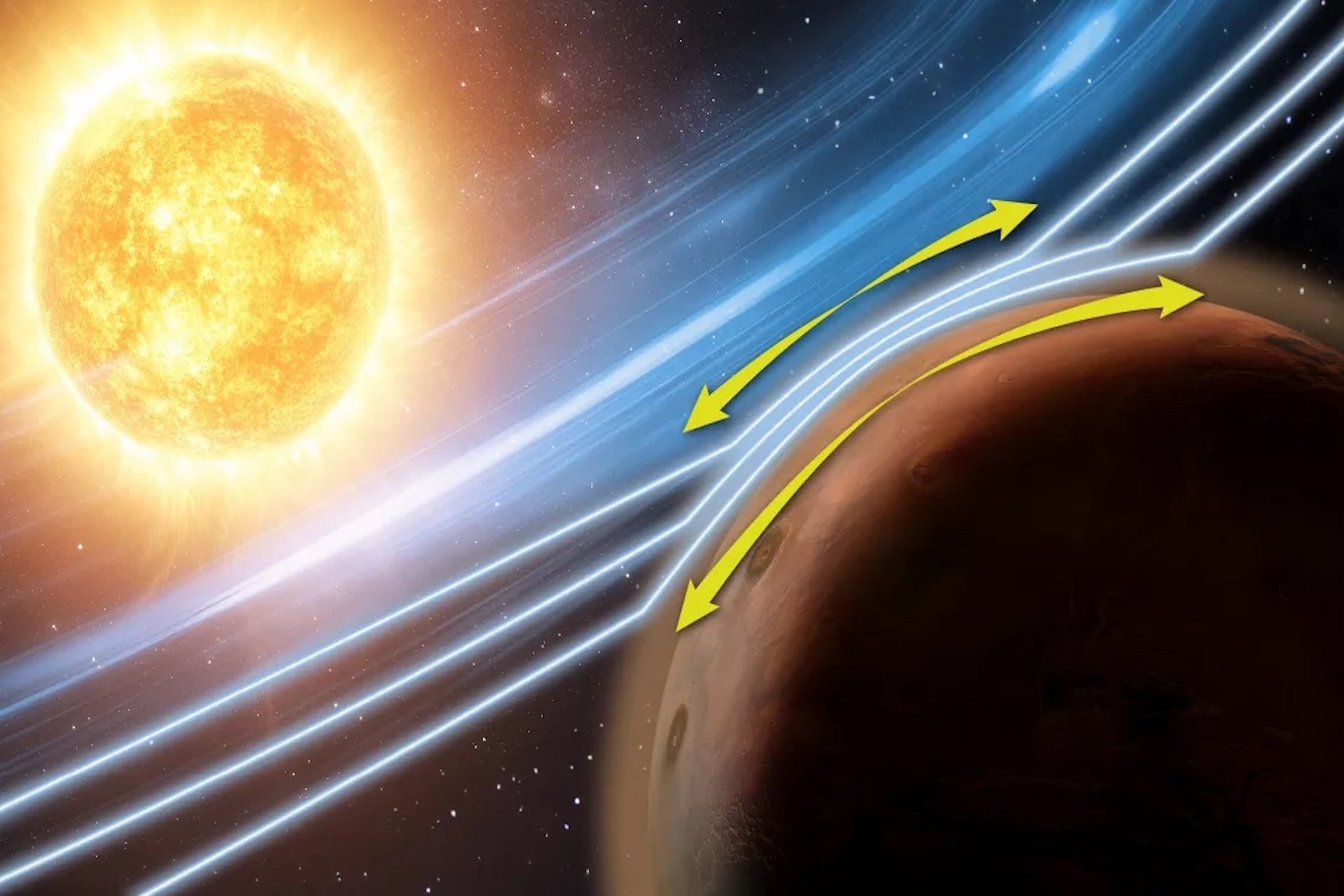
Using data from NASA’s MAVEN (Mars Atmosphere and Volatile Evolution) mission, scientists identified the Zwan-Wolf effect in Mars’ atmosphere. The phenomenon is known to occur in Earth’s magnetosphere, whereby charged particles get squeezed and pushed along magnetic field lines like toothpaste coming out of a tube, according to NASA.
Scientists had previously assumed that Mars wouldn’t produce the same large-scale magnetic plasma behavior seen on Earth, as it lacks the same kind of planetary shield. The new findings, published in Nature, change how scientists think about Mars and other unmagnetized worlds.
Magnetic behavior
NASA launched the MAVEN spacecraft to Mars in November 2013 to explore the planet’s upper atmosphere and its interactions with the Sun and solar wind. The goal is to better understand how Mars lost its atmosphere to space roughly 3.5 to 4 billion years ago.
In December 2023, MAVEN watched as a large solar storm hit the Red Planet. While analyzing the data, scientists saw a strange pattern taking place deep inside the Martian atmosphere. “When investigating the data, I all of a sudden noticed some very interesting wiggles,” Christopher Fowler, a research assistant professor at West Virginia University in Morgantown and lead author of the study, said in a statement. “I would never have guessed it would be this effect, since it’s never been seen in a planetary atmosphere before.”
The Zwan-Wolf effect is a phenomenon whereby charged particles are squeezed through magnetic structures called flux tubes when the magnetic field is compressed. On Earth, the effect helps redirect solar wind (a stream of charged particles) around the planet’s magnetosphere. Surprisingly, the MAVEN observations showed plasma inside Mars’ atmosphere behaving like plasma near Earth’s magnetosphere boundary.
“No one expected that this effect could even occur in the atmosphere,” Fowler said. “That’s what makes this even more exciting. It introduces interesting physics that we haven’t yet explored and a new way the Sun and space weather can change the dynamics in the Martian atmosphere.”
Stormy weather
During the 2023 solar storm, the scientists first noticed peculiar fluctuations in measurements of the magnetic field as the MAVEN spacecraft flew through the Martian atmosphere. They then dug deeper inside the data, looking at observations made by several instruments on board MAVEN, including measurements of the charged particle environment in the ionosphere. The ionosphere is the upper layer of the atmosphere where solar radiation strips electrons from atoms, creating electrically charged plasma.
After uncovering more interesting features in the data and ruling out several other possibilities, the team behind the study pinpointed the source as the elusive Zwan-Wolf effect. The study suggests that the Zwan-Wolf effect may be occurring constantly in Mars’ ionosphere, albeit at levels undetectable by MAVEN’s instruments. The effect of the solar storm, however, may have amplified the phenomenon and allowed scientists to observe it in the data for the first time.
“Knowing how space weather interacts with Mars is essential,” Shannon Curry, the principal investigator of MAVEN and research scientist at the Laboratory for Atmospheric Space Physics at the University of Colorado Boulder, said in a statement.
The recent findings will not only help scientists better understand how space weather affects planets like Mars, but they also provide new insights into how the Zwan-Wolf effect may take place at similar unmagnetized bodies like Venus or Saturn’s moon, Titan.
“The MAVEN team continues making new discoveries with our datasets and finding these links between our host star and the Red Planet,” Curry added.
Unfortunately, MAVEN is currently lost in space. NASA lost signal from the spacecraft on December 6, 2025, and has not been able to reestablish connection ever since. The space agency has set up an anomaly review board to assess MAVEN’s current state and the likelihood of its recovery. We hope the Martian probe phones home soon.