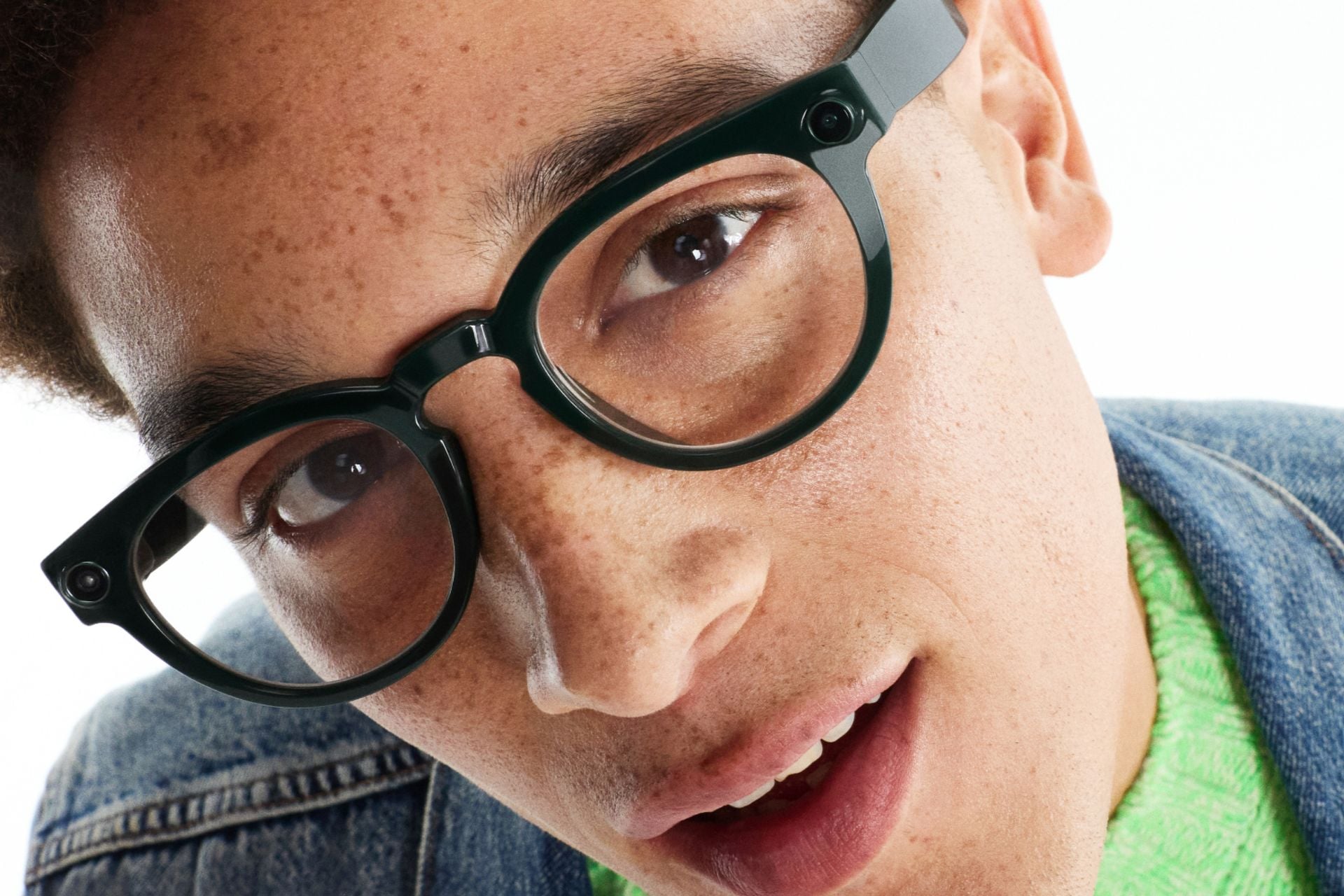
Google might be interested in smart glasses for the first time since Google Glass, but it’s not particularly interested in saying so—at least not in those exact terms. During the company’s two-hour keynote at I/O 2026, Google talked a fair amount about its future with face-worn wearables, including upcoming collabs with eyewear brands Warby Parker and Gentle Monster, but there was one thing missing: it never actually said “smart glasses.”
Nay, in Google-speak, its new wearable—a pair of glasses with cameras, speakers, and AI—are “intelligent eyewear.” Hell, by Google’s estimation, these smart glas—er, intelligent glasses—aren’t even camera glasses, they’re audio glasses. That’s in spite of the fact that they most certainly have cameras on them that can take pictures and videos—same as the Ray-Ban Meta AI glasses.
It’s not altogether surprising that Google has its own name for smart glasses; big tech companies love to slap their own marketing onto existing categories. Even Meta calls its Ray-Bans “AI glasses,” not “smart glasses.” Apple is almost notorious for rebranding. The Vision Pro, for example, is a “spatial computer” in the company’s lexicon, not an XR headset (it’s definitely an XR headset).
Very excited about our progress on Intlligent Eyewear with our launch of audio glasses coming this fall. Amazing hardware from @SamsungMobile and beautiful designs from @WarbyParker and @_GentleMonster_ with the best of @GeminiApp onboard. pic.twitter.com/E58p7fArxj
— Sameer Samat (@ssamat) May 19, 2026
Marketing isn’t unusual, but it is interesting that Google, the progenitor of the perennially loathed Google Glass, seems to be making such stark distinctions with its smart glasses, especially in the camera department. I can concede “intelligent eyewear” as a moniker, since it’s basically the same difference as “smart glasses,” but “audio glasses”? I’m not so sure. There are actual audio glasses out there that focus more on playing music and taking calls, and they, by my definition—and most people’s, I would imagine—do most certainly not have a camera on them.
Calling Google’s intelligent eyewear “audio glasses” is like calling a digital camera a microphone. Sure, most can record video and, therefore, audio as a result, but it’s not the defining feature. The second there’s a camera on a pair of glasses, they’re camera glasses. If I’m being honest, it feels like Google is trying to avoid the camera of it all, and I can’t say I blame it.

Google is, as I mentioned before, the inventor of Google Glass, which literally spawned its own accidental pejorative, “Glasshole,” back in 2013 when pushback stymied smart glasses in their infancy. Cameras are divisive, and if Meta’s recent (mostly self-inflicted) foibles are any indication, they still rub people the wrong way. Google, I assume, is going to try its best to avoid another Google Glass situation with some suggestive marketing, but in this case, it feels like a bit of a stretch.
What I’d really like to see—rather than marketing—is some growth. There’s likely never going to be a solution to the fact that smart glasses with cameras for photo and video can easily be used as a tool to spy on people and otherwise record them without their knowledge, but Google can (theoretically) move the needle on privacy for its users. It could, for instance, decide not to use videos and pictures from its intelligent eyewear customers to train AI as Meta has.
And who knows? Maybe it still will. For now, though, we’re just left with a little wearable word salad, and I can’t say that’s a menu item I’m particularly inclined to order.