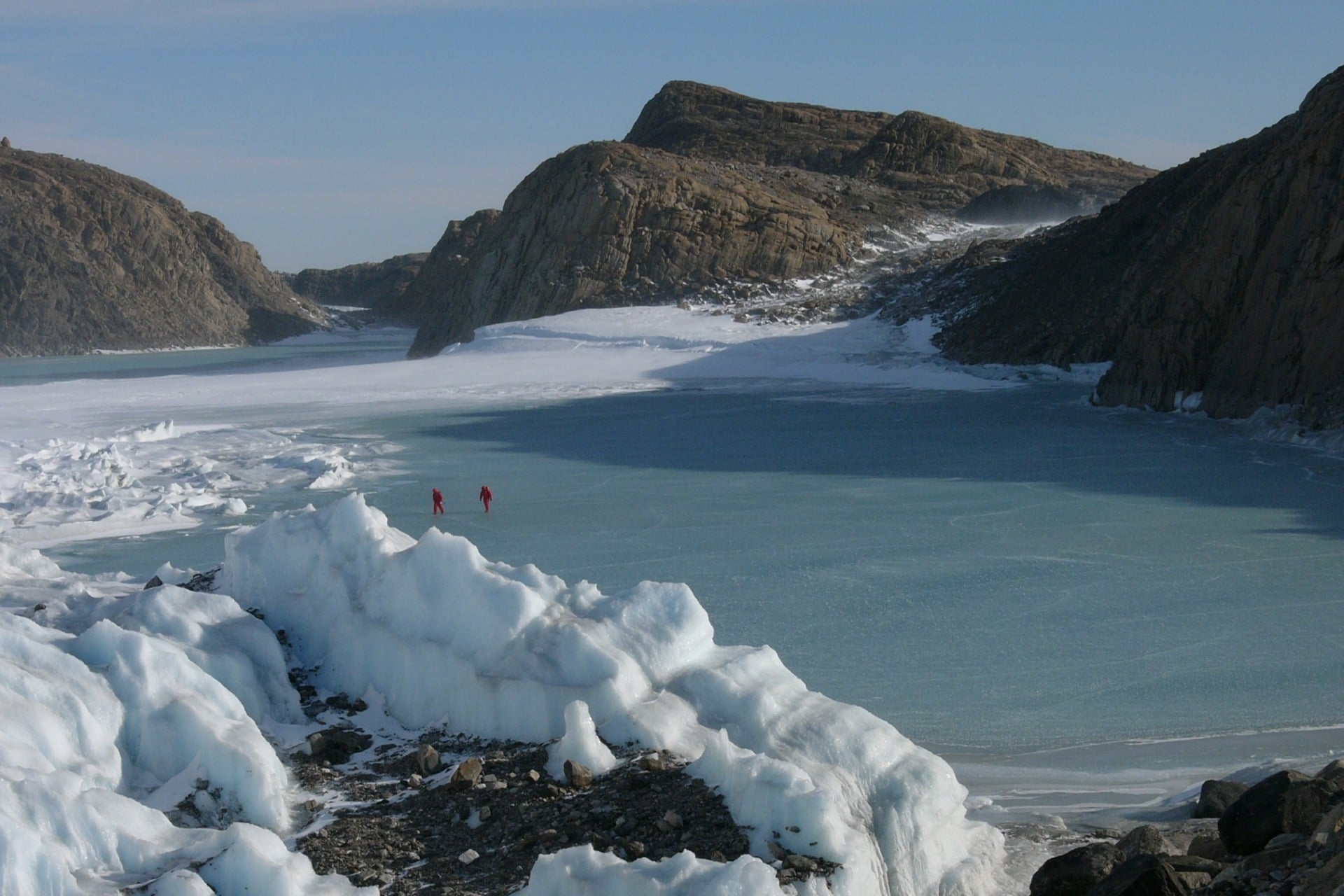
The East Antarctic Ice Sheet is almost unfathomably huge. Covering about 75% of the entire frigid continent (nearly everything on its side of the Transantarctic Mountains), the sheet covers about 3.9 million square miles (10.2 million square kilometers) and extends down 1.4 miles (2.2 km), on average, before coming into contact with Earth’s surface. At its deepest, the ice plunges down over 3 miles (4.9 km).
For decades, scientists assumed that this literally continent-sized block of ice rested on an expansive and stable chunk of Earth’s crust known as a craton. A team of researchers has now complicated that picture—mapping a vast, interconnected geological structure that fans out from a troubling “tectonic deformation.” Beneath this ice sheet, thinner and more geologically recent slices of crusty lithosphere fan out into hidden valleys called “pull-apart basins.”
These basins—30 elongated wedge-shaped valleys in total—constitute an entirely new, continental-scale geological region underneath Antarctica, in fact, one which the researchers have named the East Antarctic Fan-Shaped Basin Province (EAFBP). But it’s how they likely formed that has now caught researchers’ attention.
To put it bluntly, it turns out that about 90% of the planet’s fresh water ice may not be on solid ground. Geologist John Goodge called the team’s findings “provocative” in an independent commentary on the new study, published Thursday in the journal Nature Geoscience.
“East Antarctica is typically considered from seismic tomography and geodetics to be ancient and generally stable,” according to Goodge, who studies continental tectonics with the nonprofit Planetary Science Institute. “[But] something else is going on at depth.”
Continental divides
Goodge speculates that this seemingly “coherent pull-apart system,” as presented in the new study, might help explain a variety of mysterious heat and water flows beneath this ice sheet’s surface, like that enormous subglacial lake identified in 2016 or some of the hundreds more like it.
The study’s authors, led by geophysicist Egidio Armadillo at the University of Genoa in Italy, agreed: “Because these basins underlie about half of the East Antarctic Ice Sheet, they are likely to heavily influence both ice-flow and landscape evolution,” the researchers wrote in their study, also published Thursday in Nature Geoscience.
Armadillo’s team, coordinating across Europe and the U.K., developed their new understanding of Antarctica’s hidden bedrock via an exhaustive set of sensory data. Gravitational and magnetic anomalies were mapped via low-altitude airborne surveys. Ground surface features were mapped with seismic tools, using sound waves that vibrate through the ice and ping back information about subglacial landscapes in 3D.
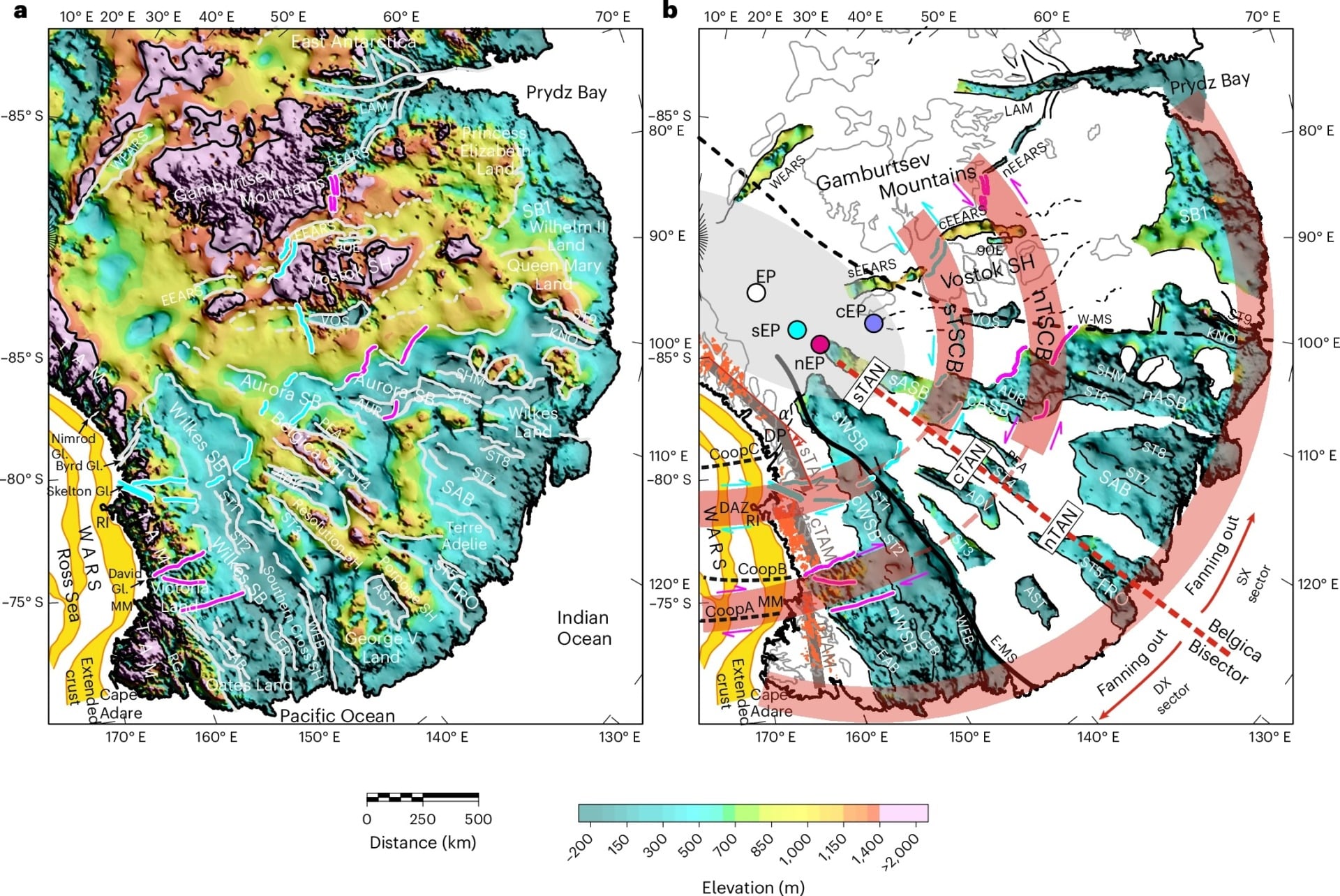
All of this data—the fruits of “multi-national efforts to image within and below the ice sheet,” as Goodge put it—had already revealed that regions of the continent were “undergoing more rapid movement and ice-mass loss than previously recognized.” Armadillo’s team merely helped to explain why.
The mechanism Armadillo and his colleagues proposed for the formation of these fan-shaped basins is called “distributed rotational extension.” It involves points called Euler poles around which tectonic plates pivot or rotate rather than smash into each other or pull apart. The result is a bit like decks of cards being spread out on a table, thinning out the stack of Earth’s crust as it moves.
An icy situation
Goodge took pains to spell out the basins’ implications for melting Antarctic ice due to climate change and the risk of rising global sea levels.
The mere existence of these basins, he wrote, “could introduce widespread, systemic instability to the East Antarctic Ice Sheet” via thinner layers of Earth’s crust and more heat flow from below. On top of that, a series of fault-line “troughs” documented between the basins appear “tailor-made to promote outward flow of ice streams from the interior” into the world’s oceans, he said.
That said, the team’s findings are unlikely to end this debate. As Goodge noted, Antarctica is “the last continental frontier of scientific exploration.” It’s still a very mysterious place, one that’s challenging to study given its inhospitable temperatures and extreme geography. Its “cryptic subglacial geology” might stay that way for a while.