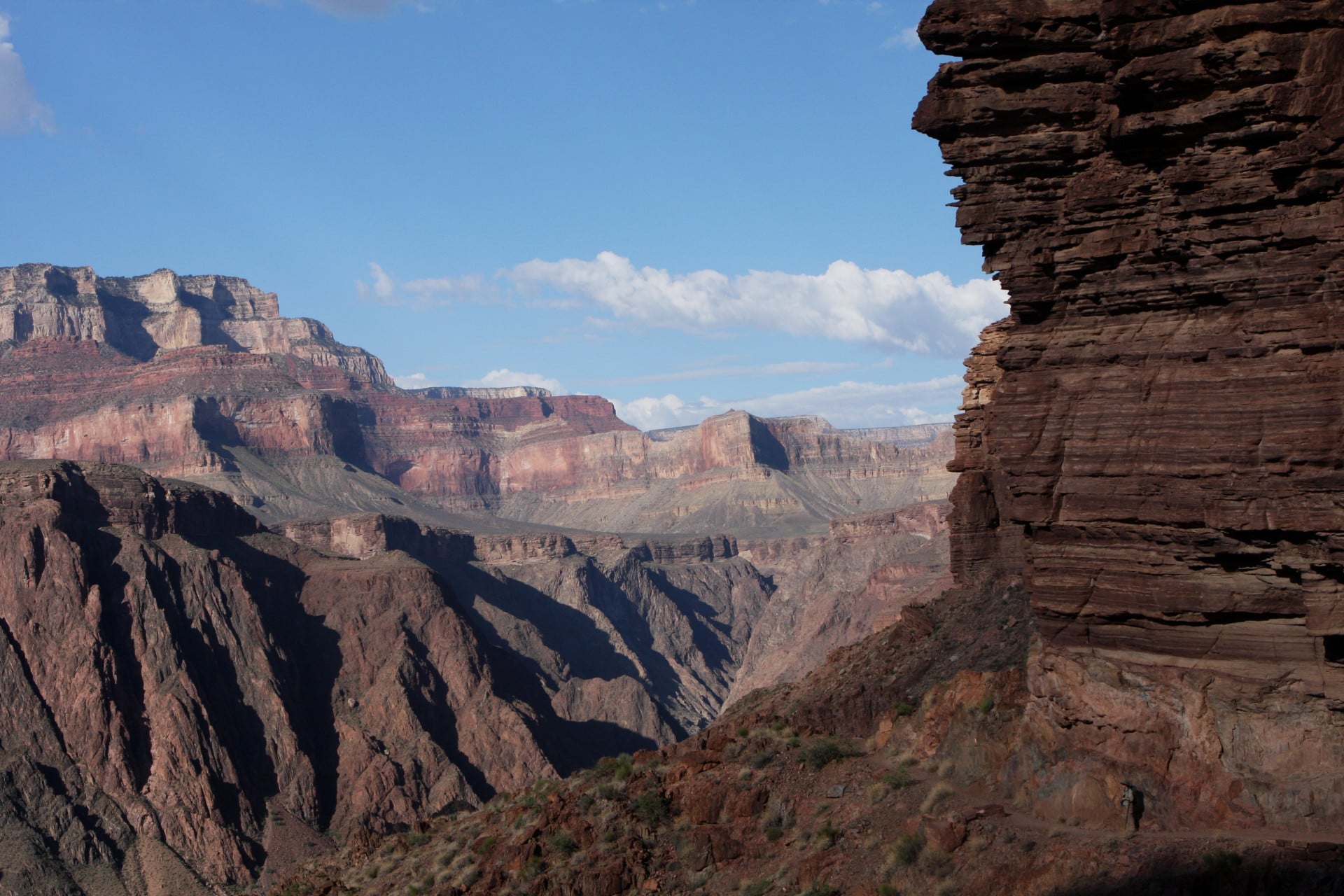
Earth’s geological history is like a book. At the start of this book you have layers of ancient rock from billions of years ago, and these layers grow younger as you turn the “pages.” But unlike your typical book, Earth’s geological chronicle sometimes has entire missing sections covering hundreds of millions to billions of years—and scientists believe they’ve figured out why.
Geologist John Wesley Powell first identified the “Great Unconformity” at the Grand Canyon, explaining how sedimentary rocks from the Cambrian sat right above much older igneous and metamorphic rocks from over a billion years ago. In a paper published today in Nature, researchers demonstrated how mantle convection over hundreds of millions of years may have resulted in this odd geological arrangement we see today. According to the study, this “missing layer” gradually subsided into the ocean during a period of slow sinking that began at the onset of the Phanerozoic, Earth’s current geologic eon.
“Imagine a book where a huge section in the middle has been ripped out,” Santosh Dhungana, the study’s lead author and a PhD candidate at the University of Wollongong in Australia, said in a statement. “The Great Unconformity is that gap in Earth’s story, with the narrative jumping from the early chapters straight to a much later part of the story. Our research suggests these pages weren’t lost by chance.”
The Grand Canyon’s ‘missing time’
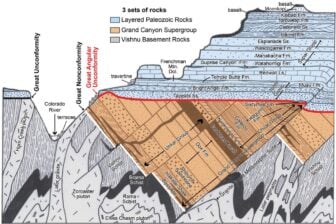
Researchers estimate the Great Unconformity represents roughly 1.2 billion years of missing rock record at the Grand Canyon. These gaps don’t necessarily equate to “missing time” created by “unknown events,” according to a National Park Service (NPS) blog post on the Grand Canyon’s numerous unconformities. For instance, geologists can deduce what may have happened—like the effects of long-term erosion—based on rock layers surrounding an unconformity. Sometimes, there are even smaller unconformities—called disconformities—that are less evident to the naked eye but show relatively clear signs of fossil evidence and erosion, explained the NPS.
That said, big-scale unconformities have appeared in Europe, Australia, Africa, and Asia, with the missing record ranging between 200 million years to well over a billion years, according to the statement. So, although the paper primarily focused on the Great Unconformity, it also used data from formations in Baltica (northwestern Eurasia) and North China to investigate the phenomenon on a global scale.
“Many explanations for the Great Unconformity had been proposed but few had been tested against how the Earth actually behaves over time,” explained study corresponding author Nicolas Flament, a geologist at the University of Wollongong, in the statement.
Earth’s ups and downs
For the study, Dhungana and Flament modeled patterns of mantle convection over hundreds of millions of years. Then, they compared their simulations with the volume of sediment preserved on continents over time. As the mantle—a layer of hot rocks—slowly moves beneath the surface, the movement generates currents that can lift or pull down huge chunks of land.
According to the team’s models, it appears that around one billion to 540 million years ago, these currents caused continents to gradually rise. This was followed by a long period of sinking during the Phanerozoic, and the ancient continental cores—the missing “pages” of the unconformity—probably disappeared into the ocean. Then, the seas and sediments “buried the worn rock surface,” as the statement puts it, resulting in the Great Unconformity we see today.
“Sometimes what is missing can tell us more about the story of Earth than what we can see,” Flament added. “A single, long period of uplift followed by a long period of sinking would have been the ideal recipe for removing the rock and preserving the worn surface.”
Remarkably, the team found that its model predictions were fairly consistent with where the best preserved and documented unconformities were discovered. It’s worth noting that the cutoff between these layers—around 540 million years—marks the start of the Cambrian era, when life on Earth experienced unprecedented growth. Given how landscape dynamics affect seawater chemistry and more, the findings may point to new clues in our understanding of the Cambrian explosion, according to the paper.