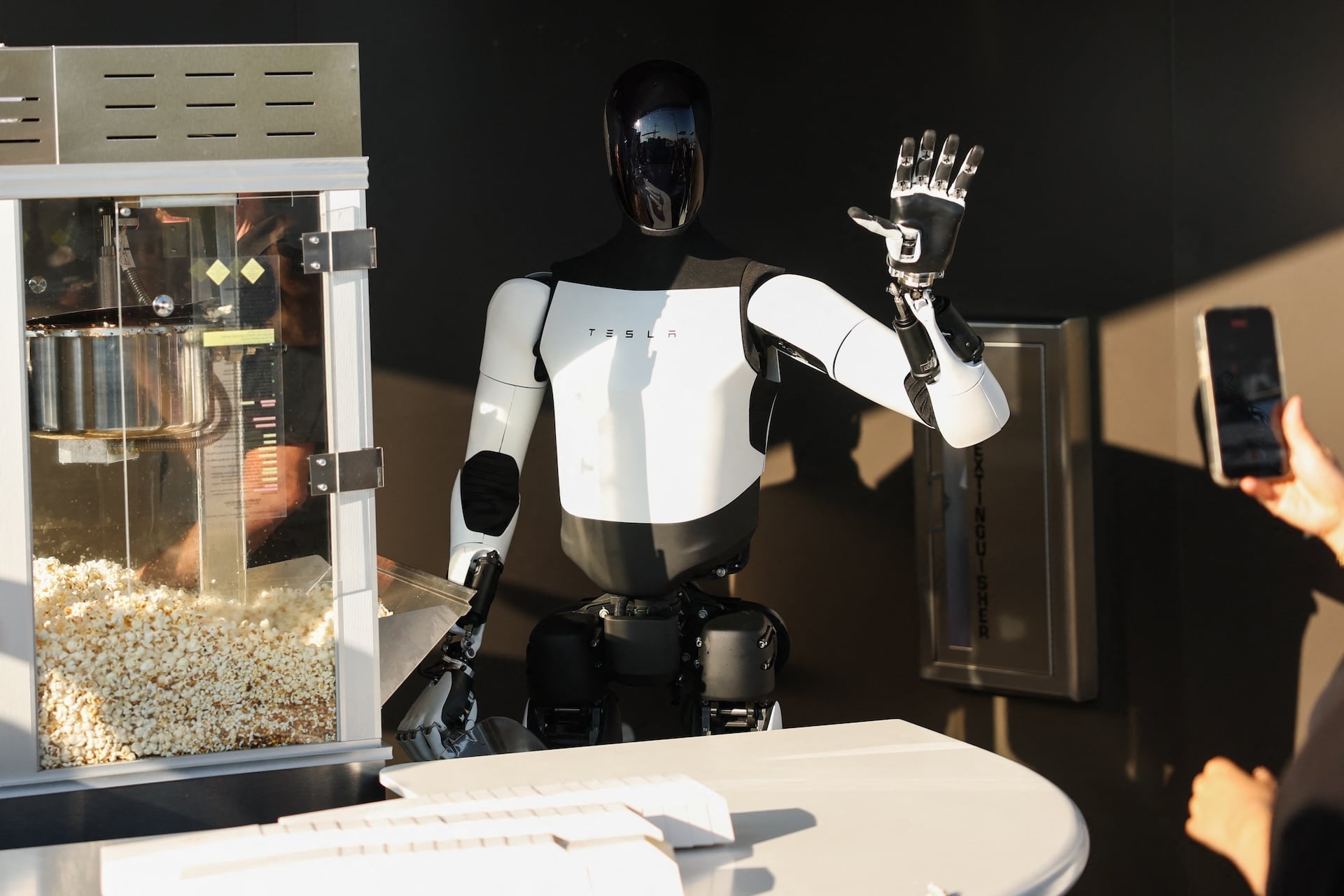
Tesla is starting to ramp up production of its Optimus humanoid robots, but the complex design of the robots’ hands are already giving the company a headache.
The Information reported Friday, citing people familiar with the matter, that Tesla produced several hundred Optimus robots a week last month, up from just a few dozen a week only a few months earlier.
However, that’s still far below Tesla’s stated goal of producing around 20,000 robots a week.
Tesla CEO Elon Musk first announced plans for a humanoid robot in 2021, when the project was still called the Tesla Bot. The company then showed off its first working Optimus prototype the following year. Since then, Musk has pitched the robot as a general-purpose assistant that could eventually do everything from factory work to household chores and even babysitting.
On an investor call in July, Musk said that he thinks the Optimus could be “the biggest product ever.”
Earlier this year, Tesla wound down production of its Model S and Model X EVs at its Fremont, California, factory to free up space for production of the Optimus robots.
But now that Tesla has ramped up production of Optimus V3, a newer version that is lighter and equipped with more cameras, the company is starting to run into some hurdles, according to The Information.
The outlet reports that equipment at several stations on the production line, including those that assemble the robots’ hands and joints, isn’t always lining up parts precisely. This has led to more robots coming off the line needing to be fixed.
Another major challenge is building the robots’ hands at scale. One person familiar with the matter told The Information that each hand and forearm contains more than 100 screws and other small parts that have to be assembled manually.
The hands reportedly are also not durable enough for sustained use, and some of their touch sensors have had reliability problems. As a solution, Tesla has developed a replaceable “sensing glove” containing the hand’s touch sensors so the entire hand doesn’t have to be swapped out if they fail. The company plans to incorporate this glove into next year’s model.
And manufacturing isn’t the only issue. It sounds like Optimus still can’t reliably handle a wide variety of tasks without specific training. People familiar with the matter told The Information that the robots still need to be programmed and trained for individual jobs with basic tasks taking several days to learn.
For now, Tesla is using most of the robots it produces internally for testing, training, and data collection. At its factories, the robots are being used in “tightly controlled areas where their movements and tasks can be closely supervised,” according to The Information.
Still, Musk said earlier this year that Tesla could begin selling Optimus robots by late 2027. The Information says the company currently plans to initially lease the robots to commercial customers. It also plans to use data collected from robots working in customers’ factories and warehouses to improve AI systems.
Tesla did not immediately respond to a request for comment.