In a deeply divided country, there’s at least one thing most Americans seem to agree on: Silicon Valley does not have their best interests at heart.
Tech companies have sunk vast fortunes in AI, promising a second Industrial Revolution that will free humans from drudgework, accelerate scientific discovery, cure cancer, and generally improve everyone’s quality of life. Almost in the same breath, however, they admit there’s a nonzero chance that it could wipe out humanity. Needless to say, that’s too high a chance for many people to justify automated assistants that can clean up your email inbox or organize your work calendar: a recent poll from the Associated Press-NORC Center for Public Affairs Research found that the majority of American adults (64%) think AI is developing too quickly. Even leaders from OpenAI and Anthropic have called for a unilateral slowdown until proper guardrails can be put in place. President Trump, however, has flatly rejected those calls in the name of maintaining technological supremacy over China, and mocked American communities’ backlash to data centers, saying it would end up making them “backwards and poor.”
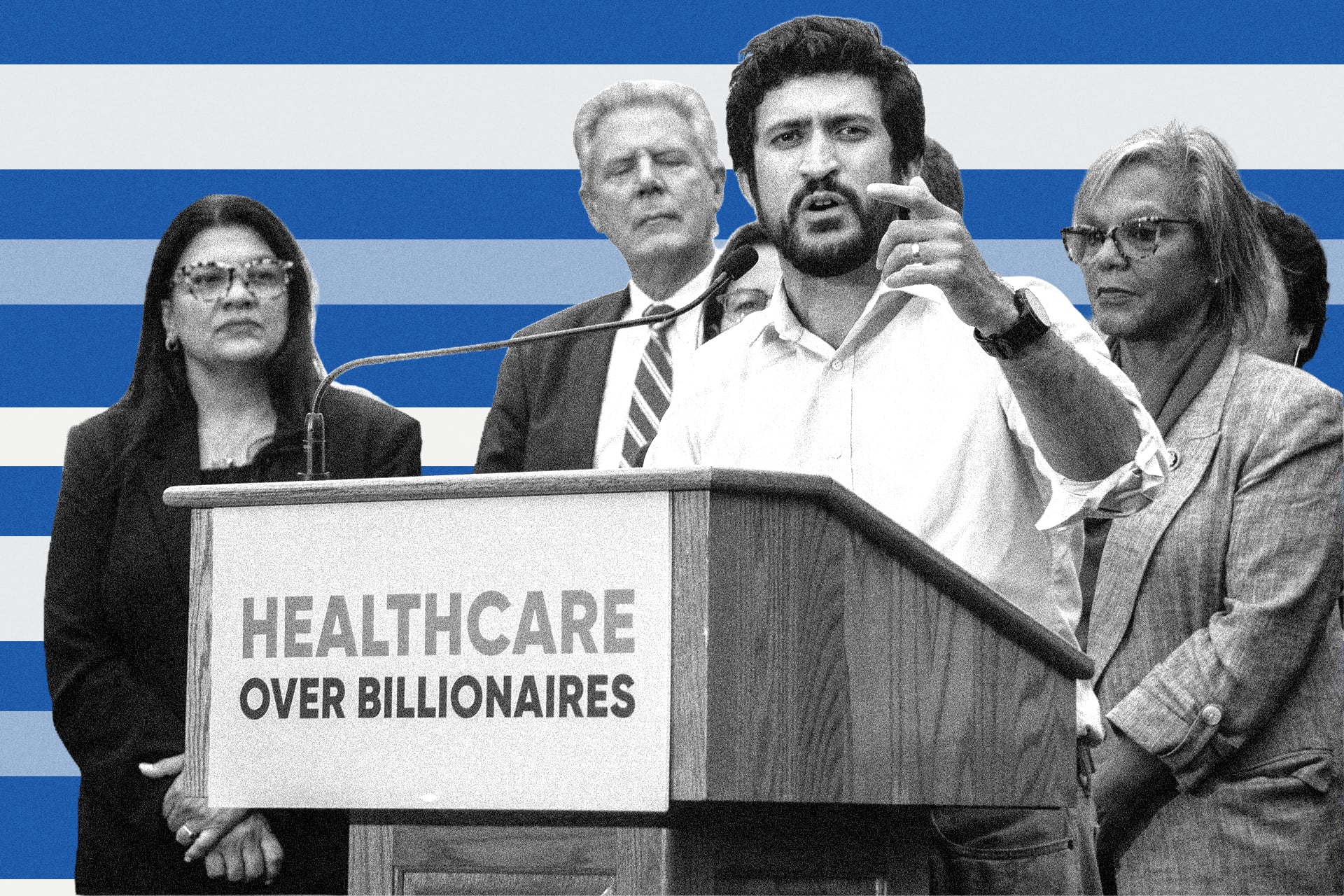
The widespread public anxiety about AI and the failure of the current administration to respond to it in any meaningful way could be the Democratic Party’s saving grace, according to Congressman Greg Casar.
Casar, now thirty-seven, is the youngest person ever to chair the Democratic Progressive Caucus, a group of nearly one hundred liberal lawmakers. A former union organizer, he’s made a name for himself on Capitol Hill in recent years by challenging the unregulated AI industry mostly from an economic angle. He’s introduced legislation seeking to ban AI-powered “surveillance pricing,” to force AI companies to pay for their own data center electricity bills, and to impose an “AI tax”—again taken from the coffers of AI developers—directed towards Americans who lose their jobs to AI-driven automation.
“I was always skeptical of the idea of mass unemployment trying to be made a little bit more tolerable with a small amount of UBI,” Casar told Gizmodo, referring to universal basic income. “That kind of Silicon Valley vision of the future always seemed dystopian to me.”
That skepticism became much more acute last year, when his first child was born. That, he says, was the moment when the dangers of a totally unregulated AI industry started to feel less like a future danger and more of a present, immediate threat. “This really became the top issue for me when I was sitting up at my house late at night between changing diapers, and the joy of having a new baby, and sleeplessness, and thinking about the future of all kids, but very specifically my kid,” he said. While on paternity leave, he sent a note to his team letting them know that its priorities would be reoriented around what he regards as the three most pressing AI-related risks: “mass unemployment, mass surveillance, and mass destruction.”
While tech executives like Sam Altman and Dario Amodei have urged Congress to impose AI safety guardrails, lawmakers have for the most part been reluctant to pass legislation. For Casar, this complacency has been a career-defining opportunity. “Of all the issues that I could be working on to try to secure a future for ourselves and for kids being born today, it is helping to fill the leadership gap on thoughtful protections against AI,” he said. It’s also an opportunity for a rudderless Democratic party to regain its bearings and its appeal.
“Democrats need to draw a really clear line and say: We stand with the overwhelming majority of Americans who know in their gut that these AI billionaires are just trying to get rich,” he said. “It’s the right place to be morally, but it’s also the right thing for us to do politically right now.” He notes that many Americans are in a kind of political limbo with respect to AI: a recent poll from NBC found that close to half (44%) of American adults don’t trust either the Democratic or Republican establishment to responsibly handle the AI threat (only 5% said they have equal faith in both parties). “We can win the trust of those millions of voters by taking a really strong and clear stand.”
What would such a “strong and clear stand” actually look like in practice? For starters, Casar says, his fellow democrats should reject political donations from AI-friendly political action groups, such as Leading the Future (LTF). He’s in good company: last month, an open letter signed by over 170 current and former Democratic campaign staff members urged party leaders not to accept contributions from LTF and Think Big PAC, another super PAC that supports “Democratic candidates who champion a pro-innovation, pro-AI vision that ensures America remains the global leader in artificial intelligence,” according to its website. So politically toxic have such super PACs become that OpenAI president Greg Brockman and his wife have reportedly decided they would not fulfill their promise to donate $50 million to LTF.
But Casar’s vision goes far beyond cutting ties with deep-pocketed super PACs. Last month, he and Senator Bernie Sanders—probably the most vocal adversary of the unregulated AI industry on Capitol Hill—introduced a bill which would ban the development of “superintelligence,” an as-yet theoretical AI system that would be smarter than humans, and therefore possibly more difficult to control than the LLMs of today. It would also prohibit recursive self-improvement, or RSI, a technique (again, still unrealized) that would allow AI systems to improve themselves without any human oversight—“jet fuel for AI,” Casar calls it.
It was an industry-wide race to build RSI that Jacob Coxon, the former Anthropic and OpenAI employee, warned about in his viral X post last month, to which Anthropic’s lead alignment researcher responded by declaring that there was a greater than ten percent chance of AI wiping out all of humanity by the end of the decade. That jarred many U.S. lawmakers out of their stupor on the AI issue. Josh Shapiro, for example, the Democratic governor of Pennsylvania who’s expected to make a bid for the presidency in 2028, went from being an advocate of data centers to being an outspoken opponent. And just days after Coxon posted his warning to social media, more than twenty members of Congress called for federal regulation of AI.
Casar and Sanders envision their proposed ban being enforced by a federal committee, which would in turn work with its counterparts in other governments around the world. Companies or individuals caught violating the prohibition on superintelligence would be subject to harsh penalties on par with those in place around the illicit development of nuclear weapons. In a way, Casar says, this would just be taking tech leaders like Elon Musk at their word when they say that AI poses a greater threat to humanity than nuclear catastrophe. “We should take that seriously, and regulate [AI] like we would nuclear weapons,” Casar said. “You don’t let somebody develop nuclear weapons in their backyard. We don’t let private corporations sell plans for biochemical or nuclear weapons.”
While the Silicon Valley elite has tended to justify the encroachments of AI through a utopian-flavored technological determinism, Casar is trying to rally his party into active resistance. He doesn’t necessarily disagree with AI company leaders when they say the technology’s impacts on the economy and society at large could be as monumental as those caused during the Industrial Revolution; he’s just concerned with who is going to reap the benefits of those changes.
But at the end of the day, he’s an optimist—as a new father, he doesn’t have much choice. “These are dark and scary times, but I’m inherently hopeful,” he said towards the end of our conversation. “When we had the Industrial Revolution, we realized we needed child labor laws. In the Nuclear Revolution, we realized we needed arms control treaties and nuclear nonproliferation [pacts]. And now, during the AI Revolution, we can choose a path where we protect our jobs, and our freedoms, and our lives.”