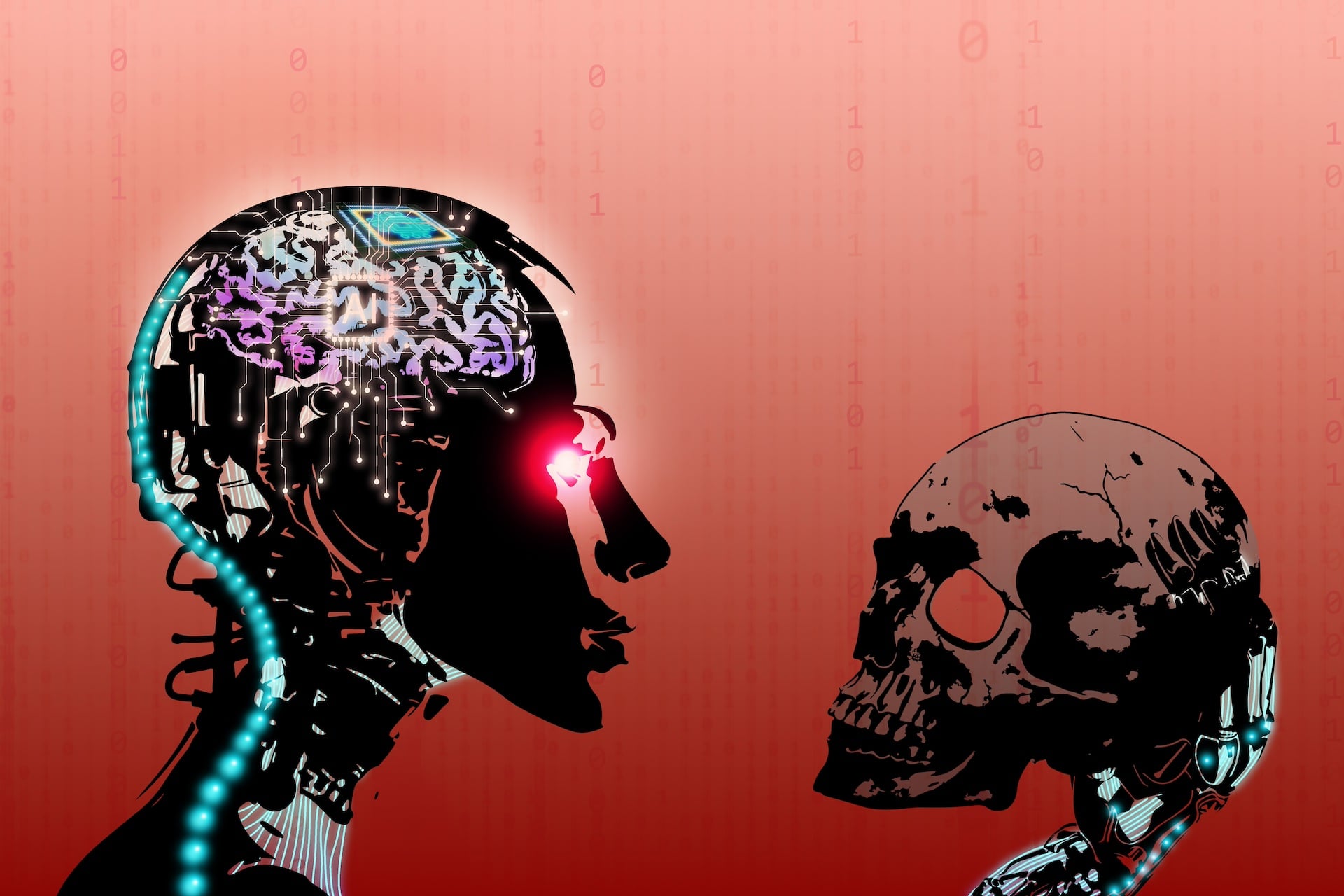
“This is the end,” the pioneering roboticist and artificial intelligence researcher Hans Moravec wrote in 1987. Humanity, he believed, was on the cusp of transcending the cumbersome process of Darwinian evolution—and with it, mortality itself. Our physical bodies would be discarded, and in their place would rise robotic übermenschen. Our minds, so tragically prone to decline as we age, would be transferred to flawless, immortal code. Machines were about to mature “from the simple devices they still are, to entities as complex as ourselves, to something transcending everything we know, in whom we can take pride when they refer to themselves as our descendants,” Moravec wrote.
Moravec’s vision of a future ruled not by flesh-and-blood human beings but by our post-biological successors found fertile ground in the then-fledgling area known as Silicon Valley, where the counterculture of the 1960s was morphing into a spirit of entrepreneurialism, anti-authoritarianism, and grand visions for the future of humanity inspired by sci-fi luminaries like Isaac Asimov and Philip K. Dick. In time, the school of thought known as “transhumanism”—which holds that human beings will eventually be able to liberate themselves from biological constraints, including death, with the help of technology—would become a quasi-religion among many of the American tech industry’s most powerful players, an intellectual rationale and an ideological motivation to build machines that are more capable in every way than human beings, no matter the risk.
This helps resolve a question which many people have undoubtedly asked themselves over these past couple of weeks, amid a flurry of predictions from Silicon Valley insiders that AI could one day wipe out all of humanity: If that really is a legitimate possibility, why continue to build it? The most common response to that question is taken right out of the Manhattan Project playbook: If we don’t build it first, one of our adversaries will—and no one wants to live in a world where an authoritarian regime has a monopoly on superintelligence, just as no sane person in the 1940s would’ve wanted the Third Reich to build a nuclear bomb before the Allies. In an essay published earlier this month calling for a slowdown among frontier AI labs, Anthropic CEO Dario Amodei wrote that “a Chinese lead in AI would pose grave danger for the United States and the world.”
That us-or-them argument rests upon the implicit assumption that superintelligence is a historical inevitability, something that couldn’t be avoided even if we wanted to. Tech bros will point to charts plotting the inexorable, exponential rise of computing power dictated by Moore’s Law, and to forecasts of an imminent “Singularity”—the theoretical moment when the capabilities of AI surpass our own—as proof that the technology they’re building is an unstoppable force, and that anyone who dares stand in the way is either stupid, evil, or both.
Peter Thiel, a self-professed Christian and one of Silicon Valley’s most powerful investors, has frequently aired public warnings of the arrival of the Antichrist, which he believes will be personified by someone like the environmental activist Greta Thunberg: “a Luddite who wants to stop all science,” in his words. In an infamous exchange with the former New York Times columnist Ross Douthat last year, Thiel wavered before responding to the question of whether or not the human race should survive into the future. He paused for a few moments before saying “Yes,” then proceeded to incoherently describe some future version of transhumanism blended with Orthodox Christian theology. “We want you to be able to change your heart and change your mind and change your whole body,” he said. (It’s worth noting that the term “transhuman” is believed to have first appeared in an English translation of Dante’s Paradiso, the final portion of the Divine Comedy which depicts the author’s fictional ascent into Heaven.)
Similarly, the tech investor Marc Andreessen—general partner at Andreessen Horowitz—wrote in his 2023 “Techno-Optimist Manifesto” that the enemies of progress included a litany of “zombie ideas, many derived from Communism,” which stood in the way of humanity achieving its rightful destiny as the master and Promethean civilizer of the cosmos. Among them were “existential risk” and the precautionary principle, the latter being the idea that new ideas and technologies should be regarded as potentially dangerous until proven otherwise. (Andreessen would’ve presumably scoffed at a statement made earlier this week by the United Nations’ International Independent Scientific Panel on AI that the precautionary principle should serve as the tech industry’s guiding light as it continues to build ever-more powerful versions of the technology.)
The so-called techno-optimists have found an ally in Donald Trump, who has dismissed Amodei’s call for a slowdown, which was quickly endorsed by other prominent AI leaders, including OpenAI’s Sam Altman and SpaceXAI’s Elon Musk, calling it a “SICK conspiracy” spread to benefit China. (Thiel and Andreessen publicly supported and financially backed Trump’s bids for the presidency in 2016 and 2024, respectively. Musk, the wealthiest man in the world and a staunch believer in the idea that humans will one day merge with machines, was also an ardent Trump supporter in the most recent election.)
Silicon Valley tycoons like Thiel, Andreessen, and Musk insist that everything they do is for the betterment of humanity. The mission of Musk’s SpaceX, for example, is to make humanity an interplanetary species, thereby eliminating the possibility that it’ll get wiped out by some natural cataclysm, like an asteroid hitting Earth or a supervolcano erupting. Thiel has cofounded or financed multiple tech companies named after The Lord of the Rings, a fantasy epic about a small group of humble underdogs overthrowing a tyrannical Dark Lord. (The fact that it’s also a warning about the dangers of rampant technological development and industrialization seems to have been lost on Thiel and the other tech elites who have appropriated Tolkien.) The techno-optimists, according to Andreessen’s manifesto, are “Undertaking the Hero’s Journey, rebelling against the status quo, mapping uncharted territory, conquering dragons, and bringing home the spoils for our community.”
Yet lurking beneath all the mythical flourishes is a vision of the future that is deeply anti-human: One where the inexorable march of technological progress will soon make human beings obsolete. According to this worldview, if the capabilities of human minds and bodies will soon be eclipsed by digital ones, it’s for the best if we just step out of the way and let this next evolutionary stage take its rightful course.
For dyed-in-the-wool transhumanists, though, this isn’t a cause for despair—quite the opposite. The postbiological machine age will, paradoxically, be a continuation of the human spark even if homo sapiens aren’t around to see it. If you’re confused, you’re not alone. Transhumanists often refer to “humanity” as both the flesh-and-blood human beings of today and the machine offspring that will soon supposedly replace us. They will be built in our image, as God created Adam in His, and so can be regarded as both human and post-human. “I consider these future machines our progeny,” Moravec once wrote, “ourselves in more potent form. Like biological children of previous generations, they will embody humanity’s best hope for a long-term future. It behooves us to give them every advantage, and to bow out when we can no longer contribute.” Read that last line again. According to Moravec, humanity has a moral obligation to eventually cede control to machines—and to go the way of the dodo, fading into oblivion. The philosopher Derek Shiller put a finer point on this in a 2017 paper titled “In Defense of Artificial Replacement,” in which he argued humans “should engineer our extinction so that our planet’s resources can be devoted to making artificial creatures with better lives.”
Over and over again, Silicon Valley’s elites say the only way for humanity to flourish in the future is if it figures out how to safely build artificial superintelligence. But almost in the same breath, they’ll also say that even if that happens, homo sapiens will disappear, replaced by… something else. Something like us, and yet radically alien. As always, this is presented to the public as if it were an ontological fact of history, rather than the product of choices being made in the present by a small group of wealthy tech executives and venture capitalists.
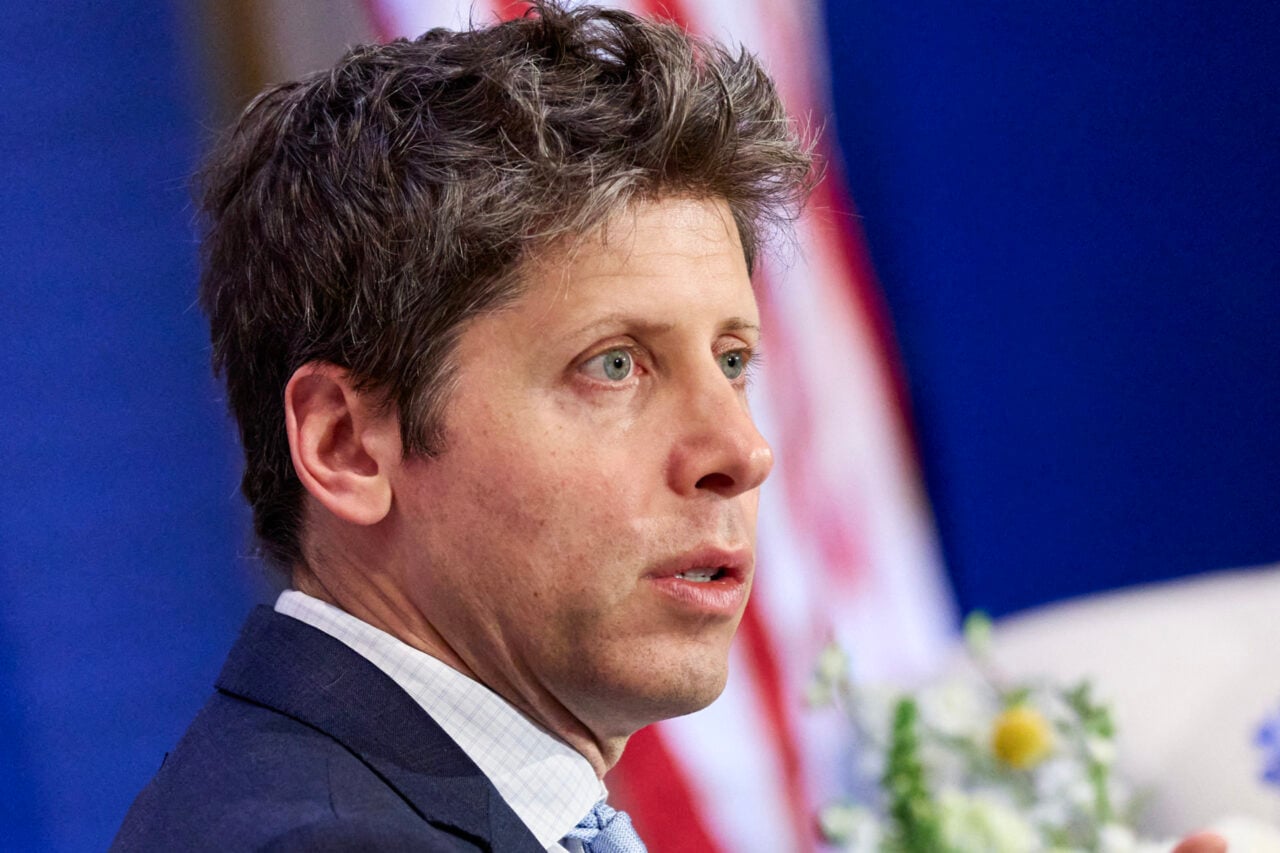
“We will be the first species ever to design our own descendants,” Altman wrote in a 2023 essay. “My guess is that we can either be the biological bootloader for digital intelligence and then fade into an evolutionary tree branch, or we can figure out what a successful merge looks like.”
READ MORE: