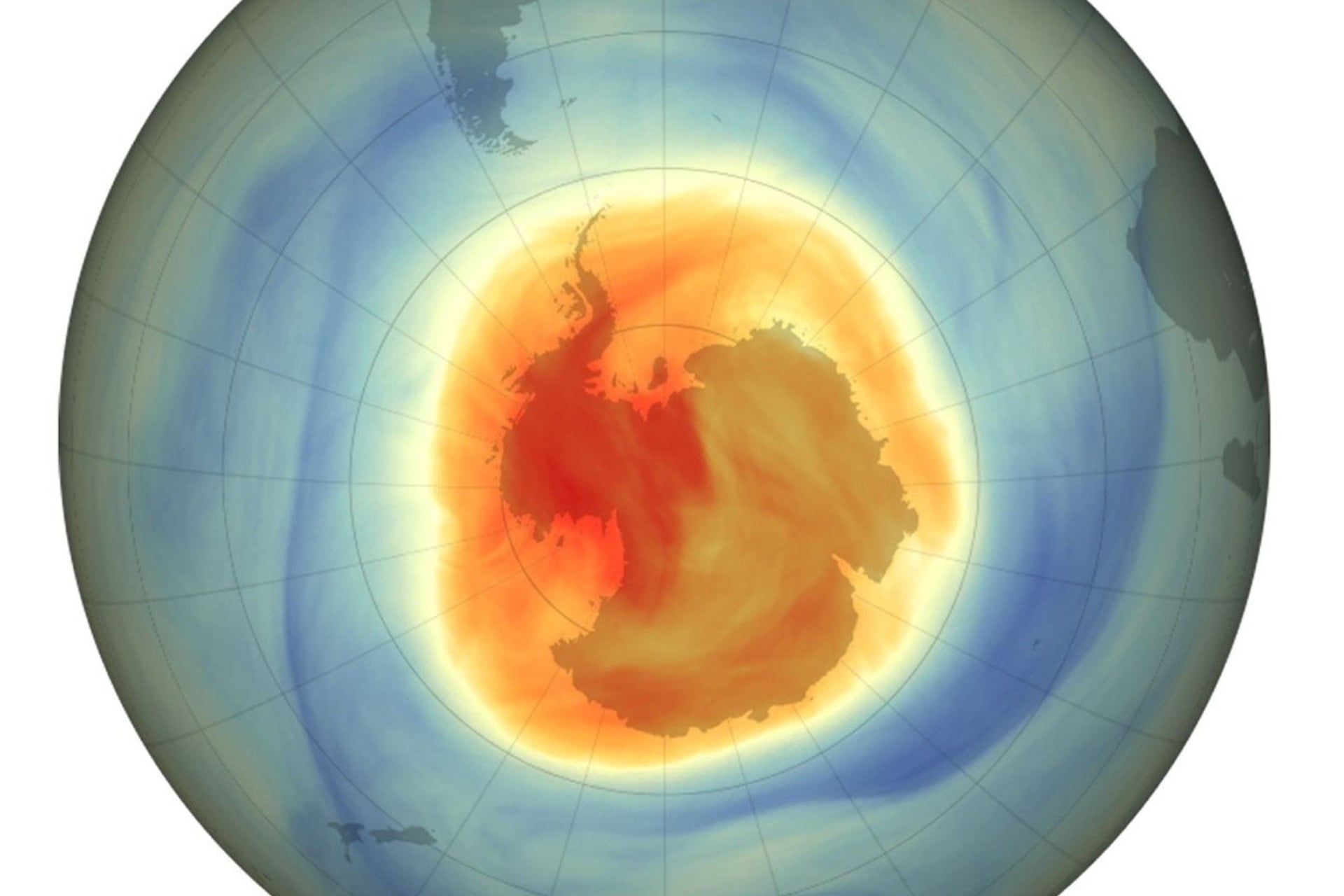
The ozone hole has made its annual appearance over the South Pole, and this year, it’s the biggest it’s been in a decade. Scientists believe “atypical weather conditions” are to blame.
An unusually powerful polar vortex allowed the hole to grow particularly large in September, according to a report from NASA and the National Oceanic and Atmospheric Administration (NOAA). When it reached its greatest extent on September 18, it stretched across 10.5 million square miles (27.1 million square kilometers). That’s nearly three times the area of the United States, and about 90% as large as the biggest ozone hole ever observed, which occurred on September 9, 2000.
Last year, federal scientists reported a relatively small hole—the fifth smallest since 1992. Despite this year’s significant size jump, experts say the ozone hole is still on track to recover by the end of the century.
“The annual ozone hole has been forming later in the season in recent years, which tells us the ozone layer is healing,” Paul Newman, a senior scientist at the University of Maryland and leader of NASA’s ozone research team at Goddard Space Flight Center, said in a statement. “But an unusually powerful polar vortex has extended ozone depletion in the Antarctic this season, allowing the hole to grow to proportions we haven’t seen in a decade.”
How the polar vortex influences the ozone hole
This region of exceptionally depleted ozone forms in the Antarctic stratosphere in late winter and early spring. Human-made air pollutants containing chlorine and bromine, primarily chlorofluorocarbons (CFCs), initiate the depletion process.
When air currents carry these gases up into the stratosphere, ultraviolet radiation breaks them down, freeing chlorine and bromine atoms that interact with cloud particles and destroy ozone. The polar vortex—a large current of low pressure and cold air that spins clockwise around the South Pole—keeps frigid air locked tight over Antarctica, creating the cold conditions necessary to produce polar stratospheric clouds. Thus, it plays a key role in the ozone hole’s formation.
This year, the polar vortex was unusually strong. That’s partly because planetary-scale weather systems that typically break up the vortex were especially weak in August and September, according to Amy Butler, a research scientist at the NOAA Chemical Sciences Laboratory. “That weak wave action kept the strongest polar vortex winds farther from the South Pole by several degrees of latitude, creating a larger area for conditions ideal for ozone depletion to occur.”
Recovery continues
Scientists discovered the ozone hole in 1985. The finding quickly garnered global attention as experts warned that the depletion of the stratospheric ozone layer would allow more harmful ultraviolet radiation to reach Earth’s surface. Two years later, the international community adopted the Montreal Protocol, a treaty aimed at phasing down the consumption and production of ozone-depleting substances like CFCs.
Chlorine levels in the Antarctic stratosphere have since declined by about a third relative to levels in the 1980s, according to Stephen Montzka, senior scientist at NOAA’s Global Monitoring Laboratory.
Today, NOAA and NASA scientists monitor the health of the stratospheric ozone layer using satellites, weather balloons, and ground-based instruments. In October, for example, NOAA scientists at the South Pole Baseline Atmospheric Observatory used balloon-borne instruments to measure ozone concentrations directly overhead, finding that they reached their lowest value for the year on October 17.
These agencies’ ongoing monitoring efforts have shown that the Montreal Protocol was a success and that the ozone hole is on track to recover later this century. This year’s polar-vortex-fueled size increase has not derailed that progress. Newman points out that the 2026 hole could have been 1 million to 2 million square miles (2.5 to 5.2 million sq km) larger if ozone-depleting air pollutants were as prevalent today as they were in 2000.
This year’s unusually large hole serves as a reminder that recovery doesn’t follow a straight line and drives home the importance of continuing to phase out these chemicals.