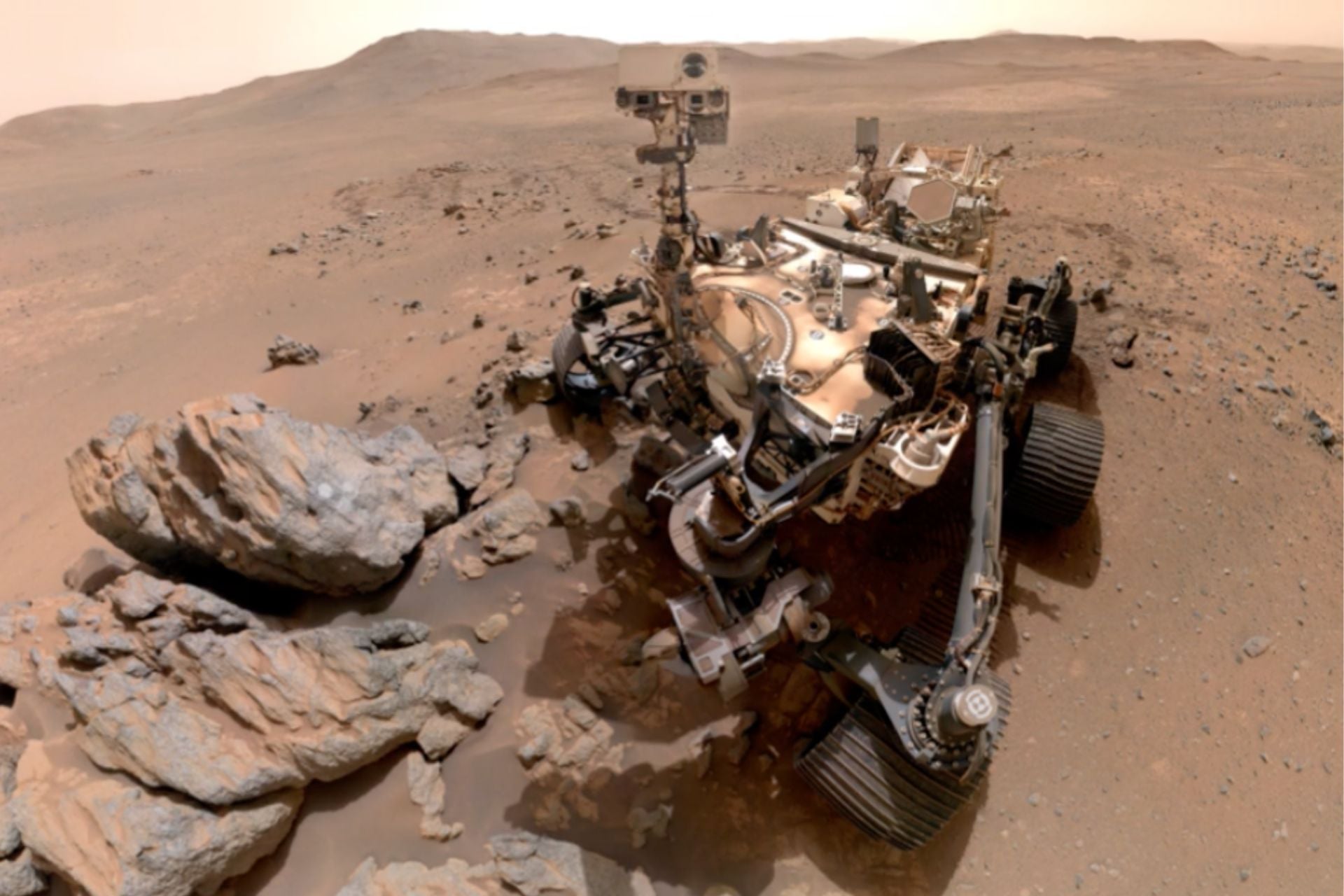
NASA has paused science operations on two of its ongoing Mars missions due to separate glitches, with teams working to investigate the cause behind the recent technical issues.
The Perseverance rover went into a protective safe mode due to a malfunction with both of its ultra high frequency (UHF) radios, which allow the robot to send large volumes of data to Martian orbiters to relay to Earth. Meanwhile, the Mars Odyssey spacecraft experienced a malfunction with its reaction wheel, which helps it change its orientation as it orbits the Red Planet.
NASA is hoping to get both missions to resume their science activities by the end of November, delivering precious data from Mars’ orbit, as well as its dusty surface.
Perseverance’s heartbeat
The trouble for Perseverance began on October 30 as the rover was powering on for the day’s operations. Its radio usually sends a series of electronic pings, which NASA refers to as heartbeats, to the rover’s onboard computer. That didn’t happen, triggering an onboard fault protection system that turned off the unresponsive radio and switched to a backup. It also placed the rover in safe mode, which turned off all non-essential systems.
“The rover’s main computer continually listens for that ping,” Steven Lee, Perseverance project manager at NASA’s Jet Propulsion Laboratory, said in a statement. “Every time it hears the ping, it resets a counter. However, if the radio stops sending the heartbeat due to a fault, after a certain number of missing heartbeats in a row, the computer swaps to the redundant one.”
On that dreaded day, there were 25 missed heartbeats, which equated to around 100 seconds of silence.
The team of engineers behind the missions recovered the rover from safe mode and evaluated the diagnostic data. That’s when the team noticed another issue, the backup UHF radio was transmitting at about half of its expected power output.
For now, the team has stopped relying on both radios to communicate with the rover. Instead, Perseverance is currently communicating directly with NASA’s Deep Space Network using X-band communications over its high-gain antenna.
This form of direct-to-Earth communication, however, has a major downside in that it provides a significantly lower data rate, according to NASA. As such, engineers have paused science and instrument operations on the Perseverance rover to conserve bandwidth for diagnostic data as they work on recovering the primary radio. That means Percy is currently sitting idly on Mars, with not much else to do.
The Odyssey orientation
The Mars Odyssey spacecraft, which launched in 2001, was the first spacecraft to make a global map of the chemical elements and minerals that make up the Martian surface. It also acts as a communication relay between Mars rovers and mission control on Earth.
Odyssey currently holds the record for the longest continually active mission in orbit around a planet other than Earth. But between November 4 and 6, the orbiter was in safe mode after one of its reaction wheels stopped spinning.
Reaction wheels on any spacecraft speed up or slow down to change their angular momentum, allowing the spacecraft to rotate and adjust its angle for activities like pointing its solar arrays toward the Sun. Mars Odyssey is equipped with four reaction wheels, and it only needs three to orient itself. Unfortunately, one of the wheels failed in 2013, which means its backup is already in use.
Without three working reaction wheels, the spacecraft has to rely solely on its hydrazine thrusters to remain oriented. But the 25-year-long mission only has hydrazine to orient itself without reaction wheels for one to two months, according to the team’s estimates.
Odyssey is no longer in safe mode but its science operations are currently on pause as the mission team runs tests on the malfunctioning reaction wheel. The wheel was able to move after being commanded during one test, but further testing is still required to find out if it can be recovered.
The tests are set to conclude during the last week of November, at which point the mission team is hoping Odyssey will be able to resume its science operations. Hopefully by then, the Perseverance rover will be back to exploring the Martian terrain as Odyssey hovers above.